


According to a National Center for Health Statistics data brief published in March 2021, 12.6% of American adults aged 50 and older have osteoporosis, and another 43.1% have low bone mass severe enough to raise their fracture risk. Every one of those patients is a potential bone density scan, and every scan needs a CPT code, a supporting diagnosis, and often a modifier identifying who performed which part of the service.
For students learning medical billing and for providers running an imaging department, the bone density scan CPT code family looks simple at first glance: four numbers, 77080, 77081, 77085, and 77086, cover most of what a DEXA machine does. The complexity shows up in how those codes interact with each other, with Medicare’s coverage rules, and with the modifiers required to get a claim paid on the first submission.
Bone density scan CPT codes at a glance
Dual-energy X-ray absorptiometry, DXA in CPT descriptors and DEXA in most clinical conversation, passes two X-ray beams of different energy levels through bone and soft tissue. The difference in absorption isolates bone mineral content, producing the T-score and Z-score that clinicians use to diagnose osteoporosis and osteopenia. The scan site and the technology used both have to match the CPT code before a claim goes out.
CPT/HCPCS code | Technology | Skeletal region | What it covers |
77080 | DXA | Axial (hip, spine, pelvis) | Standard central bone density study; one unit per session regardless of how many axial sites are scanned |
77081 | DXA | Appendicular (forearm, wrist, heel) | Peripheral bone density study |
77085 | DXA | Axial, plus vertebral fracture assessment | Combines a central study and a fracture check in one code; replaces 77080 rather than adding to it |
77086 | DXA | Vertebral fracture assessment (standalone) | Reported alone only when no full axial study accompanies it |
77078 | Quantitative CT | Axial | Used when DXA results would be unreliable, such as with spinal hardware or severe deformity |
76977 | Ultrasound | Peripheral | Screening tool; not a diagnostic substitute for DXA |
G0130 (HCPCS) | Single-energy X-ray absorptiometry | Peripheral | Older peripheral technology, still active but rarely used today |
CPT 77080 is the code billed most often. It covers a central scan of the axial skeleton, usually the hip and lumbar spine, and is reported once per session no matter how many axial sites are imaged; scanning both hips and three vertebral levels in one visit still nets a single unit. AAPC notes that 77080, 77081, 77085, and 77086 each carry a Medically Unlikely Edit of one, so a second unit billed the same date gets rejected.
77081 applies the same technology to peripheral sites, useful when a full central study is not accessible or not clinically indicated.
77085 folds a vertebral fracture assessment into the axial study rather than adding to it. Medicare’s coding guidance is explicit that 77080, 77085, and 77086 cannot appear together on one claim, because they describe overlapping ways of billing the same central scan. 77086 is reserved for the less common case where a fracture assessment happens without a full axial study attached to it.
Quantitative CT (77078) gets used when spinal hardware, severe scoliosis, or extreme obesity makes DXA results unreliable. Ultrasound (76977) is a screening tool for peripheral sites, not a diagnostic substitute for DXA. HCPCS G0130 covers single-energy absorptiometry, an older peripheral technology that DXA and ultrasound have mostly replaced, though the code remains active for facilities that still use it.
When 77080 and 77081 can be billed together
For years, standard advice held that 77080 and 77081 should never appear on the same claim. A Clinical Examples in Radiology bulletin, jointly published by the American Medical Association and the American College of Radiology in the summer of 2007, stated that 77080 was valued to include a peripheral study when both were performed on the same date. Coders who submitted both codes typically saw one denied as a duplicate.
That guidance shifted. Starting with the 2019 CPT codebook, the instructional note changed to permit both codes on the same date when a physician documents medical necessity for both an axial and a peripheral study, provided the second code carries a distinct-service modifier. CMS followed in June 2020 with Transmittal 10193, directing contractors to accept modifier XU (a more specific version of modifier 59, denoting an unusual service that does not overlap the primary procedure) on 77080 when billed with 77081, and on 77081 when billed with 77085. The change does not guarantee payment everywhere: some Medicare Administrative Contractors, including WPS Medicare, still will not reimburse both studies on the same date, or within 30 days, without documentation that the original measurement used a non-DEXA technology and a confirmatory study was necessary.
Medicare’s bone mass measurement benefit
Medicare covers bone density testing under National Coverage Determination 150.3, effective January 1, 2007. The underlying coverage conditions sit in federal regulation at 42 CFR 410.31, and they are more specific than most billing students expect.
A beneficiary qualifies for a covered bone mass measurement if at least one of five conditions applies:
- A woman determined by her treating physician or qualified nonphysician practitioner to be estrogen-deficient and at clinical risk for osteoporosis, based on her medical history and other findings.
- An individual with vertebral abnormalities shown on an X-ray to be indicative of osteoporosis, osteopenia, or vertebral fracture.
- An individual receiving, or expecting to receive, glucocorticoid therapy equivalent to an average of 5.0 mg or more of prednisone per day for more than three months.
- An individual with primary hyperparathyroidism (ICD-10-CM E21.0).
- An individual being monitored to assess the response to, or efficacy of, an FDA-approved osteoporosis drug therapy.
The frequency rule causes more denials than the qualifying conditions do. The regulation does not say “every 24 months.” It says Medicare may cover a bone mass measurement once at least 23 months have passed since the month the previous one was performed. A patient scanned in March 2024 can get a covered repeat as early as February 2026, because the count runs from the month, not the calendar date.
A confirmatory baseline exception rarely appears in training material but occasionally appears in practice. If a beneficiary’s initial bone mass measurement used a technology other than central DEXA (peripheral ultrasound or SEXA, for example), Medicare will cover a follow-up axial DEXA scan sooner than the standard frequency window, specifically to establish a DEXA baseline for future monitoring. If the initial test was already a central DEXA study, this exception does not apply.
One detail that surprises new billers: when coverage conditions are met, Medicare waives the Part B deductible and the usual 20% coinsurance for bone mass measurement. Noridian Healthcare Solutions, a Medicare Administrative Contractor, lists it among preventive services with cost-sharing waived, consistent with the Medicare Benefit Policy Manual, Chapter 15, Section 80.5. Patients often assume they owe 20% under the general Part B rule, and clarifying that up front heads off disputes later.
Coverage outside of Medicare
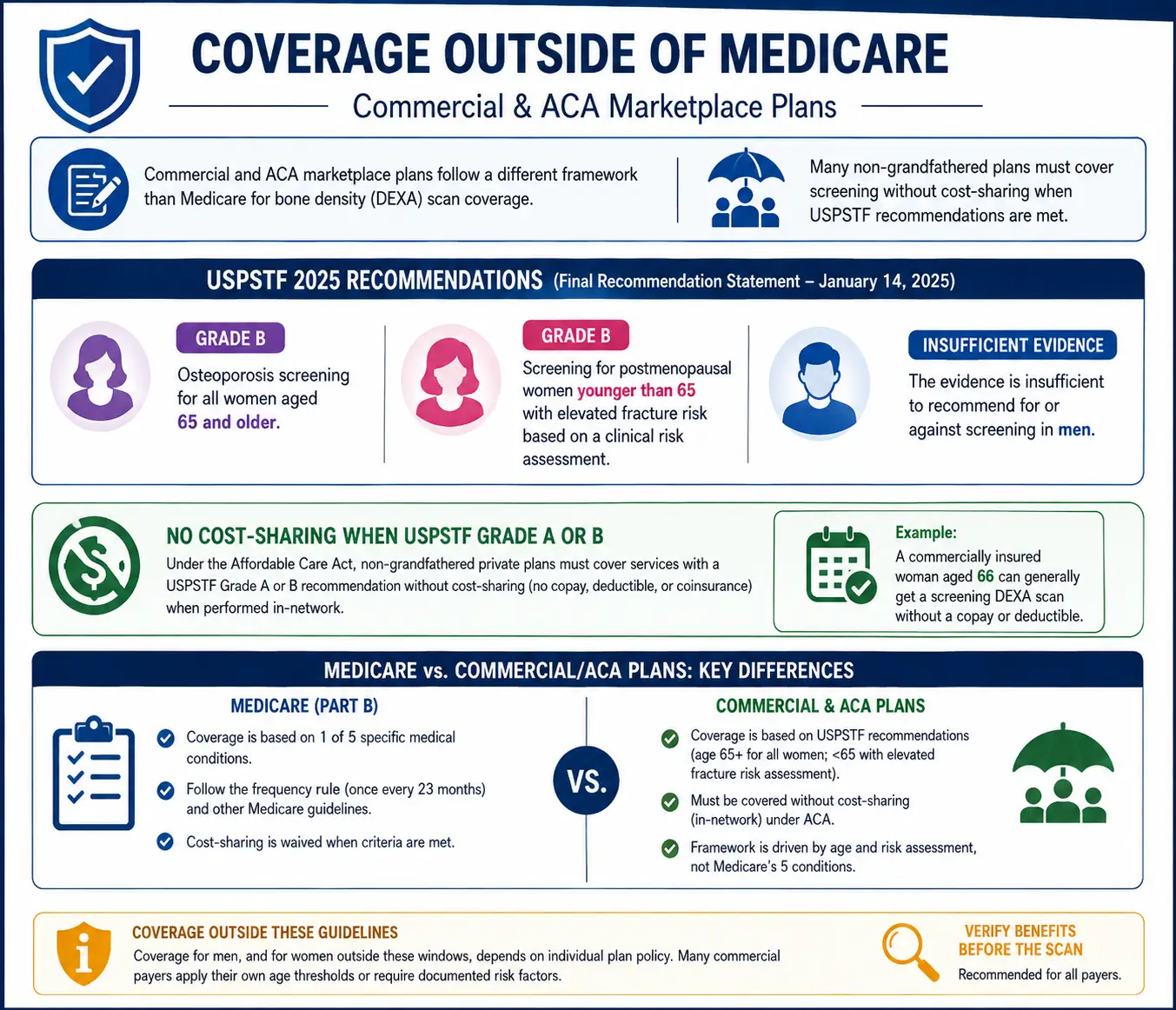
Commercial and ACA marketplace plans follow a different framework. The U.S. Preventive Services Task Force issued a final recommendation statement on January 14, 2025, assigning a Grade B recommendation to osteoporosis screening for all women aged 65 and older, and a Grade B recommendation to screening postmenopausal women younger than 65 who have elevated fracture risk based on a clinical risk assessment. The Task Force found the evidence insufficient to recommend for or against screening in men.
A Grade A or B USPSTF recommendation triggers a requirement, under the Affordable Care Act, that non-grandfathered private plans cover the service without cost-sharing when performed in-network. A commercially insured woman aged 66 can generally get a screening DEXA scan without a copay or deductible, regardless of whether she meets any of Medicare’s five conditions. Billers moving between Medicare and commercial claims need to keep the frameworks separate: Medicare asks whether one of five conditions applies, while ACA-compliant plans key off age and, for younger women, a documented risk assessment.
Coverage for men, and for women outside these windows, still exists but depends on individual plan policy. Many commercial payers apply their own age thresholds or require documented risk factors, so verifying benefits before the scan remains worthwhile regardless of payer.
Diagnosis codes that support medical necessity
The CPT code describes what was done. The ICD-10-CM code has to justify why, and a mismatched diagnosis denies a claim just as reliably as a wrong procedure code. Diagnosis codes commonly linked to bone density claims include:
- Z13.820, encounter for screening for osteoporosis, for patients who meet a screening indication without an established bone disease diagnosis.
- M81.0, age-related osteoporosis without current pathological fracture, for an established diagnosis with no active fracture.
- M80.0-, age-related osteoporosis with current pathological fracture, which requires a seventh character identifying the episode of care.
- M85.8-, other specified disorders of bone density and structure, which covers osteopenia. CMS added this subcategory to the approved bone mass measurement diagnosis list through a 2016 correction to Change Request 9252, after the original list left it out.
- Z79.52, long-term use of systemic steroids, for the glucocorticoid-therapy condition. Z79.51 covers inhaled steroids and is not the code Medicare’s guidance points to for systemic dosing.
- Z90.721 or Z90.722, acquired absence of ovary, unilateral or bilateral, often reported with the estrogen-deficiency condition for women who had an oophorectomy.
- Z09, encounter for follow-up examination after completed treatment, for monitoring bone density after a course of osteoporosis medication ends.
Pairing an otherwise correct CPT code with a diagnosis that does not appear on a payer’s covered list, for instance billing 77080 against a diagnosis the Local Coverage Determination does not recognize, remains one of the most common reasons a DEXA claim denies on first submission.
Modifiers that determine who gets paid
A bone density scan splits into a technical component (the equipment, the technologist, the facility overhead) and a professional component (the physician’s interpretation and written report). How a practice bills depends on who performed which part.
Modifier 26 reports the professional component alone: a radiologist who reads a scan without owning the DEXA equipment appends 26 to bill only the interpretation.
Modifier TC reports the technical component alone: a facility that owns the scanner and employs the technologist, but sends images elsewhere for interpretation, bills TC.
A global claim, with no modifier, applies only when one entity owns the equipment, employs the technologist, and provides the interpretation. Billing global without meeting all three conditions is a common finding in payer audits.
Modifier 59, or the more specific X-modifiers (XE, XS, XP, XU), override a National Correct Coding Initiative bundling edit when two codes that would normally be treated as overlapping represent genuinely distinct services, such as the 77080-and-77081 scenario described earlier. XU specifically signals an unusual service that does not overlap the primary procedure, and it is the modifier CMS Transmittal 10193 calls out for this code family.
Modifiers GA, GZ, and GY come into play when a scan will not meet Medicare’s coverage criteria. GA indicates the practice issued an Advance Beneficiary Notice and the patient agreed in writing to be financially responsible if Medicare denies the claim, for example when a patient requests a repeat scan at 18 months without a qualifying reason for early retesting. GZ indicates the practice expects a medical-necessity denial but never obtained a signed ABN, which generally means the practice cannot bill the patient for the denied amount. GY indicates a service statutorily excluded from the Medicare benefit altogether, where no ABN applies because the beneficiary was never entitled to coverage. Claims combining GA, GZ, and GY on the same line get rejected, so a coder has to select the one that actually fits the situation.
Where DEXA claims go wrong
A handful of errors account for most bone density claim denials.
Site-code mismatches top the list. A radiology report documenting a wrist scan billed under 77080 instead of 77081 will deny, because the code and the documented anatomy disagree. Whoever assigns the code should read the anatomic site described in the report rather than defaulting to whichever code the practice bills most often.
Missing interpretation reports cause a smaller but persistent share. Medicare’s billing and coding guidance for bone mass measurement requires a signed and dated physician interpretation containing the bone density measurement, the corresponding T-score or Z-score, and a clinical impression. A scan without that documentation on file is not billable, even when the technical component was performed correctly.
Ordering-provider documentation gets overlooked as well. The regulation requires that a physician or qualified nonphysician practitioner treating the patient, after evaluating the need for the test, order it. A scan ordered under a standing protocol, without a note tying it to the patient’s individual risk factors, invites a medical-necessity denial on audit even when the diagnosis code looks correct.
Building a clean claim from the start
The bone density scan CPT code family is small, seven codes in regular use, but the coverage logic layered on top of it is not. A clean claim depends on matching the CPT code to the documented anatomic site and technology, pairing it with an ICD-10-CM code the payer recognizes, and applying 26 or TC correctly when the professional and technical components split across entities. For Medicare claims, confirming which of the five NCD 150.3 conditions applies, and checking the 23-month frequency window against the month of the prior scan rather than the date, catches most denials before they happen. CMS publishes the NCD, the Local Coverage Determinations, and the billing and coding articles that spell out every rule described here, and checking a claim against them before submission remains the most reliable habit a biller can build.