


Chronic hepatitis C accounted for 101,525 newly reported cases in the United States during 2023, a rate of 36.2 per 100,000 people, according to the CDC’s 2023 Viral Hepatitis Surveillance Report. Behind each of those cases sits a claim, and behind each claim sits a coder translating a lab result and a clinical note into a single diagnosis code. For chronic hepatitis C, that code is B18.2, but getting from a positive lab result to a clean claim takes more than typing four characters into a claim form. This piece covers the chronic hepatitis C ICD-10 code, how it differs from the codes for acute and unspecified hepatitis C, what documentation actually supports assigning it, and what payers ask for before they approve treatment.
The ICD-10-CM code for chronic hepatitis C
Where B18.2 sits in the code set
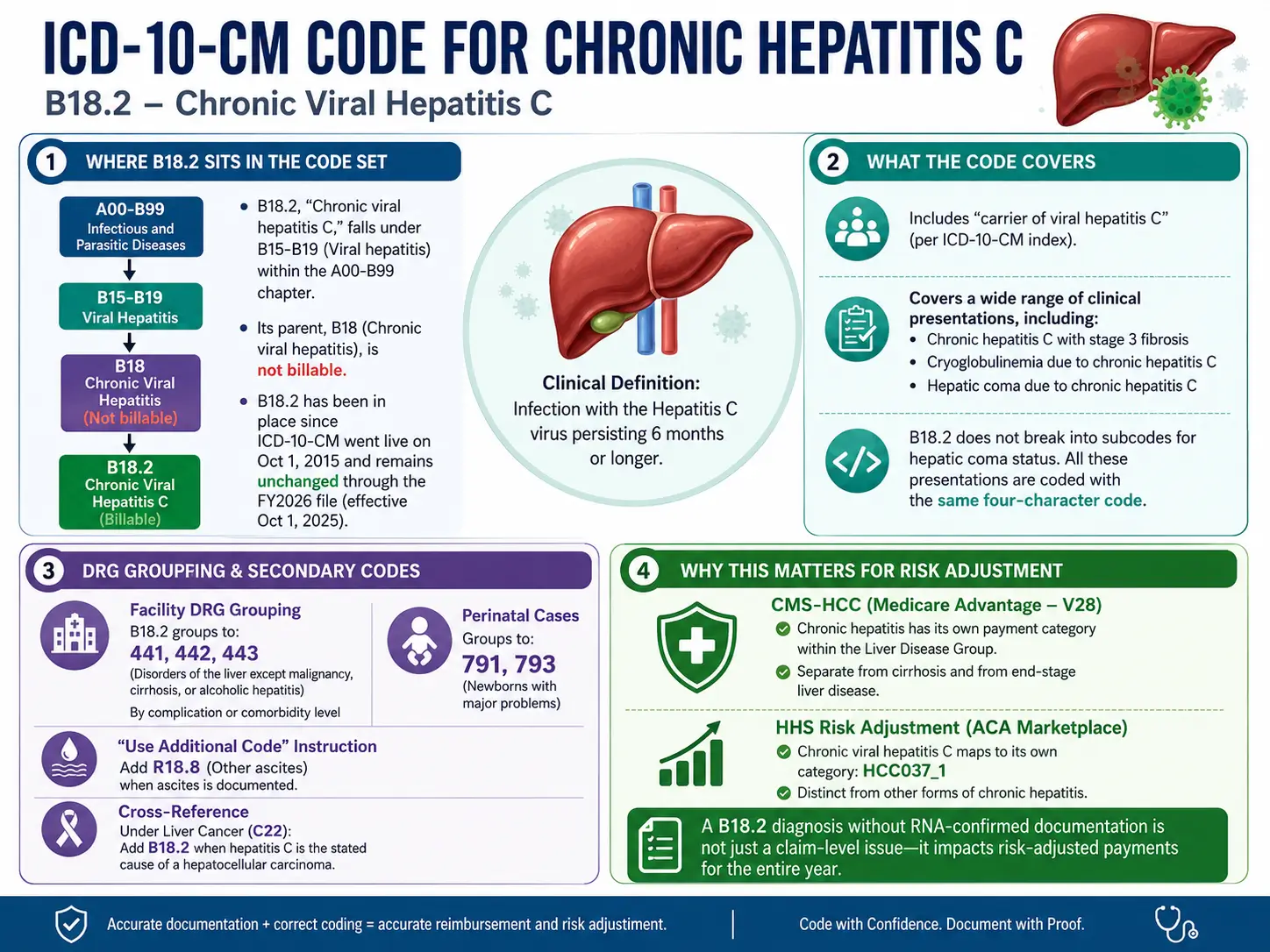
B18.2, listed in the ICD-10-CM tabular index as “Chronic viral hepatitis C,” sits inside the B15-B19 range for viral hepatitis, itself part of the larger A00-B99 chapter for infectious and parasitic diseases. Its immediate parent category, B18 (Chronic viral hepatitis), is not billable on its own. B18.2 is the specific code underneath it that carries reimbursement weight.
The code has not changed since ICD-10-CM went into effect on October 1, 2015. Every annual revision cycle since, through the FY2026 file effective October 1, 2025, lists B18.2 with no changes. That kind of stability is unusual in a code set that revises thousands of entries a year, and it reflects how settled the clinical definition has become: infection with the hepatitis C virus persisting six months or longer.
What the code covers
B18.2 also covers more ground than its short description suggests. The official ICD-10-CM index lists “carrier of viral hepatitis C” as applicable to B18.2, and the code’s approximate synonyms span presentations as different as chronic hepatitis C with stage 3 fibrosis, cryoglobulinemia due to chronic hepatitis C, and hepatic coma due to chronic hepatitis C. Unlike the codes for acute and unspecified hepatitis C, B18.2 does not split into separate subcodes based on hepatic coma status. Every one of those clinical pictures gets the same four-character code, which puts more weight on the surrounding documentation and any secondary codes to tell the rest of the story.
DRG grouping and secondary codes
On the facility side, B18.2 groups to MS-DRGs 441, 442, and 443 (disorders of the liver except malignancy, cirrhosis, or alcoholic hepatitis, split by complication or comorbidity level), and, for perinatal cases, to DRGs 791 and 793 for newborns with major problems. The category carries a “use additional code” instruction for ascites (R18.8) when documented, plus a cross-reference under liver cancer (C22) reminding coders to add B18.2 when hepatitis C is the stated cause of a hepatocellular carcinoma diagnosis.
Why this matters for risk adjustment
Getting this code right also matters outside the claim itself. Under the CMS-HCC model that sets Medicare Advantage capitation payments, now on version V28, chronic hepatitis holds its own payment category within the Liver Disease Group, separate from cirrhosis and from end-stage liver disease. The HHS risk adjustment model used for ACA marketplace plans does the same thing at the code level: chronic viral hepatitis C maps to its own category, HCC037_1, distinct from other forms of chronic hepatitis. A B18.2 diagnosis that is not backed by the RNA-confirmed documentation described below is not only a claim-level problem. On a risk-adjusted plan, it is a data point feeding into what the plan is paid to manage that patient for the rest of the year.
How B18.2 differs from the other hepatitis C codes
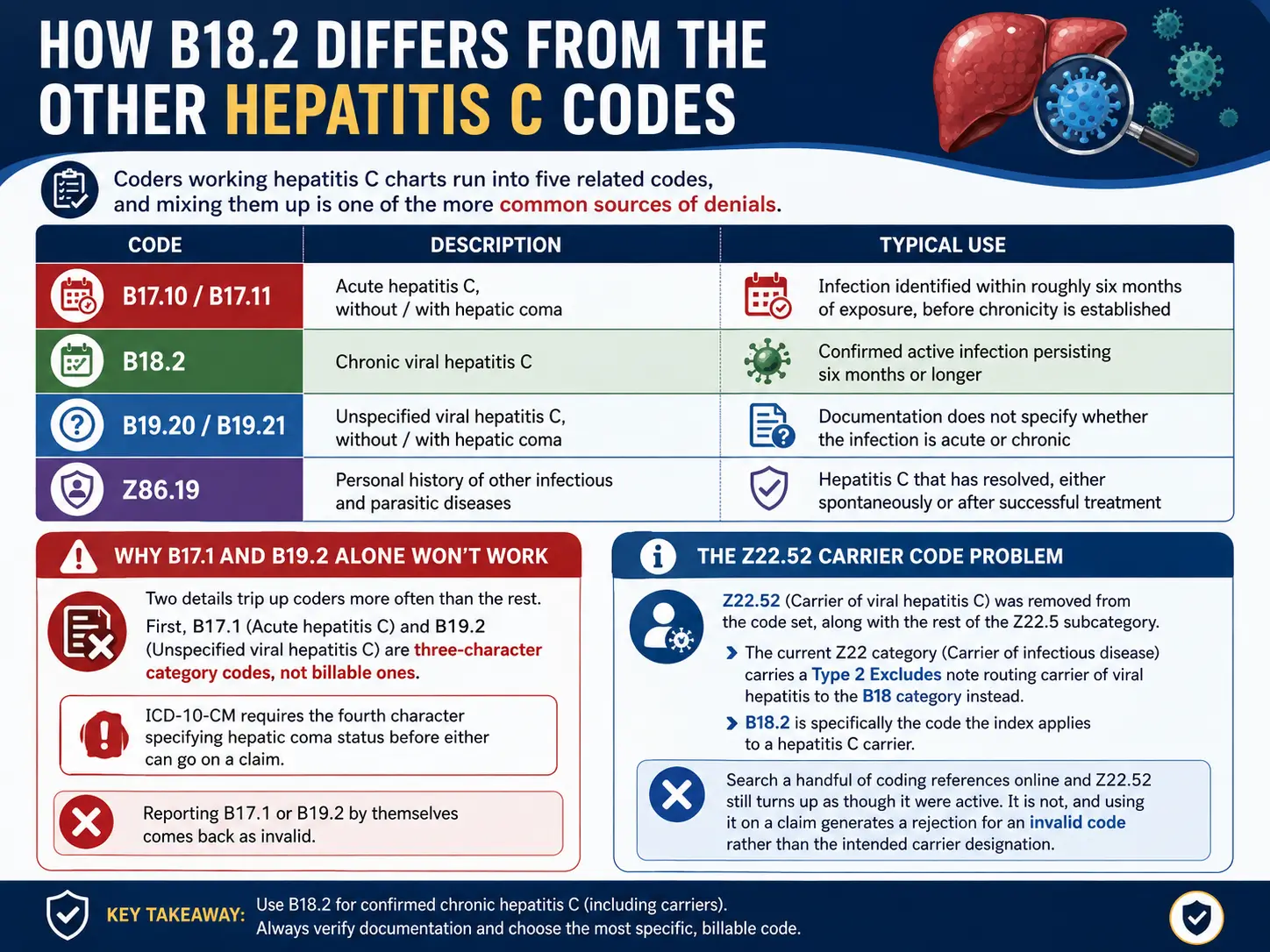
Coders working hepatitis C charts run into five related codes, and mixing them up is one of the more common sources of denials.
Code | Description | Typical use |
B17.10 / B17.11 | Acute hepatitis C, without / with hepatic coma | Infection identified within roughly six months of exposure, before chronicity is established |
B18.2 | Chronic viral hepatitis C | Confirmed active infection persisting six months or longer |
B19.20 / B19.21 | Unspecified viral hepatitis C, without / with hepatic coma | Documentation does not specify whether the infection is acute or chronic |
Z86.19 | Personal history of other infectious and parasitic diseases | Hepatitis C that has resolved, either spontaneously or after successful treatment |
Why B17.1 and B19.2 alone won’t work
Two details trip up coders more often than the rest. First, B17.1 (Acute hepatitis C) and B19.2 (Unspecified viral hepatitis C) are three-character category codes, not billable ones. ICD-10-CM requires the fourth character specifying hepatic coma status before either can go on a claim. Reporting B17.1 or B19.2 by themselves comes back as invalid.
The Z22.52 carrier code problem
Second, and less well known, is what happened to the code many billing references still list for carrier status. Z22.52 (Carrier of viral hepatitis C) was removed from the code set, along with the rest of the Z22.5 subcategory. The current Z22 category (Carrier of infectious disease) carries a Type 2 Excludes note routing carrier of viral hepatitis to the B18 category instead, and B18.2 is specifically the code the index applies to a hepatitis C carrier. Search a handful of coding references online and Z22.52 still turns up as though it were active. It is not, and using it on a claim generates a rejection for an invalid code rather than the intended carrier designation.
What documentation supports assigning B18.2
Antibody tests confirm exposure, not activity
A reactive hepatitis C antibody test (CPT 86803) tells a provider that a patient was exposed to HCV at some point. It does not, by itself, confirm the infection is still active. Somewhere between 15% and 45% of people infected with HCV clear the virus spontaneously without treatment, according to the World Health Organization’s hepatitis C fact sheet, which means antibody reactivity alone cannot support a chronic hepatitis C diagnosis code.
RNA testing confirms active infection
What confirms active infection is a detectable, quantified hepatitis C RNA result, billed under CPT 87522 (infectious agent detection by nucleic acid, hepatitis C, quantification). Many labs run this automatically as a reflex test once the antibody screen comes back reactive, billing the two together. If the RNA result comes back undetectable on an antibody-positive patient, that patient has resolved hepatitis C rather than chronic hepatitis C, and the correct code is Z86.19, not B18.2.
Genotype testing and the simplified treatment algorithm
Genotype testing (CPT 87902) used to be close to mandatory before starting treatment. It still appears as a line item on many payer forms, but the AASLD/IDSA HCV Guidance simplified treatment algorithm, introduced in 2019 and updated again in the panel’s 2023 guidance, allows genotype testing to be skipped for treatment-naive adults without cirrhosis, or with compensated cirrhosis, who are candidates for a pangenotypic regimen such as glecaprevir/pibrentasvir or sofosbuvir/velpatasvir. The 2023 update went further, dropping pretreatment genotyping entirely from the minimal-monitoring pathway and replacing scheduled on-treatment visits with a single adherence check around week 4 and a sustained virologic response test at week 24.
Establishing chronicity
Chronicity itself needs its own documentation trail: typically a positive RNA result on at least two occasions six months apart, or a single positive result paired with a clinical history consistent with a long-standing infection, such as documented risk factors, prior abnormal liver enzymes, or an earlier reactive antibody test already on the chart. A growing share of these diagnoses now start with routine screening rather than symptoms. Since March 2020, the U.S. Preventive Services Task Force has recommended one-time hepatitis C screening, a Grade B recommendation, for all asymptomatic adults aged 18 to 79, replacing an earlier approach that limited routine screening mostly to the 1945-1965 birth cohort and other high-risk groups. Medicare covers this screening under HCPCS code G0472.
Medical necessity and payer documentation for antiviral therapy
Getting a chronic hepatitis C diagnosis onto a claim is only the first hurdle. Getting a direct-acting antiviral (DAA) regimen covered brings its own documentation requirements, and payer forms have not fully caught up to how far clinical guidance has simplified treatment.
What prior authorization forms ask for
A review of prior authorization forms currently used by Florida Medicaid, Ohio Medicaid, Iowa Medicaid, and Louisiana Medicaid turns up a fairly consistent list of what plans still want on file: a detectable HCV RNA result within a defined window (commonly 12 months, sometimes as tight as 180 days), the HCV genotype where the plan still requires it, whether the patient is treatment-naive or treatment-experienced (and if experienced, the prior regimen, duration, and response), fibrosis stage, and a Child-Pugh score when cirrhosis is documented. The ICD-10 code itself is usually a required field on the form, not an afterthought.
The hepatitis B screening requirement
One requirement that is easy to miss sits outside the hepatitis C chart entirely: hepatitis B status. In October 2016, the FDA required a boxed warning on all direct-acting antiviral labels after identifying 24 cases of HBV reactivation in HCV/HBV coinfected patients treated with DAAs between November 2013 and July 2016, two of them fatal and one requiring a liver transplant. Reactivation typically appeared four to eight weeks after treatment began. The FDA’s guidance is direct: screen every patient for current or prior HBV infection before starting a DAA, and monitor for reactivation during and after treatment. Several state Medicaid programs, including Louisiana’s fee-for-service plan, have built that screening requirement directly into their prior authorization paperwork, so a hepatitis C prior auth missing an HBV coinfection assessment is missing a field the reviewer is specifically checking for.
Prior authorization trends worth tracking
State-level restrictions are easing
Coverage restrictions on hepatitis C treatment have loosened considerably since DAAs became available, though the pace varies by state. According to tracking maintained by the National Viral Hepatitis Roundtable and Emory University’s HepVu project, 28 states, including Michigan, had eliminated prior authorization entirely for first-time hepatitis C treatment as of February 2024. An earlier compilation of the same data found that 34 states had eliminated or reduced fibrosis-stage restrictions, with 2 states still requiring a minimum fibrosis level before covering treatment, 30 states had loosened sobriety requirements, with 22 maintaining some form, and 28 states had scaled back rules limiting which specialists could prescribe DAAs, with 15 still maintaining some restriction.
Documentation still matters without prior authorization
None of that means billing teams can skip gathering supporting documentation in a state without prior authorization. Payers that dropped prior authorization for first-time treatment still audit claims after the fact, and a chart missing a confirmatory RNA result, a chronicity timeline, or an HBV screening note, where one was required, is exposed to post-payment recoupment even without a pre-service denial.
Coding errors that trigger hepatitis C claim denials
A handful of mistakes account for most of the denials seen on chronic hepatitis C claims:
- Reporting the non-billable three-character codes B17.1 or B19.2 instead of the required fourth-character subcode.
- Using Z22.52 or another Z22.5 code for carrier status, a code family that no longer exists in current ICD-10-CM.
- Assigning B18.2 based on a reactive antibody test alone, without a documented quantitative RNA result confirming active infection.
- Submitting a DAA prior authorization without an HBV coinfection screening note, where the payer’s form requires one.
- Leaving off secondary codes the category instructs coders to add, such as R18.8 for ascites, or B18.2 itself when hepatitis C is the stated cause of a liver malignancy coded to C22.
Getting the claim right the first time
None of these pieces are complicated on their own. The friction comes from how many of them have to line up before a chronic hepatitis C claim goes out clean: the right fourth-character code, an RNA result that actually confirms active infection rather than past exposure, a chronicity timeline in the chart, and, if antiviral therapy is on the table, an HBV screening note sitting next to the genotype and fibrosis results the payer’s form is asking for. A documentation checklist built around those five items, rather than reliance on the diagnosis code alone, is what keeps chronic hepatitis C claims out of the denial queue.