


A claim that bounces back with a clearinghouse rejection code hasn’t been reviewed by an insurance company at all. It never got that far. For billers who are new to the field, that distinction trips people up constantly, and it’s worth getting right before anything else, because the fix for a rejection and the fix for a denial are two different workflows.
Clearinghouse rejection codes are the messages a claims clearinghouse sends back when an electronic claim fails a validation check before it reaches the payer. The check might catch a typo in a patient’s date of birth. It might catch an ICD-10 code that expired on October 1 of last year. Either way, the claim stops moving until someone corrects it and sends it again.
What a clearinghouse actually does before a claim reaches the payer
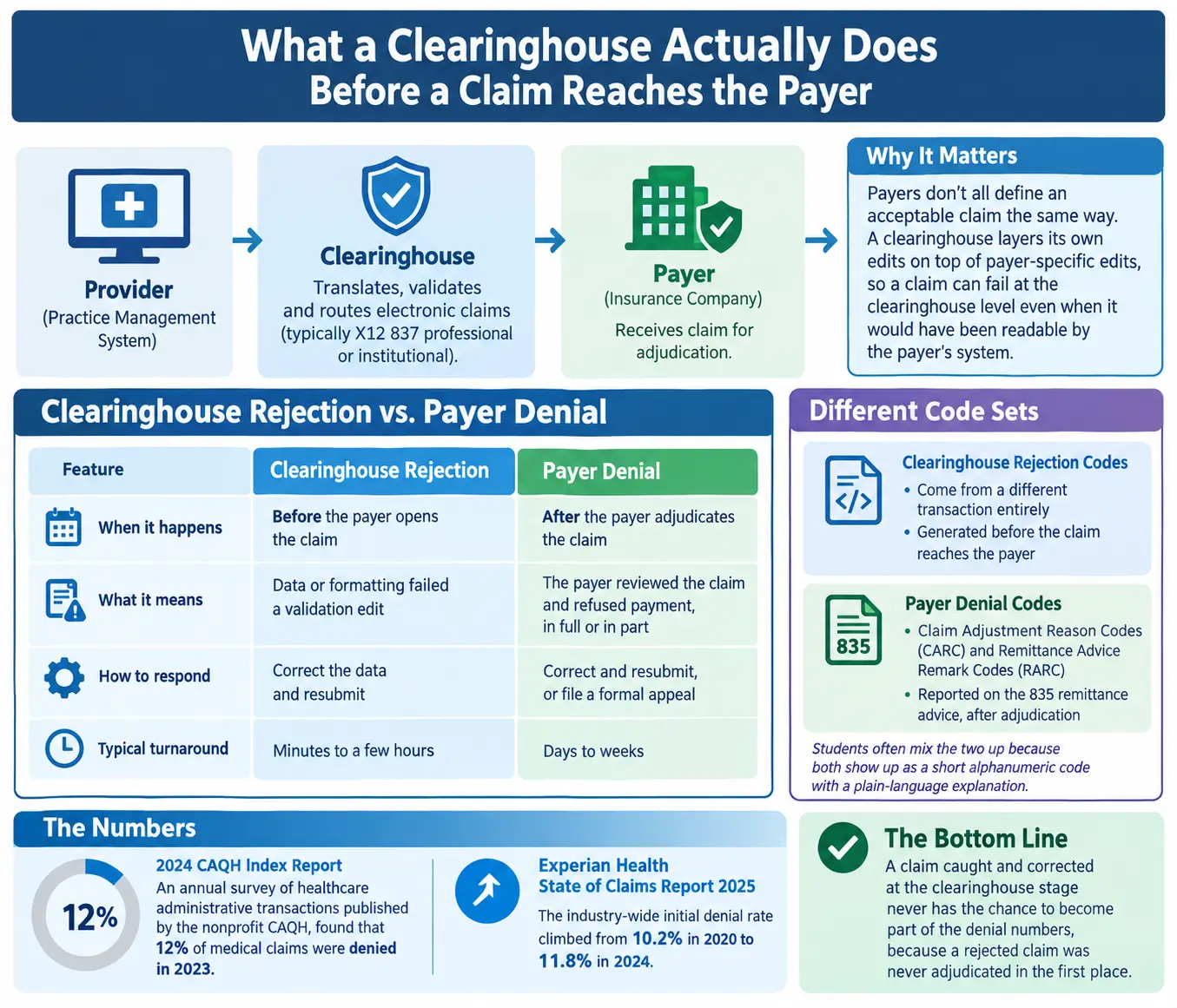
A clearinghouse sits between a provider’s practice management system and the insurance company’s claims intake system. Its job is to translate, validate, and route electronic claims, most often the X12 837 professional or institutional transaction, so that what arrives at the payer meets that payer’s formatting rules.
This matters because payers don’t all define an acceptable claim the same way. One plan wants a nine-digit ZIP code on every claim; another doesn’t check it at all. A clearinghouse layers its own edits on top of payer-specific edits, so a claim can fail at the clearinghouse level even when it would have technically been readable by the payer’s own system.
Rejections and denials get lumped together constantly, but they come from different stages of the process and carry different consequences:
Clearinghouse rejection | Payer denial | |
When it happens | Before the payer opens the claim | After the payer adjudicates the claim |
What it means | Data or formatting failed a validation edit | The payer reviewed the claim and refused payment, in full or in part |
How to respond | Correct the data and resubmit | Correct and resubmit, or file a formal appeal |
Typical turnaround | Minutes to a few hours | Days to weeks |
The two also live in different code sets. Medical billing denial codes are the Claim Adjustment Reason Codes (CARC) and Remittance Advice Remark Codes (RARC) reported on the 835 remittance advice, after adjudication. Clearinghouse rejection codes come from a different transaction entirely, generated before the claim ever reaches that stage. Students preparing for billing certification exams often mix the two up because both show up as a short alphanumeric code with a plain-language explanation next to it.
The stakes behind avoiding rejections are real. According to the 2024 CAQH Index report, an annual survey of healthcare administrative transactions published by the nonprofit CAQH, 12 percent of medical claims were denied in 2023. Separately, Experian Health’s State of Claims Report 2025 found the industry-wide initial denial rate climbed from 10.2 percent in 2020 to 11.8 percent in 2024. A claim caught and corrected at the clearinghouse stage never has the chance to become part of those denial numbers, because a rejected claim was never adjudicated in the first place.
How a claim actually moves through the clearinghouse
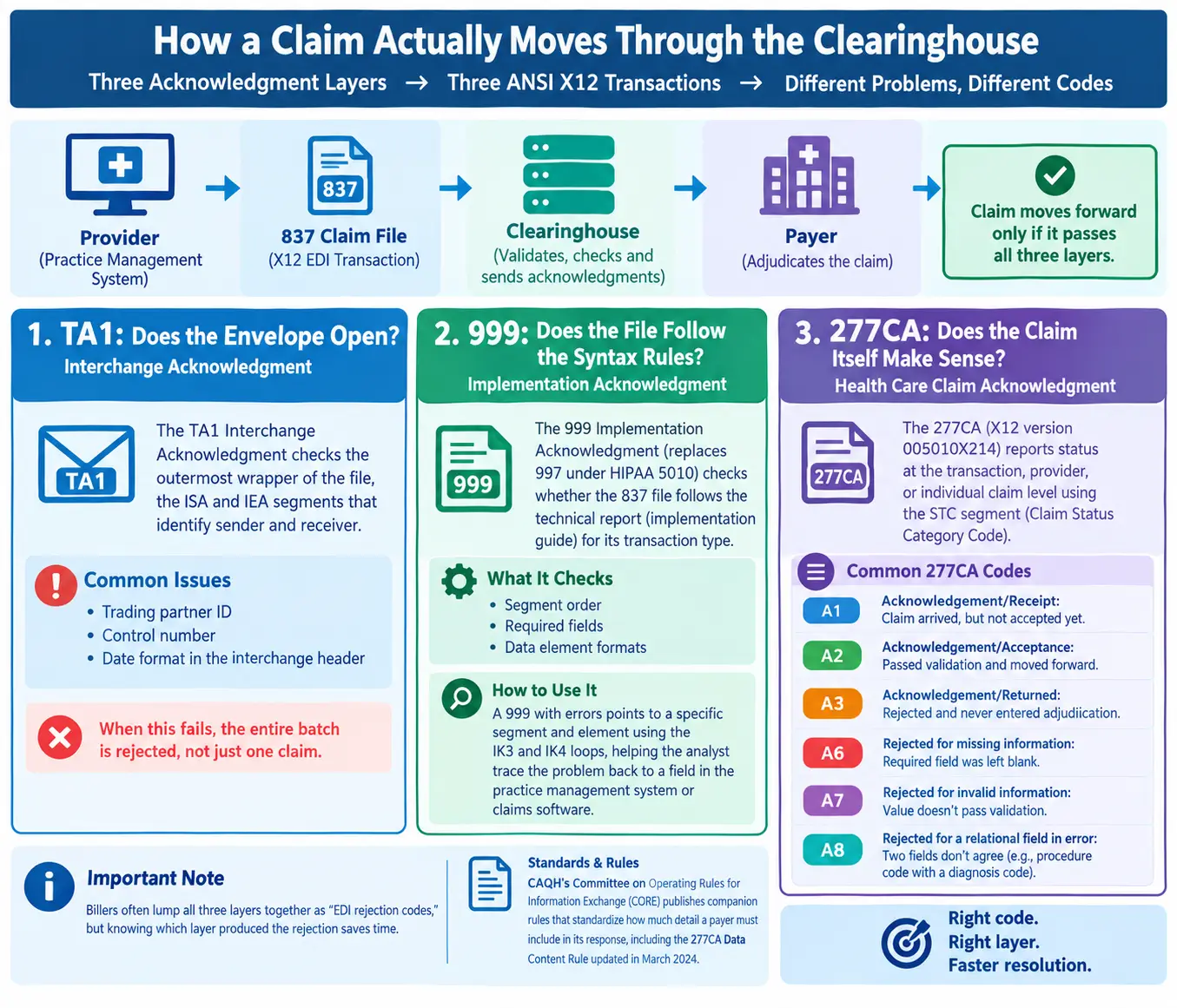
Most explanations of clearinghouse rejection codes skip the part that tells a biller where to look. Electronic claims move through three layers of acknowledgment, each governed by its own ANSI X12 transaction standard, and each catches a different kind of problem. Billers often lump all three together as “EDI rejection codes,” but knowing which layer produced the rejection saves time.
TA1: does the envelope open?
The TA1 Interchange Acknowledgment checks the outermost wrapper of the file, the ISA and IEA segments that identify sender and receiver. A TA1 rejection usually means a trading partner ID, a control number, or a date format in the interchange header is wrong. When this fails, the entire batch is rejected, not just one claim.
999: does the file follow the syntax rules?
The 999 Implementation Acknowledgment replaced the older 997 transaction under the HIPAA 5010 standard. It checks whether the 837 file follows the technical report, or implementation guide, for its transaction type: segment order, required fields, data element formats. A 999 with errors points to a specific segment and element using the IK3 and IK4 loops, usually enough for a claims analyst to trace the problem back to a field in the practice management system or claims management software.
277CA: does the claim itself make sense?
The 277 Health Care Claim Acknowledgment (277CA), standardized under X12 version 005010X214, is where most of what billers call clearinghouse rejection codes actually live. It reports status at the transaction, provider, or individual claim level using the STC segment, which carries a Claim Status Category Code. A handful of these codes, maintained by X12, the standards body chartered by the American National Standards Institute, account for most of the traffic a billing office sees:
- A1, Acknowledgement/Receipt: the claim arrived, but this alone does not mean it was accepted
- A2, Acknowledgement/Acceptance into adjudication system: the claim passed validation and moved forward
- A3, Acknowledgement/Returned as unprocessable claim: the claim was rejected and never entered adjudication
- A6, Acknowledgement/Rejected for missing information: a required field was left blank
- A7, Acknowledgement/Rejected for invalid information: a field was filled in, but the value doesn’t pass validation
- A8, Acknowledgement/Rejected for a relational field in error: two fields that should agree with each other don’t, a common example being a procedure code paired with a diagnosis code that doesn’t support medical necessity for that service
CAQH’s Committee on Operating Rules for Information Exchange (CORE) publishes companion rules that standardize how much detail a payer must include in its response, including the 277CA Data Content Rule updated in March 2024.
Common reasons for claim rejections
Underneath the A6, A7, and A8 category codes sits a smaller set of specific problems that repeats across nearly every specialty and every clearinghouse, whether the platform is Availity, Waystar, Office Ally, or a Cognizant TriZetto Provider Solutions gateway. Many billers still call that last one “Gateway EDI,” a name that traces back to a St. Louis clearinghouse TriZetto acquired in February 2011; training materials and older companion guides sometimes still label its output as gateway EDI rejection codes, even though the branding changed years ago.
Missing or invalid patient identifier. The subscriber ID, name, or date of birth on the claim doesn’t match what the payer has on file. This happens after address changes, name changes following marriage or divorce, or a transposed digit in the patient identification number.
Invalid diagnosis code. ICD-10-CM codes are updated every October 1. A code that was valid last year can be deleted, split, or replaced, and a claim using an outdated code fails validation even if the coder followed last year’s manual correctly.
Invalid or mismatched payer ID. Every payer has a routing number within a given clearinghouse’s system. Typing the wrong payer ID, or using an outdated one after a plan migrates following a merger, sends the claim looking for a destination that doesn’t match its content. Some payers add a second layer of scrutiny on top of the ID number, requiring exact payer name matching against their internal roster before the claim clears.
Missing or invalid claim frequency code. The third digit of the claim frequency type code tells the payer whether this is an original claim (1), a replacement of a previously submitted claim (7), or a void of a prior claim (8). Submitting a correction without code 7 and the required payer document control number referencing the original claim triggers an automatic rejection.
Authorization or access restriction errors. These surface when a provider isn’t enrolled with a payer under the National Provider Identifier submitted, or when the clearinghouse has no current trading partner agreement on file for that provider and payer combination. It is a data error the clearinghouse can catch through claim logic, without ever needing to ask the payer.
Invalid procedure code or place of service pairing. CPT and HCPCS codes update every January 1. A deleted or bundled code, or a code paired with a place of service that doesn’t support it, fails the clearinghouse’s claim scrubber before it ever reaches the payer.
What happened when the largest clearinghouse went offline
The scale of clearinghouse dependency became visible on February 21, 2024, when Change Healthcare, a subsidiary of UnitedHealth Group’s Optum division, was hit by a ransomware attack. According to a report from the U.S. House Energy and Commerce Committee, Change Healthcare processes roughly 15 billion medical claims a year, accounting for close to 40 percent of all claims submitted nationwide. The American Hospital Association, citing an analysis by the revenue cycle data firm Kodiak Solutions, reported that the value of claims submitted by more than 1,850 hospitals and 250,000 physicians in Kodiak’s client base dropped by $6.3 billion in the first three weeks after the attack, as providers lost their normal path for electronic claim submission.
Practices that had never had to think about clearinghouse mechanics were filing paper claims, switching to backup clearinghouses on short notice, and re-learning validation rules under time pressure. Some payers, including Elevance Health, extended timely filing deadlines by 30 days for affected providers. The episode is a reminder that a rejected claim is, in a narrow sense, the easier problem to have: the file reached a clearinghouse and got a response. A claim that can’t be submitted at all is a harder one.
Methods for resubmitting rejected medical claims
Fixing a rejection follows a consistent sequence, regardless of which code triggered it.
- Read the full rejection text, not just the code. A category code like A7 tells you the type of problem. The accompanying free-text description, pulled from the STC segment or a payer companion guide, tells you which field failed.
- Compare the rejected field against its source of truth. For patient identifiers, that means re-verifying eligibility. For diagnosis or procedure codes, that means checking the current code set rather than a template saved from a prior visit.
- Correct the claim in the practice management system, not only in the clearinghouse portal, so the fix carries forward to future claims for the same patient.
- Apply the correct claim frequency code if this is a replacement of a claim that already reached the payer. A resubmission without frequency code 7 and the original payer claim control number is often rejected again, this time for looking like a duplicate.
- Resubmit promptly. Timely filing clocks do not pause for a rejection. Medicare’s deadline, set at 12 months from the date of service under 42 CFR 424.44 following Section 6404 of the Affordable Care Act, runs from the date of service, not the date of the original submission attempt. Commercial payers often use shorter windows, frequently 90 to 180 days.
- Track the resubmission so a corrected claim doesn’t quietly disappear if it rejects again for an unrelated reason.
Reducing rejections with better clearinghouse claim validation
A claim scrubber built into the practice management system or the clearinghouse portal catches the same edits a payer would apply, before submission, and is the most direct way to cut down repeat rejections. Running eligibility verification at check-in, rather than relying on insurance information collected months earlier, addresses the patient identifier and coverage mismatches that account for a large share of first-submission rejections. Keeping CPT, HCPCS, and ICD-10 code sets current on their update cycles, January 1 and October 1, closes the gap that opens every year when new codes take effect and old ones sunset.
None of this eliminates clearinghouse rejection codes completely. Payer systems change their edits without much notice, patients move, and data entry errors happen in any process that involves people typing information by hand. What consistent claim validation does is shrink the volume of rejections down to the ones that genuinely need a person to catch something a system couldn’t. That’s a more realistic aim for a billing office than chasing an inbox with zero rejected claims, and it’s a better use of an experienced biller’s time than re-keying the same date of birth twice.