


A patient walks in favoring one leg, points to the outside of the joint, and says the ache has been building for three weeks. The provider examines the knee, orders an X-ray, and documents “right knee pain, etiology unclear.” That single line determines which ICD-10 code lands on the claim, and getting it wrong can mean a denial, an audit flag, or weeks of delayed reimbursement.
For medical billers, coders, and the providers who supervise them, ICD-10 codes for right knee pain are not a niche topic. Knee complaints rank among the most common reasons patients see orthopedists, primary care physicians, and physical therapists. The coding rules around laterality, specificity, and chronicity trip up new coders more often than almost any other musculoskeletal category.
The scale involved makes the extra care worthwhile. In 2022, an estimated 18.9% of U.S. adults age 18 and older had diagnosed arthritis, according to National Health Interview Survey data published by the National Center for Health Statistics (Elgaddal et al., NCHS Data Brief No. 497, February 2024), with prevalence climbing from 3.6% among adults 18 to 34 to 53.9% among those 75 and older. Osteoarthritis, the degenerative condition most often behind knee pain, accounts for an estimated 32.5 million of those cases nationwide, per CDC data summarized by the Osteoarthritis Action Alliance at the University of North Carolina. Knee osteoarthritis is not strictly a disease of the elderly, either: annual incidence peaks between ages 55 and 64, and more than half of adults with symptomatic knee osteoarthritis are younger than 65, according to the same source. Add sprains, bursitis, effusions, and pain that never gets a firm diagnosis, and right knee complaints show up on a steady share of outpatient claims across specialties.
Quick answer: The ICD-10-CM code for pain in the right knee is M25.561. If a specific diagnosis has already been confirmed, such as effusion, osteoarthritis, or bursitis, that code replaces the symptom code as the primary diagnosis. The breakdown below covers laterality rules, chronic pain sequencing, and the documentation payers expect to see.
What ICD-10 code M25.561 actually covers
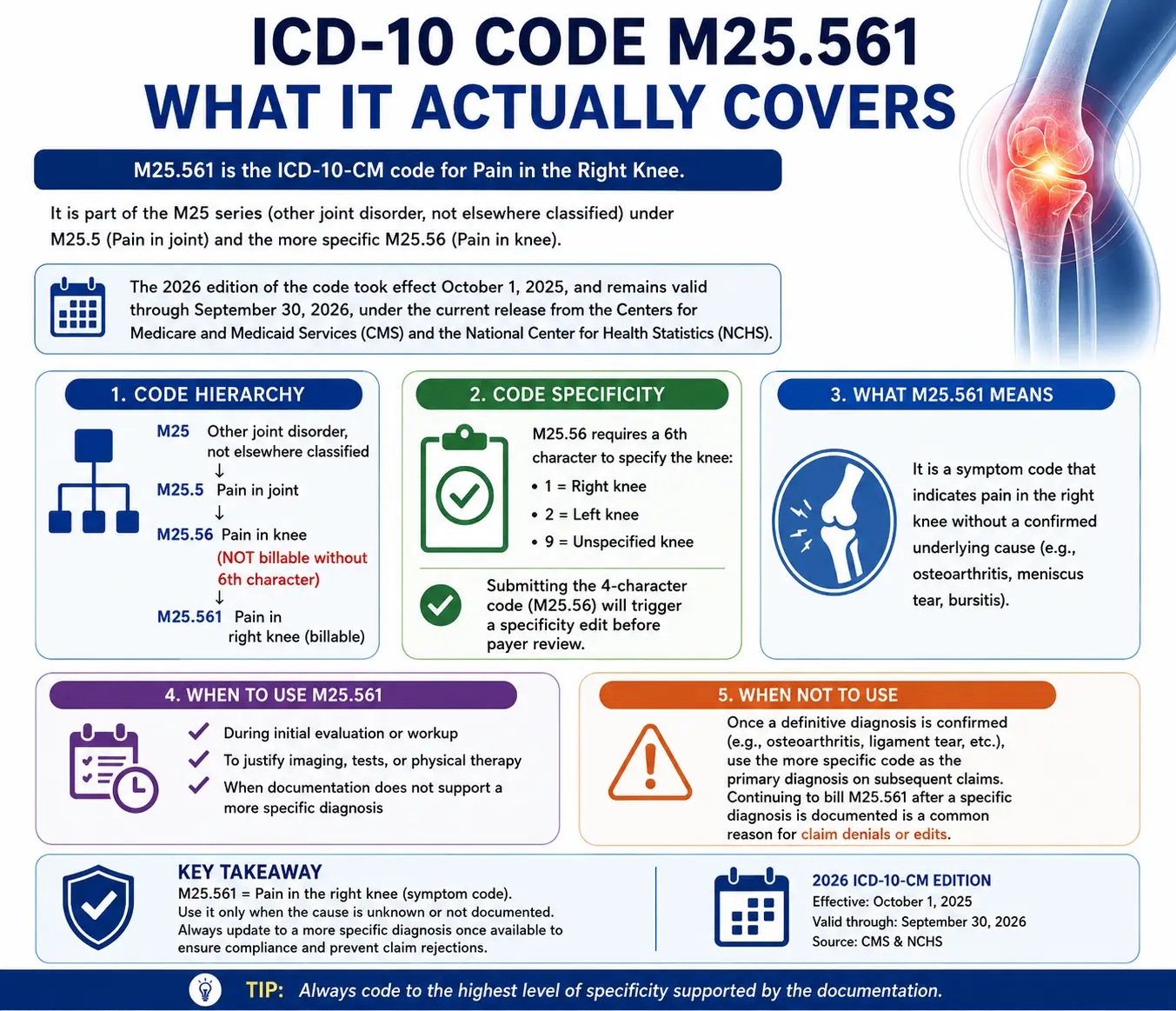
M25.561 is the ICD-10-CM code for pain in the right knee. It sits under category M25 (other joint disorder, not elsewhere classified), within subcategory M25.5 (pain in joint) and the more specific M25.56 (pain in knee). The 2026 edition of the code took effect October 1, 2025, and remains valid through September 30, 2026, under the current release from the Centers for Medicare and Medicaid Services (CMS) and the National Center for Health Statistics (NCHS).
M25.56 itself is not billable. It needs a sixth character to specify which knee: 1 for right, 2 for left, 9 for unspecified. Submitting the four-character parent code without that sixth digit trips a specificity edit before a payer even looks at the clinical content of the claim.
M25.561 functions as a symptom code. It documents that the patient has pain in the right knee without a confirmed underlying cause such as osteoarthritis, a meniscus tear, or bursitis. Coders reach for it during an initial workup, when imaging or physical therapy needs justification before a diagnosis exists, or when the documentation genuinely does not support anything more specific. Once a definitive diagnosis is confirmed, whether through exam findings, imaging, or lab work, the more specific code should take over as the primary diagnosis on later claims. Continuing to bill M25.561 after a chart already documents osteoarthritis or a ligament tear is one of the more common ways these claims lose specificity over time.
The three laterality codes for knee pain
Code | Description | When to use |
M25.561 | Pain in right knee | Right-sided pain documented, no confirmed diagnosis |
M25.562 | Pain in left knee | Left-sided pain documented, no confirmed diagnosis |
M25.569 | Pain in unspecified knee | Side not identified anywhere in the medical record |
Bilateral knee pain has no combined code of its own. When both knees hurt and the chart documents both sides, coders report M25.561 and M25.562 together as two separate diagnoses on the same claim. Reporting M25.569 for a patient with documented bilateral pain is a frequent, avoidable error, and the unspecified code does not mean “both sides” anyway. It means the side was never recorded, which reflects a documentation gap rather than a clinical finding.
This structure follows a general principle in the ICD-10-CM Official Guidelines for Coding and Reporting: when a paired body part has no bilateral code, coders assign separate codes for the left and right sides rather than one combined entry. The unspecified code is reserved for genuinely missing information, not convenience.
Common ICD-10 codes for right knee pain beyond M25.561
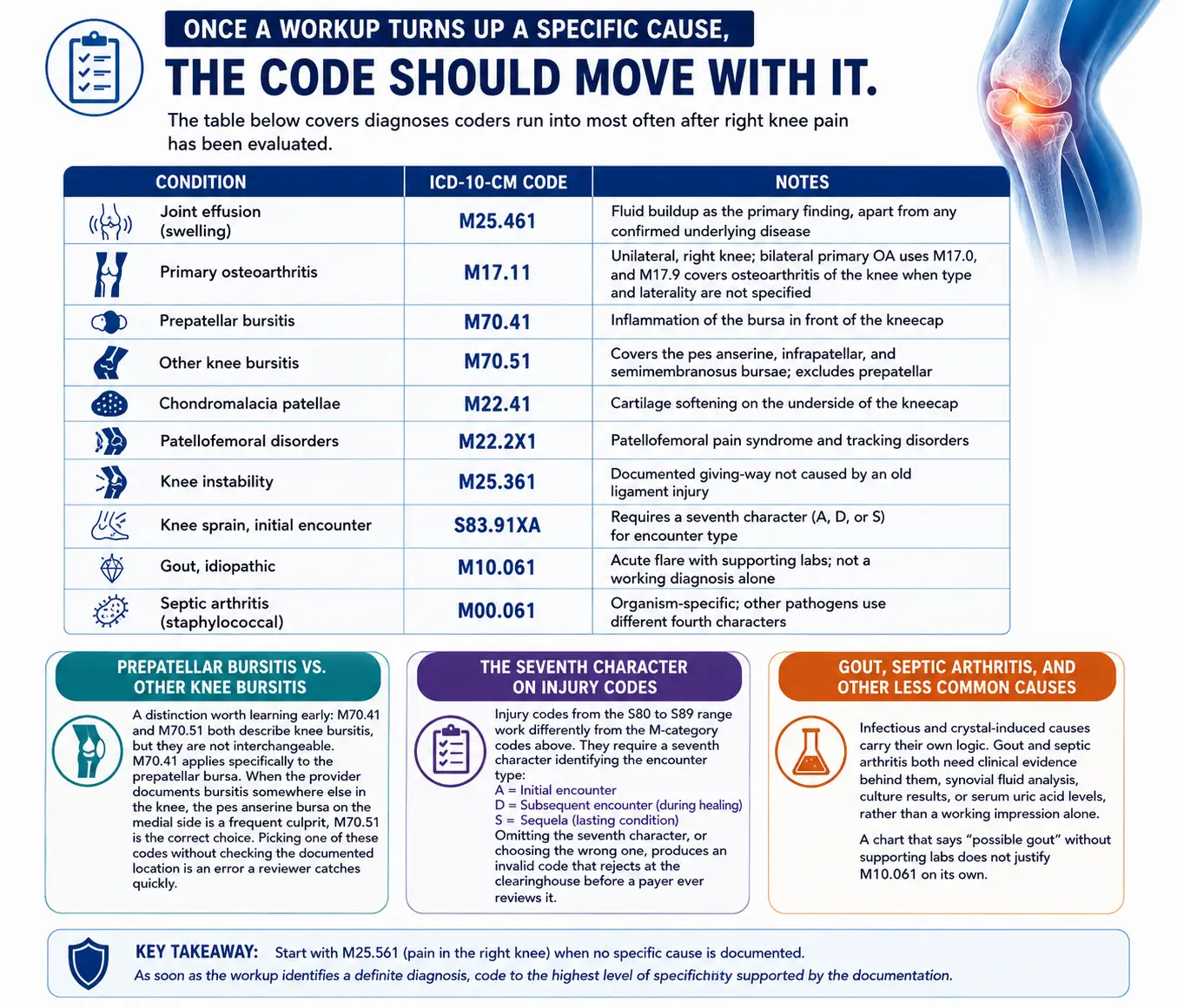
Once a workup turns up a specific cause, the code should move with it. The table below covers diagnoses coders run into most often after right knee pain has been evaluated.
Condition | ICD-10-CM code | Notes |
Joint effusion (swelling) | M25.461 | Fluid buildup as the primary finding, apart from any confirmed underlying disease |
Primary osteoarthritis | M17.11 | Unilateral, right knee; bilateral primary OA uses M17.0, and M17.9 covers osteoarthritis of the knee when type and laterality are not specified |
Prepatellar bursitis | M70.41 | Inflammation of the bursa in front of the kneecap |
Other knee bursitis | M70.51 | Covers the pes anserine, infrapatellar, and semimembranosus bursae; excludes prepatellar |
Chondromalacia patellae | M22.41 | Cartilage softening on the underside of the kneecap |
Patellofemoral disorders | M22.2X1 | Patellofemoral pain syndrome and tracking disorders |
Knee instability | M25.361 | Documented giving-way not caused by an old ligament injury |
Knee sprain, initial encounter | S83.91XA | Requires a seventh character (A, D, or S) for encounter type |
Gout, idiopathic | M10.061 | Acute flare with supporting labs; not a working diagnosis alone |
Septic arthritis (staphylococcal) | M00.061 | Organism-specific; other pathogens use different fourth characters |
Prepatellar bursitis versus other knee bursitis
A distinction worth learning early: M70.41 and M70.51 both describe knee bursitis, but they are not interchangeable. M70.41 applies specifically to the prepatellar bursa. When the provider documents bursitis somewhere else in the knee, the pes anserine bursa on the medial side is a frequent culprit, M70.51 is the correct choice. Picking one of these codes without checking the documented location is an error a reviewer catches quickly.
The seventh character on injury codes
Injury codes from the S80 to S89 range work differently from the M-category codes above. They require a seventh character identifying the encounter type: A for the initial encounter, D for a subsequent encounter during healing, or S for a sequela, meaning a lasting condition caused by the original injury. Omitting the seventh character, or choosing the wrong one, produces an invalid code that rejects at the clearinghouse before a payer ever reviews it.
Gout, septic arthritis, and other less common causes
Infectious and crystal-induced causes carry their own logic. Gout and septic arthritis both need clinical evidence behind them, synovial fluid analysis, culture results, or serum uric acid levels, rather than a working impression alone. A chart that says “possible gout” without supporting labs does not justify M10.061 on its own.
Coding acute versus chronic right knee pain
Whether right knee pain is acute or chronic changes which codes apply and how they get sequenced, even though ICD-10-CM has no single dedicated code for “chronic knee pain.” Instead, coders pair the laterality code with a pain-qualifier code from category G89 (pain, not elsewhere classified) when the documentation supports it.
Most coding guidance generally considers pain lasting less than three months to be acute, while pain that continues for three months or longer is often classified as chronic. However, coders should always rely on the provider’s documented diagnosis rather than assigning acute or chronic status based solely on duration. When chronic right knee pain has no confirmed structural cause, report G89.29 (Other chronic pain) together with M25.561 (Pain in right knee). If the pain is acute and results from a recent injury, use G89.11 (Acute pain due to trauma) alongside M25.561 and the appropriate injury code from the S83 category.
Sequencing depends on why the patient came in. Per the ICD-10-CM Official Guidelines for Coding and Reporting, Section I.C.6, a code from category G89 belongs as the first-listed diagnosis only when pain control is the primary reason for the visit, or when it adds detail the site code alone cannot provide. If the encounter is for evaluation or treatment of the knee condition itself, the site-specific code, M25.561, leads and the pain code follows as secondary. If the visit is specifically a pain-management encounter, that order flips.
G89.29 should not be confused with G89.4 (chronic pain syndrome), a clinically distinct diagnosis describing chronic pain accompanied by documented, significant psychosocial dysfunction. Duration alone does not justify G89.4. The provider has to document that broader relationship directly before a coder assigns it.
Documentation that supports medical necessity
Insurers do not pay claims because a valid code exists on the form. They pay because the documentation justifies the service billed against it. A handful of habits repeatedly separate clean right knee pain claims from denied ones.
History and exam findings
Laterality needs to appear explicitly in the note rather than get inferred from the chief complaint alone. A history covering onset, duration, and the character of the pain, sharp, aching, intermittent, worse with weight-bearing, supports the medical necessity of a diagnostic workup. Physical exam findings carry similar weight: documented range of motion, specific stability tests such as the Lachman or McMurray maneuver, presence of effusion or crepitus, and the precise location of tenderness give the coder something concrete to work from instead of a code chosen by inference. Practices that build laterality into their templates as a required field, rather than leaving it to free text, cut down on this error before it ever reaches the coder.
Functional limitation and imaging
Functional limitation is often the missing piece. A note stating that the patient struggles to walk, climb stairs, or kneel gives a reviewer a reason the visit, imaging, or therapy was necessary beyond pain alone. This matters even more for advanced imaging. Most payers expect documented conservative treatment first, typically several weeks of physical therapy or anti-inflammatory medication, along with mechanical symptoms like locking or catching, before an MRI ordered on a pain-only diagnosis gets approved.
Matching CPT and ICD-10 laterality
CPT and ICD-10 codes need to agree on laterality too. A right knee X-ray billed with modifier RT should pair with M25.561, not M25.562 or M25.569. Payer claim-edit systems check this automatically, and a mismatch is one of the most common, and most avoidable, reasons an otherwise clean claim gets kicked back.
Where these claims go wrong
A short list of recurring errors accounts for a large share of the denials tied to right knee diagnoses:
- Billing the non-billable parent code M25.56 instead of a full six-character code
- Defaulting to M25.569 (unspecified knee) when the note actually documents a side
- Continuing to bill M25.561 on follow-up visits after the diagnosis has evolved into a confirmed condition such as osteoarthritis or a meniscus tear
- Omitting or misusing the seventh character on S83 injury codes
- Mismatching a CPT laterality modifier against the ICD-10 code’s laterality
- Reporting a specific code, such as M17.11 for osteoarthritis, without imaging or exam findings in the chart to support it
The Office of Inspector General has named musculoskeletal coding, knee diagnoses among them, a recurring focus area in its improper-payment reviews, and CMS’s Targeted Probe and Educate program treats this exact kind of documentation-to-code mismatch as a trigger for closer scrutiny. One stale or unspecified code rarely causes trouble on its own. A pattern of them across a practice’s claims is what draws attention.
FAQs
What is the ICD-10 code for right knee pain?
M25.561. It applies when the record documents right-sided knee pain without a confirmed underlying diagnosis.
Is M25.561 a billable code?
Yes. It is a complete, six-character code valid for reimbursement. The four-character parent code, M25.56, is not billable on its own and will trigger a specificity edit.
What’s the ICD-10 code for right knee pain when the side isn’t documented?
M25.569 (pain in unspecified knee). It should only be used when the record genuinely does not identify which knee is affected, not as a stand-in for bilateral pain or a shortcut around documenting laterality.
What is the ICD-10 code for chronic right knee pain?
There is no single dedicated code. Coders pair M25.561 with G89.29 (other chronic pain), sequenced first or second depending on whether the visit is for the knee condition itself or for pain management.
Can M25.561 and M25.562 be billed on the same claim?
Yes, for documented bilateral knee pain. ICD-10-CM has no combined bilateral code for knee pain, so both laterality codes are reported together as separate diagnoses.
Should M25.561 still be used once osteoarthritis or another diagnosis is confirmed?
No. Once a specific diagnosis appears in the chart, such as M17.11 for osteoarthritis or M25.461 for effusion, that code should replace the symptom code as the primary diagnosis going forward.
Getting right knee pain ICD-10 coding right comes down to matching the code to what the documentation actually supports, not to whatever seems close enough. M25.561 remains correct when pain is the only confirmed finding. The moment a specific diagnosis, effusion, osteoarthritis, bursitis, or a ligament sprain, enters the chart, the code should move with it. Coders who treat laterality, chronicity, and specificity as three separate checks, rather than one afterthought, tend to see fewer denials and cleaner first-pass payment on these claims.