


Congenital heart defects are the most common birth defect in the United States. The CDC reported in February 2026 that they affect nearly 1% of births, roughly 40,000 infants a year, and that about one in four of those is a critical defect needing intervention in the first year of life. Every one of those patients needs imaging that maps the heart’s structure accurately. CPT Code 93303 is the code tied to that work: a complete transthoracic echocardiogram performed to evaluate congenital cardiac anomalies. Coders confuse it with the standard adult echo code more than almost any other pairing in cardiology billing, and the mistake shows up as denials.
What CPT code 93303 covers
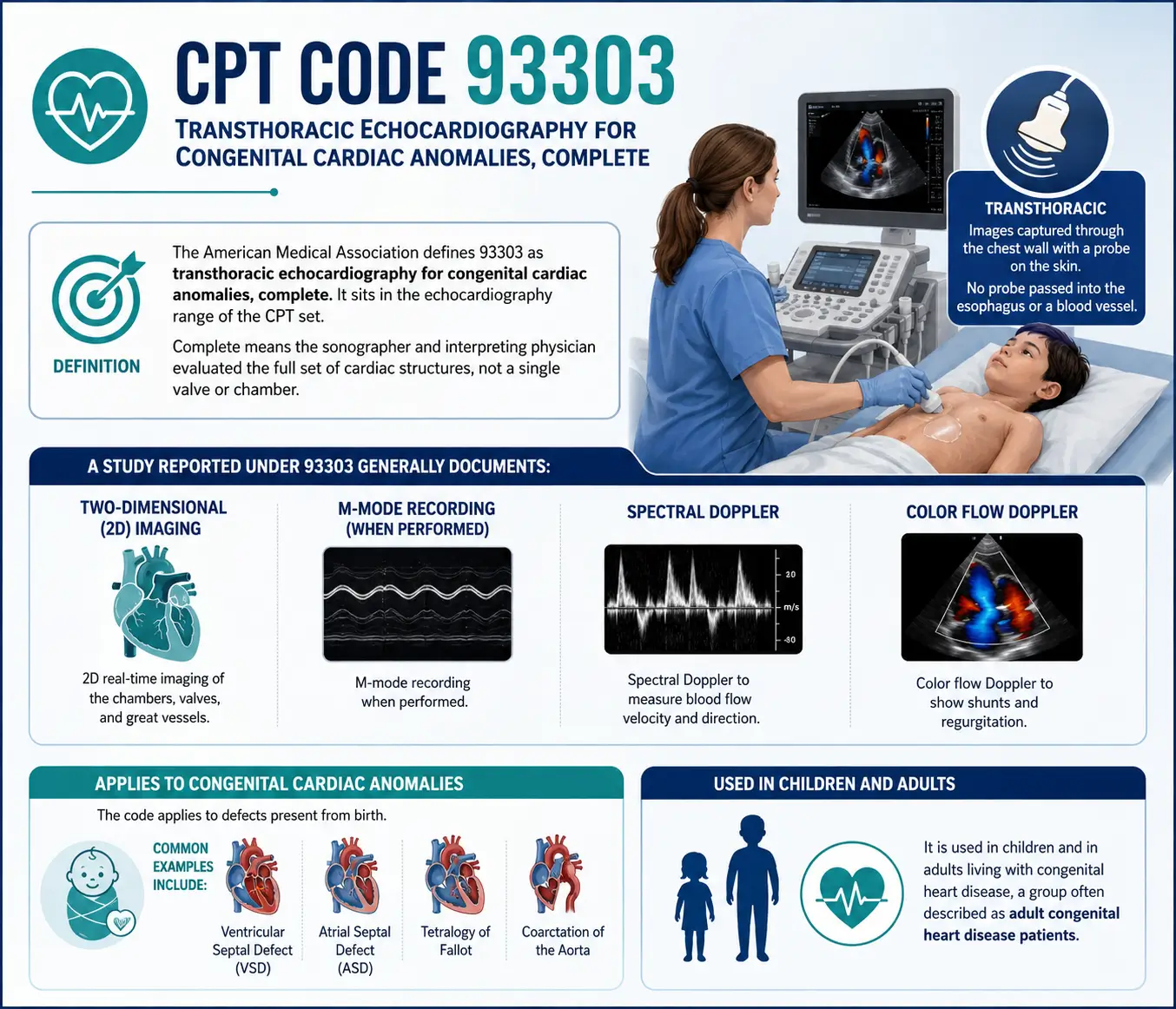
The American Medical Association defines 93303 as transthoracic echocardiography for congenital cardiac anomalies, complete. It sits in the echocardiography range of the CPT set. Transthoracic means the images are captured through the chest wall with an ultrasound probe placed on the skin, with no probe passed into the esophagus or a blood vessel. Complete means the sonographer and interpreting physician evaluated the full set of cardiac structures, not a single valve or chamber.
A study reported under 93303 generally documents:
- Two-dimensional (2D) real-time imaging of the chambers, valves, and great vessels
- M-mode recording when performed
- Spectral Doppler to measure blood flow velocity and direction
- Color flow Doppler to show shunts and regurgitation
The code applies to defects present from birth. Common examples include ventricular septal defect, atrial septal defect, tetralogy of Fallot, and coarctation of the aorta. It is used in children and in adults living with congenital heart disease, a group often described as adult congenital heart disease patients.
When 93303 is the wrong code
The most frequent error is reporting 93303 for an acquired condition. Ischemic heart disease, hypertensive changes, and valve disease that developed later in life belong under the standard echocardiography codes, not the congenital ones.
CPT guidance also draws a narrow line around incidental findings. Coding guidance has advised that a study turning up only a patent foramen ovale, or an isolated bicuspid aortic valve, does not by itself justify the congenital codes. The same principle appears in older CPT Assistant guidance summarized on the AAPC coding forum: when congenital disease is suspected but the echo does not confirm a congenital anomaly, the noncongenital echo codes apply instead.
Consider a practical case. A 6-year-old is referred for a murmur, and the echo confirms a moderate perimembranous ventricular septal defect with a left-to-right shunt on color flow. That first complete study is 93303. Six months later the child returns for a scheduled recheck of the same defect with no new symptoms. That limited study is 93304, not another 93303.
93303 versus 93304
Both codes describe congenital transthoracic echo. The difference is scope. 93303 is the complete study, usually the first full evaluation. 93304 is the follow-up or limited study, used when a known anomaly is being rechecked and a full assessment is not clinically needed. Billing the complete code for a focused recheck is a common audit flag, because the report will not support the full scope.
93303 compared with 93306 and other echo codes
The choice between congenital and noncongenital codes changes both the documentation and the add-on rules. This table lays out the codes most often mixed up with 93303.
CPT code | Description | Doppler in the descriptor | Typical use |
93303 | Congenital TTE, complete | No | First complete congenital study |
93304 | Congenital TTE, follow-up or limited | No | Recheck of a known congenital defect |
93306 | TTE complete, with spectral and color flow Doppler | Yes (bundled) | Standard complete adult echo with Doppler |
93307 | TTE complete, without Doppler | No | Complete adult echo, structure only |
93308 | TTE, follow-up or limited | No | Focused noncongenital recheck |
The 93306 descriptor names spectral and color flow Doppler inside the code itself. That single fact drives the add-on rules described next.
The Doppler add-on question
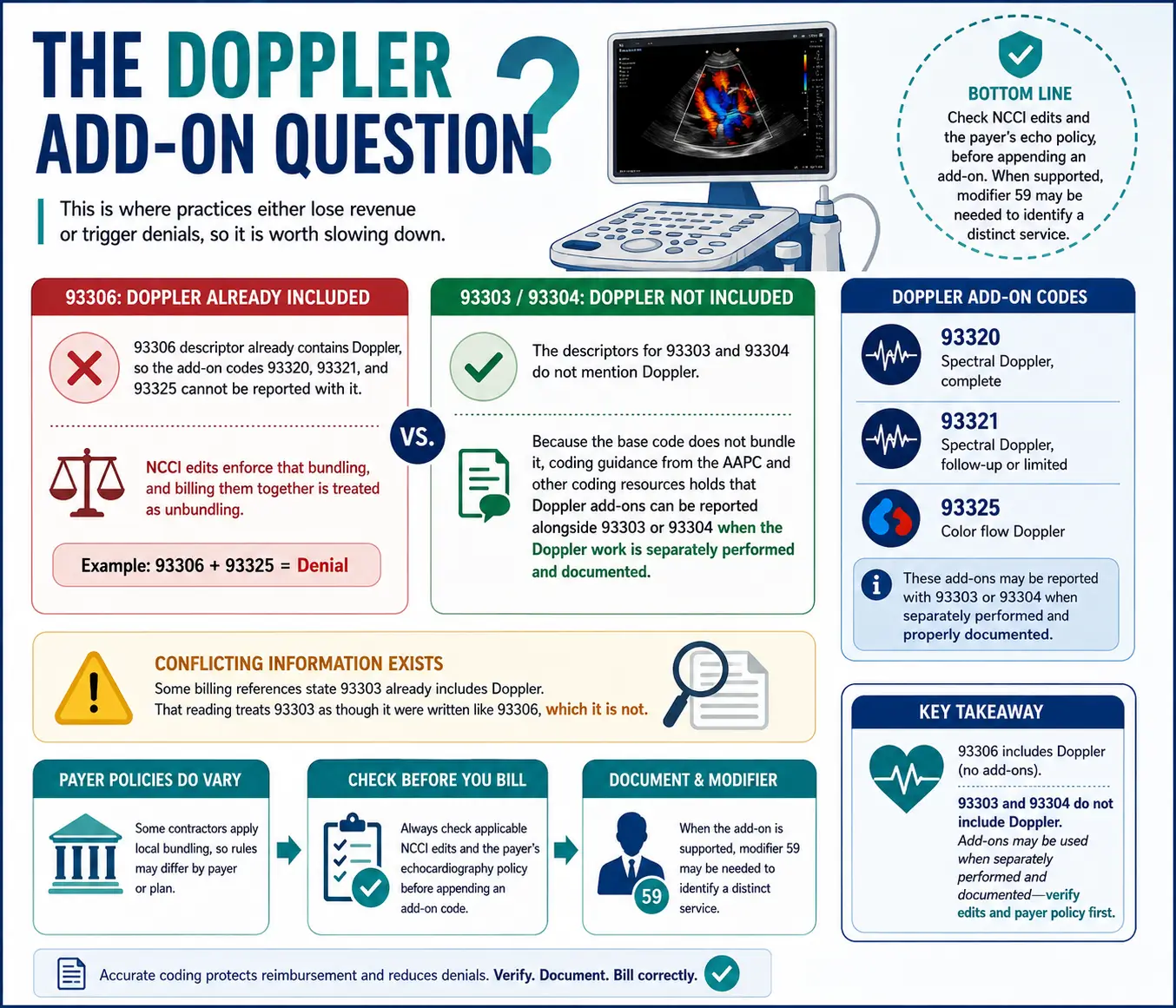
This is where practices either lose revenue or trigger denials, so it is worth slowing down.
Because the 93306 descriptor already contains Doppler, the add-on codes 93320, 93321, and 93325 cannot be reported with it. The National Correct Coding Initiative (NCCI) edits enforce that bundling, and billing them together is treated as unbundling.
The congenital codes are written differently. The descriptors for 93303 and 93304 do not mention Doppler. Because the base code does not bundle it, coding guidance published through the AAPC and other coding resources holds that the Doppler add-ons can be reported alongside 93303 or 93304 when the Doppler work is separately performed and documented:
- 93320: spectral Doppler, complete
- 93321: spectral Doppler, follow-up or limited
- 93325: color flow Doppler
Some billing references state the opposite and claim 93303 already includes Doppler. That reading treats 93303 as though it were written like 93306, which it is not. Payer policies do vary, and some contractors apply local bundling, so the safe step is to check the applicable NCCI edits and the payer’s echocardiography policy before appending an add-on. When the add-on is supported, modifier 59 may be needed to identify a distinct service.
Documentation that supports the code
A clean 93303 claim rests on a report that shows a complete congenital evaluation was performed and interpreted. Auditors and payers look for a clinical indication tied to a congenital diagnosis, then for evidence that the full study was actually done. That means 2D imaging documented across the chambers, valves, and great vessels, M-mode findings where recorded, and both spectral and color flow Doppler findings with the abnormality described in real terms. A note that reads “VSD present, left-to-right shunt, moderate in size” tells the reviewer far more than “Doppler performed.”
The interpreting physician’s signature carries weight. In the AAPC forum discussion referenced above, coders flagged reports where the echo was performed several days before the physician authenticated the read. Prompt, dated authentication keeps the professional component defensible if a claim is reviewed.
Billing, modifiers, and frequency
93303 carries a zero-day global period, so no post-procedure follow-up days are folded into the payment. The service splits into two components, and the modifier depends on who owns the equipment and who reads the study:
- Modifier 26 (professional component): the physician interprets the study but does not own the equipment
- Modifier TC (technical component): the facility owns the equipment and staff and bills separately from the reading physician
- No modifier (global service): the same entity owns the equipment and provides the interpretation
Medical necessity ties back to the diagnosis. Congenital echo codes pair with ICD-10 codes in the Q20 to Q28 range for congenital malformations of the circulatory system, such as Q21.0 for ventricular septal defect and Q21.1 for atrial septal defect. Z87.74, personal history of a corrected congenital heart malformation, can support a follow-up study depending on the payer’s local coverage determination, so it is worth verifying against the applicable LCD.
Repeat studies draw scrutiny. Many payers, including Medicare, limit how often echocardiography can be billed for the same patient. When a patient returns, the record needs a reason the reviewer can see: new symptoms, a change in clinical status, or a defined monitoring interval. Reimbursement itself comes from the Medicare Physician Fee Schedule and varies by geographic area through the local Medicare Administrative Contractor, so no single national dollar figure applies to the code.
Getting 93303 right
Accurate use of CPT Code 93303 comes down to three checks. Confirm the anomaly is congenital rather than acquired. Confirm the study was complete rather than a follow-up that belongs under 93304. Then decide on Doppler add-ons from the actual documentation and the payer’s edits, keeping in mind that the congenital codes do not bundle Doppler the way 93306 does. Practices that build those checks into their echo workflow report fewer denials on congenital studies and hold up better when a payer asks to see the record.