


CPT code 93306 is the code cardiology practices bill more than almost any other diagnostic imaging code they own. It reports a complete transthoracic echocardiogram, the standard heart ultrasound performed through the chest wall, done with both spectral and color flow Doppler. Get the documentation right and the claim moves through cleanly. Miss one required element and the same study, performed the same way, can get downcoded or denied. This guide walks through what CPT code 93306 actually requires, how it differs from the codes billers confuse it with, what Medicare expects to see in the chart, and what the code pays under the 2026 fee schedule.
What CPT code 93306 covers
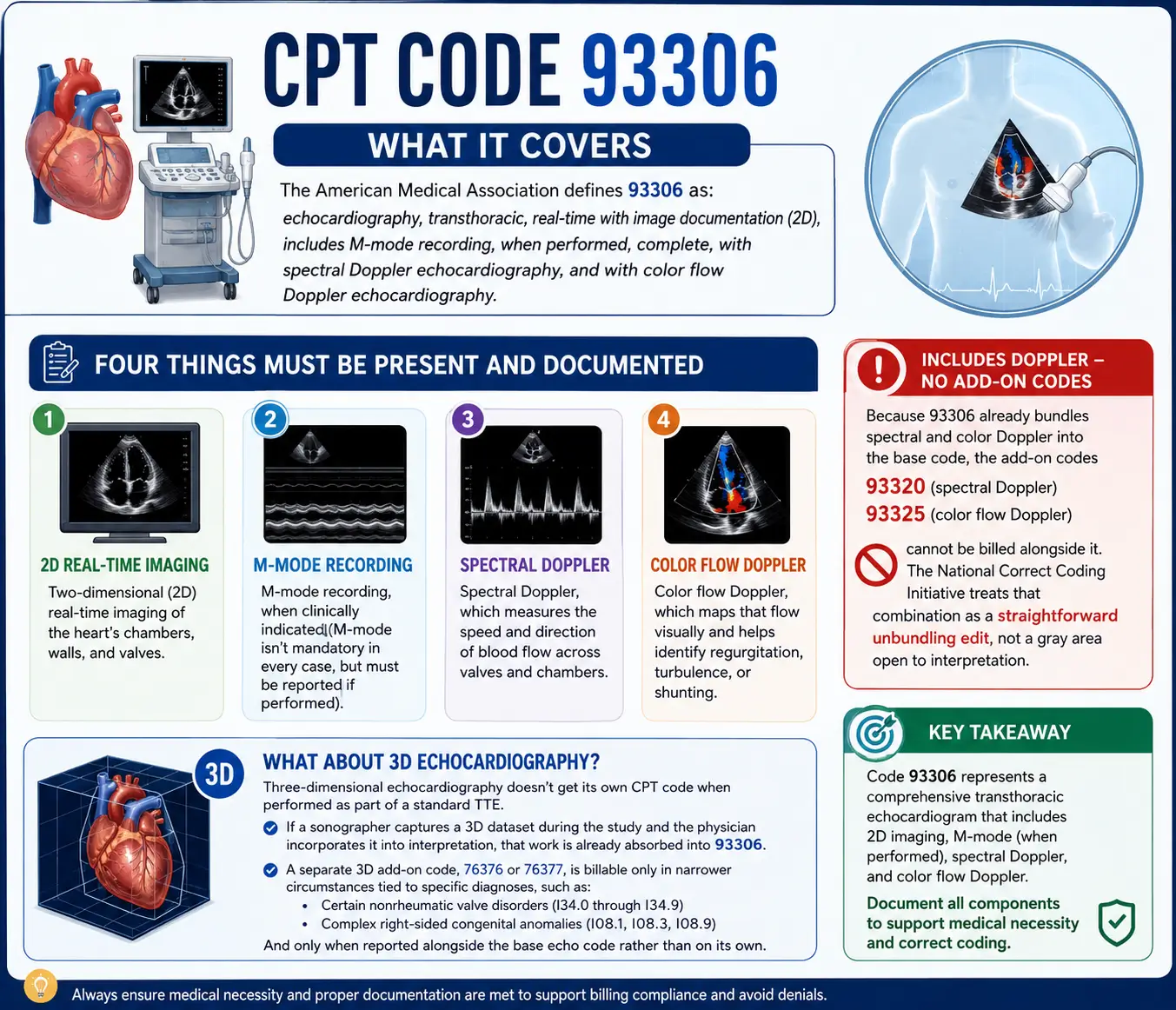
The American Medical Association defines 93306 as: echocardiography, transthoracic, real-time with image documentation (2D), includes M-mode recording, when performed, complete, with spectral Doppler echocardiography, and with color flow Doppler echocardiography.
Four things have to be present, and documented, for a study to qualify as 93306:
- Two-dimensional (2D) real-time imaging of the heart’s chambers, walls, and valves
- M-mode recording, when clinically indicated (M-mode isn’t mandatory in every case, but must be reported if performed)
- Spectral Doppler, which measures the speed and direction of blood flow across valves and chambers
- Color flow Doppler, which maps that flow visually and helps identify regurgitation, turbulence, or shunting
Because 93306 already bundles spectral and color Doppler into the base code, the add-on codes 93320 (spectral Doppler) and 93325 (color flow Doppler) cannot be billed alongside it. The National Correct Coding Initiative treats that combination as a straightforward unbundling edit, not a gray area open to interpretation.
Three-dimensional echocardiography doesn’t get its own CPT code when performed as part of a standard TTE. If a sonographer captures a 3D dataset during the study and the physician incorporates it into interpretation, that work is already absorbed into 93306. A separate 3D add-on code, 76376 or 76377, is billable only in narrower circumstances tied to specific diagnoses, such as certain nonrheumatic valve disorders (I34.0 through I34.9) or complex right-sided congenital anomalies (I08.1, I08.3, I08.9), and only when reported alongside the base echo code rather than on its own.
How 93306 compares to the other echo codes
Most of the confusion in cardiology coding comes from choosing between codes that all describe some version of “heart ultrasound.” Here’s how the main ones split:
Code | What it reports | Doppler included |
93306 | Complete TTE with 2D and M-mode | Spectral and color flow |
93307 | Complete TTE with 2D and M-mode | None (billed separately if performed) |
93308 | Follow-up or limited TTE | Depends on what’s performed |
93303 | TTE for congenital heart disease | Spectral and color flow |
93307 applies when a complete anatomic study is performed but no Doppler work is done or documented, which is uncommon outside of specific screening protocols. 93308 covers a focused, targeted study rather than a full assessment, such as a follow-up scan to recheck a known finding rather than reassess the whole heart. Billing 93306 for what the documentation actually supports as a limited study is one of the more common audit triggers in cardiology practices, since the code, and the payment tied to it, assumes a full anatomic and hemodynamic evaluation took place.
93303 exists for a different clinical question. Where 93306 addresses acquired heart disease (valve degeneration, ischemic damage, cardiomyopathy), 93303 is reserved for studies where the primary reason for the echo is evaluating a congenital structural defect, such as a septal defect or an abnormal great-vessel connection, regardless of the patient’s age. A cardiologist can order 93303 for a 60-year-old adult if the clinical question being asked is congenital in nature rather than acquired.
Establishing medical necessity
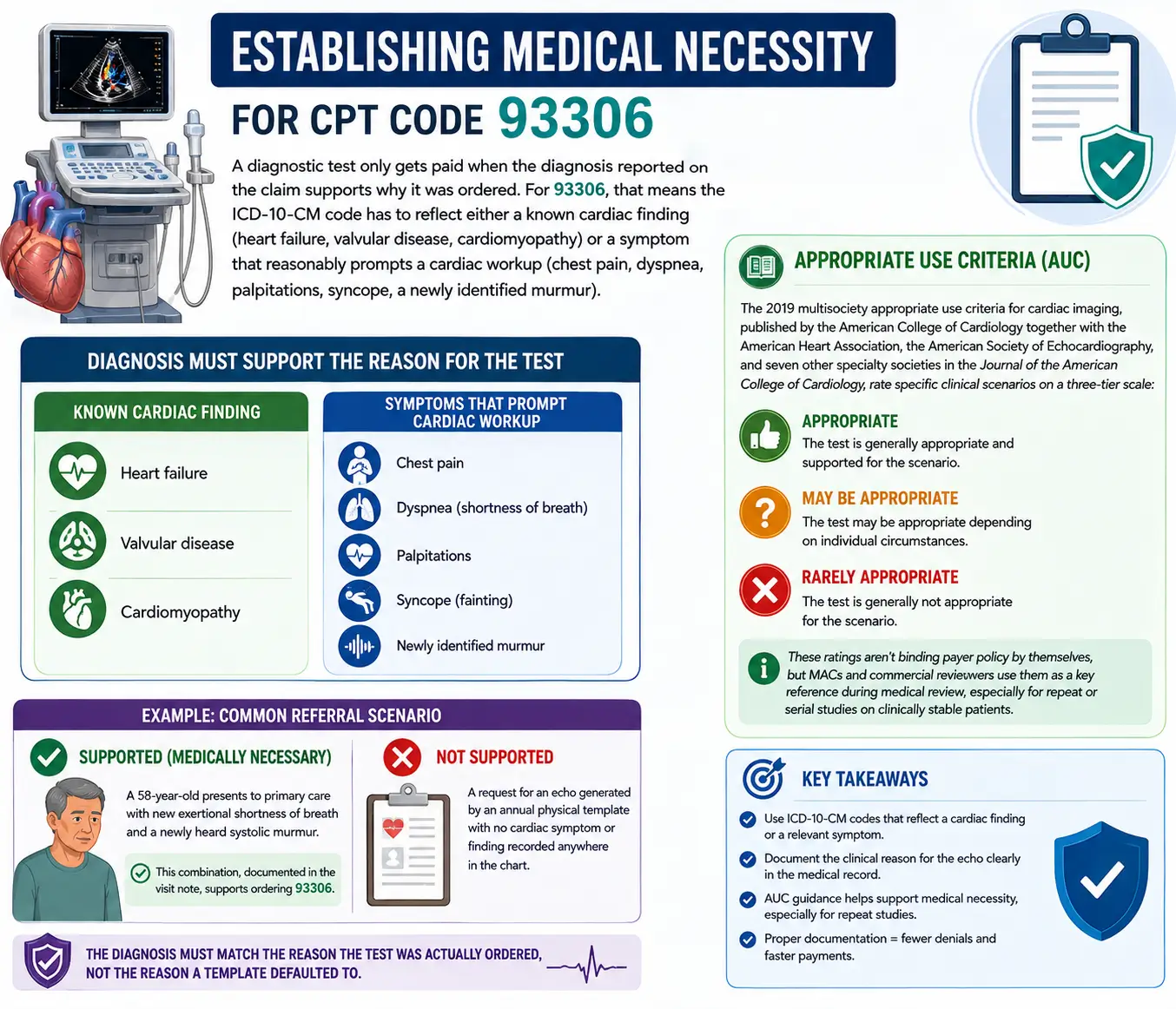
A diagnostic test only gets paid when the diagnosis reported on the claim supports why it was ordered. For 93306, that means the ICD-10-CM code has to reflect either a known cardiac finding (heart failure, valvular disease, cardiomyopathy) or a symptom that reasonably prompts a cardiac workup (chest pain, dyspnea, palpitations, syncope, a newly identified murmur).
The 2019 multisociety appropriate use criteria for cardiac imaging, published by the American College of Cardiology together with the American Heart Association, the American Society of Echocardiography, and seven other specialty societies in the Journal of the American College of Cardiology, rate specific clinical scenarios on a three-tier scale: appropriate, may be appropriate, or rarely appropriate. These ratings aren’t binding payer policy by themselves, but Medicare Administrative Contractors and commercial reviewers lean on them when a claim is pulled for medical review, particularly for repeat or serial studies on patients who are clinically stable.
Consider a common referral: a 58-year-old presents to primary care with new exertional shortness of breath and a newly heard systolic murmur. That combination, documented in the visit note, supports ordering 93306. What doesn’t support it is a request for an echo generated by an annual physical template with no cardiac symptom or finding recorded anywhere in the chart. The diagnosis has to match the reason the test was actually ordered, not the reason a template defaulted to.
Covered diagnoses under Medicare’s local coverage rules
Echocardiography has no single national coverage determination, so coverage detail lives in local coverage articles published separately by each Medicare Administrative Contractor. CGS Administrators, the MAC for Jurisdiction 15 (Kentucky and Ohio), publishes one example: Billing and Coding Article A57306. Its list of ICD-10-CM codes that support medical necessity for 93306, 93307, 93308, and the related Doppler add-on codes runs past 1,000 individual codes, spanning everything from acute conditions like infective endocarditis and cardiac tamponade to chronic findings such as hypertensive heart disease, atherosclerotic coronary disease, and congenital malformations.
That breadth is the point of the code. Echocardiography supports the workup of an unusually wide range of conditions, from stroke-related diagnoses (ordered to rule out a cardiac embolic source) to oncology codes (ordered to establish a cardiac baseline before cardiotoxic chemotherapy, reported with Z01.818, then monitored during treatment with Z51.81 and confirmed complete with Z08). Practices billing 93306 across state lines shouldn’t assume one MAC’s covered-diagnosis list matches another’s word for word. The codes overlap heavily, but the source articles differ by jurisdiction, so billers should pull the article specific to the MAC actually processing the claim.
One narrow but useful example of how specific these local articles get: CGS’s article notes that echocardiograms performed as part of the CAMZYOS Risk Evaluation and Mitigation Strategy (REMS) program must carry the KX modifier and are limited to patients with NYHA Class II to III obstructive hypertrophic cardiomyopathy, reported with diagnosis code I42.1. It’s a small rule, easy to miss on a generic billing checklist, and one denial from overlooking it is enough to make it worth building into a practice’s coding workflow.
Frequency limitations and repeat studies
Medicare doesn’t publish a fixed national limit on how many times 93306 can be billed for the same patient over a given period. What MACs apply instead is ordinary medical necessity review: a repeat complete echo on a clinically stable patient, without documentation of a new symptom, a change in exam findings, or a new cardiac event since the last study, invites scrutiny. The clinical justification needs to be visible in the note itself, not assumed from the fact that time has passed since the prior study.
Same-day repeat studies are handled through modifiers rather than frequency counting. When a second, medically necessary TTE is performed on the same date as an earlier one (a pre- and post-intervention comparison, for example), modifier 76 (repeat procedure by the same physician) or modifier 77 (repeat procedure by a different physician) identifies the second claim as distinct rather than a duplicate billing error.
Modifier 26, TC, and the global claim
Echocardiography splits into a technical component (the equipment, the sonographer’s time, and image acquisition) and a professional component (the physician’s interpretation and signed report). CMS assigns 93306 a PC/TC indicator of 1, which means the code can be billed globally or split between the two parties who each performed half of the work.
- No modifier, billed globally: used when the same practice owns the equipment and employs the interpreting physician, typical of an office-based cardiology group.
- Modifier 26, professional component: used when a physician interprets a study performed on equipment they don’t own, such as a cardiologist reading an echo acquired at a hospital.
- Modifier TC, technical component: used by the facility or practice that owns the equipment and performed the study but didn’t interpret it.
Billing 93306 globally while the facility separately bills 93306-TC for the same study is a common two-party billing error, and it typically results in one of the two claims getting denied once the payer identifies the overlap.
Modifier 59 has a narrower role. It’s appended when the echo is a separately identifiable service from another procedure billed on the same date, and it should only be used when documentation actually supports that the two services were clinically distinct, not as a default workaround whenever a bundling edit fires.
What CPT 93306 pays in 2026
Under the 2026 Medicare Physician Fee Schedule, CPT 93306 carries a work RVU of 1.42 and a non-facility total RVU of 5.89. Applied against the 2026 non-qualifying-participant conversion factor of $33.4009, that works out to a national payment of roughly $197 before geographic adjustment. Actual payment moves up or down from there based on the Geographic Practice Cost Index for the Medicare locality where the service is billed, so a practice in a high-cost urban area and one in a rural county will see different final numbers for the identical code and the identical claim.
Commercial payers generally price 93306 as a percentage of the Medicare rate, negotiated separately in each contract, which is why the same code can produce noticeably different payments from two different insurers covering two patients seen in the same office on the same day. Practices that bill the technical and professional components separately should expect the technical component, which carries the practice expense and equipment cost, to make up the larger share of the combined payment.
Common reasons CPT 93306 claims get denied
Most 93306 denials trace back to a small set of recurring issues rather than anything unusual. The documentation doesn’t support all four required elements (2D imaging, M-mode when performed, spectral Doppler, and color flow Doppler), so the payer downgrades the claim to 93307 or 93308. The ICD-10 code reported doesn’t match a documented symptom or finding in the chart. Add-on codes 93320 or 93325 get billed alongside 93306 despite already being bundled into it. Or the technical and professional components get billed by two different parties without the correct modifiers, creating a payment collision that delays both claims.
None of these are complicated fixes on their own. A report template that forces documentation of all four required components, a coding review step that checks the ICD-10 code against the ordering note before submission, and a clear internal policy on who bills which modifier when a study crosses facility lines will resolve most of what shows up in a typical cardiology practice’s denial log.