


Most established patient practices bill 99212 more often than their coders track. The code sits one step above the nurse visit and one step below the everyday 99213, and it carries its own documentation logic that catches newer billers off guard. This guide covers what CPT 99212 actually requires in 2026, how much it pays, when a modifier belongs on the claim, and where the code gets confused with its neighbors.
What is CPT code 99212?
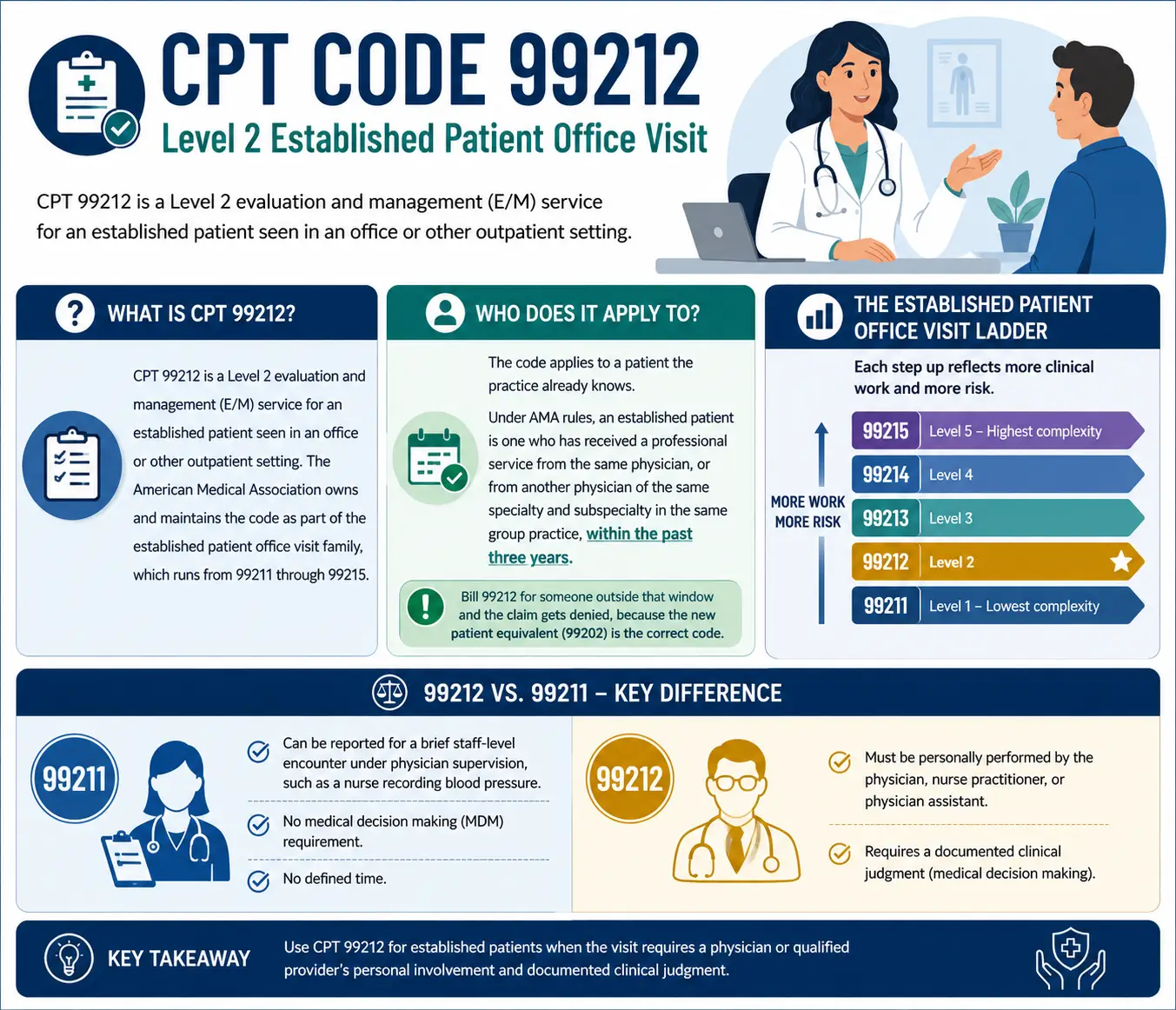
CPT 99212 is a Level 2 evaluation and management (E/M) service for an established patient seen in an office or other outpatient setting. The American Medical Association owns and maintains the code as part of the established patient office visit family, which runs from 99211 through 99215. Each step up that ladder reflects more clinical work and more risk.
The code applies to a patient the practice already knows. An established patient, as defined by the AMA, is someone who has received a professional service from the same physician or from another physician with the same specialty and subspecialty within the same group practice during the previous three years. Bill 99212 for someone outside that window and the claim gets denied, because the new patient equivalent (99202) is the correct code.
One detail separates 99212 from the code directly below it. 99211 can be reported for a brief staff-level encounter under physician supervision, such as a nurse recording blood pressure, and it carries no medical decision making requirement and no defined time. 99212 has to be personally performed by the physician, nurse practitioner, or physician assistant, and it requires a documented clinical judgment.
The two ways to report 99212: MDM or time
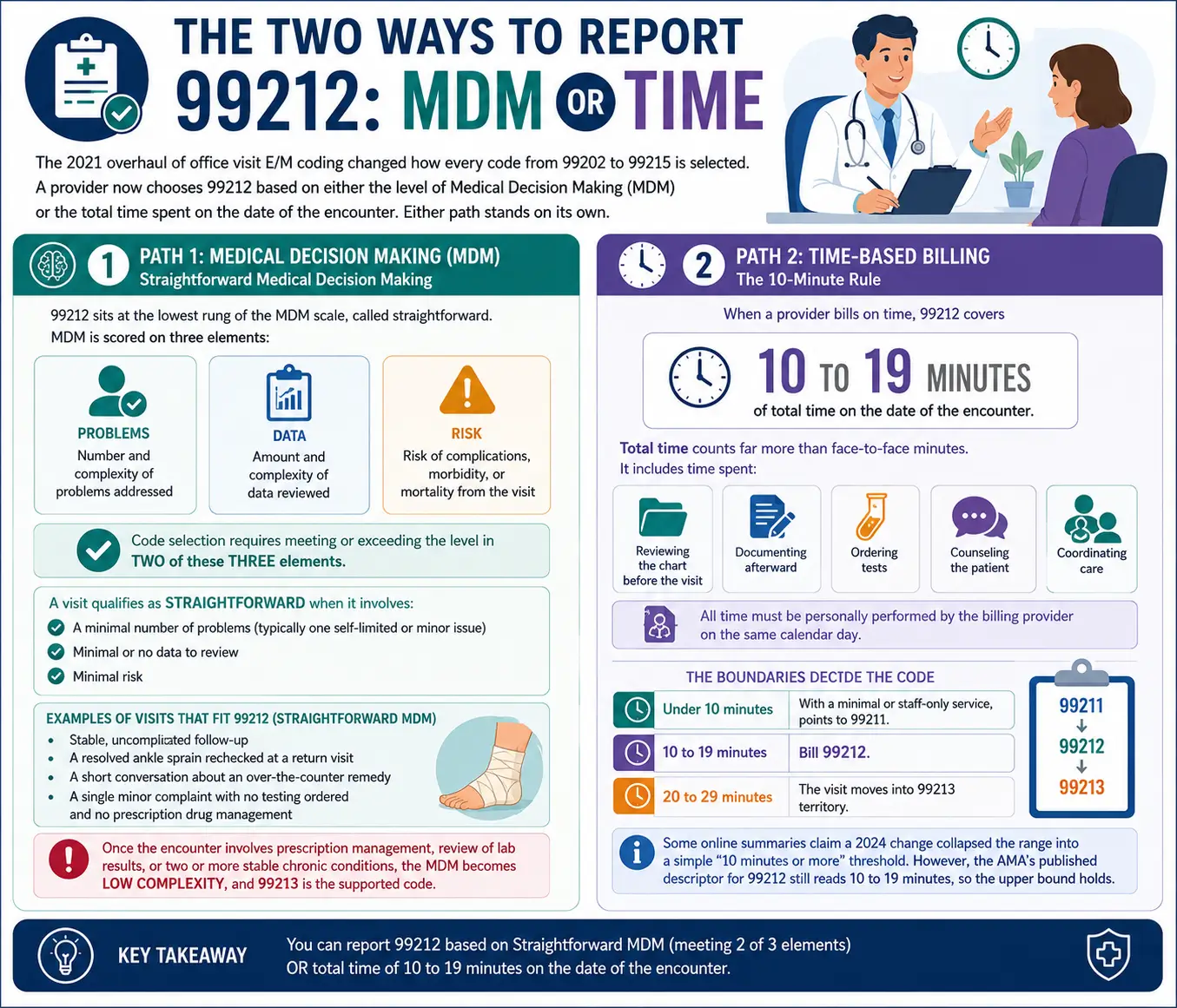
The 2021 overhaul of office visit E/M coding changed how every code from 99202 to 99215 is selected. History and physical exam no longer drive the code level. A provider now chooses 99212 based on either the level of medical decision making or the total time spent on the date of the encounter. Either path stands on its own.
Straightforward medical decision making
99212 sits at the lowest rung of the MDM scale, called straightforward. Medical decision making is scored on three elements: the number and complexity of problems addressed, the amount and complexity of data reviewed, and the risk of complications, morbidity, or mortality from the visit. Code selection requires meeting or exceeding the level in two of those three elements. A visit meets the straightforward level of medical decision making when it involves a minimal number of problems usually a single self-limited or minor condition requires little or no data review, and carries minimal risk to the patient.
Consider a stable, uncomplicated follow-up. A resolved ankle sprain rechecked at a return visit. A short conversation about an over-the-counter remedy. A single minor complaint with no testing ordered and no prescription drug management. Once the encounter involves prescription management, review of lab results, or two or more stable chronic conditions, the decision making becomes low complexity, and 99213 is the supported code.
Time-based billing and the 10-minute rule
When a provider bills on time, 99212 covers 10 to 19 minutes of total time on the date of the encounter. The AMA lists this range directly in the code descriptor. Total time counts far more than face-to-face minutes. It includes reviewing the chart before the visit, documenting afterward, ordering tests, counseling the patient, and coordinating care, provided the billing provider personally performs the work on that calendar day.
The boundaries decide the code. Under ten minutes of total time, with a minimal or staff-only service, points to 99211. Cross nineteen minutes and the visit moves into 99213 territory (20 to 29 minutes). A few online summaries claim a 2024 change collapsed the range into a simple “10 minutes or more” threshold, but the AMA’s published descriptor for 99212 still reads 10 to 19 minutes, so the upper bound holds.
CPT 99212 documentation checklist
Documentation is where most 99212 denials start. The note has to justify the level whether the provider chose MDM or time. A defensible 99212 record includes:
- The established patient’s chief complaint or reason for the visit
- A medically appropriate history and examination for the problem (no minimum number of elements is required, but the note should reflect what was performed)
- An assessment that names the problem addressed
- A clear plan, including any instructions, over-the-counter recommendations, or follow-up
- Either the elements that support straightforward MDM or a total time statement with the minutes documented for that date
- An ICD-10 diagnosis that establishes medical necessity for the visit
That last item deserves attention. A payer pays for a 99212 only when the linked diagnosis supports the need for a physician-level service. Coding a stable follow-up to a nonspecific complaint with no clear clinical reason invites a medical necessity denial even when the note itself reads cleanly.
A short documentation example
A 28-year-old established patient returns to confirm that a lateral ankle sprain has resolved. Pain is gone. The patient bears full weight without difficulty and has returned to normal activity. Examination shows no swelling, full range of motion, and no tenderness on palpation. Assessment: resolved lateral ankle sprain. Plan: activity as tolerated, return only if symptoms recur.
That note supports 99212. It documents one resolved self-limited problem, no diagnostic data reviewed, and minimal risk, which is the definition of straightforward MDM. If the provider preferred time-based billing, a line reading “total time 12 minutes on date of service, including chart review and documentation” would carry the same claim.
99212 reimbursement in 2026
99212 carries a work RVU of 0.70, the component that measures the physician’s time and effort. Add practice expense and malpractice RVUs and the total in the non-facility (office) setting comes to roughly 1.5 RVUs.
Medicare payment is the total RVU multiplied by geographic adjustment factors and then the annual conversion factor. 2026 brought a structural change absent from the fee schedule for about thirty years: two separate conversion factors, required under the Medicare Access and CHIP Reauthorization Act. According to the CMS CY 2026 Physician Fee Schedule final rule released on October 31, 2025, the qualifying Alternative Payment Model (APM) participant conversion factor is $33.5675, and the conversion factor for non-qualifying participants (most physicians) is $33.4009. Both rose from the 2025 factor of $32.3465, increases of 3.77 percent and 3.26 percent respectively.
Run the math at the non-qualifying factor and 99212 pays roughly $52 nationally in the office setting before geographic adjustment. Published fee-schedule lookups list figures between about $52 and $59 for 2026 depending on the practice expense values applied, and the facility rate is lower because the hospital absorbs the overhead. Every locality differs because of the Geographic Practice Cost Index (GPCI).
E/M coders caught a break in the 2026 rule. CMS finalized a 2.5 percent efficiency adjustment that reduced the work RVUs on most non-time-based procedural, surgical, and imaging codes. As the healthcare advisory firm PYA noted in its February 2026 analysis, that cut does not apply to time-based services, a category that includes evaluation and management, behavioral health, and Medicare telehealth. So 99212 keeps its full work RVU and still gains the higher conversion factor.
Commercial payers set their own rates. Reported ranges for 99212 run higher than Medicare, often between about $65 and $100 depending on the contract and region, though every payer schedule is negotiated separately. Verify contracted amounts rather than assuming a fixed markup over Medicare.
How 99212 compares to nearby codes
The established patient codes differ by decision making and time. This table shows where 99212 sits.
Code | MDM level | Total time (2026) | Physician presence |
99211 | None required | Not defined | May be staff-only under supervision |
99212 | Straightforward | 10-19 minutes | Required |
99213 | Low | 20-29 minutes | Required |
99214 | Moderate | 30-39 minutes | Required |
The most common real-world error lives at the 99212 and 99213 border. A visit that includes a prescription refill decision, review of a lab result, or management of stable chronic conditions has already crossed into low-complexity MDM, and coding it as 99212 leaves money on the table. The opposite mistake, coding a single minor complaint as 99213, invites an audit. Both errors compound across a high-volume schedule, which is why the boundary between these two codes is worth training staff on directly.
Does CPT 99212 need a modifier?
A routine 99212 visit needs no modifier. The claim carries the code, the ICD-10 diagnosis that supports medical necessity, and place of service 11 for an office. One situation changes that, and it is performing a procedure on the same day.
Modifier 25 signals a significant, separately identifiable E/M service provided by the same clinician on the same day as a procedure or other service. It attaches to the E/M code, never to the procedure. The AMA and the CMS National Correct Coding Initiative Policy Manual, effective January 1, 2026, define the standard the same way, and the E/M work has to go beyond the routine evaluation already built into the procedure.
A Medicare example from the administrative contractor Noridian shows 99212-25 in practice. A patient’s wound is closed after a motor vehicle accident (CPT 12032), and the provider also checks for neurological injury. Because the wound repair carries a global period and the neurological evaluation is separate, modifier 25 is appended to 99212 so both services are paid. Payers scrutinize this pairing. Cigna, for one, has required documentation supporting modifier 25 when it is billed with 99212 through 99215 alongside a minor procedure since May 2023, so the note has to keep the E/M work and the procedure work clearly separate in the record.
Can CPT 99212 be billed via telehealth?
Yes, and the 2026 rules rest on a law that nearly lapsed. Medicare’s pandemic-era telehealth flexibilities expired at the end of January 2026 before Congress restored them. On February 3, 2026, President Trump signed the Consolidated Appropriations Act, 2026 (H.R. 7148), extending these flexibilities through December 31, 2027. As the Kaiser Family Foundation reported, the extension keeps the patient’s home as an eligible originating site, removes geographic restrictions, and continues audio-only coverage. The Congressional Budget Office scored the extension at $3.8 billion over 2026 to 2028.
A 99212 telehealth visit uses the same straightforward MDM or 10 to 19 minute standard as an in-person visit. How the claim signals telehealth depends on the payer:
- Original Medicare identifies telehealth by place of service, not modifier 95. Use POS 10 when the patient is at home, which pays the higher non-facility rate, and POS 02 when the patient is elsewhere. Modifier 93 flags an audio-only encounter.
- Commercial and Medicare Advantage payers generally want modifier 95 on 99212 through 99215 for a synchronous audio-video visit.
A separate wrinkle arrived in 2026. The AMA created a 98000-series family of telemedicine codes that build the modality into the descriptor, so no telehealth modifier is needed. Many commercial payers and state Medicaid programs accept them, but Medicare does not, and it rejects 98000 through 98015 in favor of the standard 99202 through 99215 codes with a place of service. Confirm which set each payer wants before the claim leaves the system.
Medicare pays the same amount for an in-person and a home-based telehealth E/M visit when POS 10 is used. Behavioral health telehealth to the home was made permanent through earlier legislation, while the broader flexibilities carry the December 31, 2027 expiration that billing teams should keep in their work queues.
Common reasons 99212 claims get denied
A short list of errors accounts for most 99212 rejections:
- Billing 99212 for a new patient. Payers cross-reference their own claims history, and a patient with a paid claim inside three years triggers an automatic denial. Use 99202 instead.
- Documentation too thin for straightforward MDM. A note without an assessment and plan, or without a clearly documented problem, fails to support even this basic level.
- Time-based billing with no time recorded. General statements such as “brief visit” are not sufficient for time-based coding. The documentation must clearly record both the total minutes spent and the date of service.
- Undercoding a 99213 as 99212. Prescription management or lab review pushes the visit into low-complexity MDM, and coding it down forfeits legitimate revenue.
- Missing or unsupported modifier 25. When a procedure runs the same day, the E/M note has to justify a separate, significant service, or the visit gets bundled into the procedure payment.
CPT 99212 rewards specific documentation. The note has to match either the straightforward MDM definition or the 10 to 19 minute time range, the patient has to be established, modifier 25 belongs on the claim only when a separate procedure happens the same day, and telehealth claims route by payer type (place of service for original Medicare, modifier 95 for most commercial plans). At the 2026 non-qualifying conversion factor of $33.4009 and a work RVU of 0.70, the code pays modestly per encounter. Volume is what makes accuracy at the 99212 and 99213 boundary add up to real money over a year.