


Diagnostic upper endoscopy is one of the highest-volume procedures in gastroenterology, and CPT code 43235 is the code that carries it. It is also one of the easiest codes in the 432xx series to bill wrong. Payment for 43235 vanishes the instant a biopsy forceps, injection needle, or dilator enters the working channel, and coders who miss that shift produce denials that look like documentation failures but are really code-selection failures.
Scale matters here. Peery and colleagues, writing in Gastroenterology (Burden and Cost of Gastrointestinal, Liver, and Pancreatic Diseases in the United States: Update 2024), estimated 7,248,276 upper endoscopies performed in US adults during 2022. A one percent error rate across a code family that size is not a rounding problem for a practice.
This guide covers what 43235 includes, how Medicare pays it in 2026, which modifiers apply, what the operative note has to show, and where claims actually break.
What CPT code 43235 describes
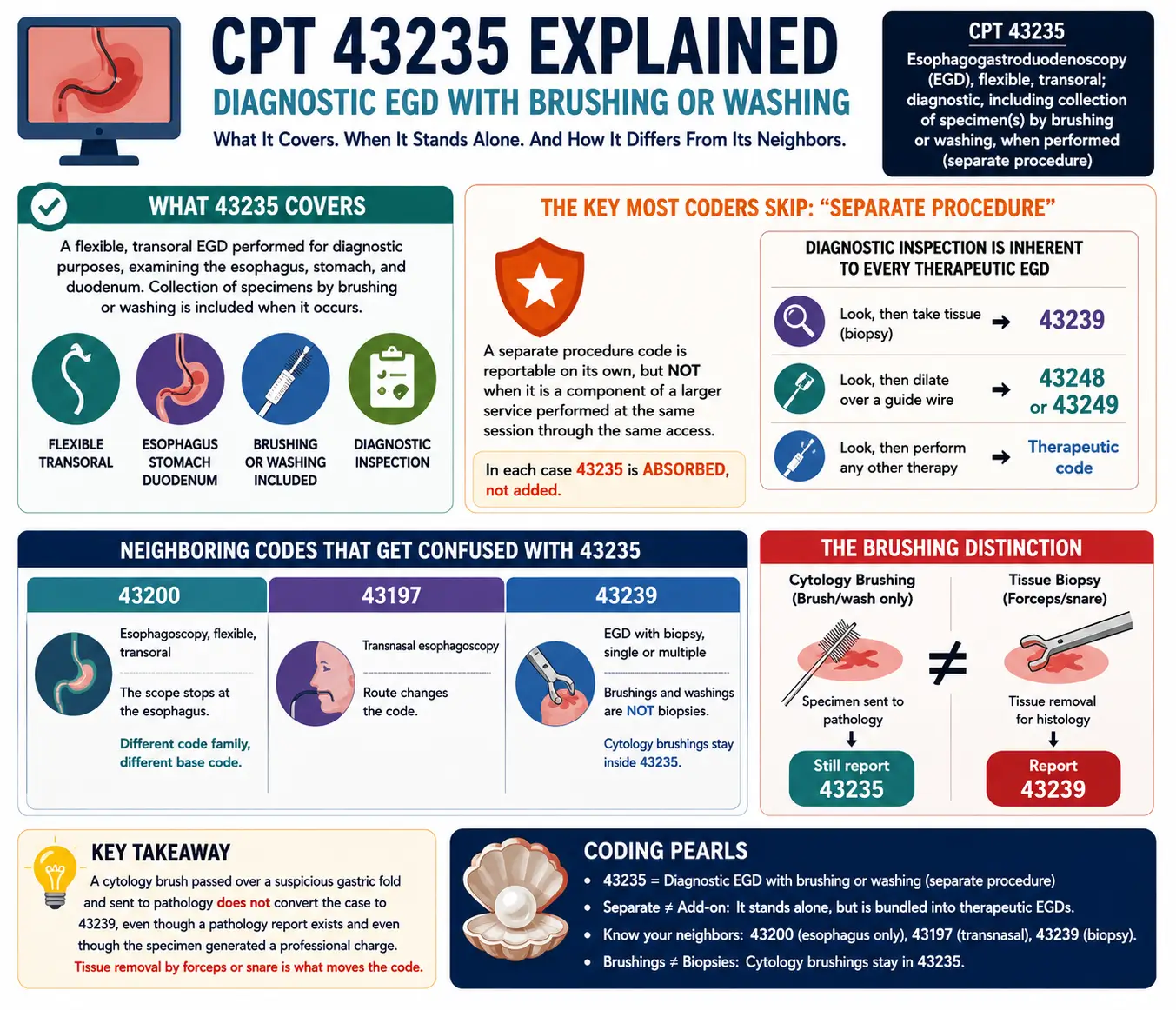
The descriptor covers a flexible, transoral esophagogastroduodenoscopy performed for diagnostic purposes, examining the esophagus, stomach, and duodenum, with collection of specimens by brushing or washing bundled in when it happens. The AMA tags it a separate procedure, which is the part most coders skim past.
That designation has teeth. A separate procedure code is reportable on its own, but not when it is a component of a larger service performed at the same session through the same access. Diagnostic inspection is inherent to every therapeutic upper endoscopy. Look at the mucosa, then take tissue, and the correct code is 43239. Look, then dilate over a guide wire, and it is 43248 or 43249 depending on method. In each case 43235 is absorbed, not added.
Three neighboring codes get confused with it regularly:
- 43200 is esophagoscopy, flexible, transoral. The scope stops at the esophagus. Different code family, different base code.
- 43197 is transnasal esophagoscopy. Route changes the code.
- 43239 is EGD with biopsy, single or multiple. Brushings and washings are not biopsies. Cytology brushings stay inside 43235.
The brushing distinction produces steady denial volume. A cytology brush passed over a suspicious gastric fold and sent to pathology does not convert the case to 43239, even though a pathology report exists and even though the specimen generated a professional charge. Tissue removal by forceps or snare is what moves the code.
How 43235 functions as an endoscopic base code
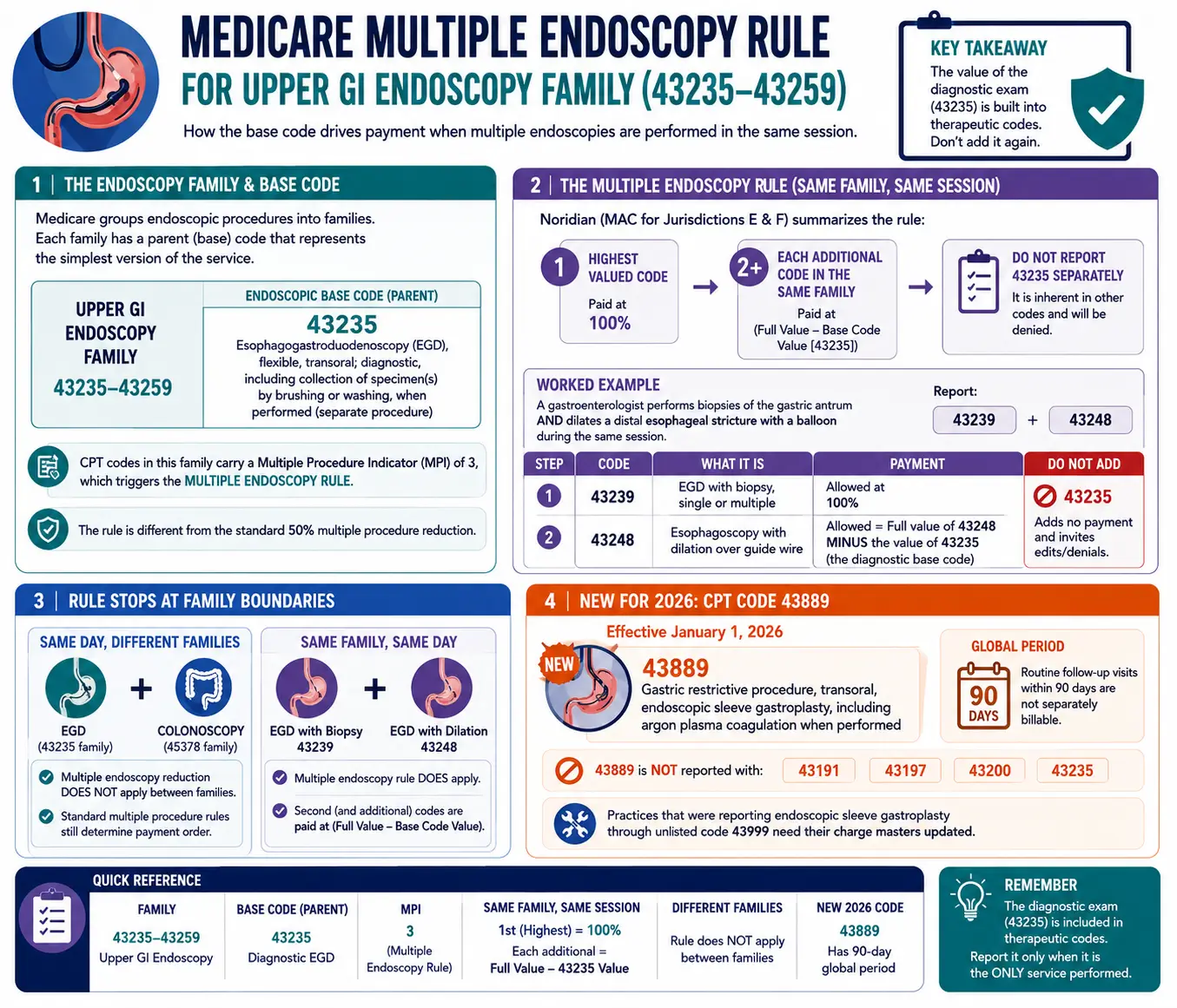
Medicare classifies endoscopic procedures into families. Each family has a parent code, called the endoscopic base code, that represents the simplest version of the service, and the Medicare Physician Fee Schedule Relative Value File identifies it in the ENDO BASE field. For the upper GI endoscopy family running from 43235 through 43259, that parent is 43235.
Codes in the family carry a multiple procedure indicator of 3, which triggers the multiple endoscopy rule rather than the standard 50 percent multiple procedure reduction. Noridian, the Medicare Administrative Contractor for Jurisdictions E and F, summarizes the mechanics plainly: when two or more endoscopies from the same family are performed at one session, the highest valued procedure is allowed at 100 percent, and each additional procedure in that family is paid at its full value minus the value of the base code.
A worked example makes the arithmetic visible. A gastroenterologist performs biopsies of the gastric antrum and dilates a distal esophageal stricture with a balloon during the same session. Report 43239 and 43248. The higher valued code pays in full. The second pays its allowable minus the allowable for 43235, because the value of the diagnostic exam already sits inside both codes. Reporting 43235 as a third line does nothing except invite an edit.
The rule stops at family boundaries. An EGD and a colonoscopy performed the same day belong to different families with different base codes, so the multiple endoscopy reduction does not apply between them, though standard multiple procedure logic still ranks them.
New for 2026: CPT code 43889 (gastric restrictive procedure, transoral, endoscopic sleeve gastroplasty, including argon plasma coagulation when performed) took effect January 1, 2026. The 2026 CPT Coding Update published jointly by AGA, ACG, and ASGE instructs that 43889 is not reported with 43191, 43197, 43200, or 43235. Unlike the diagnostic code, 43889 carries a 90-day global period, so routine follow-up visits inside that window are not separately billable. Practices that were reporting endoscopic sleeve gastroplasty through unlisted code 43999 need their charge masters updated.
2026 Medicare payment for CPT code 43235
Two things changed the math for 2026, and both came out of the CY 2026 Physician Fee Schedule final rule (CMS-1832-F), released October 31, 2025.
First, statute now requires two conversion factors. CMS finalized $33.5675 for qualifying Alternative Payment Model participants and $33.4009 for everyone else, increases of 3.77 percent and 3.26 percent over the 2025 factor of $32.35. Section 71202 of the One Big Beautiful Bill Act provided a temporary 2.5% payment increase for one year, while a positive 0.49% budget neutrality adjustment contributed to the remaining increase.
Second, CMS finalized an efficiency adjustment of negative 2.5 percent applied to work RVUs and the intra-service portion of physician time for nearly all non-time-based codes. Diagnostic EGD was not exempt. The work RVU for 43235 sits at 2.04 for 2026.
The practical effect is a code whose conversion factor went up while its work value went down, which is why year-over-year payment looks close to flat rather than tracking the headline increase.
Setting | 2026 payment basis | Approximate national amount |
Physician, office or other non-facility | MPFS | $323 |
Physician, facility (hospital outpatient or ASC) | MPFS | $111 |
Hospital outpatient department | APC 5301, status indicator T | $927 |
Ambulatory surgery center | Payment indicator A2 | $498 |
Amounts are national and unadjusted. Geographic practice cost indices move every one of them, and the facility figure for the physician differs from the non-facility figure by roughly $212 because scope equipment, reprocessing, and clinical staff time are facility costs when the case is done in a hospital or ASC.
One more 2026 change deserves attention from practices with hospital-based physicians. CMS reduced the portion of facility practice expense RVUs allocated based on work RVUs to half the amount allocated in the non-facility setting, citing the shift from independent practice toward hospital employment. Groups modeling physician compensation off facility-setting payment should rerun those models rather than assuming the prior relationship holds.
Sedation coding, which is where money quietly leaks
Moderate sedation stopped being bundled into GI endoscopy codes in 2017. When the endoscopist personally provides moderate sedation to a Medicare beneficiary, report G0500 for the initial 15 minutes of intra-service time, with 99153 for each additional 15 minutes. G0500 requires an independent trained observer monitoring the patient’s level of consciousness and physiologic status, and it applies to patients age 5 and older.
Two traps follow.
Noridian’s guidance is explicit that in a facility setting, the endoscopist may not bill 99153, because the add-on code is technical only and the independent trained observer is a facility expense. The facility bills it. Physician groups that carried an office-based sedation workflow into an ASC and never changed the charge capture have been submitting a code they cannot be paid for.
The second trap runs the other direction. The American College of Gastroenterology has noted that commercial insurers may not accept G0500. Most expect 99152 with 99153. Verify by payer rather than by habit.
If an anesthesia professional provides the sedation, the endoscopist reports the procedure code only. The anesthesia side uses 00731 for upper GI endoscopy not otherwise specified or 00732 for ERCP, both of which replaced the deleted 00740 in 2018.
Documentation the operative note must contain
Medical necessity for upper GI endoscopy is governed at the contractor level. Novitas Solutions maintains LCD L35350, Upper Gastrointestinal Endoscopy (Diagnostic and Therapeutic), supported by billing and coding article A57414, which lists 43235 among the covered CPT codes along with the ICD-10-CM codes that support medical necessity. A separate policy, L34434, Upper Gastrointestinal Endoscopy and Visualization, with article A56389, covers other jurisdictions. Neither list is universal, and the articles state plainly that not every covered diagnosis applies to every procedure code.
Beyond the diagnosis code, the report should establish:
- The clinical indication in narrative form, not just an ICD-10 code dropped into a template field.
- Extent of examination. Reaching the second portion of the duodenum is what makes the procedure an EGD rather than a gastroscopy. Auditors look for it. Name the landmarks.
- Findings in each of the three segments, including normal findings.
- Whether brushings or washings were collected and where the specimen went.
- An affirmative statement that no biopsy or therapeutic intervention was performed, which pre-empts the most common downcoding argument.
- Sedation medications, doses, intra-service start and stop times, and identification of the independent observer when G0500 is reported.
- Recovery status and any adverse events.
Repeat procedures attract the closest review. The ACG clinical guideline on Barrett’s esophagus recommends surveillance intervals of 3 to 5 years for patients without dysplasia, and the AGA’s 2025 surveillance guideline suggests against surveillance endoscopy for patients with columnar-lined esophagus under 1 cm with intestinal metaplasia. When a claim arrives at an interval shorter than published guidance supports, the note has to explain why in clinical terms.
Modifiers that apply to 43235
52 (reduced services). The physician completed less than the full described service by choice or anatomy, with no patient risk involved. A scope that cannot be advanced past the pylorus, so the duodenum is never examined, is the standard example. Report 43235-52.
53 (discontinued procedure). The physician stopped because continuing endangered the patient. Hypoxia, arrhythmia, and hemodynamic instability belong here. The distinction from modifier 52 is patient risk, and the note must document the reason for termination.
73 and 74. These are facility modifiers for hospital outpatient departments and ASCs, not physician modifiers. Use 73 when the procedure is discontinued before anesthesia administration and 74 when it is discontinued after. Physicians use 53 for the same encounter.
59 or XU. Reserve for genuinely distinct sessions. CMS continues to prefer the more specific X modifiers over unspecified 59. Appending 59 to force 43235 alongside a therapeutic code from the same family is not a distinct service argument, and it is the kind of pattern that draws post-payment review.
25. Applies to a separately identifiable evaluation and management service on the same day, beyond the usual pre-procedure assessment for a minor procedure.
Modifiers 26 and TC do not apply. There is no professional and technical split on a global surgical code. Modifiers PT and 33 also do not fit here in the way they do for colonoscopy, because Medicare has no screening benefit for upper endoscopy. An EGD ordered for Barrett’s surveillance is a diagnostic service, and coding it as preventive will not create coverage that does not exist.
The four denial patterns worth building edits around
- 43235 billed with a same-session therapeutic code from the same family. Fix it at the front end with a claim scrubber rule rather than at appeal.
- Diagnosis not on the contractor’s covered list. Pull the ICD-10 tables from A57414 or A56389 for your jurisdiction and load them into the scheduling workflow, not just the billing workflow.
- 99153 billed by the physician in a facility setting. Route it to the facility side.
- Extent of examination absent from the note. If the duodenum is not documented, the payer has a defensible argument that a different code applies.
None of these require an appeal specialist. They require a coder who knows that 43235 is a base code, a template that forces the duodenum field, and a payer matrix that distinguishes G0500 from 99152. Practices that fix those three things typically stop arguing about diagnostic EGD claims altogether, which frees the appeals effort for the therapeutic codes where the dollars per claim are three to five times higher.