


A radiology practice that mis-codes CPT 71260 rarely finds out on the first claim. The pattern usually surfaces months later, when a Medicare Administrative Contractor pulls a batch of charts for post-payment review and finds the same documentation gap repeated across dozens of encounters. CPT code 71260 describes a computed tomography scan of the chest performed with intravenous contrast material, and it is one of the higher-volume thoracic imaging codes billed across hospital, outpatient, and freestanding imaging settings. Coding it correctly takes more than knowing what the descriptor says. It takes knowing what a payer expects to find in the chart, when 71260 can be billed alongside CPT 74177 for a combined staging study, and where practices most often leave reimbursement on the table or invite an audit they didn’t need to invite.
What CPT code 71260 includes
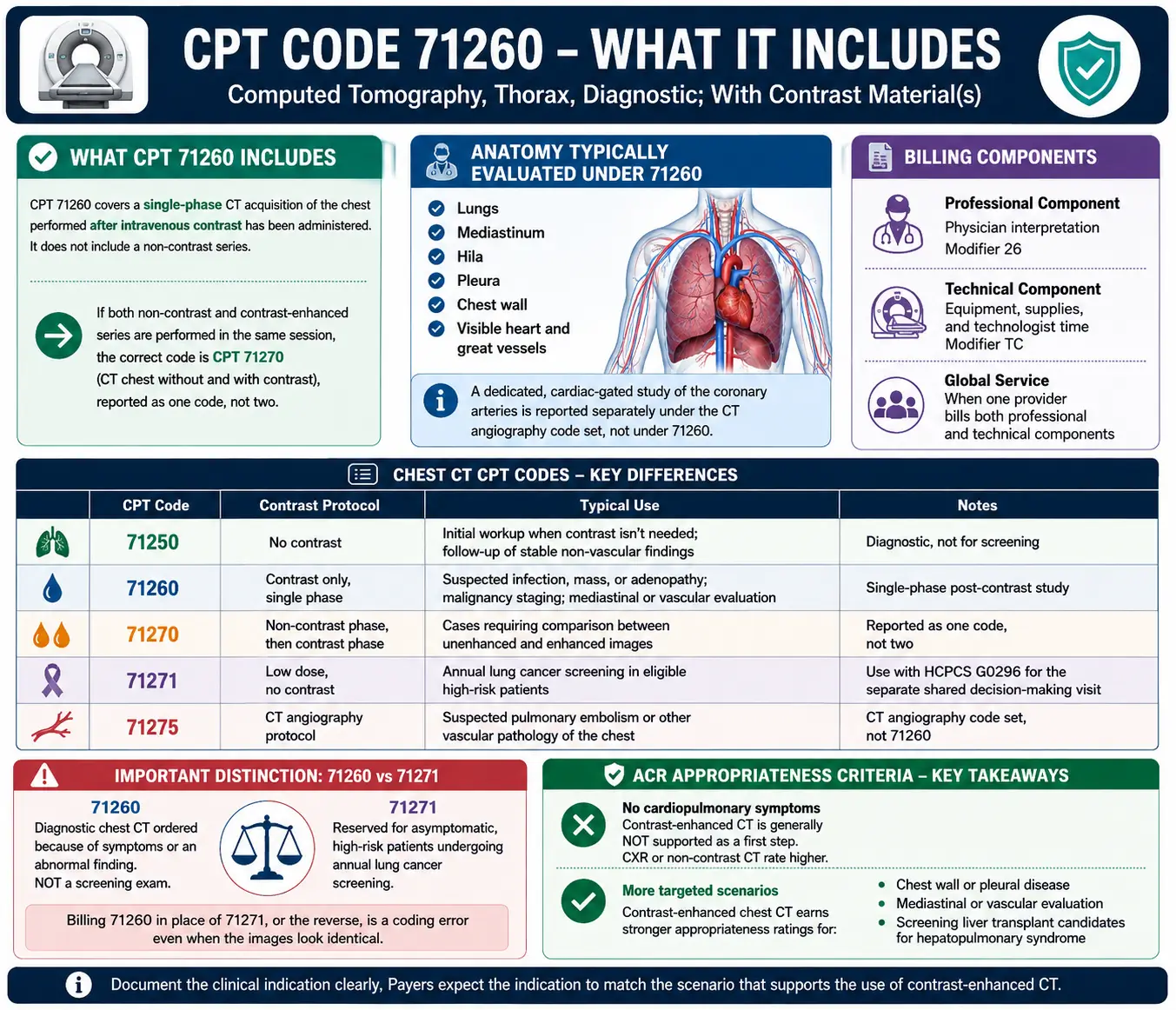
The American Medical Association’s descriptor for CPT code 71260 is “Computed tomography, thorax, diagnostic; with contrast material(s).” That wording is narrower than it looks. It covers a single-phase CT acquisition of the chest obtained after intravenous contrast has been administered, and nothing else. If a technologist runs a non-contrast series first and then a contrast-enhanced series in the same session, the study is no longer a 71260; it becomes CPT 71270 (CT chest without and with contrast), reported as one code rather than two.
Structures typically evaluated under 71260 include the lungs, mediastinum, hila, pleura, chest wall, and the visible heart and great vessels. A dedicated, cardiac-gated study of the coronary arteries is reported separately under the CT angiography code set, not under 71260, even when performed during the same visit. Like most radiology codes, 71260 splits into a professional component (physician interpretation, modifier 26), a technical component (equipment, supplies, and technologist time, modifier TC), and a global service when one provider bills both.
Chest CT has five closely related codes, and mixing them up is one of the more common sources of denials in thoracic imaging billing:
CPT code | Contrast protocol | Typical use |
71250 | No contrast | Initial workup when contrast isn’t needed; follow-up of stable non-vascular findings |
71260 | Contrast only, single phase | Suspected infection, mass, or adenopathy; malignancy staging; mediastinal or vascular evaluation |
71270 | Non-contrast phase, then contrast phase | Cases requiring comparison between unenhanced and enhanced images |
71271 | Low dose, no contrast | Annual lung cancer screening in eligible high-risk patients; not a diagnostic code |
71275 | CT angiography protocol | Suspected pulmonary embolism or other vascular pathology of the chest |
The distinction between 71260 and 71271 matters beyond terminology. 71271 is reserved for asymptomatic, high-risk patients undergoing annual lung cancer screening, typically alongside HCPCS code G0296 for the separate shared decision-making visit Medicare requires before the first screening scan. A diagnostic chest CT ordered because of symptoms or an abnormal finding does not become a screening exam just because the patient also happens to meet screening eligibility criteria. Billing 71260 in place of 71271, or the reverse, is a coding error even when the images look identical.
The American College of Radiology’s Appropriateness Criteria, an evidence-based rating system its expert panels update annually, adds useful shape to when contrast is actually warranted. For routine chest imaging in a patient with no cardiopulmonary symptoms, the criteria don’t support contrast-enhanced CT as a first step; radiography or non-contrast CT rate higher instead. Contrast-enhanced chest CT earns stronger appropriateness ratings in more targeted scenarios, such as evaluating chest wall or pleural disease, or screening liver transplant candidates for hepatopulmonary syndrome. A payer reviewing a 71260 claim is essentially asking whether the documented indication matches the kind of scenario the specialty literature supports.
Documentation requirements for CPT 71260
Order and signature requirements
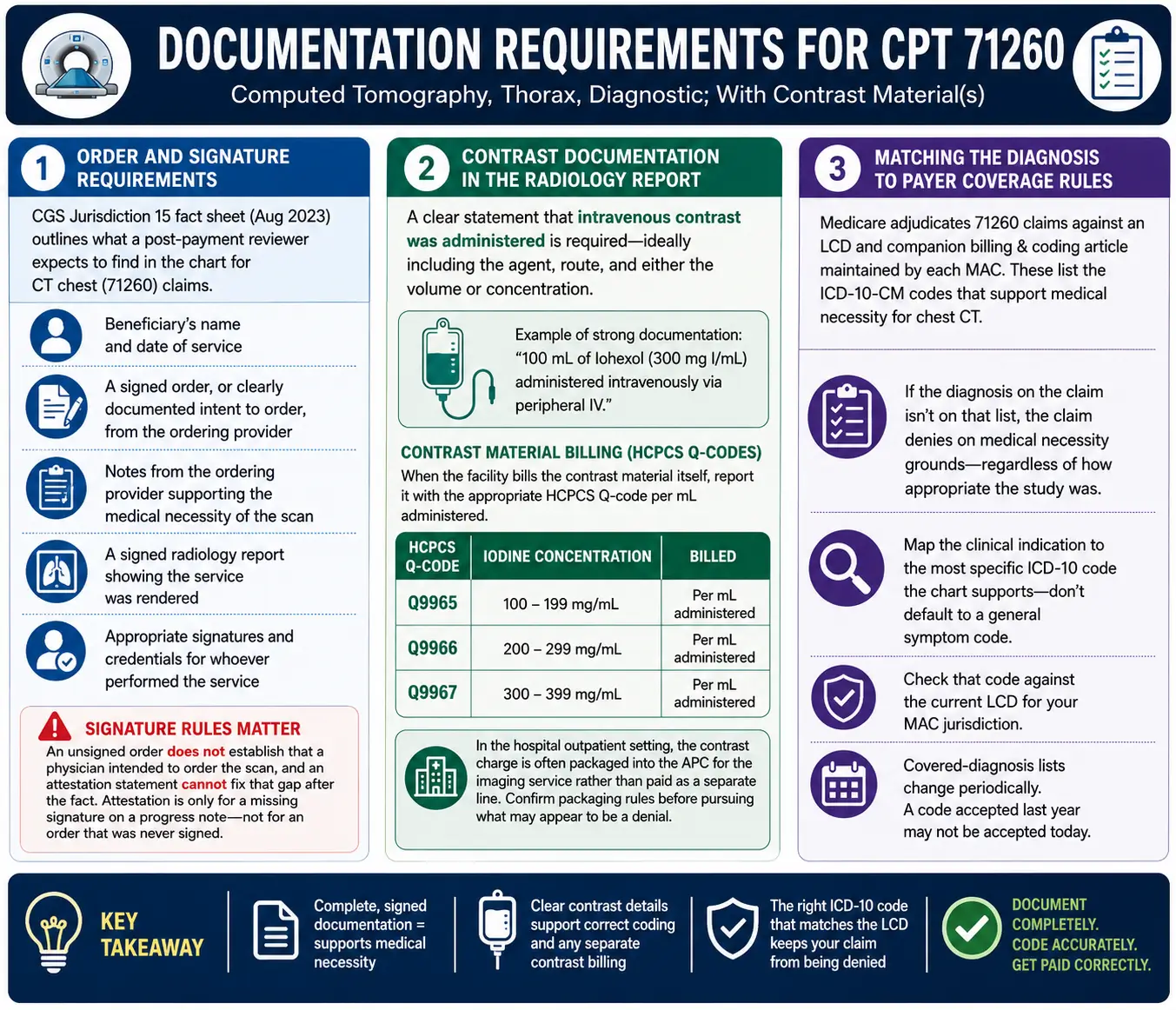
CGS Administrators, the Medicare Administrative Contractor for Jurisdiction 15, published a fact sheet in August 2023 that lays out exactly what a post-payment reviewer expects to find in the chart for CT chest and CT abdomen claims, 71260 included. The list is short but unforgiving:
- The beneficiary’s name and date of service
- A signed order, or clearly documented intent to order, from the ordering provider
- Notes from the ordering provider supporting the medical necessity of the scan
- A signed radiology report showing the service was rendered
- Appropriate signatures and credentials for whoever performed the service
The signature rules trip up practices that otherwise document well. An unsigned order or requisition does not, on its own, establish that a physician intended to order the scan, and CGS is explicit that an attestation statement cannot fix that gap after the fact. Attestation is only available when a progress note that otherwise supports the order is missing a legible signature; it is not a substitute for an order that was never signed at all. Treating those two situations as interchangeable is how an appealable denial becomes a final one.
Contrast documentation in the radiology report
The word “contrast” appearing somewhere in a report is weak documentation on its own. Reviewers look for a clear statement that intravenous contrast was administered, ideally naming the agent, the route, and either the volume or the concentration, rather than a generic reference to a “contrast-enhanced” study.
That level of detail connects to a separate billing line, too. When the facility bills the contrast material itself, it is reported with its own HCPCS Q-code rather than folded into the CPT charge. Low-osmolar iodinated contrast is split by iodine concentration: Q9965 covers 100 to 199 mg per mL, Q9966 covers 200 to 299 mg per mL, and Q9967 covers 300 to 399 mg per mL, each billed per milliliter actually administered. In the hospital outpatient setting, this charge is often packaged into the Ambulatory Payment Classification for the imaging service rather than paid as a separate line, which is worth confirming before staff spend time chasing what looks like a denial but is actually a bundled payment.
Matching the diagnosis to payer coverage rules
Medicare adjudicates 71260 claims against a Local Coverage Determination and a companion billing and coding article maintained by each Medicare Administrative Contractor, which together list the ICD-10-CM codes that support medical necessity for chest CT. If the diagnosis submitted on the claim isn’t on that list, the claim denies on medical necessity grounds regardless of how clinically appropriate the study actually was. Coders should map the clinical indication to the most specific ICD-10 code the chart supports, rather than defaulting to a general symptom code, and check that code against the current LCD for their MAC jurisdiction. These covered-diagnosis lists change periodically, and a code accepted last year is not guaranteed to still be accepted today.
When CPT 71260 can be billed with CPT 74177
Chest CT and abdomen/pelvis CT are different anatomic regions, and no single CPT code combines all three areas into one contrast-enhanced study. A patient who needs the chest, abdomen, and pelvis imaged, which is routine in oncology staging, is billed under two separate codes: the appropriate chest code (71260, for a single contrast-only phase) and 74177 for the combined abdomen and pelvis study. Each code is payable independently when the record supports medical necessity for that specific region on its own, not simply for the visit as a whole.
Modifier XS for Separate Anatomic Structures
Submitting both codes for the same date of service can still trigger a National Correct Coding Initiative procedure-to-procedure edit, since CMS’s edit tables flag many same-day imaging pairs for review even when the anatomy is genuinely distinct. The fix is a modifier that tells the payer the two studies represent separate, medically necessary services rather than a duplicate charge. Modifier XS, which specifically denotes a separate structure, is the more precise choice here and has been CMS’s preferred alternative to the older, less specific modifier 59 since 2015. Billing forums are full of coders reporting the same fix after a first submission of 71260 and 74177 came back denied: resubmit with XS on the lower-valued code, and the claim pays.
How Multiple Procedure Payment Reduction Applies
Even with the correct modifier attached, a second payment mechanic often catches billing staff off guard. CT of the chest and CT of the abdomen and pelvis fall within the same imaging grouping CMS uses for its Multiple Procedure Payment Reduction on diagnostic imaging. Full payment goes to whichever study carries the higher fee schedule value; the technical component of the second study is reduced by 50 percent, and its professional component by 5 percent, under the framework CMS finalized effective January 1, 2017. That reduction is not a denial and doesn’t need a modifier to correct; it’s a built-in adjustment. For 2026, it applies against a physician fee schedule conversion factor that CMS raised by 3.26 percent for most physicians (3.77 percent for qualifying alternative payment model participants), according to the American Medical Association’s summary of the final rule. A biller who isn’t expecting the reduction will lose time investigating a “short payment” that actually processed correctly the first time.
Best Billing Scenario for CPT 71260 and 74177
The most defensible version of this scenario looks like this: an oncology patient with known or suspected malignancy needs full-body staging, the order documents a distinct clinical reason for imaging both the chest and the abdomen/pelvis, each region’s report independently supports the diagnosis billed for it, and the claim carries modifier XS on the lower-valued code. Practices run into trouble when they default to both codes on every CT order without confirming the chest component was independently indicated.
Common coding, modifier, and reimbursement errors
Reporting the wrong contrast protocol
The single most frequent 71260 error is a mismatch between the protocol ordered and the protocol actually performed. If the technique section shows a non-contrast series followed by a contrast series, the correct code is 71270, not 71260, and CPT does not allow the two phases to be unbundled into 71250 plus 71260 on the same claim. Coders should verify the technique section of the report itself rather than coding from the order alone, since the two don’t always match.
Confusing diagnostic and screening codes
71260 and 71271 describe different clinical purposes even when the anatomy scanned looks the same on the images. A diagnostic chest CT ordered because of an abnormal finding does not become a screening exam just because the patient also meets the age and smoking-history criteria for lung cancer screening, and a genuine annual screening study should never be billed as 71260 to sidestep screening frequency limits or eligibility documentation. Payers track frequency by code, and a mismatch here draws attention fast.
Submitting an unsupported diagnosis code
A diagnosis that accurately describes the patient’s condition is not automatically a diagnosis the payer’s LCD recognizes for 71260. Coders who reach for the most familiar or most general code, instead of checking it against the current billing and coding article for their jurisdiction, generate denials that were entirely avoidable, particularly right after a MAC updates its covered diagnosis list.
Reaching for modifier 59 by default
CMS has favored the more specific X-modifiers over modifier 59 since 2015, and XS is the better fit for two same-day CT studies of genuinely separate regions like the chest and the abdomen/pelvis. Modifier 59 still works and isn’t wrong, exactly, but some payers process X-modifier claims more consistently, and heavy, undifferentiated use of 59 is one of the patterns auditors look for first.
Overlooking the CT equipment payment reduction
Since 2016, Medicare has required a “CT” modifier on claims for CT services in the 71250 through 71275 range when the equipment used doesn’t meet the National Electrical Manufacturers Association’s XR-29 dose optimization standard, a requirement that traces back to Section 218(a) of the Protecting Access to Medicare Act of 2014. The payment reduction, 5 percent when it took effect and 15 percent since 2017, applies whether or not the practice remembers to check its scanner against the standard. Imaging centers running older CT units should confirm compliance status directly with the manufacturer rather than assume the requirement doesn’t apply to them.
Mistaking a payment reduction for a denial
When 71260 and 74177 are billed correctly for the same encounter, the lower-valued study’s technical component still comes back at half the expected fee schedule amount, by design. Billing staff who don’t recognize the Multiple Procedure Payment Reduction sometimes resubmit the claim, add unnecessary modifiers, or file an appeal, none of which changes a payment that was calculated correctly the first time.
Keeping 71260 claims audit ready
CPT code 71260 isn’t a complicated code to understand, but it sits at the intersection of several rules that each carry their own denial risk: a narrow, contrast-only descriptor, a signature standard that doesn’t bend for a missing order, an LCD-driven diagnosis requirement, and two separate payment mechanics, NCCI bundling and the imaging MPPR, that both apply whenever it’s billed alongside 74177. Practices that build a documentation checklist around the CGS Administrators fact sheet, verify the protocol actually performed against the report rather than the order, and know the difference between a modifier problem and a built-in payment reduction see fewer denials and spend less staff time chasing payments that were never actually wrong.