


A coronary CT angiogram takes twenty minutes on the table and hours to code correctly. That gap between the scan and the claim is where most cardiac imaging denials start. This CPT code 75574 cheat sheet walks through the descriptor, what’s bundled into it, the modifiers that actually apply, the documentation Medicare’s auditors are now checking line by line, and what the code pays in 2026.
What is CPT code 75574
CPT code 75574 is billed for computed tomographic angiography of the heart, the coronary arteries, and the bypass grafts when present, performed with contrast material and including 3D image postprocessing. That’s the American Medical Association’s official long descriptor, and it’s the one payers match against the claim. In plain terms, it’s the code for a coronary CT angiogram (CCTA): a contrast-enhanced CT scan built specifically to visualize the coronary arteries and, where relevant, any prior bypass grafts.
The Society of Cardiovascular Computed Tomography (SCCT) lists 75574 the same way in its current code reference: coronary CT angiography of the heart, coronary arteries, and bypass grafts when present, with contrast and included 3D postprocessing. It’s the code radiology and cardiology practices use for the standard chest-pain-workup CCTA, for post-CABG graft patency checks, and for pre-procedural coronary mapping ahead of structural interventions.
CPT 75574 description in plain terms: what’s actually bundled
The descriptor packs in more than a scan of the coronary arteries. Per the AMA’s language, 75574 includes, when performed:
- Evaluation of cardiac structure and morphology
- Assessment of cardiac function
- Evaluation of venous structures
- 3D image postprocessing
Because postprocessing is written into the code itself, 76376 and 76377 (3D rendering add-on codes) are not separately reportable alongside 75574. A coder who tacks on 76377 for the reconstructed images is duplicating something Medicare already paid for inside the base code, and that’s an easy target on a post-payment review.
75572 vs 75573 vs 75574: telling the cardiac CT family
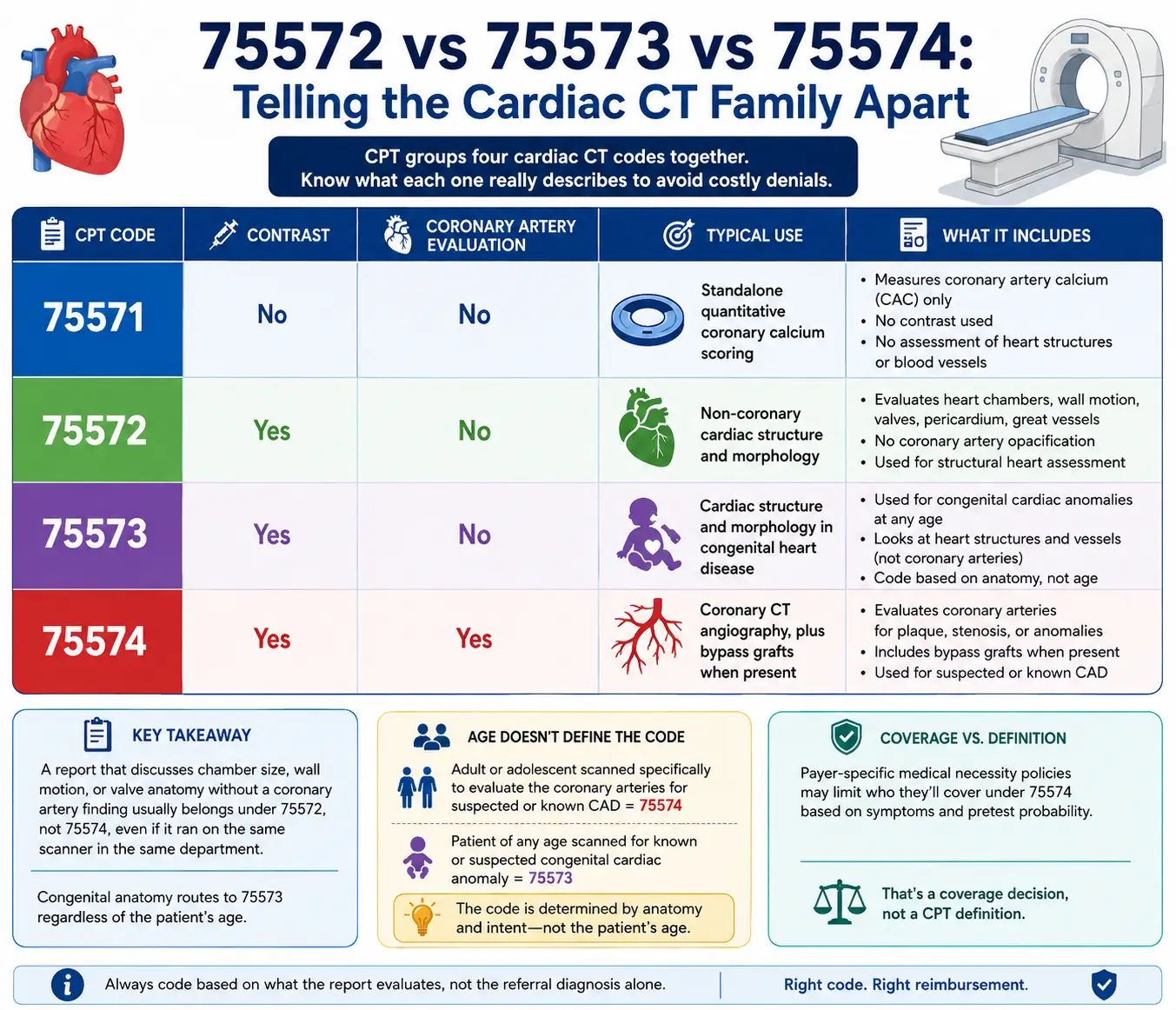
The cardiac CT section of CPT groups four codes together, and mixing them up is one of the more common denial triggers in cardiovascular billing. AAPC’s coding education team has fielded this exact question repeatedly: of the four, 75574 is the only one that actually describes an angiogram of the coronary arteries. The other three describe structural or calcium imaging without coronary artery opacification.
CPT code | Contrast | Coronary artery evaluation | Typical use |
75571 | No | No | Standalone quantitative coronary calcium scoring |
75572 | Yes | No | Non-coronary cardiac structure and morphology |
75573 | Yes | No | Cardiac structure and morphology in congenital heart disease |
75574 | Yes | Yes | Coronary CT angiography, plus bypass grafts when present |
A report that discusses chamber size, wall motion, or valve anatomy without a coronary artery finding usually belongs under 75572, not 75574, even if it ran on the same scanner in the same department. Congenital anatomy, meanwhile, routes to 75573 regardless of the patient’s age; a congenital diagnosis on the chart doesn’t automatically make it a 75574 study, and the choice comes down to what the report actually evaluates, not the referral diagnosis alone.
There isn’t a hard, CPT-defined age cutoff written into the 75574 descriptor itself. What determines the code is anatomy and intent: an adult or adolescent patient being scanned specifically to evaluate the coronary arteries for suspected or known coronary artery disease is a 75574 study. A patient, of any age, being scanned for a known or suspected congenital cardiac anomaly is coded to 75573. Payer-specific medical necessity policies (discussed below) may still narrow who they’ll cover under 75574 based on symptoms and pretest probability, but that’s a coverage decision, not a definitional one.
Does CPT code 75574 include calcium scoring
Yes, when it’s part of the same session. When calcium scoring is performed as part of the same cardiac CT study represented by 75572 through 75574, it is not reported separately with 75571. Billing 75571 alongside 75574 for the same encounter is a classic unbundling error and one of the more frequent triggers for a National Correct Coding Initiative (NCCI) edit denial on cardiac imaging claims. Code 75571 only stands on its own when calcium scoring is the entire, standalone reason for the visit, on a separate encounter from any contrast CCTA.
New for 2026: CPT 75577 and how it changes the coronary CT workflow
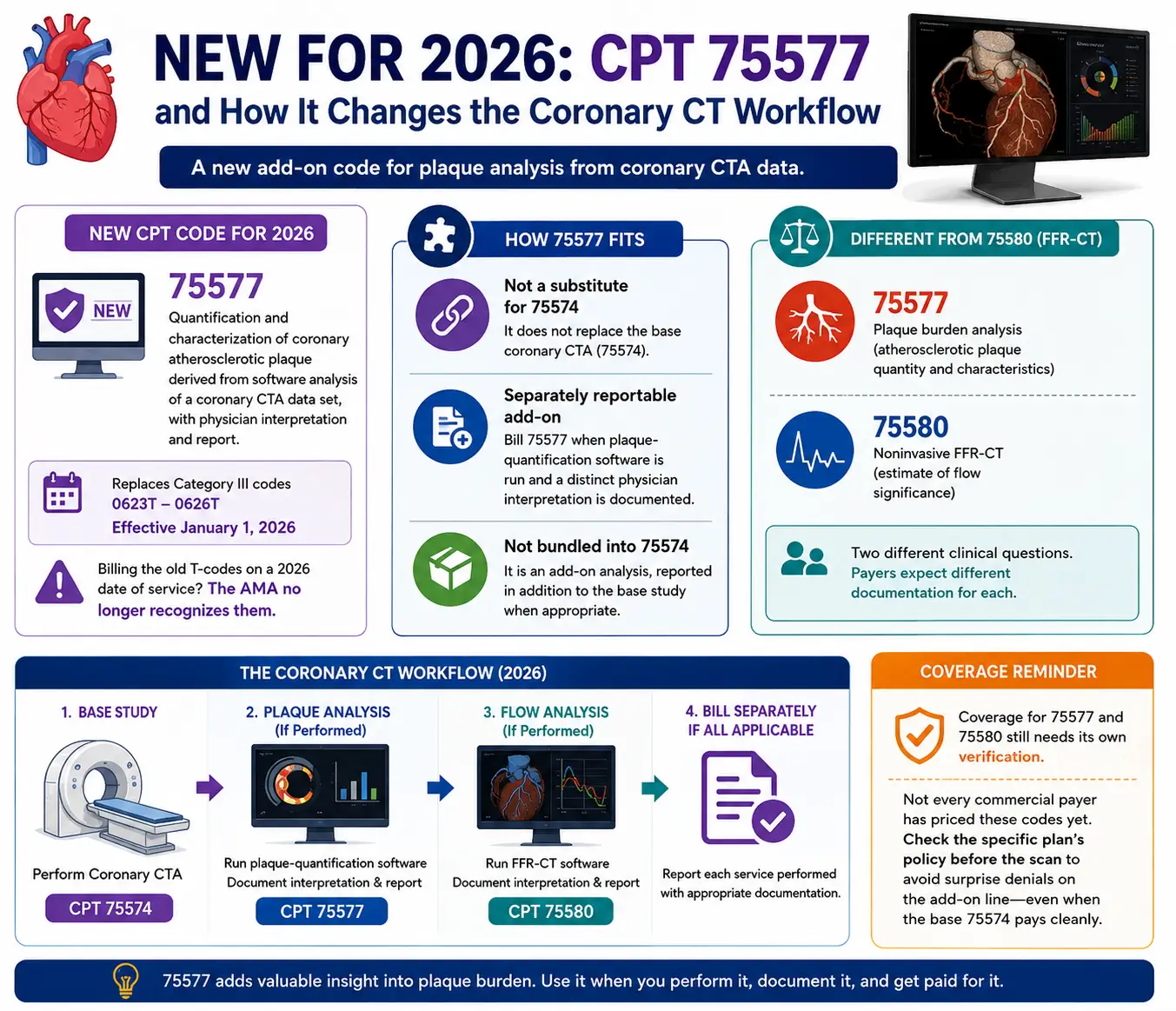
The 2026 CPT code set added a genuinely new element to this family: CPT 75577, for quantification and characterization of coronary atherosclerotic plaque derived from software analysis of a coronary CTA data set, with physician interpretation and report. It replaced the temporary Category III codes 0623T through 0626T effective January 1, 2026, according to the American College of Cardiology’s December 2025 coding update. A practice still submitting the old T-codes on a 2026 date of service is billing a code the AMA no longer recognizes.
75577 is not a substitute for 75574 and isn’t bundled into it; it’s a separately reportable add-on analysis, billed when the plaque-quantification software is actually run and a distinct interpretation is documented. It’s also not the same thing as CPT 75580, the code for a noninvasive fractional flow reserve estimate (FFR-CT) derived from the same CCTA data set. 75580 became a Category I code back in 2024, replacing the earlier 0501T-0504T series. Plaque burden and flow significance are two different clinical questions, and payers expect two different pieces of documentation to support them, even when both analyses pull from the same acquisition. Coverage for 75577 and 75580 still needs its own verification; not every commercial payer has priced them yet, so checking the specific plan’s policy before the scan avoids a surprise denial on the add-on line even when the base 75574 pays cleanly.
CPT 75574 documentation requirements
Medicare’s payment integrity contractors have specifically flagged this code. CMS approved a Recovery Audit Contractor (RAC) topic, dated August 28, 2025, that names CPT 75574 directly, applying to outpatient hospital claims across every A/B MAC jurisdiction in the country. The stated purpose is to check whether the medical record supports Medicare’s coverage criteria, current coding guidelines, and medical necessity for the CCTA billed. That’s a strong signal that thin documentation on this code carries real financial risk in 2026, not a theoretical one.
A defensible 75574 report generally needs to show:
- ECG gating technique. Proof the acquisition was synchronized to the cardiac cycle is close to a universal payer expectation for cardiac CTA.
- Coronary artery findings by vessel, with stenosis severity documented for each major vessel, including graft assessment in post-CABG patients.
- Contrast details: the agent, concentration, and volume administered, which also supports any separately billed contrast supply line.
- Structural and functional findings, when performed, since that scope is part of what the code descriptor already covers.
- A clear, unambiguous impression that actually answers the clinical question the order was written for.
One documentation pattern deserves specific attention because it quietly undermines a claim: a report that states the coronaries were “not well visualized, refer to coronary angiogram.” When the dictation defers the core finding to a different study, the medical necessity for having billed the coronary CTA in the first place becomes hard to defend under audit. The safer practice is to document what was actually seen, including limited or suboptimal segments, rather than pushing the clinical answer onto a downstream test.
CPT 75574 modifiers: 26, TC, and when 59 actually applies
Because 75574 has no assigned global period (it’s designated status “XXX” on the Medicare Physician Fee Schedule), the professional/technical split works the same way it does for other diagnostic imaging codes:
- Modifier 26 reports the professional component only, the physician’s interpretation and written report, used when the interpreting physician doesn’t own the scanner.
- Modifier TC reports the technical component only, covering the equipment, technologist time, and facility overhead, used by the entity that owns and operates the CT scanner.
- No modifier (global billing) applies when the same practice both owns the equipment and provides the interpretation.
Modifier 59, or one of its more specific successors (XE, XP, XS, XU), only comes into play when an NCCI procedure-to-procedure edit exists between 75574 and another code billed the same day, and the modifier indicator on that edit pair allows an override. CMS’s own guidance on these modifiers is explicit that they should be used only when documentation genuinely supports a distinct session, distinct anatomic site, or distinct, non-overlapping service, and that a more specific X-modifier should be used ahead of the generic 59 whenever one applies. Appending 59 as a default way to force two codes through together, without that documentation, is the pattern auditors look for first.
Prior authorization isn’t a modifier, but it belongs in the same workflow checklist. Many commercial payers, including a number of Blue Cross Blue Shield plans, require prior authorization for 75574 before the scan is performed, and failing to secure it ahead of the date of service is a routine, preventable cause of denial. TRICARE, through Humana Military’s medical policy, covers CPT codes 75572 through 75574 for multislice or multidetector CT angiography of the heart, subject to its own medical necessity terms.
Medical necessity, Medicare coverage, and how MACs decide
Original Medicare doesn’t cover CCTA under a single national policy; coverage runs through Local Coverage Determinations set by each Medicare Administrative Contractor. The governing LCD for this service, “Cardiac Computed Tomography & Angiography (CCTA)” (L33423), and its companion billing and coding article (A56691), lay out the covered ICD-10 diagnosis codes for 75571, 75572, and 75574 in that MAC’s jurisdiction. A diagnosis code that isn’t on the covered list gets denied as not medically necessary, regardless of how clean the imaging technique was.
In practice, the diagnoses that show up most often on clean 75574 claims include R07.9 (chest pain, unspecified), I25.10 (atherosclerotic heart disease of native coronary artery without angina pectoris), and Z95.1 (presence of aortocoronary bypass graft) for post-surgical graft evaluation. The diagnosis submitted on the claim has to match what’s actually documented in both the ordering physician’s indication and the radiology report; a mismatch between the two is a recurring, avoidable source of denials.
Some payers layer a proprietary guideline on top of the LCD framework. Kaiser Permanente, for example, uses the MCG Care Guideline “Cardiac CT Angiography (CTA)” (A-0483) for its own medical necessity determinations on 75572 through 75574, separate from whatever the local Medicare LCD says. That’s a reminder that “Medicare covers it” and “this specific commercial plan covers it” are two different questions that both need checking before the patient is scheduled.
CPT 75574 reimbursement in 2026
Payment starts with the code’s relative value units (RVUs), which CMS multiplies by the annual conversion factor to set the national rate. Based on CMS’s 2026 National Physician Fee Schedule Relative Value File, 75574 carries a work RVU of 2.34 and a total RVU of 9.75. Applied against the 2026 conversion factor of $33.4009, that produces a national, non-facility Medicare payment of roughly $325.66, before any geographic adjustment.
That national figure isn’t what a given practice actually collects. CMS applies Geographic Practice Cost Indices (GPCIs) to the work, practice expense, and malpractice components of the RVU separately, so the allowed amount moves up or down a few percentage points by locality. Facility and non-facility settings are priced differently as well, since a hospital-based technical component reflects different overhead than a freestanding imaging center. On top of that, Medicare pays 80% of the allowed amount for the professional side, with the remaining 20% falling to the patient or secondary coverage, and the Medicare-paid portion is still subject to the standard 2% sequestration reduction. A practice billing globally, without splitting 26 and TC, is collecting a combined rate that reflects both components together, which is a materially different number from either component billed alone.
For 2026 specifically, CMS finalized a broader practice-expense methodology change that shifts indirect cost allocation between facility and non-facility settings, plus a -2.5% efficiency adjustment applied to certain non-time-based codes on a three-year cycle. An analysis of diagnostic radiology codes affected by that adjustment showed an average reduction of roughly 2.15% across the group. Whether 75574 specifically moved up or down from its 2025 rate in a given locality depends on how those combined adjustments interact with that MAC’s GPCI values, which is exactly why checking the current local fee schedule, rather than relying on last year’s number, matters before budgeting expected revenue from coronary CTA volume.
Getting a coronary CTA claim paid cleanly on the first pass comes down to the same handful of details every time: the right code chosen from the 75571-75574 family, a report that documents gating, vessel-by-vessel findings, and contrast specifics without deferring the core answer elsewhere, the correct modifier for who owns the scanner versus who read the study, a diagnosis code that matches both the order and the LCD, and prior authorization secured before the patient is on the table. None of that is complicated in isolation. It’s the volume of moving parts, multiplied across a busy schedule, that turns small gaps into real, recoverable revenue left on the table.