


Three-dimensional reconstruction has moved from a specialty technique to a routine part of surgical planning, and the billing rules around it have not gotten any friendlier. CPT code 76377 pays for 3D rendering performed on an independent workstation, with a physician concurrently supervising the postprocessing and producing an interpretation and report. Billed correctly, it adds roughly $79 in Medicare revenue to an imaging session. The problem is that the code sits next to one of the longest prohibition lists in the CPT manual, and payers deny it constantly for reasons that are entirely preventable.
This guide walks through the full code description, the line separating 76376 from 76377, current 2026 reimbursement figures, and the documentation that holds up when an auditor pulls the chart.
What is CPT code 76377?
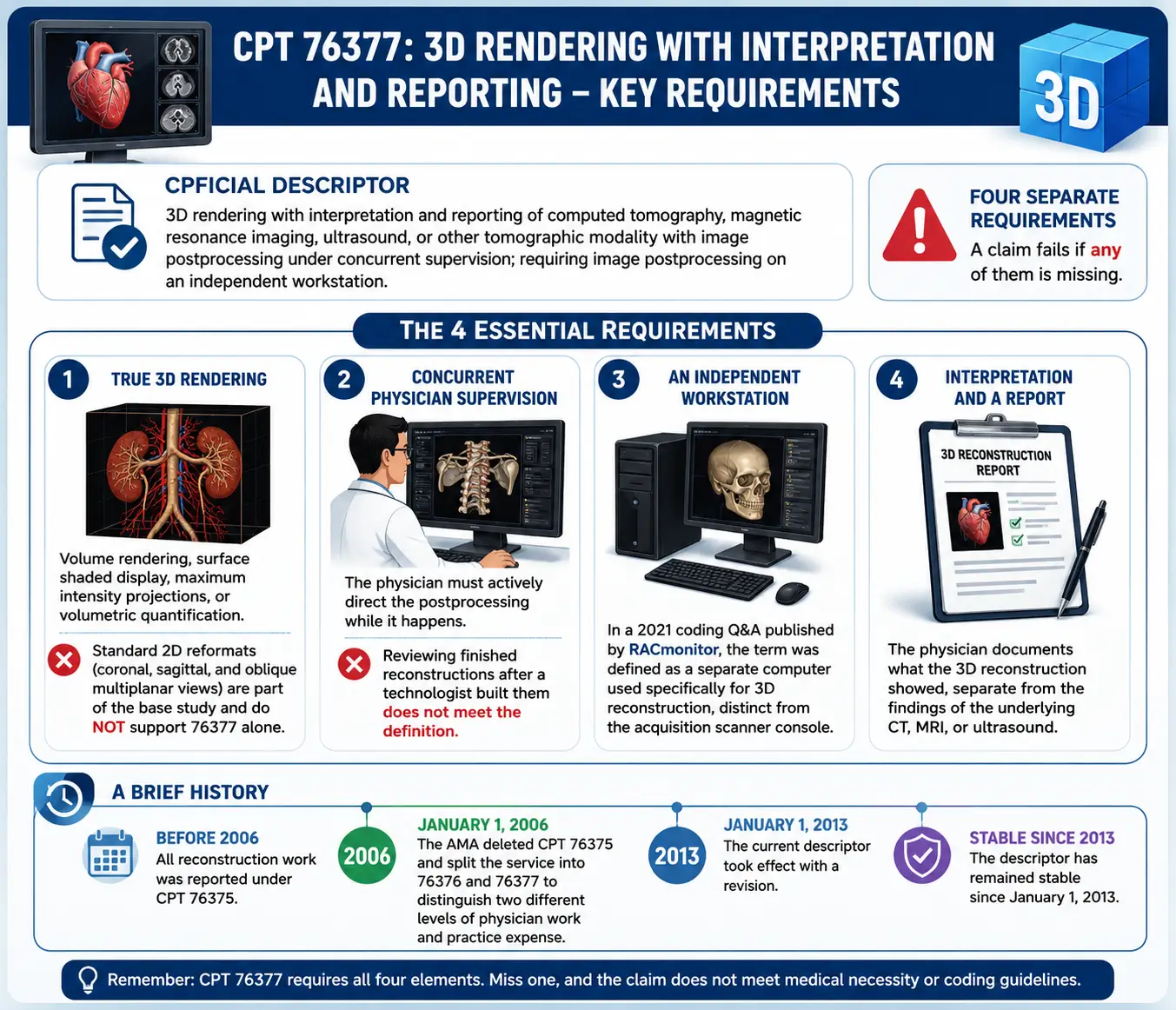
The official descriptor reads: 3D rendering with interpretation and reporting of computed tomography, magnetic resonance imaging, ultrasound, or other tomographic modality with image postprocessing under concurrent supervision; requiring image postprocessing on an independent workstation.
Four separate requirements sit inside that one sentence, and a claim fails if any of them is missing.
- True 3D rendering. Volume rendering, surface shaded display, maximum intensity projections, or volumetric quantification. Standard two-dimensional reformats (coronal, sagittal, and oblique multiplanar views) are considered part of the base imaging study and never support 76377 on their own.
- Concurrent physician supervision. The physician must actively direct the postprocessing while it happens. Reviewing finished reconstructions after a technologist built them does not meet the definition.
- An independent workstation. In a 2021 coding Q&A published by RACmonitor, the term was defined as a separate computer used specifically for 3D reconstruction, distinct from the acquisition scanner console.
- Interpretation and a report. The physician documents what the 3D reconstruction showed, separate from the findings of the underlying CT, MRI, or ultrasound.
The code also has a history worth knowing. Before 2006, all reconstruction work was reported under CPT 76375. The American Medical Association deleted that code and split the service into 76376 and 76377 effective January 1, 2006, precisely to distinguish two different levels of physician work and practice expense. The current descriptor took effect with a revision on January 1, 2013 and has been stable since.
CPT 76376 vs CPT 76377: the workstation is the dividing line
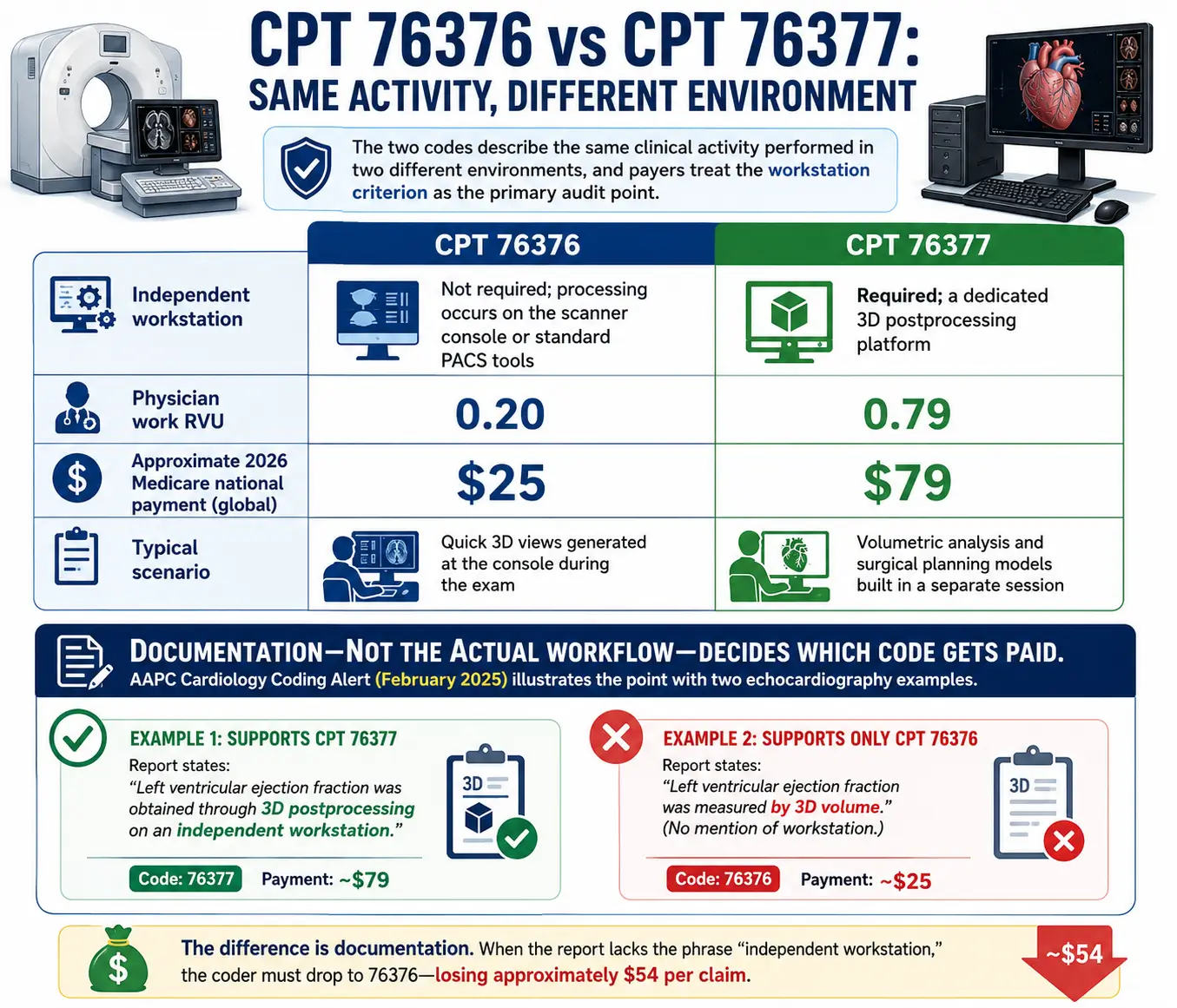
The two codes describe the same clinical activity performed in two different environments, and payers treat the workstation criterion as the primary audit point.
CPT 76376 | CPT 76377 | |
Independent workstation | Not required; processing occurs on the scanner console or standard PACS tools | Required; a dedicated 3D postprocessing platform |
Physician work RVU | 0.20 | 0.79 |
Approximate 2026 Medicare national payment (global) | $25 | $79 |
Typical scenario | Quick 3D views generated at the console during the exam | Volumetric analysis and surgical planning models built in a separate session |
Documentation, not the actual workflow, decides which code gets paid. An AAPC Cardiology Coding Alert published in February 2025 illustrates the point with two echocardiography examples. When a report states that left ventricular ejection fraction was obtained through 3D postprocessing on an independent workstation, 76377 is supported. When the report says only that ejection fraction was measured “by 3D volume” and never mentions the workstation, the coder has no choice but to drop to 76376 and forfeit roughly $54 per claim.
When should CPT 76377 be used?
The code applies when a physician needs a reconstructed volumetric model to answer a question that the source images cannot. Common clinical situations include:
- Preoperative planning for complex fractures, particularly acetabular, tibial plateau, and calcaneal injuries where fragment orientation determines the surgical approach
- Craniofacial and maxillofacial reconstruction
- Evaluation of congenital anomalies, including congenital heart disease on echocardiography
- Tumor volumetrics before resection or to measure treatment response
- Chamber volume and ejection fraction quantification from 3D echocardiographic datasets
- Airway assessment before complex intubation or stent placement
Medical necessity for the 3D work itself matters as much as the necessity of the base exam. A Medicare local coverage determination on 3D interpretation and reporting of imaging studies (L30729) required the base imaging procedure to be billed on the same claim, and contractors have consistently expected a documented reason for the reconstruction. Running 3D on every abdominal CT as a department default, then billing 76377 across the board, is a pattern that attracts prepayment review.
CPT 76377 billing guidelines
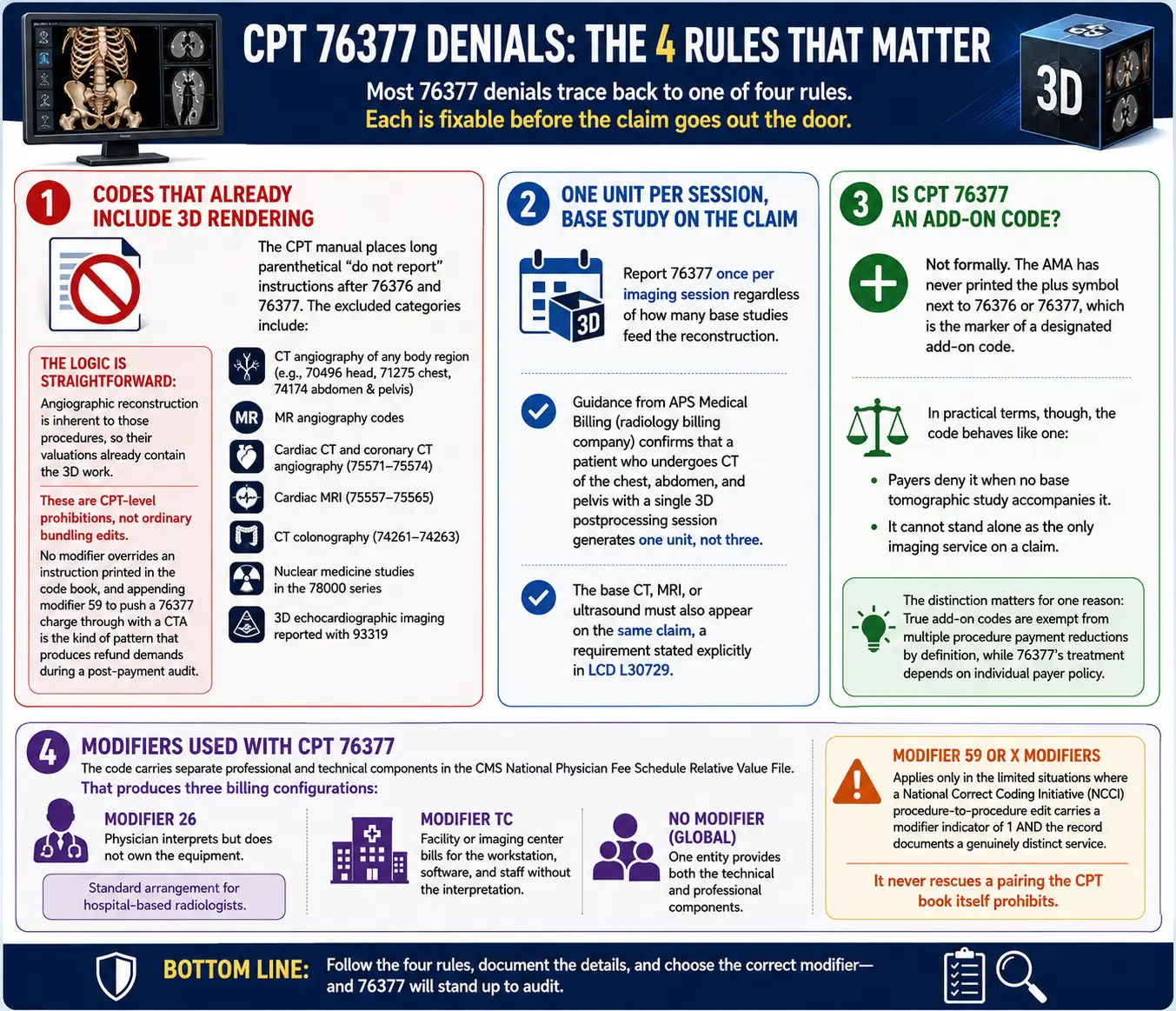
Most 76377 denials trace back to one of four rules. Each is fixable before the claim goes out the door.
Codes that already include 3D rendering
The CPT manual places long parenthetical “do not report” instructions after 76376 and 76377. The excluded categories include:
- CT angiography of any body region (for example, 70496 for the head, 71275 for the chest, 74174 for the abdomen and pelvis)
- MR angiography codes
- Cardiac CT and coronary CT angiography (75571 through 75574)
- Cardiac MRI (75557 through 75565)
- CT colonography (74261 through 74263)
- Nuclear medicine studies in the 78000 series
- 3D echocardiographic imaging reported with 93319
The logic is straightforward: angiographic reconstruction is inherent to those procedures, so their valuations already contain the 3D work. These are CPT-level prohibitions, not ordinary bundling edits. No modifier overrides an instruction printed in the code book, and appending modifier 59 to push a 76377 charge through with a CTA is the kind of pattern that produces refund demands during a post-payment audit.
One unit per session, base study on the claim
Report 76377 once per imaging session regardless of how many base studies feed the reconstruction. Guidance published by the coding team at APS Medical Billing, a radiology billing company, confirms that a patient who undergoes CT of the chest, abdomen, and pelvis with a single 3D postprocessing session generates one unit, not three. The base CT, MRI, or ultrasound must also appear on the same claim, a requirement stated explicitly in LCD L30729.
Is CPT 76377 an add-on code?
Not formally. The AMA has never printed the plus symbol next to 76376 or 76377, which is the marker of a designated add-on code. In practical terms, though, the code behaves like one: payers deny it when no base tomographic study accompanies it, and it cannot stand alone as the only imaging service on a claim. The distinction matters for one reason. True add-on codes are exempt from multiple procedure payment reductions by definition, while 76377’s treatment depends on individual payer policy.
Modifiers used with CPT 76377
The code carries separate professional and technical components in the CMS National Physician Fee Schedule Relative Value File. That produces three billing configurations:
- Modifier 26 when the physician interprets but does not own the equipment, which is the standard arrangement for hospital-based radiologists
- Modifier TC when a facility or imaging center bills for the workstation, software, and staff without the interpretation
- No modifier (global) when one entity provides both
Modifier 59, or the more specific X modifiers, applies only in the limited situations where a National Correct Coding Initiative procedure-to-procedure edit carries a modifier indicator of 1 and the record documents a genuinely distinct service. It never rescues a pairing the CPT book itself prohibits.
CPT 76377 reimbursement in 2026
Medicare pays 76377 under the Physician Fee Schedule. For calendar year 2026, the national payment is approximately $79 globally, built on a physician work RVU of 0.79, before geographic adjustment through the Geographic Practice Cost Indices. The comparable figure for 76376 is about $25. Actual allowed amounts shift by locality; practices in high-cost metropolitan payment areas collect more than the national figure, rural localities less.
The hospital outpatient story is different. Under the Outpatient Prospective Payment System, 76376 and 76377 carry status indicator N, meaning payment is packaged into the primary procedure and the hospital receives nothing separately. Facilities should still report the code with an appropriate charge, because CMS uses hospital claims data when it sets future rates.
Commercial payers reimburse at higher levels. National average payments compiled from federally mandated price transparency files by PayerPrice, verified in July 2026, show Blue Cross Blue Shield plans averaging $89.72, UnitedHealthcare $104.46, Cigna $131.47, and Aetna $140.19 for the code. Individual contracted rates vary widely; the same transparency data shows negotiated amounts for a single payer ranging from under $100 to over $280 depending on the provider group and specialty.
Documentation that survives an audit
Payers reviewing 76377 look for five elements. Reports missing any of them get downcoded to 76376 or denied outright.
- An order or a documented clinical indication for the 3D reconstruction
- Identification of the independent workstation, by vendor or platform name
- A statement that the physician provided concurrent supervision of the postprocessing
- The findings of the 3D reconstruction, described separately from the base study findings
- Retained 3D images available for review
A single sentence in the report can carry most of that weight. Something like: “3D volume-rendered reconstructions of the pelvis were created on an independent TeraRecon workstation under my direct supervision; the reconstructions demonstrate a both-column acetabular fracture with 8 mm of articular displacement.” The report identifies the workstation, documents physician supervision, and presents independent 3D findings.
The most common documentation failure is silence about the workstation. Coders cannot infer it, auditors will not assume it, and the difference between the two codes is worth about $54 per Medicare claim.
Why CPT 76377 claims get denied
Recurring denial causes, drawn from payer policy language and radiology billing company guidance, cluster into five patterns:
- Billing 76377 with a CTA, MRA, cardiac CT, or another study that already includes 3D reconstruction
- Reports that never mention the independent workstation
- Claims submitted without the base imaging study attached
- Reporting 76376 and 76377 together for the same session, which is never correct
- No documented medical necessity for the reconstruction itself
Every one of these is detectable in a prebill edit. Practices that build a claim scrubber rule flagging 76377 whenever an angiography or cardiac imaging code sits on the same claim eliminate the largest denial category entirely.
FAQs about CPT 76377
Who can bill CPT 76377?
Any physician or qualified healthcare professional who personally provides the concurrent supervision and the interpretation. In practice that means radiologists most often, followed by cardiologists reading 3D echocardiography and surgeons who perform their own reconstruction planning.
Can CPT 76377 be billed with CT or MRI?
Yes, with most diagnostic CT, MRI, and ultrasound studies, provided the base code is not on the CPT exclusion list. The prohibited pairings are the angiographic, cardiac, colonography, and nuclear medicine codes described earlier.
Is interpretation and reporting required for CPT 76377?
Yes. Both appear in the code descriptor. Postprocessing alone, without a physician’s interpretation and a documented report of the 3D findings, does not meet the definition of the service.
Does Medicare reimburse CPT 76377?
Yes, at roughly $79 nationally under the 2026 Physician Fee Schedule in office and freestanding settings. In hospital outpatient departments the technical payment is packaged, though the physician’s professional component remains separately payable with modifier 26.
Getting CPT code 76377 right
The entire code turns on specifics that take seconds to document and cost real money when omitted. CPT code 76377 requires an independent workstation, concurrent supervision, a separate interpretation, and a base study on the same claim, and it can never accompany the angiographic and cardiac imaging codes that already contain 3D work. The gap between doing the work and getting paid for it is usually one unwritten sentence: the one naming the workstation. Write it, and a service valued at 0.79 work RVUs pays what it should.