


The CPT code for Shingrix is 90750. The American Medical Association defines it as “zoster (shingles) vaccine, (HZV), recombinant, sub-unit, adjuvanted, for intramuscular injection.” Coders searching for the shingrix cpt code, the shingrix vaccine cpt code, or simply the cpt code for shingles vaccine all land on the same number, because 90750 is currently the only CPT code that maps to this specific product. It’s also referred to in some payer manuals as the cpt code for zoster vaccine or the cpt code for herpes zoster vaccine, though patients usually just call it the shingles shot.
That single code covers the vaccine product itself, GSK’s Shingrix, and nothing else. It does not include giving the injection, and it does not include any office visit that happens alongside it. It’s also worth noting what 90750 replaced: the older live-virus shingles vaccine, Zostavax, used CPT 90736 and was withdrawn from the U.S. market on November 18, 2020, according to the CDC. Practices still occasionally see 90736 sitting unused in an old superbill template, which causes confusion when someone assumes it’s an alternate shingrix billing code.
What the 90750 CPT code description actually covers
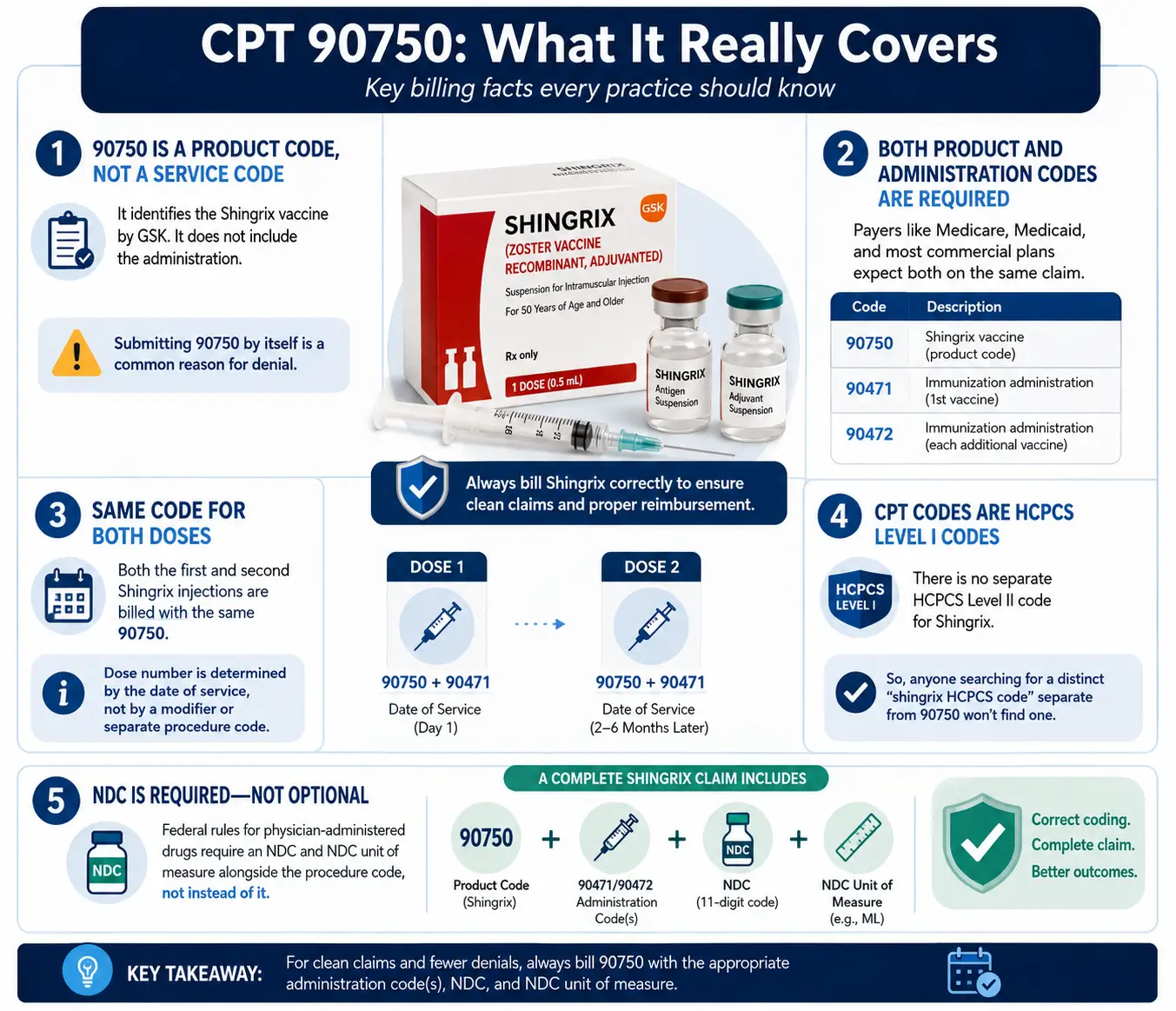
Ask five billers “what is CPT 90750” and most answer correctly on the vaccine itself, then miss the rest of the claim. 90750 is a product code, not a service code. GSK’s own billing and coding guide for Shingrix, updated February 2026, lists 90750 for the vaccine and separately lists CPT 90471 and 90472 for administering it. Medicare, most Medicaid programs, and commercial payers expect both a product code and an administration code on the same claim. Submitting 90750 by itself is one of the more common reasons a Shingrix line item gets rejected.
The code also carries no built-in reference to dose number. Both the first and second Shingrix injections are billed with the same 90750, distinguished only by the date of service, not by a modifier or a separate procedure code.
One more point worth clearing up: CPT codes are, technically, HCPCS Level I codes, so anyone searching for a distinct “shingrix hcpcs code” separate from 90750 won’t find one. There is no HCPCS Level II code for Shingrix. What a claim does need, on top of 90750, is the National Drug Code, since federal rules for physician-administered drugs require an NDC and NDC unit of measure alongside the procedure code, not instead of it.
Who Shingrix is recommended for, and the age question behind CPT 90750
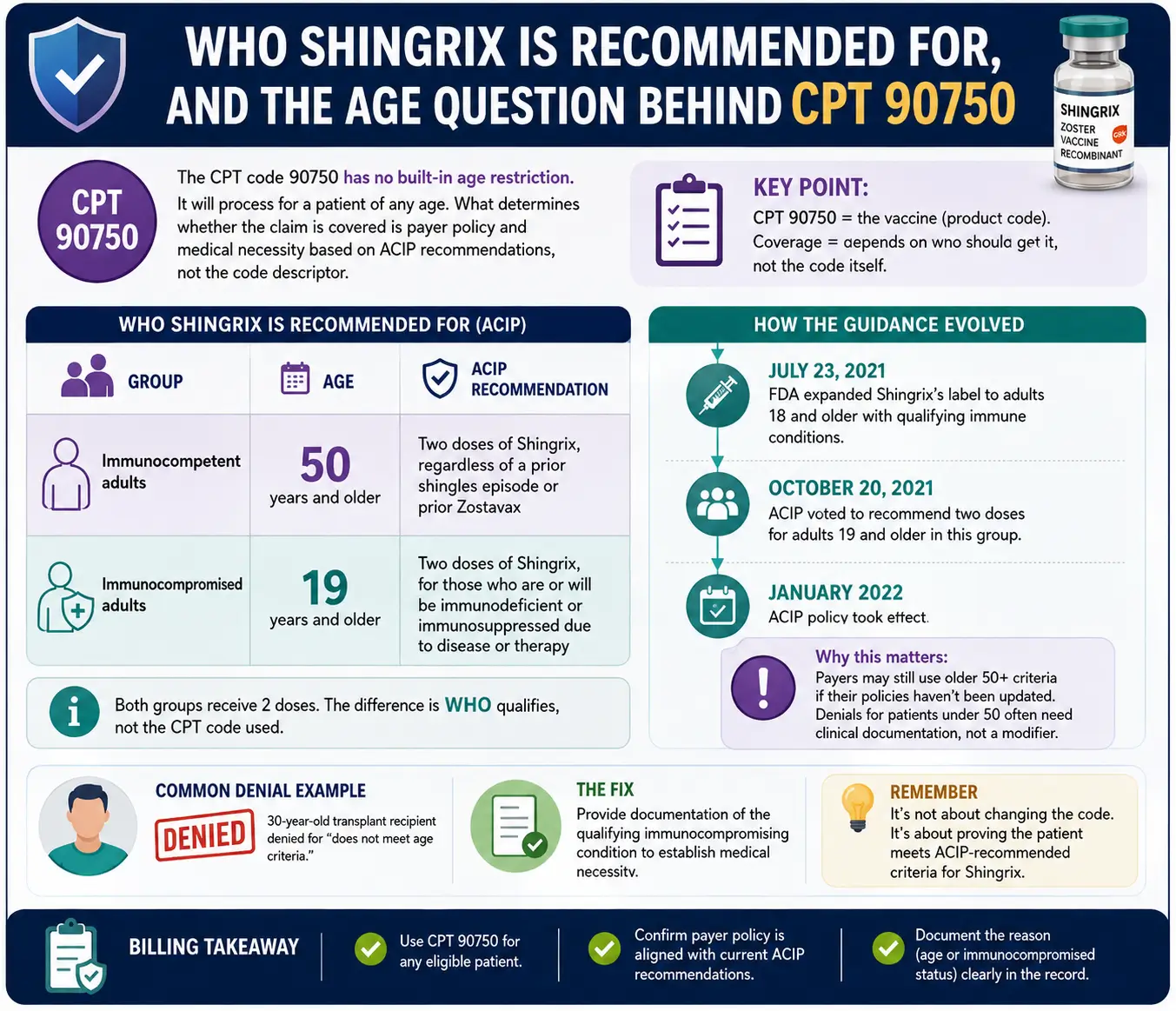
A lot of billing questions phrased as “90750 age limit” assume the CPT code itself has an age restriction written into its definition. It doesn’t. CPT 90750 will process for a patient of any age; what actually changes is whether the payer treats the claim as medically necessary, and that turns on Advisory Committee on Immunization Practices recommendations, not the code descriptor.
The CDC’s current guidance sets two eligible groups:
Group | Age | ACIP recommendation |
Immunocompetent adults | 50 years and older | Two doses of Shingrix, regardless of a prior shingles episode or prior Zostavax |
Immunocompromised adults | 19 years and older | Two doses of Shingrix, for those who are or will be immunodeficient or immunosuppressed due to disease or therapy |
The immunocompromised recommendation is newer than most billers assume. The FDA expanded Shingrix’s label to adults 18 and older with qualifying immune conditions on July 23, 2021, and ACIP voted to recommend two doses for adults 19 and older in that group on October 20, 2021, with the policy taking effect in January 2022. That gap between FDA approval and ACIP’s age-19 recommendation matters, because a payer’s medical policy may still reference the older, narrower 50-plus criteria if it hasn’t been refreshed. When a claim for a 30-year-old transplant recipient gets denied for age, the fix isn’t a modifier; it’s documentation showing the qualifying immunocompromising condition.
Shingrix dosage and the rules around the second dose
How many doses of Shingrix are required is one of the simpler questions here: two, regardless of which eligibility group the patient falls into. Shingrix is supplied as a 0.5 mL injection, and in EHR order sets it often shows up under a product description like “Shingrix (PF) 50 mcg/0.5 mL intramuscular suspension, kit” for the two-vial presentation, or “Shingrix (PF) 50 mcg/0.5 mL intramuscular syringe” for the newer prefilled syringe. Either presentation bills under the same 90750.
The standard schedule is two doses, 2 to 6 months apart, for immunocompetent adults. For immunocompromised adults who need a faster series, CDC clinical considerations allow the second dose 1 to 2 months after the first. General vaccine timing rules set a 4-week minimum between any two doses, with a 4-day grace period; a second dose given meaningfully earlier than that is considered invalid and typically has to be repeated, which creates a real billing problem, since a dose given in error and then repeated isn’t automatically a second reimbursable event. On the other end, if more than 6 months pass between doses, current CDC guidance is to give the second dose as soon as possible rather than restarting the series from dose one. None of this changes the procedure code. It changes whether the claim gets paid.
Billing the injection: CPT 90471 and 90472
Because 90750 only represents the vaccine, the Shingrix vaccine administration CPT code has to be reported as a separate line. GSK’s coding guide lists CPT 90471 for administering one vaccine at an encounter and CPT 90472 for each additional vaccine given at the same visit. In practice, a Shingrix-only visit is billed as 90750 plus 90471. A visit where the same patient also gets a flu shot adds 90472 for the second injection. Some Medicaid programs and commercial plans list their own preferred administration codes, so it’s worth checking the specific payer’s fee schedule rather than assuming 90471/90472 applies everywhere; for most commercial and Medicaid claims, though, that pairing is the default.
The ICD-10 code that pairs with 90750
The diagnosis code for the Shingrix vaccine, and the answer to “what is the ICD-10 code for Shingrix vaccination,” is Z23, encounter for immunization. It’s a general code covering any vaccine administration encounter rather than one written specifically for shingles, so payers running diagnosis-driven medical necessity checks will look at Z23 alongside the patient’s age and any immunocompromising diagnosis already on file. A practice billing for a 22-year-old on Z23 alone, with no supporting diagnosis for immunosuppression, is likely to see that claim questioned, because Z23 by itself doesn’t explain why a patient outside the routine 50-and-older group qualifies.
NDC numbers and how to prevent a rejection when billing Shingrix
Shingrix ships in two current presentations, and each has its own NDC:
- Two-vial kit (requires reconstitution): NDC 58160-823-11, made up of 58160-829-03 (adjuvant suspension) and 58160-828-03 (lyophilized antigen component)
- Prefilled syringe, FDA-approved July 16, 2025: NDC 58160-849-52 for the 10-dose carton, with 58160-849-43 for the single 0.5 mL prefilled syringe
Both presentations bill under the same CPT 90750 and share the CVX code 187, used for immunization information system reporting rather than for the medical claim itself. A separate CVX code, 188, exists for “zoster vaccine, unspecified formulation,” meant for situations where a patient’s vaccination card doesn’t specify which product they received. It isn’t a substitute for reporting 187 when the formulation is known. GSK’s manufacturer code (MVX) is SKB.
Some payers, including certain TRICARE and Medicaid systems, require an 11-digit NDC rather than the 10-digit format printed on the carton. The conversion adds a leading zero immediately after the first hyphen in the NDC. Submitting the wrong presentation’s NDC, an outdated lot, or the wrong digit format is one of the most common reasons a Shingrix claim rejects outright.
Does Medicare cover CPT 90750?
This is where a lot of billing guidance online gets it backward. Original Medicare Part B pays for a short list of preventive vaccines: flu, pneumococcal, hepatitis B for people at increased risk, and COVID-19. Shingrix isn’t on that list. There is no Part B “G-code” for Shingrix administration the way there is G0008 for flu or G0009 for pneumococcal, and billers looking for one won’t find it, because Medicare Part B does not cover Shingrix at all.
Shingrix is a Part D drug. Since January 1, 2023, the Inflation Reduction Act eliminated cost-sharing for ACIP-recommended adult vaccines under Part D, so beneficiaries with a Part D or Medicare Advantage drug plan now pay $0 out of pocket, no deductible, copay, or coinsurance, for either dose. Before that change, GSK has reported that Medicare beneficiaries paid up to $50 or less per dose in 2022.
The practical complication is that Part D runs on pharmacy claims processing, the NCPDP standard, rather than the CMS-1500 medical claim format that carries CPT 90750. According to GSK’s patient-facing coverage data, more than 95% of Medicare Part D enrollees get Shingrix at a pharmacy rather than a physician’s office, largely because most physician offices aren’t set up to bill a Part D plan directly. A practice that wants to administer Shingrix to a Medicare patient in-office needs to confirm, before the injection, that it can actually bill that patient’s specific Part D plan; if it can’t, sending the patient to a participating pharmacy is usually simpler than absorbing an unreimbursed dose. There also isn’t a single public CMS fee schedule amount for 90750 the way there is for Part B-covered vaccines, since Part D reimbursement is negotiated between the pharmacy, the plan, and its pharmacy benefit manager rather than set centrally by CMS.
Medicaid coverage for Shingrix varies by state. GSK’s coverage data indicates it’s generally covered for adults 50 and older without cost-sharing in states that expanded Medicaid eligibility under the Affordable Care Act, though a practice should still verify its own state program rather than assume coverage. Marketplace and most private commercial plans are more consistent: the ACA requires them to cover ACIP-recommended vaccines, including Shingrix, with no cost-sharing when given in-network.
Documentation that keeps a Shingrix claim from bouncing back
Beyond the codes on the claim form, a defensible Shingrix record generally includes:
- The NDC and lot number of the dose given, matched to the presentation actually administered
- The date the current Vaccine Information Statement was provided to the patient, and the date that VIS was published
- Injection site and route (intramuscular, typically the deltoid)
- The name and title of the person who administered the vaccine
- For patients under 50, the specific immunocompromising condition or therapy supporting medical necessity, not just an age exception on its own
Shingrix’s prescribing information notes that solicited local reactions in adults 50 and older included pain in 78% of recipients, redness in 38%, and swelling in 26%, with general reactions such as myalgia and fatigue each occurring in about 45%. None of that belongs in the billing note itself, but a brief line confirming the patient was counseled on expected reactogenicity, and tolerated the injection, supports the encounter if a payer later audits the chart.
Where billing errors most often happen
Three patterns account for most of the denials practices report. Submitting 90750 without an administration code is the most frequent, since the two are billed together but adjudicated as separate line items. Confusing 90750 with 90736, the discontinued Zostavax code, still turns up in older templates and copy-pasted superbills that haven’t been updated since 2020. And billing a second dose that was given before the minimum interval, without documentation that it was given in error and repeated appropriately, invites a payer to treat the claim as a duplicate rather than a valid second dose.
Getting the CPT code for Shingrix right on the claim is only the first step. The line also needs the administration code, the NDC in the format the specific payer wants, Z23 with a supporting diagnosis when the patient is under 50, and, for Medicare patients, confirmation of which benefit, Part D rather than Part B, is actually going to pay it.