


Time-based coding rewritten in 2021 changed how practices capture long office visits, and CPT code 99417 sits at the center of that shift. It is the add-on code you reach for when an outpatient evaluation and management (E/M) visit runs past the time built into a level 5 service. Used correctly, it recovers pay for work that would otherwise go unbilled. Used incorrectly, it produces denials that are tedious to appeal. The gap between those two outcomes usually comes down to a handful of details: the minute the clock actually starts, which payer is on the claim, and whether the note supports time-based selection at all.
This guide walks through the 99417 description, the exact time thresholds, the Medicare split that trips up so many billers, documentation, units, reimbursement, modifiers, and telehealth.
What is CPT code 99417?
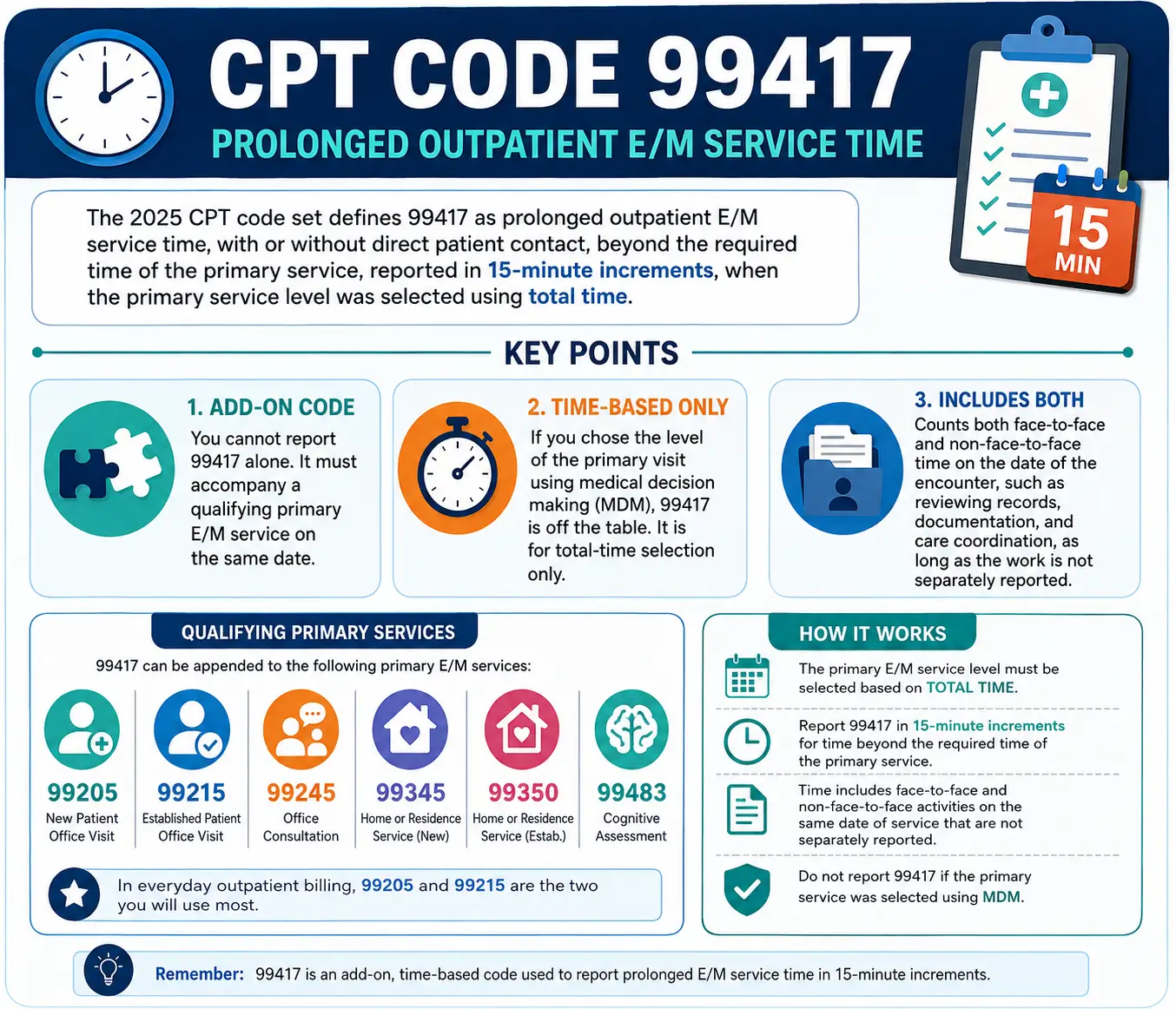
The 2025 CPT code set defines 99417 as prolonged outpatient E/M service time, with or without direct patient contact, beyond the required time of the primary service, reported in 15-minute increments, when the primary service level was selected using total time.
Three phrases in that definition carry weight.
It is an add-on code. You cannot report 99417 alone. It has to accompany a qualifying primary E/M service on the same date.
It is time-based only. If you chose the level of the primary visit using medical decision making (MDM), 99417 is off the table for that encounter. The prolonged code exists to extend a total-time selection, not an MDM selection.
It counts both face-to-face and non-face-to-face time. Reviewing outside records, documenting in the chart, and coordinating care on the date of the encounter all count toward the total, provided that work is not separately reported.
The primary codes 99417 can attach to are 99205 (new patient), 99215 (established patient), 99245 (office consultation), the home and residence services 99345 and 99350, and 99483 (cognitive assessment). In everyday outpatient billing, 99205 and 99215 are the two you will use most.
The time thresholds that trigger 99417
A level 5 visit already includes a block of time. Prolonged billing starts only after that block is full. Per the American Medical Association’s 2025 CPT guidance, you do not report the first unit of 99417 until at least 15 minutes have accumulated beyond the minimum time for the primary code.
For a new patient, 99205 covers 60 to 74 minutes. The first 99417 unit is reportable at 75 minutes.
For an established patient, 99215 covers 40 to 54 minutes. The first 99417 unit is reportable at 55 minutes.
Here is the time chart in one place.
Primary code | Patient type | Base time (AMA) | First 99417 unit (commercial) |
99205 | New | 60 to 74 min | 75 min |
99215 | Established | 40 to 54 min | 55 min |
Partial blocks are not billable. A visit has to reach the next full 15-minute mark before another unit is added, which is where the counting gets misread.
The Medicare split: 99417 vs G2212
This is the single most expensive misunderstanding in prolonged services billing, so it deserves room.
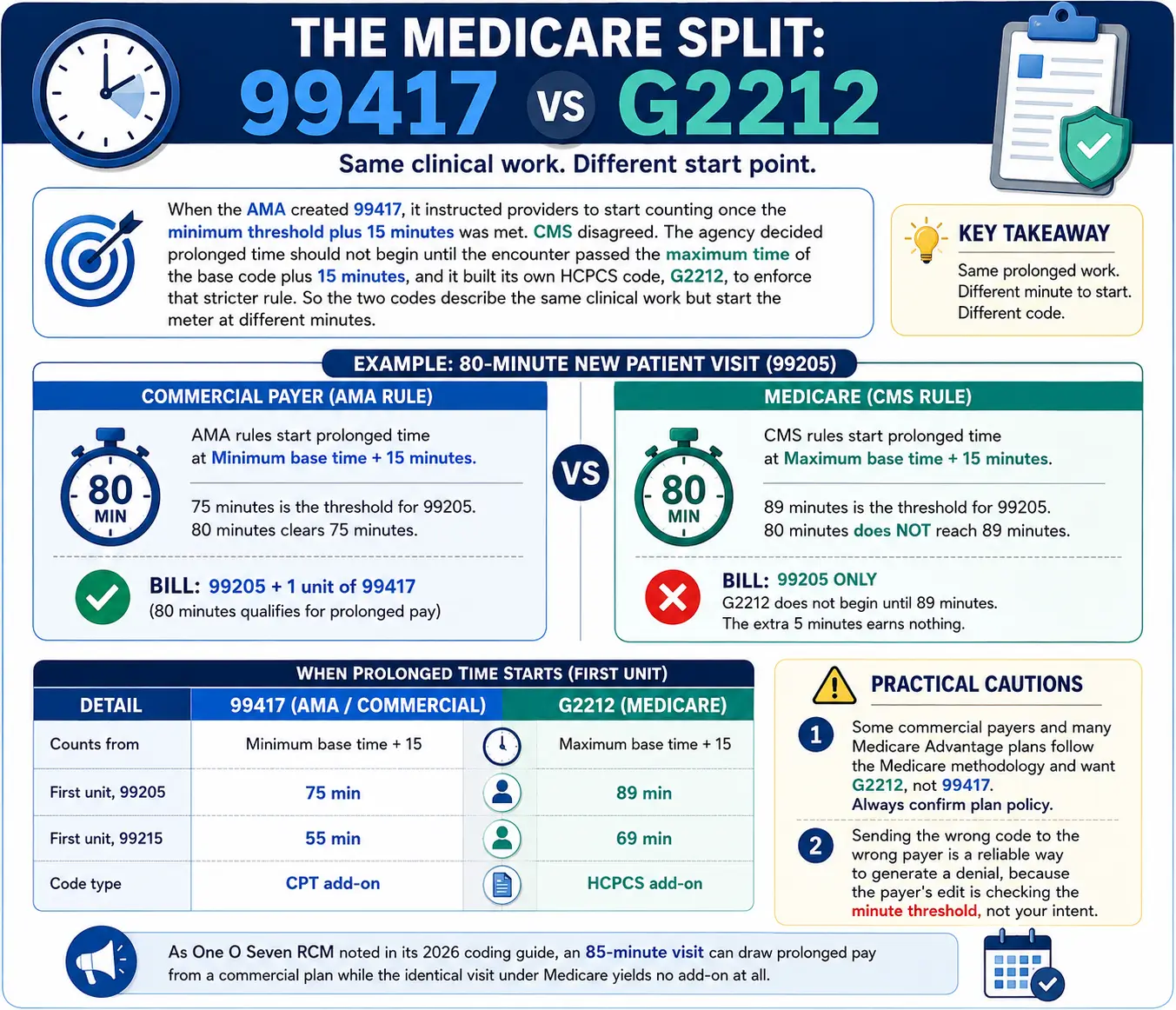
When the AMA created 99417, it instructed providers to start counting once the minimum threshold plus 15 minutes was met. CMS disagreed. The agency decided prolonged time should not begin until the encounter passed the maximum time of the base code plus 15 minutes, and it built its own HCPCS code, G2212, to enforce that stricter rule. So the two codes describe the same clinical work but start the meter at different minutes.
Take an 80-minute new patient visit. Under a commercial payer that follows AMA rules, you report 99205 plus one unit of 99417, because 80 minutes clears the 75-minute mark. Under Medicare, that same 80-minute visit supports 99205 alone. G2212 does not begin until 89 minutes (74 plus 15), so the extra 5 minutes earns nothing. As One O Seven RCM noted in its 2026 coding guide, an 85-minute visit can draw prolonged pay from a commercial plan while the identical visit under Medicare yields no add-on at all.
Detail | 99417 (AMA / commercial) | G2212 (Medicare) |
Counts from | Minimum base time + 15 | Maximum base time + 15 |
First unit, 99205 | 75 min | 89 min |
First unit, 99215 | 55 min | 69 min |
Code type | CPT add-on | HCPCS add-on |
Two practical cautions. First, some commercial payers and many Medicare Advantage plans follow the Medicare methodology and want G2212, not 99417, so plan policy has to be confirmed rather than assumed. Second, sending the wrong code to the wrong payer is a reliable way to generate a denial, because the payer’s edit is checking the minute threshold, not your intent.
How many units of 99417 can be billed
There is no fixed cap in the CPT description. You add a unit for each full 15 minutes past the starting threshold, and long visits can support more than one.
A worked example makes the arithmetic concrete. A new patient encounter runs 95 minutes. The first 74 minutes belong to 99205. Counting from the 75-minute start, minutes 75 through 89 fill the first 99417 unit. Minutes 90 through 95 are only 6 minutes, short of another full block, so they are not billable. The claim reads 99205 plus one unit of 99417.
Push that same encounter to 105 minutes and a second unit becomes reportable, since minutes 90 through 104 complete a second 15-minute block. The rule to hold onto: round down, never up, and bill only completed increments.
Documentation requirements
Prolonged services draw auditor attention because they are time-driven and easy to inflate. A defensible note answers a short 99417 documentation checklist:
- Time-based selection is stated for the primary code. The record should show the level was chosen by total time, not MDM.
- Total time is documented in minutes, ideally with start and stop or a clear total for the calendar date.
- The activities are described. History taking, counseling, record review, care coordination, and documentation performed on that date all qualify, and naming them supports the total.
- Separately billed time is excluded. Time counted toward a procedure, a distinct service, or staff-performed work cannot also count toward 99417.
- Same calendar day. All prolonged time must fall on the date of the primary encounter.
A note that reads only “spent extra time with patient” will not survive review. One that lists the minutes and what filled them will.
99417 reimbursement
Medicare pays 99417 off relative value units multiplied by the annual conversion factor, then adjusted for locality through the Geographic Practice Cost Index (GPCI). For 2025, CMS finalized a conversion factor of $32.3465, a 2.83 percent reduction from the 2024 figure of $33.2875, according to the CY 2025 Physician Fee Schedule final rule released November 1, 2024.
The code carries roughly 0.96 total RVUs in the non-facility (office) setting and about 0.79 in the facility setting. Multiplying those by the 2025 conversion factor puts the national non-facility payment near $31 per unit and the facility payment near $25, before locality adjustment. Commercial rates vary by contract and often run higher. Because the conversion factor and RVUs are reset every year, and because Congress has repeatedly adjusted the factor mid-cycle, treat any single-year figure as a baseline and confirm the current amount against the CMS fee schedule for your locality.
Does CPT 99417 need a modifier?
For the add-on code itself, usually no modifier is required. 99417 already communicates prolonged time through its descriptor.
The modifier question shows up on the primary visit, not on 99417. If a separately identifiable procedure is performed on the same day as the E/M service, the payer may expect modifier 25 on the E/M code so the visit is recognized as distinct from the procedure. That is a rule about the base code, not the prolonged add-on. Payer policies differ, so a claim that pairs an office visit, a same-day procedure, and 99417 is worth checking against the specific plan’s edits before submission.
Billing 99417 for telehealth
Prolonged outpatient time can be reported for telehealth visits, and 99417 is the add-on used once the total time clears the threshold.
Coding here got more involved in 2025. The AMA introduced a dedicated set of audio-video and audio-only telemedicine codes, 98000 through 98016, that mirror the in-person E/M structure. When those codes are selected by total time, 99417 attaches for prolonged service, starting at 75 minutes for the visit level equivalent to a new patient and at 55 minutes for the established equivalent, according to AAPC’s 2025 guidance. The Society for Maternal-Fetal Medicine’s 2025 coding tip notes that modifier 95 is not required on the new telemedicine codes, because the descriptors already indicate the service was delivered by telehealth.
Two things still matter on a telehealth claim: the place of service code that tells the payer where the patient was, and confirmation that the specific plan reimburses prolonged services rendered virtually. Some billers have hit denials trying to combine older telehealth modifiers such as GT with 99417, which is another reason to code from the current-year telemedicine set rather than legacy habits.
99417 vs 99418
The two codes are often confused because they read almost identically. The difference is setting.
99417 is for the outpatient side: office, other outpatient, and the home and residence services. 99418 is for inpatient and observation prolonged time, and it attaches to primary codes such as 99223, 99233, 99236, 99255, 99306, and 99310. Both are add-on codes, both require time-based selection of the primary service, and both count the prolonged time on the date of the encounter. If the patient was seen in the office, the code is 99417. If the patient was an inpatient or in observation, it is 99418.
Putting the 99417 description to work
The CPT 99417 description rewards precision. Report it only as an add-on to a time-selected level 5 outpatient visit, start the first unit at 75 minutes for 99205 and 55 minutes for 99215, and switch to G2212 with its higher 89-minute and 69-minute thresholds whenever the payer follows Medicare’s rule. Bill in full 15-minute blocks, document the total minutes and the activities that fill them, and confirm the current locality-adjusted rate rather than relying on last year’s number. The clinical work behind a 90-minute visit is real. Coding it to the right add-on, at the right threshold, for the right payer is what turns that work into paid work.