


Most claim problems with CPT Code J3301 trace back to three things: someone counted units by the milliliter instead of the milligram, the NDC was missing or formatted wrong, or a modifier was added that the vial never called for. None of those are hard to fix once you understand what the code actually reports and how payers read the claim line. This guide walks through the description, the unit math, the modifier logic, the administration codes that ride alongside it, and the reimbursement reality, with the payer distinctions that trip up billing staff.
What is CPT Code J3301?
J3301 is a HCPCS Level II J-code maintained by the Centers for Medicare and Medicaid Services (CMS), not a CPT code, even though almost everyone calls it “CPT J3301” out of habit. CPT codes describe procedures. J-codes describe the drug given. Both appear on the same claim, but they answer different questions.
The official j3301 description is: Injection, triamcinolone acetonide, not otherwise specified, 10 mg. That descriptor does two jobs at once. It names the drug, and it sets the billing unit at 10 mg.
Triamcinolone acetonide is a synthetic glucocorticoid used for its anti-inflammatory and immunosuppressive action. The brand most billers see is Kenalog (Bristol-Myers Squibb), supplied as Kenalog-10 at 10 mg/mL and Kenalog-40 at 40 mg/mL. Providers inject it intra-articularly into joints, intramuscularly, or into soft tissue, depending on the condition being treated: osteoarthritis, tendinitis, bursitis, allergic rhinitis, and a range of dermatologic problems.
One point worth fixing in your head early. J3301 reports the drug supply only. It does not include the work of giving the injection. That procedure is billed with a separate CPT code, which is where a lot of the confusion around this code begins.
J3301 billing units and the milligram-to-unit calculation
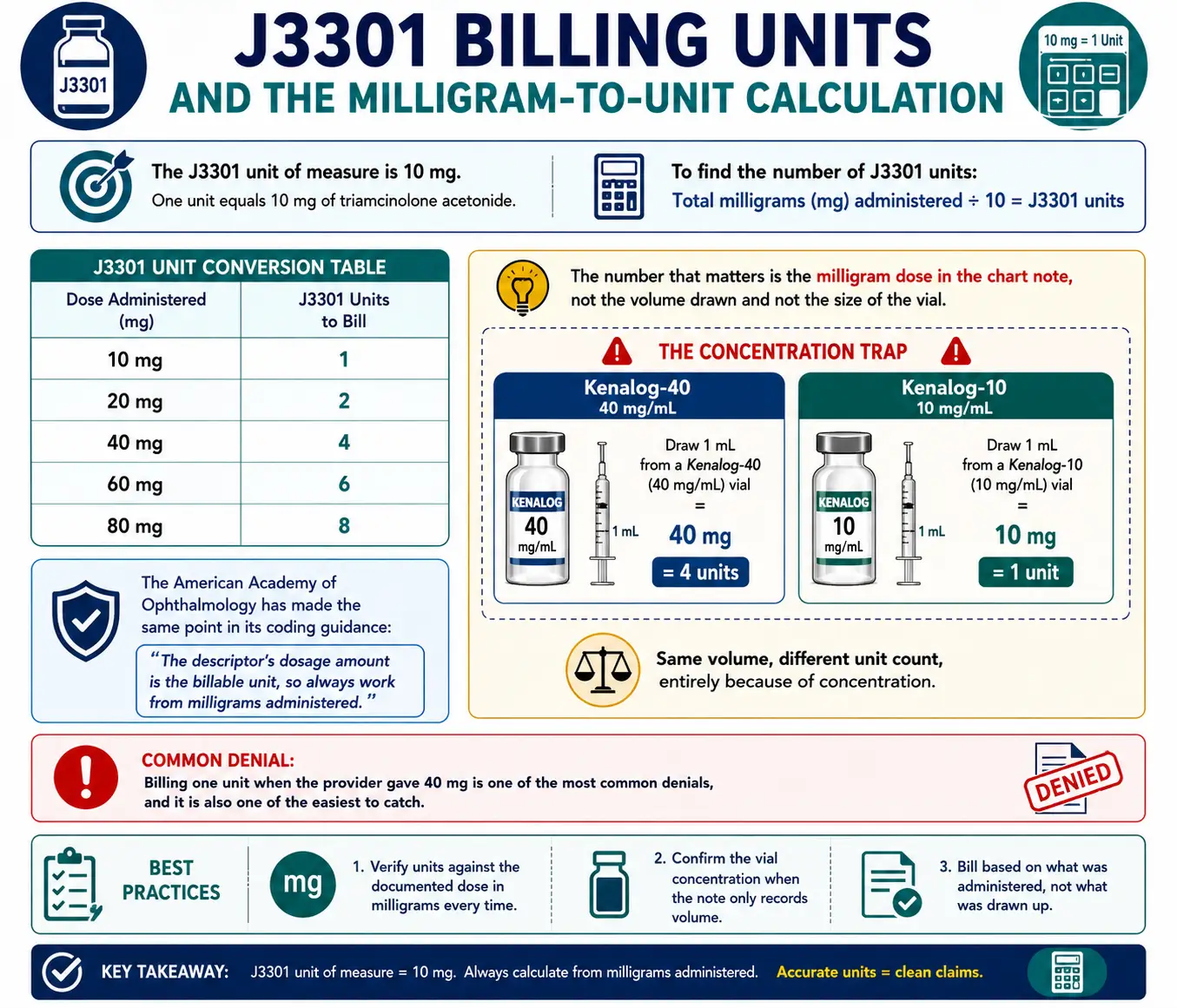
The j3301 unit of measure is 10 mg. One unit equals 10 mg of triamcinolone acetonide. To find the number of j3301 units, take the total milligrams the provider documented and divide by 10.
Dose administered | J3301 units to bill |
10 mg | 1 |
20 mg | 2 |
40 mg | 4 |
60 mg | 6 |
80 mg | 8 |
The number that matters is the milligram dose in the chart note, not the volume drawn and not the size of the vial. This is where the concentration trap catches people. Draw 1 mL from a Kenalog-40 (40 mg/mL) vial and you have administered 40 mg, which is 4 units, not 1. Draw the same 1 mL from a Kenalog-10 vial and you have given 10 mg, which is 1 unit. Same volume, different unit count, entirely because of concentration. The American Academy of Ophthalmology has made the same point in its coding guidance: the descriptor’s dosage amount is the billable unit, so always work from milligrams administered.
Billing one unit when the provider gave 40 mg is one of the most common denials, and it is also one of the easiest to catch. Verify units against the documented dose in milligrams every time, and confirm the vial concentration when the note only records volume.
Single-dose versus multi-dose vials, and why it decides the modifier
Before touching modifiers, you have to know which vial the drug came from, because that single fact controls the rest of the claim.
According to the Kenalog-40 prescribing information from Bristol-Myers Squibb, the product is supplied in three vial sizes: a 1 mL single-dose vial and 5 mL and 10 mL multi-dose vials, all at 40 mg/mL. Kenalog-10 is a multi-dose presentation as well. So triamcinolone is not uniformly a single-dose drug and not uniformly a multi-dose drug. It depends on what your practice stocked and used.
That distinction drives billing in two ways:
- From a multi-dose vial, you bill only the amount actually administered to the patient. You cannot bill for anything left in the vial, and you cannot bill wastage.
- From a single-dose vial, billing is based on the amount in the vial, and the discarded-drug rules come into play.
Get this wrong and you either leave money on the table or invite a recoupment.
Does J3301 need a modifier?
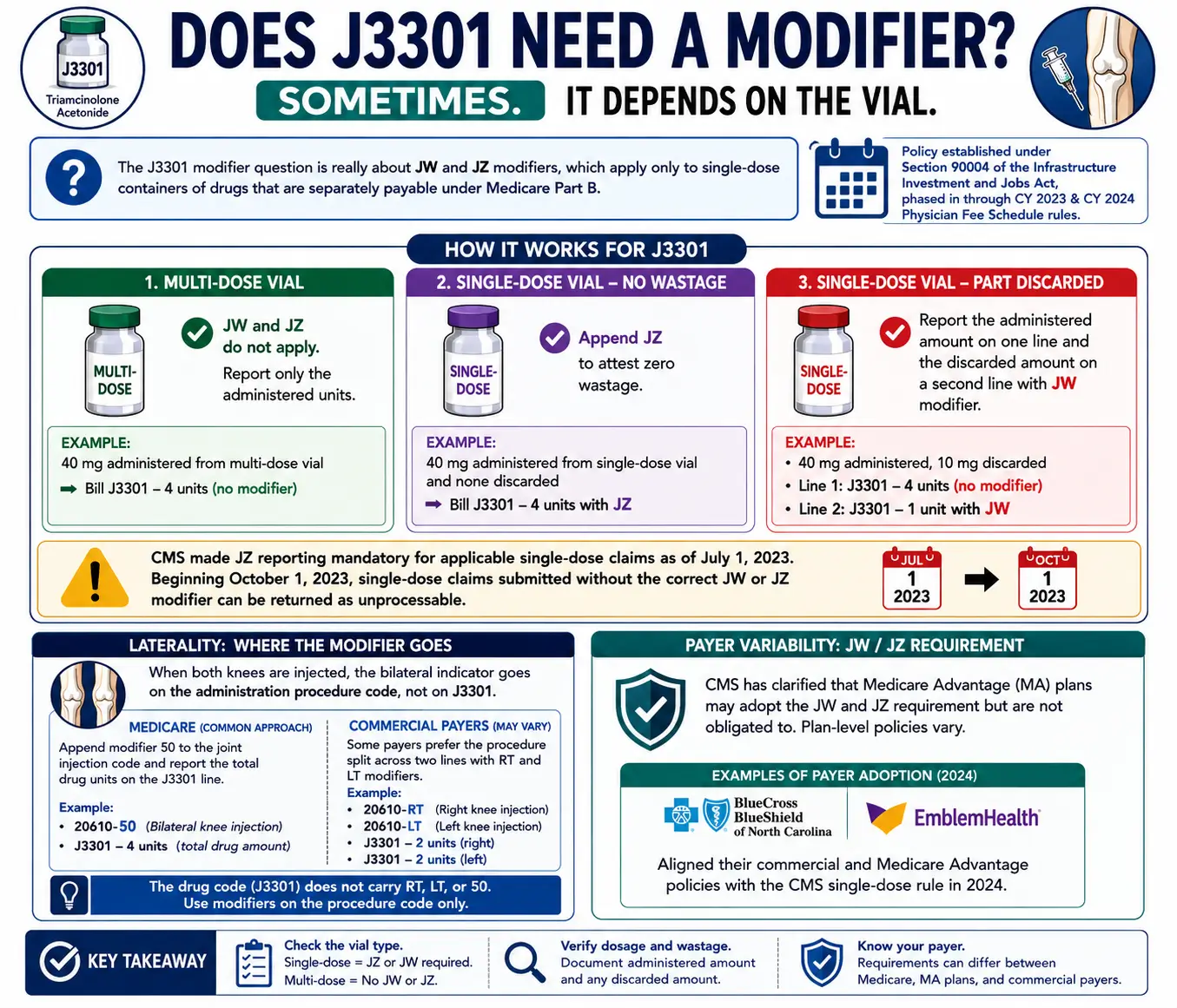
The honest answer is: sometimes, and it depends on the vial.
The j3301 modifier question is really a question about the JW and JZ modifiers, and those apply only to single-dose containers of drugs that are separately payable under Medicare Part B. CMS built the policy this way under section 90004 of the Infrastructure Investment and Jobs Act, phased in through the CY 2023 and CY 2024 Physician Fee Schedule rules.
Here is how it plays out for J3301:
- If the triamcinolone came from a multi-dose vial, JW and JZ do not apply. You report only the administered units. Adding JZ here is incorrect.
- If it came from a single-dose vial and none was discarded, append JZ to attest zero wastage.
- If it came from a single-dose vial and part was discarded, report the administered amount on one line and the discarded amount on a second line with the JW modifier.
CMS made JZ reporting mandatory for applicable single-dose claims as of July 1, 2023, and beginning October 1, 2023, single-dose claims submitted without the correct JW or JZ modifier can be returned as unprocessable. So the “does j3301 need a JZ modifier” question comes down to one check: was it a single-dose vial? If yes, JZ or JW is required. If it was a multi-dose vial, neither belongs on the claim.
A separate note on laterality. When both knees are injected, the bilateral indicator goes on the administration procedure code, not on J3301. For Medicare, that usually means appending modifier 50 to the joint injection code and reporting the total drug units on the J3301 line. Some commercial payers prefer the procedure split across two lines with RT and LT modifiers instead. The drug code itself does not carry RT, LT, or 50.
One last payer wrinkle. CMS has clarified that Medicare Advantage plans may adopt the JW and JZ requirement but are not obligated to, so plan-level policies vary. Blue Cross NC and EmblemHealth, among others, aligned their commercial and Medicare Advantage policies with the CMS single-dose rule in 2024, which shows how uneven adoption can be from one payer to the next.
Administration codes that pair with J3301
Because J3301 is a drug-only code, it has to be reported with the procedure that delivered the drug. Choosing that code correctly is where a surprising number of J3301 claims fall apart.
For a major joint, the code is CPT 20610 (arthrocentesis, aspiration, or injection of a major joint such as the shoulder, hip, knee, or subacromial bursa). The important thing here is that 20610 already includes the administration. Adding 96372 on top of it creates a bundling conflict, because 96372 is a therapeutic, prophylactic, or diagnostic injection code for intramuscular or subcutaneous injections, not joint work. Pick one. For a knee injected with Kenalog, the claim reads 20610 plus J3301, not 20610 plus 96372 plus J3301.
The right pairing depends on where the drug went:
- 20610 for major joints (shoulder, hip, knee, subacromial bursa)
- 20600, 20604, 20605, 20606, 20611 for small and intermediate joints, with or without ultrasound guidance
- 20550, 20551 for injection of a tendon sheath, ligament, or tendon origin
- 96372 for an intramuscular or subcutaneous therapeutic injection when no joint code applies, for example an IM dose for a severe allergic condition
A worked bilateral example ties the units and the procedure together. A provider injects 60 mg of triamcinolone into each knee. That is 120 mg total, which is 12 units of J3301. For Medicare the claim commonly reads 20610 with modifier 50 for the bilateral procedure, plus J3301 times 12. For a commercial plan that wants laterality split out, it becomes 20610-RT and 20610-LT on separate lines with the drug units divided across them.
An evaluation and management visit can be reported on the same day only when it is a significant, separately identifiable service, appended with modifier 25. If the patient came in for the injection and nothing else was evaluated, the E/M is not separately billable.
NDC reporting for J3301
Medicare and most Medicaid and commercial payers require the National Drug Code on the J3301 claim line, and a missing or malformed NDC for J3301 is one of the most frequent reasons the claim never even reaches adjudication.
Two formatting details cause most of the trouble. The NDC has to be reported in the 11-digit 5-4-2 format, and it has to carry the N4 qualifier on the claim line. Manufacturer labels often print the NDC in a 10-digit format, so you have to add a leading zero in the correct segment to reach 11 digits. Transcribe it straight off the vial without padding and the claim can reject.
The NDC also has to match the exact product administered. The commonly referenced Kenalog-40 codes are 0003-0293-05 for the 1 mL single-dose vial, 0003-0293-20 for the 5 mL multi-dose vial, and 0003-0293-28 for the 10 mL multi-dose vial, which become 00003-0293-05, 00003-0293-20, and 00003-0293-28 in 11-digit form. Report the NDC for the vial your practice actually used, since that is also what determines whether the single-dose modifier rules apply.
J3301 reimbursement
Medicare pays for physician-administered drugs under Part B using the average sales price (ASP) methodology, generally ASP plus 6% in the non-facility setting. CMS recalculates ASP every quarter, in January, April, July, and October, so the payment amount is not fixed across the year. Practices that buy under the 340B program are reimbursed at ASP minus 22.5%, a meaningfully lower figure.
The dollars here surprise people. For the first quarter of 2026, the CMS ASP payment limit for J3301 is about $0.74 per 10 mg unit, as published in the Medicare Part B drug pricing file. A 40 mg dose, billed as 4 units, comes to roughly $2.96 under Medicare. Triamcinolone is an inexpensive generic corticosteroid, and the drug line reflects that. The revenue in a steroid injection encounter sits in the administration code, such as 20610, not in J3301 itself.
Commercial insurers do not uniformly follow Medicare’s rules on units, modifiers, or drug pricing. Aetna billing, for example, or any other commercial plan, may set its own fee schedule, its own frequency limits, and its own NDC and modifier requirements. Check the specific plan’s policy before assuming Medicare logic carries over.
Don’t confuse J3301 with the rest of the triamcinolone family
Triamcinolone has several J-codes, and billing the wrong one is a clean way to earn a denial that documentation cannot rescue. The code has to match the exact formulation administered.
HCPCS code | Descriptor | Billing unit | Typical product |
J3300 | Triamcinolone acetonide, preservative-free | 1 mg | Triesence (ophthalmic) |
J3301 | Triamcinolone acetonide, not otherwise specified | 10 mg | Kenalog |
J3302 | Triamcinolone diacetate | 5 mg | |
J3303 | Triamcinolone hexacetonide | 5 mg | Aristospan |
J3304 | Triamcinolone acetonide, preservative-free, extended-release, microsphere | 1 mg | Zilretta |
Two of these deserve a flag. J3300 is the preservative-free formulation billed per 1 mg, used mostly in ophthalmology for intravitreal injection; a 4 mg dose is 4 units of J3300, not J3301. J3304 is the extended-release microsphere formulation (Zilretta) for osteoarthritis of the knee, also billed per 1 mg, and it reimburses at a far higher rate, around $18.60 per mg in early 2026. Using J3301 for either of those, or reaching for J3300 when the provider used ordinary preserved Kenalog, is a coding error rather than a paperwork gap. When Kenalog with preservative is given, J3301 is the right code.
Diagnosis coding and medical necessity
A payer will only cover J3301 when the diagnosis supports it. The ICD-10 code has to describe a condition for which a triamcinolone injection is reasonable and necessary. For a knee injection, that might be M25.561 or M25.562 (pain in the right or left knee) or an osteoarthritis code such as M17.11 or M17.12. Allergic and dermatologic indications carry their own diagnosis codes.
Two habits reduce medical-necessity denials. Check the Medicare Administrative Contractor’s local coverage determination for the covered ICD-10 list in your region before you submit, since contractors publish different allowed diagnoses. And make sure the documented dose, the units billed, the NDC, and the diagnosis all tell the same story on the claim.
Where J3301 claims usually break
Most J3301 denials come from a short list of preventable errors:
- Unit miscalculation, most often billing 1 unit when 40 mg was given from a 40 mg/mL vial.
- Missing or misformatted NDC, including 10-digit codes that were never padded to 11 digits or the absent N4 qualifier.
- Wrong administration pairing, such as stacking 96372 onto a 20610 joint injection.
- Wrong drug code, using J3301 for the preservative-free (J3300) or extended-release (J3304) formulation.
- Modifier misuse, adding JZ to a multi-dose claim where it does not belong, or omitting JZ or JW on a single-dose Part B claim where it is required.
Catch these before the claim goes out and the first-pass rejection rate on triamcinolone injections drops sharply.
The pattern behind all of it is consistent. J3301 pays the drug per 10 mg, it needs an accurate NDC and a correctly chosen administration code beside it, and the JW or JZ modifier belongs on the claim only when the drug came from a single-dose vial under Medicare Part B. Bill from the documented milligram dose, match the code to the exact formulation, and verify the payer’s own rules rather than assuming they follow Medicare, and most J3301 denials never happen. For claims your team keeps seeing bounce, A2Z Billings can review your triamcinolone injection workflow against current CMS and payer policies.