


Gallbladder removal is one of the highest-volume general surgery procedures billed in the United States, and most of it now runs through a laparoscope. Roughly 1.2 million cholecystectomies are performed each year, and the large majority are done laparoscopically rather than open. That volume is the reason coding accuracy matters here. One wrong digit, or a cholangiography code attached to a case that never involved contrast, turns a clean claim into a denial or an audit flag.
Three CPT codes cover the laparoscopic approach: 47562, 47563, and 47564. Each describes a different amount of work inside the abdomen, and they sit in a strict hierarchy. This guide covers what each code means, where coders get tripped up (cholangiography is the usual culprit), how the 2026 Medicare fee schedule changed the payment math, and which documentation actually supports the code you select.
The three laparoscopic cholecystectomy CPT codes
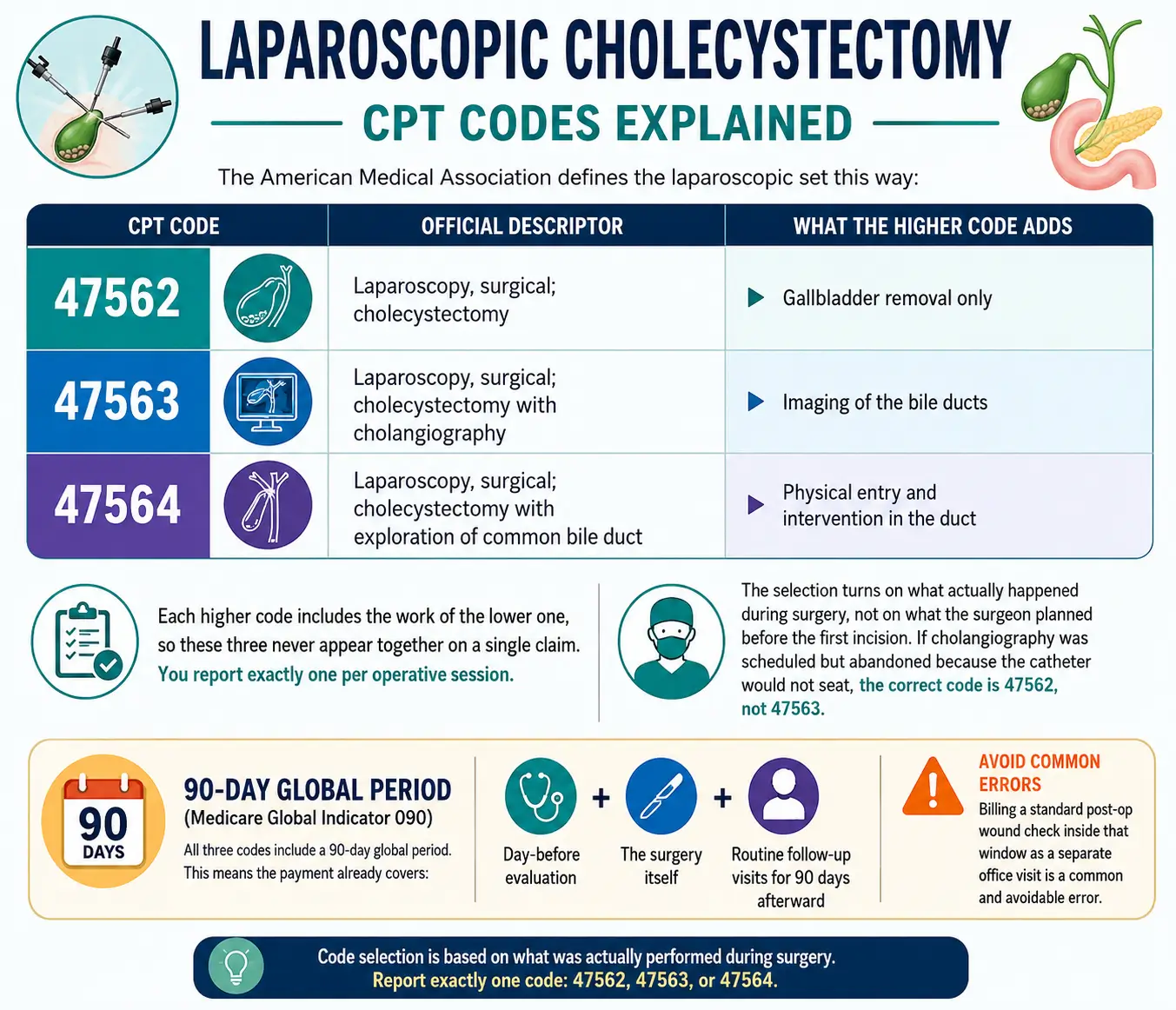
The American Medical Association defines the laparoscopic set this way:
CPT code | Official descriptor | What the higher code adds |
47562 | Laparoscopy, surgical; cholecystectomy | Gallbladder removal only |
47563 | Laparoscopy, surgical; cholecystectomy with cholangiography | Imaging of the bile ducts |
47564 | Laparoscopy, surgical; cholecystectomy with exploration of common bile duct | Physical entry and intervention in the duct |
Each higher code includes the work of the lower one, so these three never appear together on a single claim. You report exactly one per operative session. The selection turns on what actually happened during surgery, not on what the surgeon planned before the first incision. If cholangiography was scheduled but abandoned because the catheter would not seat, the correct code is 47562, not 47563.
All three carry a 90-day global period (Medicare global indicator 090). That means the payment already covers the day-before evaluation, the surgery itself, and routine follow-up visits for 90 days afterward. Billing a standard post-op wound check inside that window as a separate office visit is a common and avoidable error.
CPT 47562: standard laparoscopic gallbladder removal
CPT 47562 is the workhorse of the group. Use it when the surgeon removes the gallbladder through the laparoscope and does nothing else to the bile ducts. No contrast injection. No duct exploration. The surgeon dissects the cystic duct and cystic artery, clips and divides them, separates the gallbladder from the liver bed, and extracts it, usually inside a retrieval bag.
A typical scenario: a patient with symptomatic cholelithiasis comes in for an elective outpatient removal, the anatomy is clean, and no imaging of the ducts is needed. That is a textbook 47562.
For 2026, the work RVU for 47562 sits at roughly 10.21, down from 10.47 in 2025 after the Medicare efficiency adjustment discussed below. At the 2026 national conversion factor, the total payment lands near $630 in both facility and non-facility settings before any geographic adjustment. Actual reimbursement shifts by locality based on the Geographic Practice Cost Index, so a surgeon in a high-cost metro area collects more than one in a rural county for the identical code.
CPT 47563: adding intraoperative cholangiography
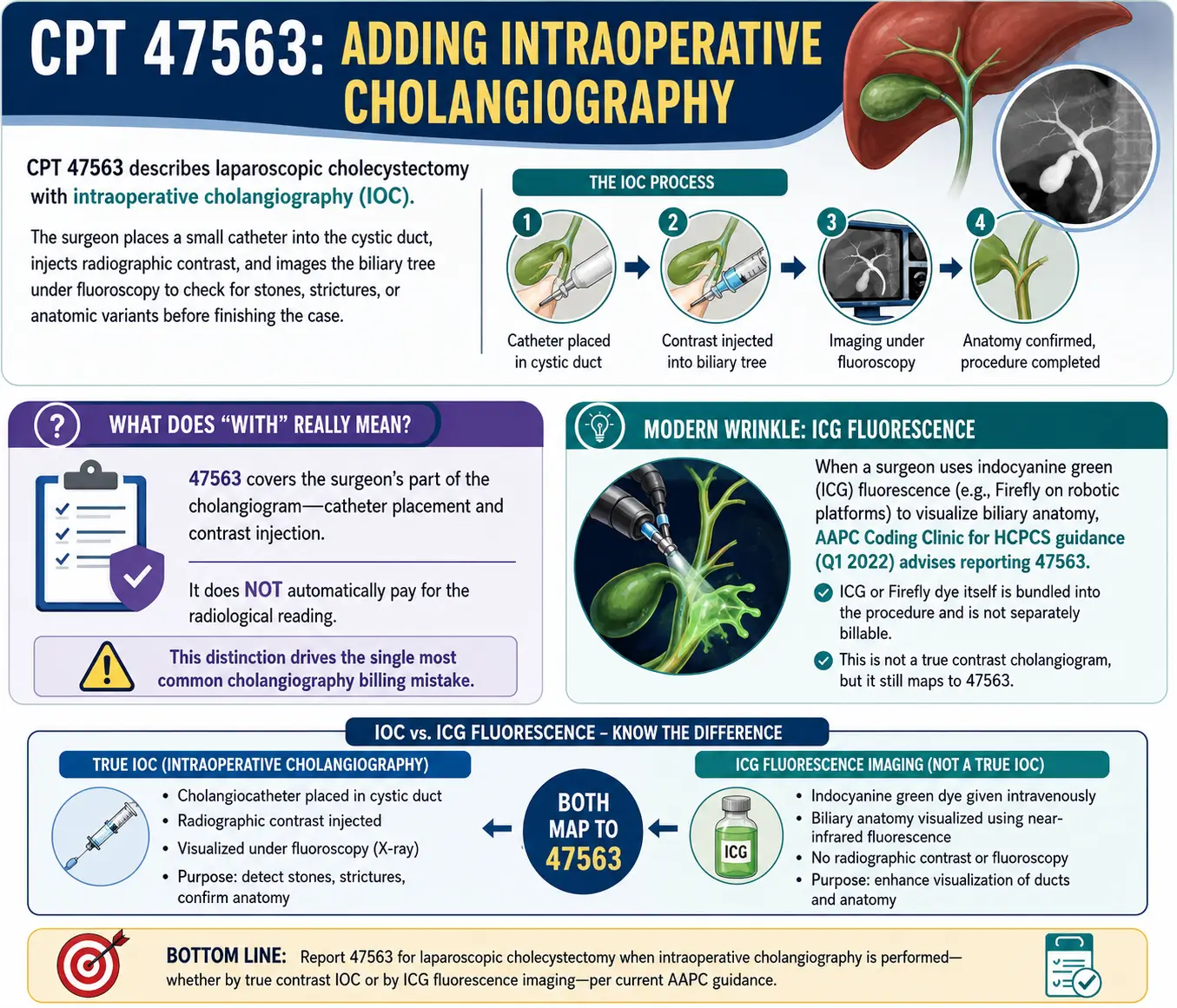
CPT 47563 describes the same gallbladder removal plus intraoperative cholangiography (an IOC). The surgeon places a small catheter into the cystic duct, injects radiographic contrast, and images the biliary tree under fluoroscopy to check for stones, strictures, or anatomic variants before finishing the case. Surgeons order it partly to reduce the risk of a missed common bile duct stone and partly to confirm anatomy before dividing structures.
The word “with” in the descriptor causes real confusion, so it is worth stating plainly: 47563 covers the surgeon’s part of the cholangiogram, meaning the catheter placement and contrast injection. It does not automatically pay for the radiological reading. That distinction drives the single most common cholangiography billing mistake, covered in the next section.
There is a modern wrinkle. When a surgeon uses indocyanine green (ICG) fluorescence (sometimes marketed as Firefly on robotic platforms) to light up the biliary anatomy, that is not a true contrast cholangiogram. Even so, AAPC Coding Clinic for HCPCS guidance from the first quarter of 2022 advised reporting 47563 for a laparoscopic cholecystectomy performed with intraoperative ICG fluorescence imaging. The ICG or Firefly dye itself is bundled into the procedure and is not separately billable. A true IOC uses a cholangiocatheter in the cystic duct with direct contrast injection under fluoroscopy, which is a different technique from fluorescence, even though both currently map to 47563.
The 74300 trap that generates denials
Here is where careful coders separate themselves. CPT 74300 is defined as cholangiography and/or pancreatography, intraoperative, radiological supervision and interpretation. The phrase “radiological supervision and interpretation” (S&I) is the tell: 74300 is the radiology piece, not a second surgical procedure.
The rule most practices need in writing:
- If the operating surgeon performs the cholangiogram and reads the images, 47563 alone captures the full service. Do not add 74300, 76000, or any separate imaging code on the surgeon’s claim. Billing it separately is unbundling, and it draws a denial.
- If a separate radiologist supervises and interprets the images, the surgeon still reports 47563 (which includes the injection), and the radiologist reports 74300 for the S&I component, usually appended with modifier 26 for the professional component.
- When supervision and interpretation are split between two physicians, for example a surgeon supervising and a radiologist interpreting, each reports 74300 with modifier 52 for reduced services. Combined payment for the fragmented code cannot exceed what a single physician would have earned for both halves.
That last split-billing scenario comes straight from long-standing Medicare S&I guidance, and it is why you sometimes see 74300-26-52 on a claim. Payers audit this pairing closely, so the documentation has to name who supervised and who interpreted.
CPT 47564: exploration of the common bile duct
CPT 47564 is the top of the laparoscopic hierarchy. The descriptor reads “cholecystectomy with exploration of common bile duct,” and it applies only when the surgeon physically intervenes inside the duct during the same session. Intervention means active work: stone extraction with a Fogarty catheter, basket retrieval, a balloon sweep, choledochotomy, or choledochoscopy.
The line coders miss is the difference between looking and acting. A note that reads “common bile duct visualized” or “CBD appeared normal” during dissection is passive observation, not exploration. It supports 47562 or 47563, not 47564. To bill 47564, the operative report has to describe entry into the duct and what was done there. Choledochoscopy performed as a distinct add-on service has its own code (+47550) in certain contexts, so read the note before reaching for the higher primary code.
47562 vs 47563: the decision that pays
Most day-to-day coding for these procedures comes down to 47562 versus 47563, so it helps to run every operative note through one question: did the surgeon inject contrast into the cystic or common bile duct, obtain images, and interpret them?
- No injection and no imaging: 47562.
- Contrast injected, images obtained and read: 47563.
- Duct physically entered with active stone or obstruction management: 47564.
Auditors also watch the ratio between the two lower codes across a practice. An unusually high share of 47563 claims relative to 47562 can flag a practice for systematic overreporting of cholangiography, especially if the operative notes do not document catheter placement, contrast, and interpretation every time. The reimbursement gap is real (47563 carried an 11.47 work RVU in 2025 against 10.47 for 47562), which is exactly why payers scrutinize it.
Laparoscopic versus open, and the conversion rule
The open equivalents share the same logic with a different approach:
Approach | Removal only | With cholangiography | With CBD exploration |
Laparoscopic | 47562 | 47563 | 47564 |
Open | 47600 | 47605 | 47610 |
Two more open codes extend the set: 47612 (with choledochoenterostomy) and 47620 (with transduodenal sphincterotomy or sphincteroplasty). They come up rarely but exist for complex biliary reconstructions.
The conversion rule is firm. When a case starts laparoscopically and the surgeon converts to an open incision because of bleeding, dense adhesions, or unclear anatomy, you bill only the open code for the completed procedure. You do not report the laparoscopic code alongside it, and you do not bill the abandoned laparoscopic start as a separate service. The finished operation is what gets coded.
What changed for 2026
The 2026 Medicare Physician Fee Schedule final rule reshaped the payment side of these codes even though the descriptors did not move. Three changes matter for cholecystectomy billing.
First, 2026 is the first year with two conversion factors. Clinicians who qualify as participants in an advanced alternative payment model use $33.5675, and everyone else uses $33.4009. The non-qualifying figure is a 3.26 percent increase over the 2025 conversion factor of $32.3465, helped by a one-time 2.5 percent bump Congress passed in the One Big Beautiful Bill Act.
Second, CMS finalized a negative 2.5 percent efficiency adjustment to the work RVUs of nearly all non-time-based procedure codes. All three laparoscopic cholecystectomy codes fall inside that group, which is why 47562 dropped from a 10.47 work RVU to about 10.21. CMS plans to reapply this adjustment every three years. For surgeons, the conversion factor increase and the efficiency cut roughly cancel out, so the net change per case is small even though the headline conversion factor went up.
Third, CMS reduced the indirect practice expense allocation for services performed in a facility to half the non-facility amount. Because most cholecystectomies happen in hospitals or ambulatory surgery centers, facility-based surgical billing feels this reallocation more than office-based work.
ICD-10 pairing and medical necessity
A correct CPT code fails without a diagnosis that establishes medical necessity, and payers audit the CPT-to-ICD-10 link aggressively. The diagnoses that support gallbladder removal fall mainly in three families:
- K80 (cholelithiasis), for example K80.20 (calculus of gallbladder without cholecystitis without obstruction) or K80.00 (calculus of gallbladder with acute cholecystitis without obstruction).
- K81 (cholecystitis), including K81.0 (acute), K81.1 (chronic), and K81.2 (acute with chronic).
- K82 (other diseases of the gallbladder), for conditions such as polyps or dyskinesia.
Because preoperative and postoperative diagnoses sometimes differ, and pathology can reclassify the finding, coders often wait for the pathology report before locking in the final diagnosis. Unspecified codes are a frequent denial trigger, so pull the most specific ICD-10 the record supports.
Modifiers that come up most
A handful of modifiers do the heavy lifting on cholecystectomy claims:
- Modifier 22 for significantly increased work, used only with documentation of extensive adhesions, severe inflammation, or difficult anatomy that genuinely extended operative time. It is not a routine add-on.
- Modifier 78 for a related return to the operating room during the 90-day global period, and modifier 79 for an unrelated procedure in that window.
- Modifier 24 for an unrelated evaluation and management visit during the global period.
- Modifier 26 on 74300 when a radiologist bills only the professional component, and modifier 52 when supervision and interpretation are split.
Documentation that survives an audit
The operative report is the source of truth. For these codes, an auditable note names the approach (laparoscopic or converted to open), states whether a cholangiogram was performed, and, if it was, records catheter placement, contrast injection, the images obtained, and the interpretation. For 47564, it describes actual entry into the duct and the intervention performed. Vague phrasing sinks otherwise valid claims, so “cystic duct cannulated, contrast injected, ducts imaged and interpreted as normal” beats “cholangiogram done” every time.
The short version for anyone coding these procedures: 47562 is a plain laparoscopic gallbladder removal, 47563 adds a documented intraoperative cholangiogram, and 47564 adds physical exploration of the common bile duct, with a 90-day global on all three. Keep 74300 off the surgeon’s claim unless a separate radiologist read the images, match the CPT to a specific K80, K81, or K82 diagnosis, and read the operative note before you pick the code rather than after.