


Every January, a version of the same question surfaces in private practice Facebook groups and billing forums: does SimplePractice report to the IRS? The honest answer needs more than a yes or no. SimplePractice itself doesn’t file a practice’s income with the IRS. Its payment processor might, but only for a slice of what a practice earns, and only once that slice crosses a specific federal threshold. Insurance reimbursements, cash, and checks never enter that reporting pathway. For healthcare providers and billing and coding students alike, knowing which dollars get reported, by whom, and under which rules, is worth understanding before tax season, not during it.
What is SimplePractice?
SimplePractice is a cloud-based electronic health record (EHR) and practice management platform built for health and wellness professionals, most commonly therapists, counselors, psychologists, social workers, occupational therapists, speech-language pathologists, and dietitians. Howard Spector founded the company in 2012 in Santa Monica, California, while training to become a marriage and family therapist himself, and that clinical background shaped the product: scheduling, documentation, insurance billing, telehealth, and client payments all live inside one system.
The platform now states on its own website that it serves more than 250,000 practitioners and over 20 million clients. In January 2024, Vista Equity Partners acquired EngageSmart, SimplePractice’s parent company at the time, in a deal reported at approximately $4 billion, taking the business private. Fletcher Dennison, SimplePractice’s chief operating officer, put the stakes of the billing side of the product simply in a published Stripe customer story: “If our customers don’t get payments right, their business won’t be operating.” That scale is part of why the tax question comes up so often, even though the answer has little to do with the platform’s size.
Does SimplePractice report to the IRS?
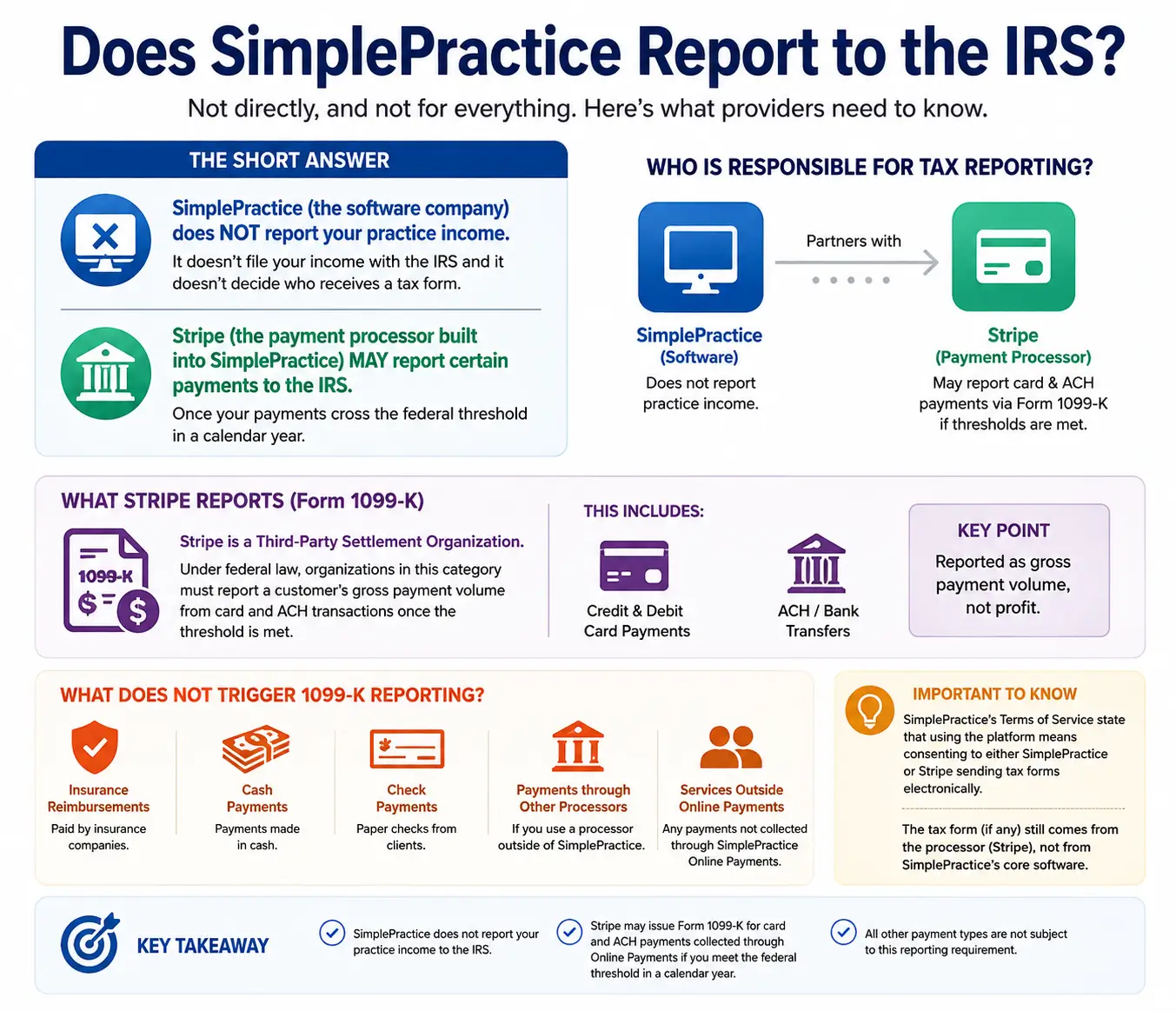
Not directly, and not for everything. SimplePractice doesn’t file a practice’s income with the IRS, and it doesn’t decide who receives a tax form. That responsibility sits with its payment processor, Stripe, which SimplePractice partners with to run its built-in Online Payments feature (sometimes called SimplePractice Payments informally). Under federal law, Stripe qualifies as a third-party settlement organization, the same category that covers PayPal, Venmo business accounts, and Square. Organizations in that category must report a customer’s gross card and ACH payment volume to the IRS once it crosses a set threshold, using Form 1099-K.
So the accurate answer has two parts. SimplePractice, the software company, does not report practice income. Stripe, the processor built into SimplePractice, may report one specific category of income (card and ACH payments collected through Online Payments) once a practice crosses the federal threshold in a calendar year. Everything else, including insurance reimbursements, cash, checks, and payments run through an outside processor, sits outside that reporting requirement entirely.
This distinction trips up a lot of providers, partly because SimplePractice’s terms of service state that using the platform means consenting to either SimplePractice or Stripe sending tax forms electronically, which is likely where the idea of “SimplePractice reporting” originates. The form itself still comes from the processor acting as a settlement organization, not from SimplePractice’s core software tracking practice revenue.
Does SimplePractice provide a 1099, or a 1099-K?
Terminology gets sloppy here. Searchers often ask whether SimplePractice “provides a 1099,” but more than 20 different 1099 forms exist, and the one relevant to SimplePractice is specifically Form 1099-K, Payment Card and Third Party Network Transactions.
Form 1099-NEC, the form most people picture when they hear “1099,” reports nonemployee compensation. A business issues a 1099-NEC when it pays an independent contractor for services rendered to that business. That isn’t the relationship between a provider and SimplePractice. Providers pay SimplePractice a monthly subscription fee for software access; SimplePractice doesn’t pay providers for anything. No nonemployee compensation flows in that direction, so a 1099-NEC has no reason to exist between the two parties. (The same law also raised the 1099-NEC threshold from $600 to $2,000, though that affects businesses paying contractors, not the SimplePractice-provider relationship.)
Form 1099-K works differently. It doesn’t report payment for services rendered to the issuer. It reports the total volume of card and third-party network payments that moved through a processor on someone’s behalf, regardless of who the customer was. Stripe issues 1099-K forms because it settles card payments for SimplePractice users, not because it employed or contracted them. That’s the only 1099 form SimplePractice’s payment infrastructure generates.
One caveat for billing students: an insurance payer that pays a provider directly outside a standard claims and EFT process, such as certain employee assistance programs, could issue its own 1099-NEC or 1099-MISC. That form comes from the payer directly, never from SimplePractice.
What your SimplePractice 1099-K includes, and what it leaves out
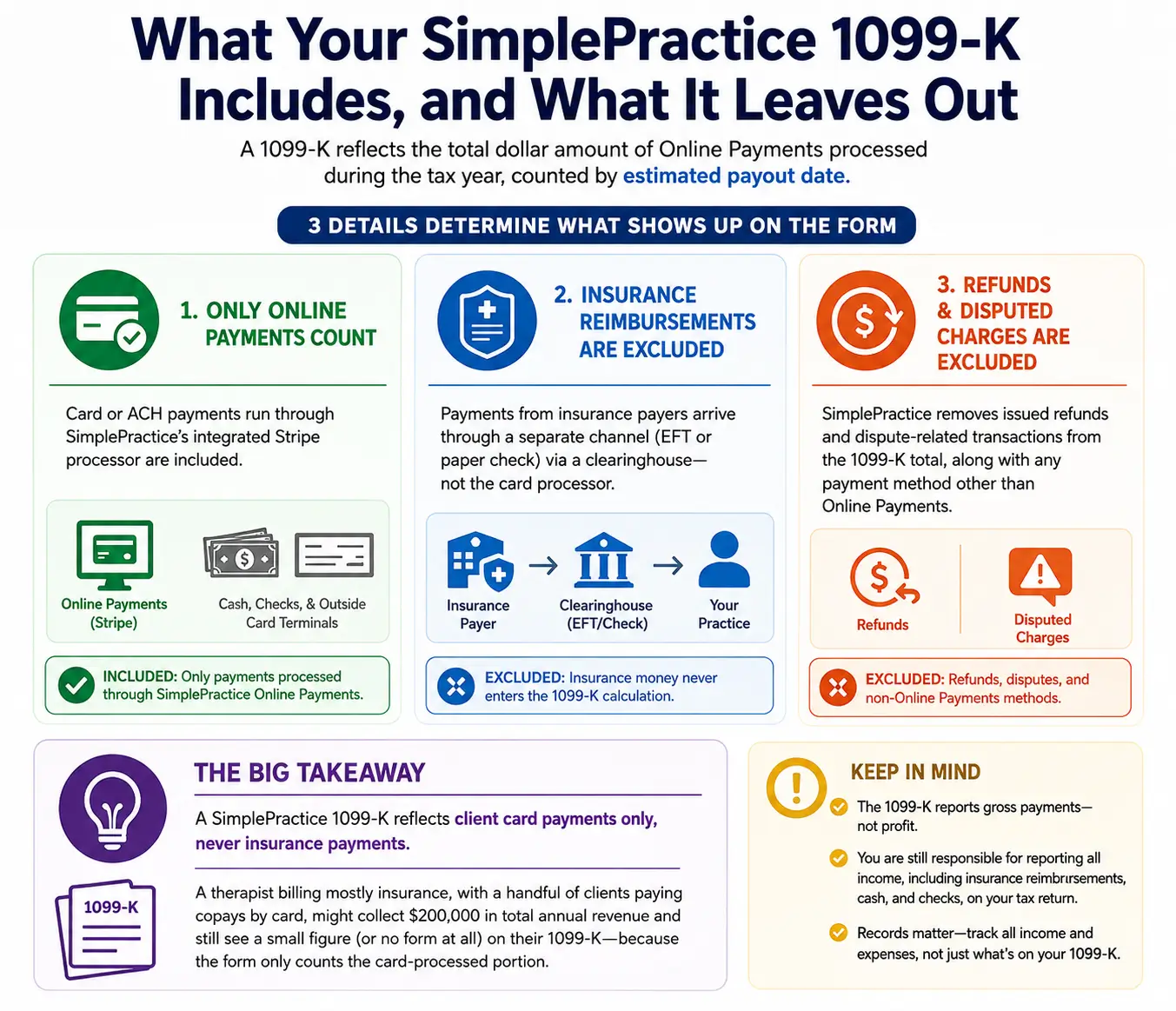
According to SimplePractice’s support documentation, a 1099-K reflects the total dollar amount of Online Payments processed during the tax year, counted by estimated payout date rather than the date a charge was entered. Three details determine what actually shows up on the form:
- Only Online Payments count. Card or ACH payments run through SimplePractice’s integrated Stripe processor are included. Cash, checks, and cards processed through an outside terminal are not, because that money never passes through SimplePractice.
- Insurance reimbursements are excluded. Payments from insurance payers arrive through a separate channel entirely, electronic funds transfer or paper check, routed through a clearinghouse rather than the card processor. Since the 1099-K only reports payment card and third-party network transactions, insurance money never enters the calculation.
- Refunds and disputed charges are excluded. SimplePractice removes issued refunds and dispute-related transactions from the 1099-K total, along with any payment method other than Online Payments.
This is the most misunderstood part of SimplePractice’s tax reporting: a SimplePractice 1099-K reflects client card payments only, never insurance payments. A therapist billing mostly insurance, with a handful of clients paying copays by card, might collect $200,000 in total annual revenue and still see a small figure (or no form at all) on their 1099-K, because the form only counts the card-processed portion.
The 1099-K reporting threshold: what changed, and what applies now
Few parts of the tax code have shifted as often as the 1099-K threshold over the past five years, and providers who last checked in 2022 or 2023 are likely working from outdated numbers.
From the form’s creation in 2011 through 2021, the threshold sat at more than $20,000 in gross payments and more than 200 transactions. The American Rescue Plan Act of 2021 rewrote that rule, dropping it to $600 with no transaction minimum, set to begin with tax year 2022. The IRS delayed enforcement repeatedly, keeping the old $20,000/200-transaction rule in place through 2023 as transition relief, then began an actual phase-in under IRS Notice 2024-85: $5,000 for tax year 2024, with plans to drop further to $2,500 for 2025 and $600 for 2026.
Congress reversed course before that plan finished playing out. The One Big Beautiful Bill Act (OBBBA), signed into law on July 4, 2025, retroactively reinstated the pre-2021 threshold of more than $20,000 and more than 200 transactions, applied back to 2022. The IRS confirmed the change in Fact Sheet 2025-08, published October 23, 2025, stating that third-party settlement organizations are no longer required to file Form 1099-K unless a payee’s gross payments exceed $20,000 and their transaction count exceeds 200 in a calendar year.
Tax year | Federal 1099-K threshold | Status |
2011 to 2021 | Over $20,000 and over 200 transactions | Original rule |
2022 (as written by ARPA) | $600, no transaction minimum | Delayed, never enforced |
2022 and 2023 (as enforced) | Over $20,000 and over 200 transactions | Transition relief |
2024 | $5,000, no transaction minimum | Phase-in step, IRS Notice 2024-85 |
2025 (as originally planned) | $2,500, no transaction minimum | Superseded before taking effect |
2025 and forward | Over $20,000 and over 200 transactions | Current rule under the OBBBA |
SimplePractice’s own 1099-K guidance, last updated in April 2026, reflects this reinstated threshold for tax year 2025: an account needs more than $20,000 in gross volume and more than 200 transactions before Stripe issues a form. Some states set lower thresholds than the federal rule; SimplePractice doesn’t publish a specific list and recommends confirming state requirements with a tax professional.
How to get your 1099-K from SimplePractice
For practices that cross the threshold, SimplePractice generates the form automatically; nobody needs to request it. A few practical details make the process easier to follow:
- Watch for an email notification. SimplePractice notifies the account owner once a 1099-K is ready, typically as tax season approaches.
- Find it under Business files. Log in and go to Settings, then Practice, then Business files to view or download the form.
- Expect electronic delivery. Physical copies aren’t mailed to active accounts. Accepting SimplePractice’s terms of service means consenting to receive 1099-Ks and related tax notices electronically.
- Closed the account? It still arrives. If a practice qualifies for a 1099-K but no longer has an active SimplePractice account, the form is mailed instead, to the business address on file.
- One form per practice. SimplePractice issues a single 1099-K to the account owner; individual clinicians in a group practice don’t each receive a separate copy.
IRS rules require these forms to reach recipients by January 31 of the following year. If that date passes with nothing in Business files, contacting SimplePractice support is faster than assuming the form was never generated.
Annual financial activity report vs. 1099-K: two different documents
A second SimplePractice document adds to the confusion, partly because it used to share a name with a tax form. SimplePractice’s annual financial activity report, previously called the Tax Report, can be generated from Analytics, then Reports, at the start of each year. Despite the old name, SimplePractice states directly that this report “isn’t the same as a 1099-K, or other reports that may be required to file taxes.”
These two SimplePractice tax documents serve different purposes, which explains why some providers assume insurance payments appear on a 1099-K when they don’t. The annual financial activity report captures everything for bookkeeping purposes: client payments, insurance payments, write-offs, subscription costs, and card processing fees (listed as Stripe processing expense). The 1099-K stays narrow on purpose: one category of payment, from one processor, tracked for one purpose, tax compliance.
Form 1099-K | Annual financial activity report | |
Issued by | Stripe, SimplePractice’s payment processor | Generated inside SimplePractice |
Official IRS tax document | Yes | No |
Includes insurance payments | No | Yes |
Includes cash, check, or external card payments | No | Yes |
Includes refunds and disputes | No | Yes |
Payment date used | Estimated payout date | Date the payment was entered |
Who can access it | Only accounts that cross the IRS threshold | Any practice, for the prior two years |
Where to find it | Settings, Practice, Business files | Analytics, Reports |
Reports older than two years aren’t retained. Once the report for a new year becomes available, the version from two years prior disappears from the account, so providers who need older records should download them before that window closes.
Is SimplePractice a clearinghouse?
No. SimplePractice is a practice management and EHR platform, not a clearinghouse. The distinction matters for the IRS question because it explains why insurance income never touches the 1099-K pathway.
A clearinghouse checks an electronic insurance claim for errors or missing information, then forwards it to the correct payer using EDI, or electronic data interchange. SimplePractice submits claims through clearinghouse partners to reach as many insurance payers as possible, but the software itself never settles or reports that money to the IRS. Neither does the clearinghouse. Its role ends at transmitting and correcting claims.
What clearinghouse does SimplePractice use?
SimplePractice’s own support documentation states that it works with multiple clearinghouses rather than a single one, and it doesn’t publish their names to customers. That’s a deliberate setup: clearinghouses don’t have access to individual SimplePractice accounts and won’t respond to a provider who contacts them directly. If a claim or payment report runs into trouble, SimplePractice’s support team is the correct contact, and staff will reach out to the clearinghouse on the provider’s behalf when needed.
For billing students, this is a common industry pattern: larger EHR platforms rarely rely on a single clearinghouse relationship, since multiple partnerships mean broader payer coverage and more redundancy, at the cost of less transparency about which company handled a given claim.
How to report taxes on SimplePractice billing
Whether or not a 1099-K arrives, every dollar a private practice earns is taxable income, and the provider, not SimplePractice, carries the responsibility for reporting it. Most solo providers report practice income on Schedule C of their personal return; providers organized as an S corporation or partnership report it through their business return instead.
Reconciling SimplePractice’s records against actual filed income takes three separate figures, not one:
- The 1099-K, if received, covers only card and ACH payments processed through Online Payments, minus refunds and disputes.
- The annual financial activity report covers client payments, insurance payments, write-offs, and fees, but isn’t itself a filing document.
- Actual bank deposits, which should match the practice’s books once processing fees, refunds, and any payments collected outside SimplePractice are accounted for.
Processing fees deserve their own line item in this payment reconciliation. SimplePractice’s Online Payments feature charges 3.15% plus $0.30 per successful transaction. Those fees are generally a deductible business expense, separate from the gross revenue figure that appears on a 1099-K, and the annual financial activity report itemizes them for that reason.
Providers who bill primarily through insurance shouldn’t expect a 1099-K to reflect much of their income. A practice collecting $150,000 a year, with $130,000 from insurance and $20,000 from card copays, would see only that card-processed portion (if it even crosses 200 transactions) on a 1099-K. The remaining $130,000 is just as taxable. A tax professional familiar with private practice, ideally one who has worked with mental health or allied health providers, can help reconcile these figures and flag deductible expenses specific to running a practice.
Mistakes providers make when reconciling SimplePractice income
A few patterns show up often enough in billing forums and practice management groups to name directly.
Some providers assume that not receiving a 1099-K means they had no reportable income for the year. They did. The threshold determines whether a form gets generated, not whether the underlying income counts as taxable.
Others treat the annual financial activity report as a substitute tax document, sometimes handing it to a preparer as if it were a 1099-K. SimplePractice’s own FAQ warns against this directly, and a preparer working from the wrong report risks misclassifying income or missing deductible fees.
In group practices, administrators sometimes expect each clinician to receive an individual 1099-K for their own client payments. SimplePractice issues one form per practice, addressed to the account owner, regardless of how many clinicians see clients under that account; payroll and income allocation get handled separately, typically through SimplePractice’s income allocation report on the Plus plan.
Finally, some providers read the gross figure on a 1099-K as their net income from card payments. It isn’t. The form excludes refunds and disputes but says nothing about processing fees, which still come out of the deposited amount and need separate tracking for an accurate profit and loss picture.
Where this leaves your practice
So, does SimplePractice report to the IRS? Not on its own, and not for everything. SimplePractice’s payment processor, Stripe, reports card and ACH payments through Form 1099-K once a practice crosses $20,000 in gross volume and 200 transactions in a calendar year, a threshold Congress restored through the One Big Beautiful Bill Act after several years of planned reductions. Insurance reimbursements, cash, checks, and payments run through outside processors stay outside that form entirely, regardless of size.
None of that changes what belongs on a tax return. Every dollar a practice collects counts as reportable income, whether a 1099-K shows up in January or not. The safer approach treats SimplePractice’s reports, the 1099-K when issued and the broader annual financial activity report, as reconciliation tools rather than the full picture, with a tax professional confirming the final numbers before filing.