


Cardiology clinics submit thousands of claims each year for ultrasound imaging of the heart. Selecting the correct Echo CPT Code ensures clinics receive payment for their services and avoid audits from Medicare. The American Medical Association (AMA) categorizes these procedures based on anatomical focus, patient age, and the exact ultrasound technologies applied.
A tiny omission in the clinical notes can lead to a rejected claim. Medical billers must verify that the physician’s dictation exactly matches the requirements for the chosen procedure code. Commercial payers and federal administrators heavily scrutinize diagnostic imaging. A deep understanding of Echocardiography Billing rules protects a clinic from revenue loss and compliance penalties.
Transthoracic guidelines and the primary Echo CPT Code
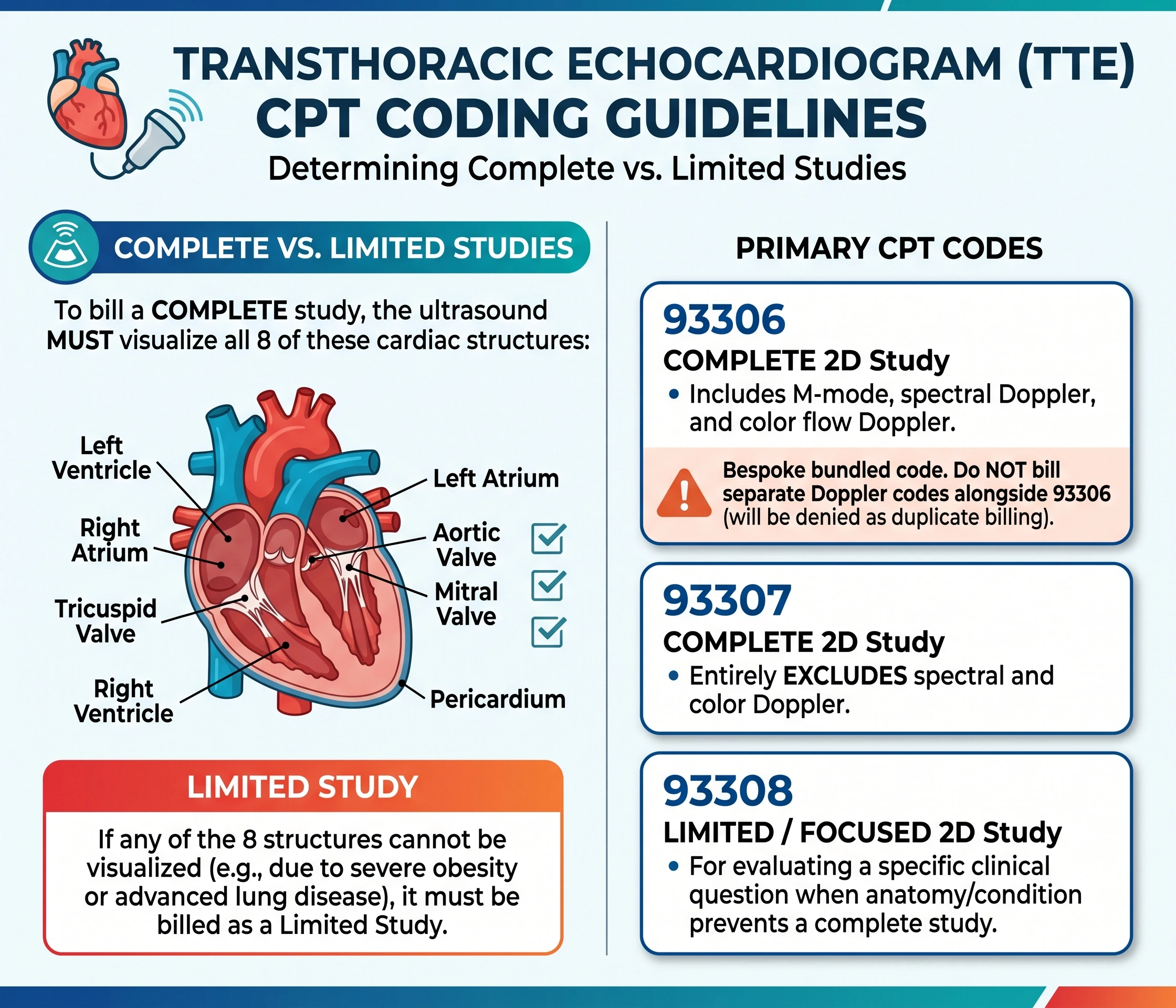
The most common cardiac ultrasound occurs across the chest wall. The AMA separates standard transthoracic tests into complete and limited studies. Correctly identifying the scope of the examination is the first step in medical coding.
To submit a Complete Echocardiogram CPT Code, the ultrasound technician must image specific cardiac structures. The American Society of Echocardiography (ASE) dictates that a complete examination requires visual assessment of the left ventricle, right ventricle, left atrium, right atrium, aortic valve, mitral valve, tricuspid valve, and the pericardium.
If a patient’s physical anatomy prevents the sonographer from viewing one of these structures, the exam is incomplete. A patient with severe obesity or advanced lung disease might not present clear imaging windows. The medical coder must then submit a Limited Echocardiogram CPT Code instead.
Specific base codes define the procedure:
- 93306 CPT Code: Represents a complete 2D study that includes M-mode recording, spectral Doppler, and color flow Doppler.
- 93307 CPT Code: Represents a complete 2D study that entirely excludes both spectral and color Doppler.
- 93308 CPT Code: Represents a focused or limited 2D study to evaluate a specific clinical question.
The 93306 code bundles the Doppler services. Years ago, coders submitted separate lines for the 2D ultrasound and the Doppler evaluations. The AMA combined them to simplify Claim Submission. Today, if a clinic bills 93306 alongside individual Doppler codes, the payer will deny the claim as duplicate billing.
Applying add-on codes for Doppler ultrasound
Sometimes a physician orders a limited baseline study but still requires Doppler technology to evaluate blood velocity. In these cases, the coder must submit the base code and attach the specific Doppler codes.
Doppler measures the speed and direction of blood flow through the heart valves. Color flow assigns visual hues to the blood based on its movement relative to the ultrasound probe. Spectral provides a graph of blood velocity.
For example, if the sonographer performs a limited echo to check for mitral regurgitation and uses color flow mapping, the coder submits the 93308 code on line one. They then add the 93325 CPT Code to represent the color flow Doppler.
Spectral Doppler requires different codes. Code 93320 indicates a complete spectral study. Code 93321 indicates a limited spectral study. Auditors routinely review claims that combine a limited 2D Echo CPT Code with Doppler add-on codes to verify the Medical Necessity of the extra testing. Clinics cannot automatically append Doppler codes to a 93308 study without a written order justifying the need for flow measurements.
Pediatric and congenital coding structures
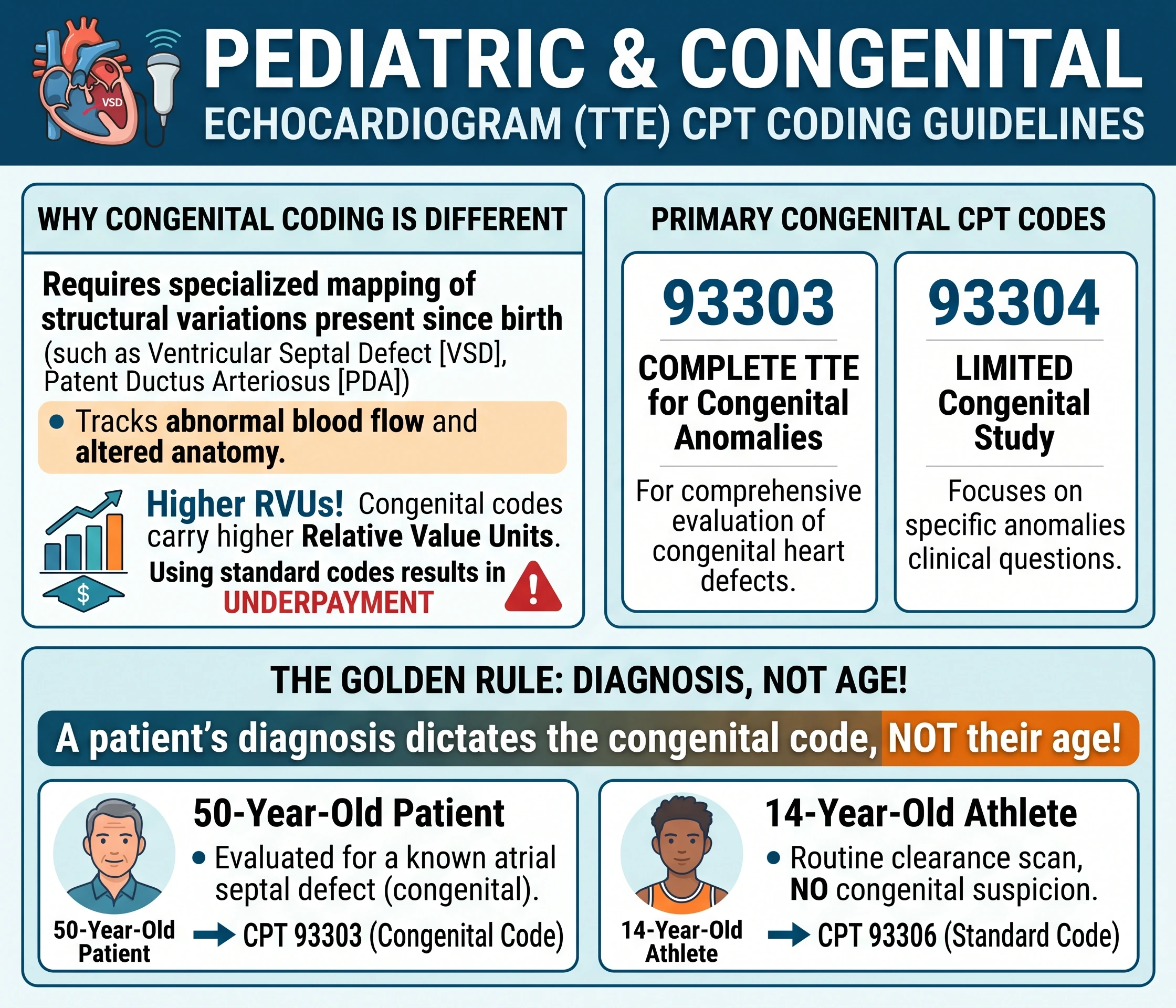
The AMA maintains separate codes for patients evaluated for congenital heart defects. Congenital ultrasound mapping requires different techniques than standard adult imaging. The technician must track abnormal blood flow and identify structural variations present since birth, such as a ventricular septal defect or a patent ductus arteriosus.
The 93303 CPT Code represents a complete transthoracic echocardiogram for congenital anomalies. The 93304 CPT Code represents a limited congenital study.
The patient’s exact diagnosis dictates the use of a Pediatric Echocardiogram CPT Code. Patient age does not determine the code. If a 50-year-old patient requires imaging for a known atrial septal defect, the clinic bills the 93303 code. If a 14-year-old athlete needs a routine clearance scan without any congenital suspicion, the clinic bills the standard 93306 code.
Using adult codes for complex congenital studies results in underpayment. The congenital codes carry higher relative value units to compensate for the extra time the sonographer spends mapping altered anatomy.
Transesophageal and stress testing rules
A transesophageal echocardiogram requires passing an ultrasound probe down the esophagus to view the posterior heart structures. Cardiologists frequently use this method to check the left atrial appendage for blood clots prior to performing an electrical cardioversion.
The primary adult TEE CPT Code is 93312. This specific code covers probe placement, image capture, and medical interpretation.
Physicians often split this work. A gastroenterologist may place the probe while a cardiologist handles the ultrasound. CPT Coding rules require split billing when this happens. Code 93313 pays the physician who inserts the probe. Code 93314 pays the physician who acquires the images and writes the report.
Cardiologists also monitor heart function under physical strain. They induce stress using a treadmill protocol or by injecting pharmacological agents like dobutamine. The standard Stress Echo CPT Code is 93351. This code pays for continuous electrocardiographic monitoring, resting images, post-stress images, and physician supervision.
Code 93350 applies when the physician performs the imaging but someone else manages the continuous ECG monitoring. This scenario frequently occurs in hospital outpatient departments, where the facility handles the physical stress test portion and the cardiologist strictly reads the ultrasound data.
Contrast injections and fetal evaluations
Sometimes standard imaging fails to produce clear borders. In other cases, physicians need to evaluate patients before they are even born. Both scenarios require specific coding pathways.
Bubble studies and contrast agents
Standard manuals do not list a single, bundled Echo with Bubble Study CPT Code. A bubble study requires the injection of agitated saline to identify right-to-left cardiac shunts.
Coders bill the primary Echocardiogram Procedure Code and attach HCPCS code A4220 for the saline flush. They also submit CPT code 96374 for the intravenous injection.
When clinics use pharmacological contrast agents (like Lumason or Definity) to improve image quality, the clinical notes must explicitly state that the resting images were inadequate. Medicare will not pay for the contrast agent unless the documentation proves the standard scan failed to visualize the left ventricular endocardial borders.
Fetal cardiology rules
Maternal-fetal medicine doctors perform specialized scans between 18 and 22 weeks of pregnancy. The primary Fetal Echocardiogram CPT Code is 76825. This covers a complete cardiovascular evaluation of the fetus. Code 76827 covers a limited study.
Payers deny these claims if the clinic bills them as routine screenings. The medical record must show a high-risk indication. Acceptable triggers include maternal type 1 diabetes, a family history of heart defects, or an abnormal four-chamber view detected during a standard obstetric ultrasound.
Echocardiography Billing compliance and modifiers
Insurance companies process claims based on exact modifiers. These two-digit additions tell the payer who owns the equipment and who provided the medical expertise.
- Modifier 26 represents the professional component. The physician bills this when they interpret the images and write the report, but do not own the ultrasound machine.
- Modifier TC represents the technical component. The facility bills this to cover the cost of the machine, the room, and the ultrasound technician’s labor.
- Global billing requires no modifier. A private clinic uses this method when they own the equipment, employ the staff, and provide the medical interpretation.
The Centers for Medicare and Medicaid Services (CMS) publishes Local Coverage Determinations outlining the exact ICD-10 diagnosis codes that prove a test was necessary. A 2021 report from the Office of Inspector General found that Medicare routinely overpaid for cardiac imaging because clinics submitted complete codes when they actually performed limited studies.
If a patient receives a full 93306 scan on a Monday, an outpatient clinic cannot bill another 93306 scan on a Wednesday unless the clinical notes detail a severe, acute change in symptoms. Routine rechecks require a limited CPT Code for Echocardiogram services.
Echo Billing accuracy requires the physician’s order, the technician’s log, and the final report to match perfectly. If the order asks for a limited scan but the technician performs a complete scan, Coding Compliance rules force the biller to submit the lower-level limited code. Clinics can only bill for what the physician originally requested.
Accurate CPT Code for Echo submissions require precise clinical documentation and strict adherence to AMA guidelines. Medical coders must evaluate the exact scope of the examination, the use of Doppler technology, and the specific patient diagnosis before submitting a claim. Clinics that enforce strict Documentation Requirements and align their practices with Payer Requirements experience fewer denials and maintain a stable revenue cycle.
Zimerov Ertover
I think this is one of the most vital info for me. And i am glad reading your article. But should remark on few general things, The site style is perfect, the articles is really excellent :D. Good job, cheers