


A patient comes in for a knee injection, a wellness visit, or a follow-up on hypertension, and the medication list includes Eliquis. Nothing about the visit relates to anticoagulation directly, but the coder still has to decide whether that detail belongs on the claim. Usually it does. The code most billers reach for is Z79.01, long term (current) use of anticoagulants, and it appears on a large share of cardiology, primary care, and post-surgical claims. Getting the Eliquis ICD 10 code right, and pairing it correctly with the diagnosis that put the patient on the drug in the first place, affects claim acceptance, risk-adjustment accuracy, and how complete the patient’s coded history looks to the next provider who reads it.
This piece works through what Z79.01 covers, when it applies to a patient taking apixaban (Eliquis’s generic name), how to sequence it against the underlying diagnosis, and where coders most often get it wrong.
What Z79.01 actually covers
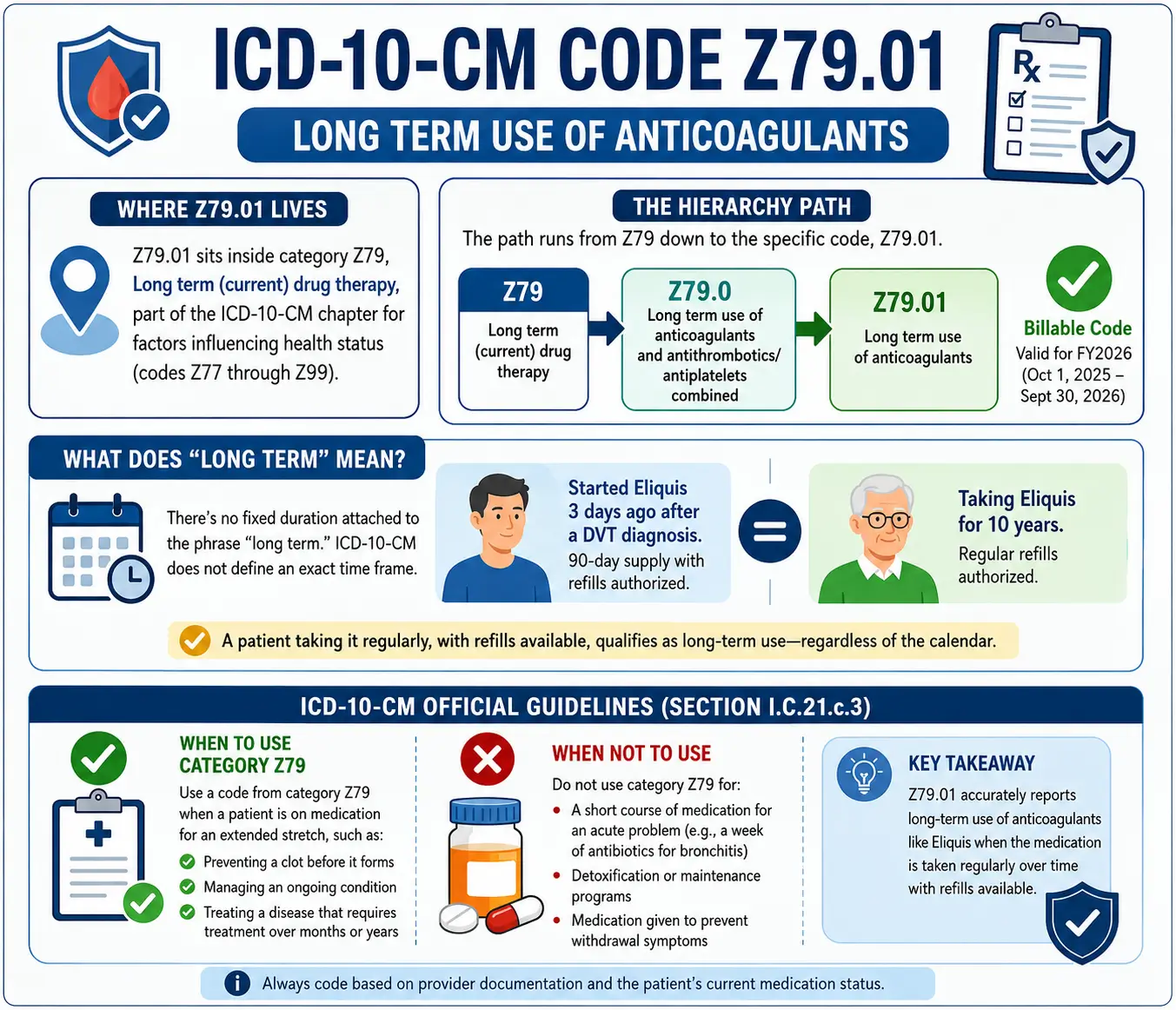
Z79.01 sits inside category Z79, long term (current) drug therapy, part of the ICD-10-CM chapter for factors influencing health status (codes Z77 through Z99). The path runs from Z79 down through Z79.0, long term use of anticoagulants and antithrombotics/antiplatelets combined, to the specific code, Z79.01. It’s billable, and valid for the fiscal year running from October 1, 2025 through September 30, 2026 under the current FY2026 ICD-10-CM code set.
There’s no fixed duration attached to the phrase “long term.” The reference guide Basic ICD-10-CM and ICD-10-PCS Coding notes that ICD-10-CM never spells out exactly how long a patient must be on a drug before it counts as long-term use; a patient taking it regularly, with refills available, qualifies regardless of the calendar. A patient started on Eliquis three days ago after a DVT diagnosis, with a 90-day supply and refills authorized, meets that standard the same as someone who has taken it for a decade.
The ICD-10-CM Official Guidelines for Coding and Reporting address category Z79 in section I.C.21.c.3. A code from this category applies whenever a patient is on medication for an extended stretch, whether that means preventing a clot before it forms, managing an ongoing condition, or working through a disease that requires treatment over months or years. It doesn’t apply to a short course of medication for an acute problem, such as a week of antibiotics for bronchitis, and it isn’t used to report detoxification, maintenance programs, or medication given to prevent withdrawal symptoms.
Why Eliquis patients carry this code
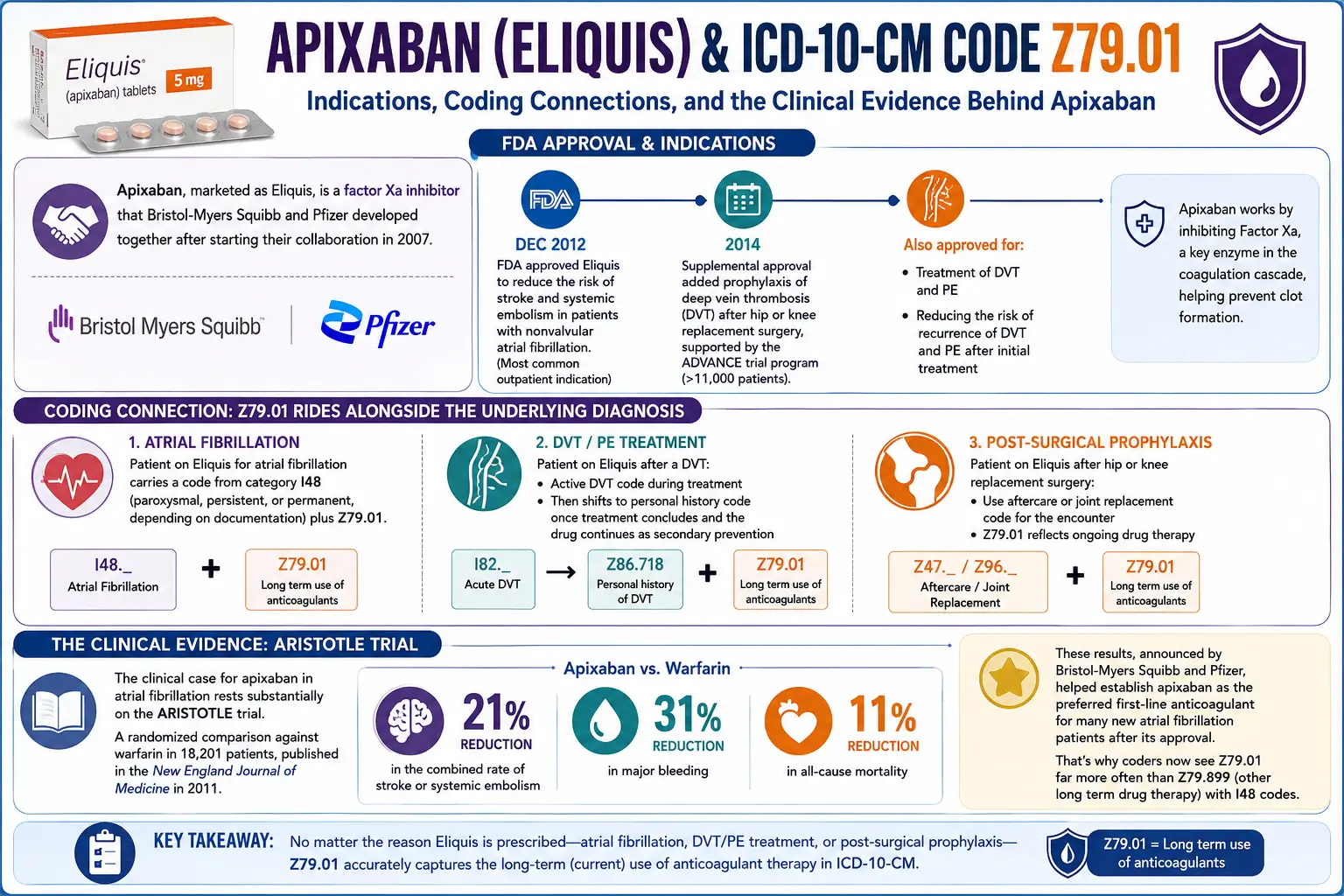
Apixaban, marketed as Eliquis, is a factor Xa inhibitor that Bristol-Myers Squibb and Pfizer developed together after starting their collaboration in 2007. The FDA approved it in December 2012 to reduce the risk of stroke and systemic embolism in patients with nonvalvular atrial fibrillation, still its most common indication in outpatient coding. A supplemental approval followed in 2014, adding prophylaxis of deep vein thrombosis (which can lead to pulmonary embolism) after hip or knee replacement surgery, supported by the ADVANCE trial program’s data on more than 11,000 patients. Eliquis also covers treatment of DVT and PE, and reducing the risk of recurrence after initial treatment.
Each indication maps to a different underlying diagnosis code, and Z79.01 rides alongside whichever one applies. A patient on Eliquis for atrial fibrillation carries a code from category I48 (paroxysmal, persistent, or permanent, depending on documentation) plus Z79.01. A patient on it after a DVT carries the active DVT code during treatment, then shifts to a personal history code once treatment concludes and the drug continues as secondary prevention. A patient on it for post-surgical prophylaxis carries the aftercare or joint replacement code for the encounter, with Z79.01 reflecting the ongoing drug therapy underneath it.
The clinical case for apixaban in atrial fibrillation rests substantially on the ARISTOTLE trial, a randomized comparison against warfarin in 18,201 patients, published in the New England Journal of Medicine in 2011. Apixaban reduced the combined rate of stroke or systemic embolism by 21 percent compared with warfarin, cut major bleeding by 31 percent, and lowered mortality by 11 percent, according to results announced by the trial’s sponsors, Bristol-Myers Squibb and Pfizer. Those numbers are a large part of why apixaban displaced warfarin as the default choice for new atrial fibrillation patients in the years after approval, and why coders now see Z79.01 far more often than Z79.899, other long term drug therapy, attached to an atrial fibrillation chart.
Sequencing Z79.01 with the diagnosis it supports
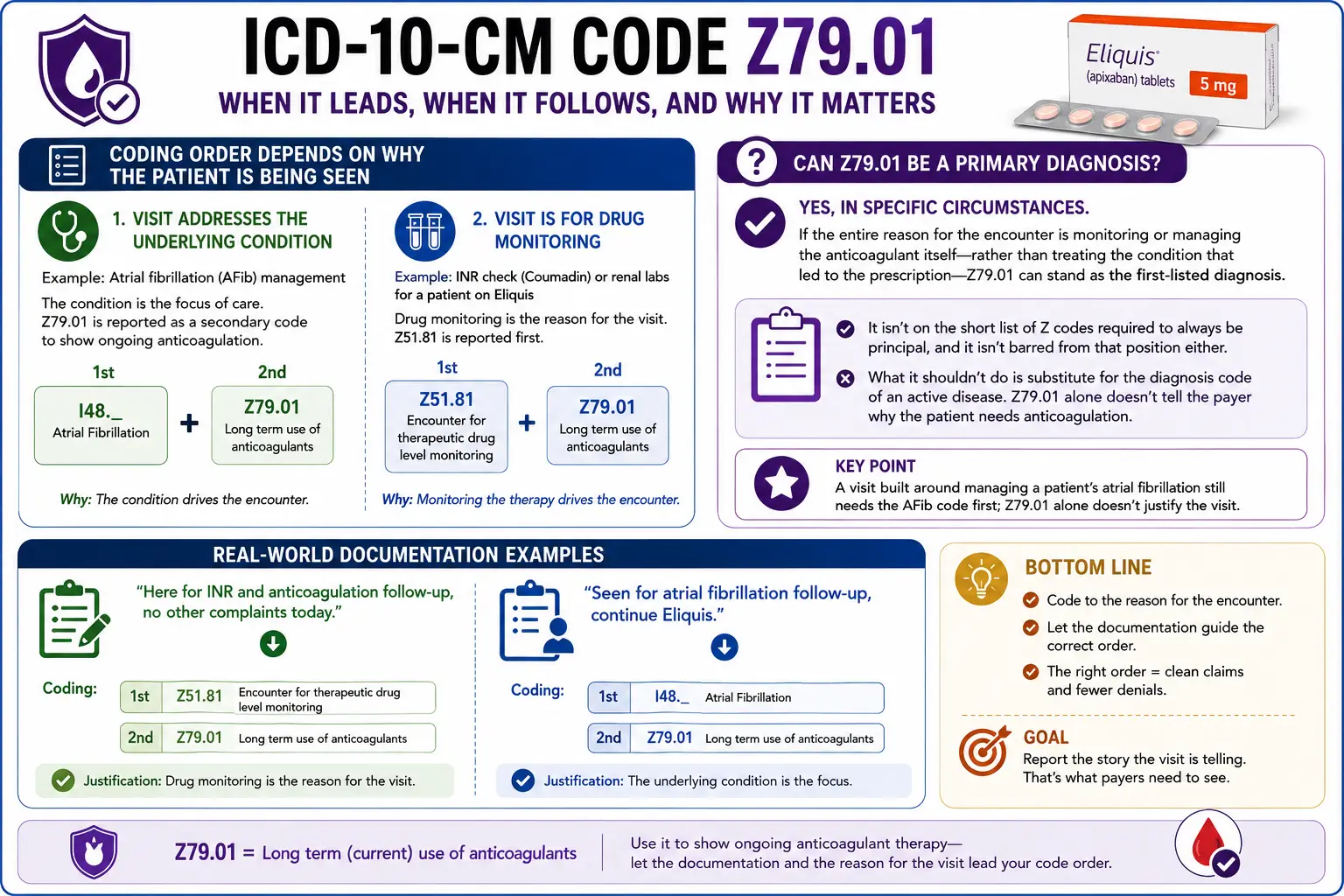
Coding order depends on why the patient is being seen. When the visit addresses the underlying condition itself, atrial fibrillation management, for example, the AFib code comes first and Z79.01 follows as a secondary code documenting ongoing anticoagulation status. When the visit exists specifically to monitor the drug (an INR check for a patient on Coumadin, or periodic renal function labs for a patient on Eliquis), the encounter code Z51.81, encounter for therapeutic drug level monitoring, leads, with Z79.01 as the secondary code explaining what’s being monitored and why.
Can Z79.01 be a primary diagnosis?
Yes, in specific circumstances. If the entire reason for the encounter is monitoring or managing the anticoagulant itself, rather than treating the condition that led to the prescription, Z79.01 can stand as the first-listed diagnosis. It isn’t on the short list of Z codes required to always be principal, and it isn’t barred from that position either. What it shouldn’t do is substitute for the diagnosis code of an active disease. A visit built around managing a patient’s atrial fibrillation still needs the AFib code first; Z79.01 alone doesn’t tell the payer why the patient needs anticoagulation.
Coders who bill for anticoagulation clinics run into this distinction constantly. A note reading “here for INR and anticoagulation follow-up, no other complaints today” supports Z51.81 as primary with Z79.01 secondary. A note reading “seen for atrial fibrillation follow-up, continue Eliquis” supports the AFib code as primary with Z79.01 secondary. The wording sounds like a small difference, but it changes which diagnosis justifies the visit on the claim.
Z79.01, Z79.02, and Z79.82 are not interchangeable
Category Z79.0 covers both anticoagulants and antithrombotics/antiplatelets, but splits them into separate codes, and aspirin gets pulled out entirely into its own code under a different subcategory. Mixing these three up is one of the more common errors on claims involving blood thinners.
Code | Covers | Typical drugs |
Z79.01 | Long term use of anticoagulants | Eliquis (apixaban), Xarelto (rivaroxaban), Pradaxa (dabigatran), Coumadin (warfarin), Lovenox (enoxaparin), heparin |
Z79.02 | Long term use of antithrombotics/antiplatelets | Plavix (clopidogrel), Brilinta (ticagrelor), Effient (prasugrel) |
Z79.82 | Long term use of aspirin | Aspirin, including low-dose cardioprotective aspirin |
Eliquis and the other drugs in the first row work by inhibiting clotting factors directly (apixaban and rivaroxaban block factor Xa, dabigatran blocks thrombin, warfarin blocks vitamin K-dependent factor synthesis). Antiplatelet drugs work differently, preventing platelets from clumping together rather than interrupting the coagulation cascade, which is why ICD-10-CM treats them as a separate code instead of a subtype of Z79.01. A patient taking both Eliquis and low-dose aspirin commonly prescribed after certain cardiac procedures should have both Z79.01 and Z79.82 reported on the same claim.
Coding the condition behind the prescription
Atrial fibrillation gets documented and billed with more granularity than many coders expect. ICD-10-CM category I48 breaks it into paroxysmal (I48.0), persistent (I48.11 for longstanding persistent, I48.19 for other persistent), chronic (I48.20), permanent (I48.21), and unspecified (I48.91) subtypes, and payers increasingly expect the specific subtype when documentation supports it rather than the unspecified code out of habit.
Venous thromboembolism history has its own recent wrinkle. Z86.71, personal history of venous thrombosis and embolism, used to be billable on its own, but it was converted into a non-specific category header and is no longer valid for claims. Coders now need one of the two codes underneath it: Z86.711 for a personal history of pulmonary embolism, or Z86.718 for a personal history of other venous thrombosis and embolism, which covers DVT. Practices that haven’t updated their encounter templates or superbills since this change are still generating claims with the old, invalid parent code, and those claims come back rejected or downcoded.
For a patient actively being treated for a new DVT or PE, the active venous thromboembolism code applies during treatment, with Z79.01 documenting the anticoagulant alongside it. Once the acute episode resolves and Eliquis continues purely to prevent recurrence, the diagnosis shifts to the personal history code, Z86.711 or Z86.718, alongside Z79.01.
When Eliquis causes bleeding instead of preventing it
Like all anticoagulants, Eliquis carries a risk of bleeding. Its boxed warning emphasizes two major safety concerns: an increased risk of stroke or other thrombotic events if the medication is discontinued too early without appropriate alternative anticoagulation, and the risk of epidural or spinal hematoma in patients undergoing neuraxial anesthesia or spinal puncture, which may result in permanent or long-term paralysis. While these issues are not directly related to ICD-10 coding, they underscore the importance of accurate documentation when initiating, discontinuing, or bridging anticoagulant therapy.
When a patient bleeds while on Eliquis, code selection depends on what’s actually documented. T45.515A, adverse effect of anticoagulants (initial encounter), applies when a provider documents a reaction to a properly prescribed and administered dose. D68.32, hemorrhagic disorder due to extrinsic circulating anticoagulants, is reserved for a genuine coagulation defect, not simply a patient who bled while on Eliquis. This distinction has caused real disagreement inside the coding community. AHA Coding Clinic for ICD-10-CM/PCS, First Quarter 2016, directed coders to assign D68.32 for bleeding related to anticoagulant therapy, while the AHA’s own 2016 ICD-10 coding handbook didn’t apply that code to comparable examples in its chapter on the subject. Coders still debate whether a physician needs to document an actual hemorrhagic disorder, rather than just a bleeding site and its cause, before D68.32 is appropriate. When the documentation is ambiguous, querying the provider beats guessing.
Emergency department charts add another layer. A fall or head injury in a patient on Eliquis gets its own injury code (a fall code from category W, or an intracranial injury code from category S06, depending on findings), with Z79.01 listed secondary to flag the bleeding risk that shapes the workup, not because the fall itself counts as an adverse drug effect.
If a patient has a documented allergy to apixaban itself, rather than an adverse bleeding event, report Z88.8 (Allergy status to other drugs, medicaments, and biological substances). ICD-10-CM does not provide a drug allergy status code specific to anticoagulants, so Z88.8 is the appropriate choice.
Eliquis ICD 10 codes at a glance
Situation | Code | Description |
Patient on ongoing Eliquis therapy | Z79.01 | Long term (current) use of anticoagulants |
Visit exists to monitor the drug | Z51.81 | Encounter for therapeutic drug level monitoring |
Reaction to a properly dosed prescription | T45.515A | Adverse effect of anticoagulants, initial encounter |
Documented coagulation defect from the drug | D68.32 | Hemorrhagic disorder due to extrinsic circulating anticoagulants |
Documented drug allergy | Z88.8 | Allergy status to other drugs, medicaments and biological substances |
History of PE, drug continues for prevention | Z86.711 | Personal history of pulmonary embolism |
History of DVT, drug continues for prevention | Z86.718 | Personal history of other venous thrombosis and embolism |
None of these replace the diagnosis that justified starting Eliquis in the first place. They describe the drug’s status and its effects; the underlying condition still needs its own code, listed according to the sequencing rules above.
How Eliquis compares with the rest of the anticoagulant class
Coding accuracy improves when billers know roughly how each anticoagulant works, since documentation habits differ across drug classes.
Drug | Generic name | Drug class | Manufacturer | Routine monitoring |
Eliquis | Apixaban | Factor Xa inhibitor | Bristol-Myers Squibb, Pfizer | None |
Xarelto | Rivaroxaban | Factor Xa inhibitor | Janssen, developed with Bayer | None |
Pradaxa | Dabigatran | Direct thrombin inhibitor | Boehringer Ingelheim | None |
Coumadin | Warfarin | Vitamin K antagonist | Multiple manufacturers | Regular INR testing |
Lovenox | Enoxaparin | Low molecular weight heparin | Sanofi-Aventis | Limited, weight-based dosing |
Heparin | Heparin (unfractionated) | Unfractionated heparin | Multiple manufacturers | aPTT monitoring, mostly inpatient |
All six code to Z79.01 when used long term, which is part of why the code appears so often on outpatient claims. Warfarin stands apart clinically because it needs routine INR draws, which is exactly the scenario where Z51.81 becomes the primary code and Z79.01 the secondary. Eliquis, Xarelto, and Pradaxa don’t require that kind of routine lab monitoring, so a visit built around one of those three drugs is less likely to have Z51.81 anywhere on the claim. Instead, the drug’s Z79.01 status tends to ride as a secondary code on visits for something else.
Generic apixaban has technically been FDA-approved since December 2019, when the agency cleared applications from Micro Labs Limited and Mylan Pharmaceuticals. It still isn’t sold in U.S. pharmacies. Patent litigation between the brand manufacturers and generic applicants pushed the earliest commercial launch date to April 1, 2028, so Eliquis remains a brand-only prescription in American billing for now, unlike Xarelto, whose first generic rivaroxaban tablets received FDA approval in March 2025. The coding doesn’t change once a generic apixaban eventually reaches pharmacy shelves; Z79.01 covers the drug class, not the brand.
Documentation gaps that lead to denials
- Listing Z79.01 without a corresponding diagnosis for why the patient needs anticoagulation, so the payer sees the drug status but not the reason behind it.
- Using the retired Z86.71 instead of Z86.711 or Z86.718, usually because a template or superbill hasn’t been updated since the code split.
- Applying D68.32 to routine, mild bleeding on a correctly dosed anticoagulant when the documentation doesn’t describe an actual coagulation defect.
- Confusing Z79.01 with Z79.02, particularly when a patient takes Eliquis alongside a separate antiplatelet drug and only one of the two codes makes it onto the claim.
- Coding unspecified atrial fibrillation (I48.91) when the chart documents a specific subtype, leaving detail on the table that a more precise code would have captured.
Roughly 3.89 percent of U.S. adults have diagnosed atrial fibrillation, according to a 2024 study in JACC: Advances that analyzed more than 259 million patient records through the Epic Cosmos platform, and about 30 percent of those patients weren’t on any anticoagulant at all. The CDC projects that 12.1 million Americans will have the condition by 2050. Given how often atrial fibrillation and Eliquis prescriptions appear together on a chart, most practices that manage anticoagulated patients will run through several of these Eliquis ICD 10 codes within a single week of billing.