


Hospitals place patients under observation status when they need extra time to determine whether a formal inpatient admission is medically necessary. During this time, the patient occupies a hospital bed and receives nursing care, testing, and physician evaluations. The patient remains an outpatient in a bed for the duration of this stay. Knowing how to bill outpatient observation services correctly requires coders to separate facility charges from professional physician services while adhering strictly to rules established by the Centers for Medicare and Medicaid Services (CMS).
Medical billers must navigate an intricate system of hourly calculations, specific revenue codes, and updated place of service rules to prevent claim denials.
What is outpatient hospital observation?
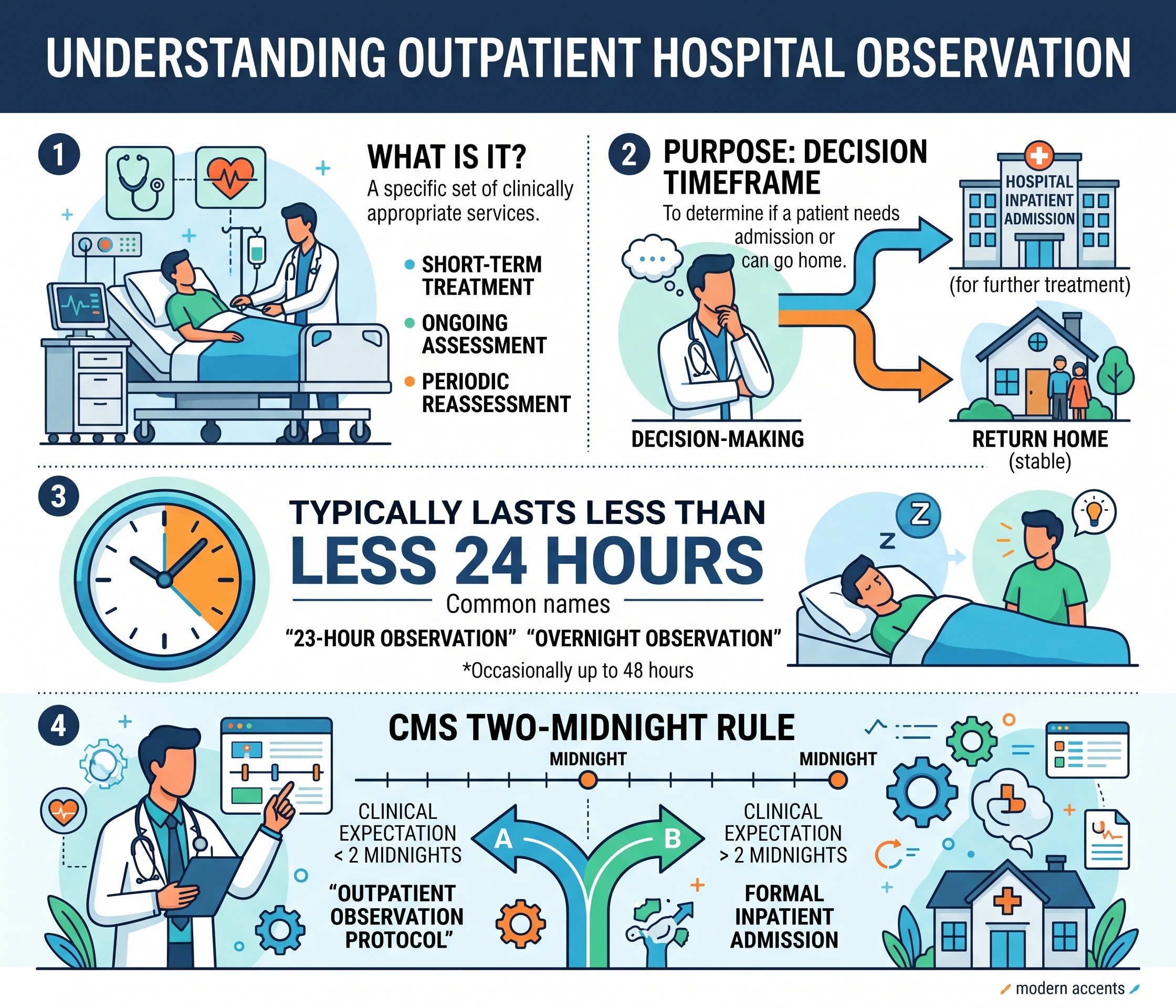
Observation care consists of a specific, clinically appropriate set of services. These services include short-term treatment, ongoing assessment, and periodic reassessment. Providers use this time to decide whether a patient requires further treatment as an admitted hospital inpatient or if they are stable enough to return home.
Observation status typically lasts less than 24 hours. Many commercial payer observation billing manuals refer to this timeframe as 23-hour observation or overnight observation. Patients occasionally remain in observation for up to 48 hours.
The CMS Two-Midnight rule heavily influences this classification. If a physician expects a patient to require hospital care that spans at least two midnights, the physician should formally admit the patient. If the clinical expectation falls short of two midnights, outpatient observation is the standard protocol.
Understanding observation CPT codes and recent E/M changes
In 2023, the American Medical Association (AMA) executed a major overhaul of observation coding guidelines. The AMA deleted the dedicated observation CPT codes that billers had used for years. Codes 99217 through 99220 and 99224 through 99226 no longer exist.
The AMA merged observation care directly into the existing hospital inpatient CPT codes. Physicians now use the exact same evaluation and management (E/M) code set for both inpatient admissions and observation stays. When seeking the CPT code for observation admission or observation discharge, coders select from the “Hospital Inpatient or Observation Care Services” category. This coding structure remains the standard for outpatient observation services 2026 guidelines.
Service Type | CPT Codes | Description |
Initial Care | 99221, 99222, 99223 | Used for the first day of an observation stay. The code selection depends on the medical decision-making complexity or total time spent by the physician. |
Subsequent Care | 99231, 99232, 99233 | Used for subsequent days the patient remains under observation. |
Same-Day Care | 99234, 99235, 99236 | Used for observation admission and discharge coding when both occur on the same calendar date. |
Discharge Management | 99238, 99239 | The CPT code used for observation discharge on a date other than the initial date. |
Facility observation coding: G0378 and G0379
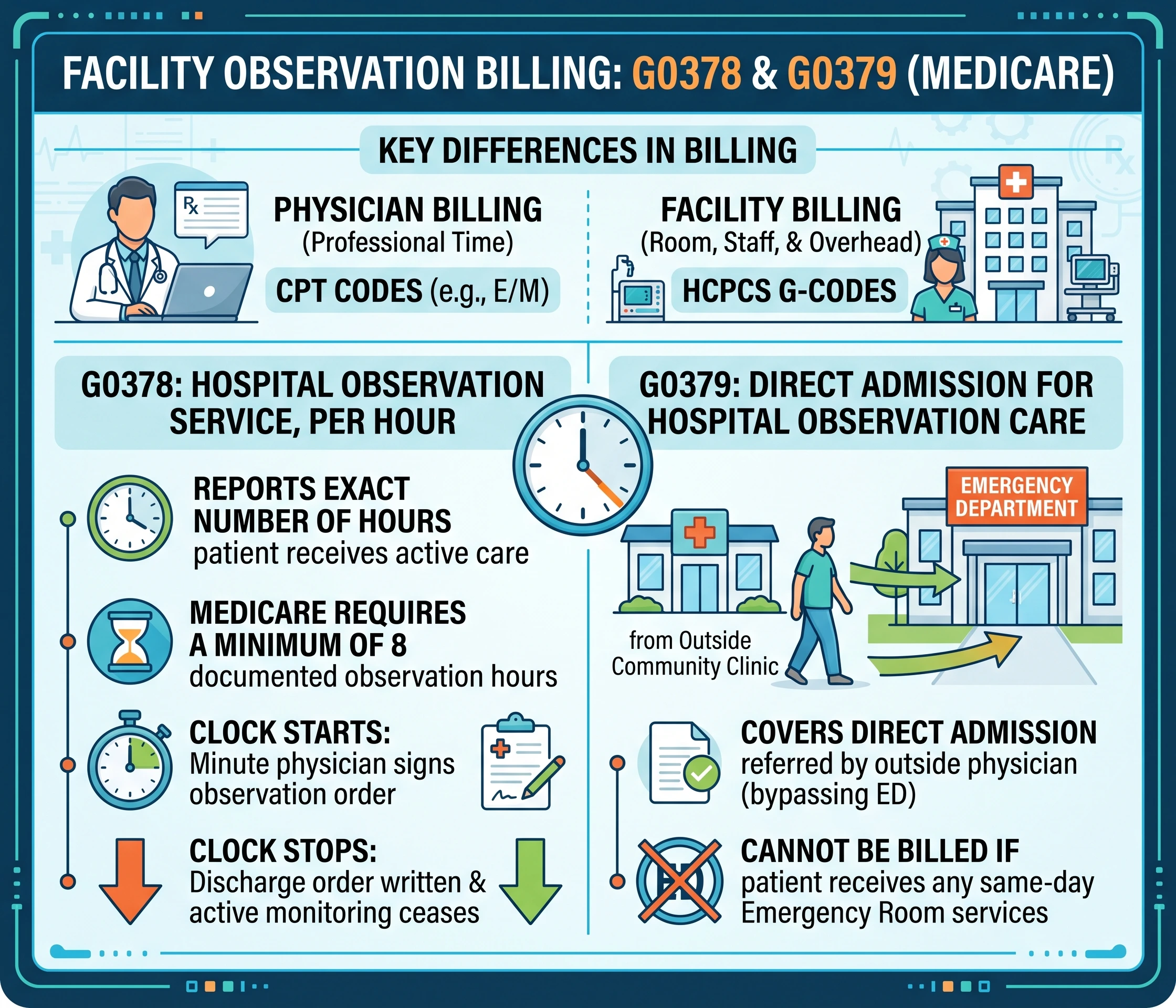
Physicians bill for their individual professional time using the CPT codes listed above. Hospitals bill for the physical use of the observation room, nursing staff, and hospital overhead using specific HCPCS codes. Facility observation billing relies almost entirely on two codes.
The G0378 CPT code description is hospital observation service, per hour. Hospitals use G0378 to report the exact number of hours a patient spends receiving active observation care. According to G0378 billing guidelines, Medicare requires a minimum of eight hours of documented observation to qualify for reimbursement. The clock starts the exact minute the physician signs the observation order. The clock stops when the physician writes the discharge order and active monitoring ceases.
The G0379 CPT code description covers the direct admission of a patient for hospital observation care. Coders use G0379 when a physician in the community assesses a patient at an outside clinic and refers them directly to the hospital for observation. This process bypasses the emergency department. G0379 billing guidelines dictate that hospitals cannot bill this code if the patient receives any emergency room services at the facility on the same calendar day.
Assigning the observation revenue code and POS
Revenue codes communicate specific facility locations and equipment usage to insurance payers. The revenue code for observation is 0762.
When hospital billers construct a UB-04 observation billing claim, they must list the total observation hours on a dedicated line item using rev code 0762. Revenue code 0762 specifically identifies observation room services. Hospitals bill this revenue code concurrently with G0378 and append the specific ICD-10 diagnosis codes that justify the extended stay.
Professional claims submitted by physicians require a Place of Service (POS) code. The observation POS code is 22. This number designates an On Campus-Outpatient Hospital. Even if the patient sleeps in a standard bed on a medical-surgical floor, the POS for observation remains 22. The patient is legally a bedded outpatient. If the physician eventually admits the patient as an inpatient, the POS changes to 21 (Inpatient Hospital) for the subsequent billing dates.
Medicare rules for observation services
CMS guidelines for observation billing enforce rigid patient notification requirements. Because observation classifies as an outpatient service, Medicare Part B covers the medical services. Patients often face higher copayments and deductibles than they would under Medicare Part A inpatient coverage. Medicare Part B also does not count observation days toward the three-day qualifying hospital stay required for skilled nursing facility (SNF) coverage.
Hospitals must issue the Medicare Outpatient Observation Notice (MOON) to any patient receiving Medicare outpatient observation for more than 24 hours. The MOON informs the patient in writing that they are under observation status rather than admitted as an inpatient. Hospital staff must explain this document, deliver it to the patient, and obtain a signature before 36 hours of observation care elapse.
Medicare outpatient billing rules also enforce the 72-hour rule, occasionally called the 3-day payment window. If a patient transitions from observation status to a formal inpatient admission at the same hospital within three days, all outpatient services merge into the inpatient Medicare Severity Diagnosis Related Group (MS-DRG) payment. The hospital cannot bill the observation stay or the observation charges in the hospital separately. The entire encounter becomes one inpatient claim.
Distinguishing observation from other hospital services
Medical billers encounter daily challenges when observation status overlaps with other outpatient procedures. Precise clinical documentation separates observation from routine postoperative recovery.
Same-day surgery vs observation
Hospitals cannot bill observation hours for standard recovery time following an outpatient surgical procedure. Standard recovery time is already factored into the primary surgical payment. Observation status only applies if a patient experiences a documented post-operative complication that requires monitoring beyond the typical recovery window. A patient experiencing uncontrolled bleeding or severe respiratory distress after a routine procedure qualifies for observation. A patient who simply takes longer to wake up from anesthesia does not.
Observation vs inpatient admission
The core difference between these two statuses involves the expected length of stay and the intensity of hospital resources. An inpatient admission requires a formal physician order explicitly stating the patient requires inpatient care. Observation serves as a limited testing and monitoring phase. Physicians use observation to gather clinical data before making the final admission decision.
Hospitals sometimes use Condition Code 44 when a physician initially admits a patient as an inpatient, but the hospital’s utilization review committee determines the medical record only supports observation level of care. Condition Code 44 allows the hospital to change the patient’s status from inpatient to outpatient observation, provided the physician agrees and changes the order before the patient is discharged.
Observation ancillary services
Patients under observation receive a variety of diagnostic tests, lab work, and imaging. Hospitals bill ancillaries and observation room charges independently. Blood tests, electrocardiograms, and x-rays receive their own specific CPT codes on the claim form. These separate ancillary charges appear in addition to the hourly G0378 observation charge.
Managing commercial and Medicaid observation billing
While Medicare sets the baseline for healthcare outpatient billing, other payers apply their own observation reimbursement parameters.
Commercial payer observation billing policies frequently require pre-authorization if the observation stay exceeds 24 hours. Some commercial HMO plans mandate that the hospital notify them immediately when a patient enters observation. Failure to secure this authorization often leads to complete claim denials.
Medicaid observation billing varies strictly by state. Some state Medicaid programs limit observation billing to a maximum of 48 hours. If the patient remains in the hospital past the 48-hour mark without an inpatient admission order, the hospital must write off the additional observation hours. Coders working with Medicaid claims must consult their specific state provider manual rather than relying on CMS Medicare rules.
Practical examples of outpatient observation coding
Applying outpatient observation billing guidelines requires coders to track time accurately and review physician documentation for specific keywords.
Consider a practical scenario. A patient arrives at the emergency department at 8:00 AM complaining of chest pain. The emergency room physician evaluates the patient, orders initial tests, and writes an order for observation care at 11:00 AM. A cardiologist assumes care of the patient, rounds on them at 2:00 PM, and documents a detailed history and physical exam. The next morning, the cardiologist reviews negative troponin blood tests and writes the discharge order at 10:00 AM.
The hospital facility coders bill 23 hours of observation. They calculate this from the 11:00 AM order to the 10:00 AM discharge. They report these 23 hours using HCPCS code G0378 alongside revenue code 0762. They also separately bill the initial ER visit and the EKG tests performed.
The cardiologist reports their professional services independently. For the first day, the cardiologist bills an initial observation care CPT code. They choose 99221, 99222, or 99223 based on the medical decision-making complexity documented in their 2:00 PM note. On the second day, the cardiologist bills for observation care discharge. They use code 99238 if the discharge paperwork and final evaluation took 30 minutes or less. They use code 99239 if the discharge process took more than 30 minutes.
Understanding how to bill outpatient observation services correctly protects facility revenue and ensures compliance with federal regulations. The accuracy of observation coding rests heavily on the exact time the physician writes the initial order, the duration of active monitoring, and the clear distinction between facility hours and professional evaluation codes. Coders who isolate these variables generate clean claims and prevent costly Medicare audits.