


There is no single ICD-10 code for high cholesterol. The code a biller selects depends on which lipid fraction is elevated, whether the pattern is inherited, and how specifically the physician documented the diagnosis. That distinction trips up new coders constantly, and it explains why so many hyperlipidemia claims come back with specificity denials.
The condition itself is common enough that getting the coding right affects a meaningful share of a practice’s claims volume. According to a National Center for Health Statistics data brief published in November 2024, 11.3% of U.S. adults age 20 and older had high total cholesterol (240 mg/dL or higher) between August 2021 and August 2023, based on NHANES survey data collected by Margaret Carroll and colleagues. The Centers for Disease Control and Prevention separately reports that close to 25 million American adults have total cholesterol above that 240 mg/dL threshold, and that roughly 86 million adults have levels above 200 mg/dL, the point at which clinicians typically start monitoring more closely. Slightly more than half of adults who could benefit from cholesterol medication, about 47 million people, are currently taking it.
This piece walks through the ICD-10-CM codes that apply to elevated cholesterol, the documentation each one requires, and the errors that show up most often on denied or downcoded claims.
The E78 category covers more than cholesterol
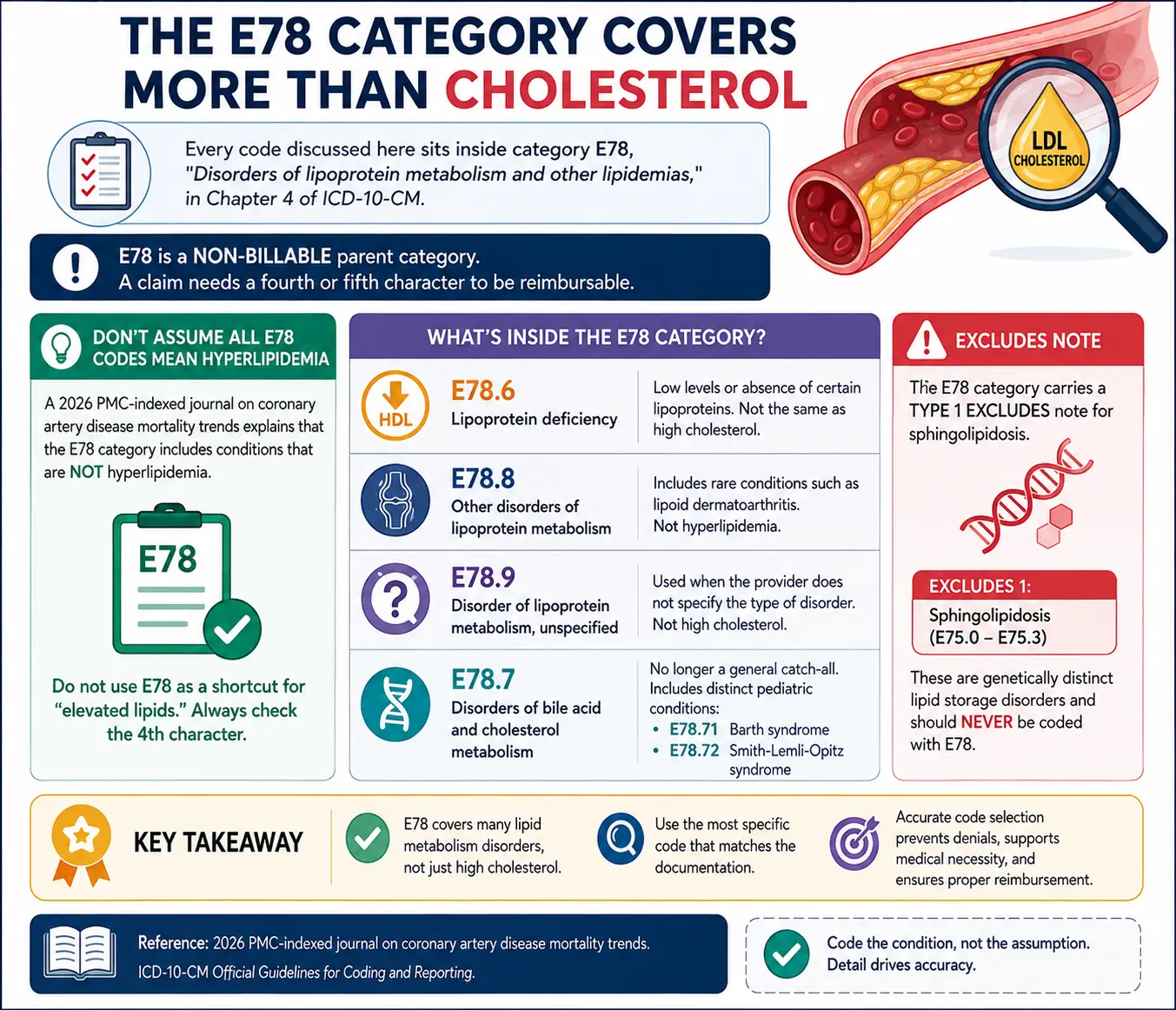
Every code discussed here sits inside category E78, “Disorders of lipoprotein metabolism and other lipidemias,” in Chapter 4 of ICD-10-CM. E78 itself is a non-billable parent category; a claim needs a fourth or fifth character to be reimbursable.
Coders sometimes treat the whole E78 block as interchangeable with hyperlipidemia, and that assumption causes problems. A 2026 letter published in a PMC-indexed journal on coronary artery disease mortality trends points out that E78 also includes codes for conditions that are not hyperlipidemia at all: E78.6 (lipoprotein deficiency), E78.8 (other disorders of lipoprotein metabolism, including lipoid dermatoarthritis), and E78.9 (disorder of lipoprotein metabolism, unspecified). E78.7, once a general catch-all, was retitled “Disorders of bile acid and cholesterol metabolism” and now includes distinct pediatric conditions such as Barth syndrome (E78.71) and Smith-Lemli-Opitz syndrome (E78.72). None of these describe a patient with ordinary high cholesterol, and using E78 as a shorthand for “elevated lipids” without checking the fourth character will misclassify the case.
The category also carries a type 1 excludes note for sphingolipidosis (E75.0 through E75.3), a genetically distinct group of lipid storage disorders that should never be coded alongside E78.
Matching the code to the lipid pattern
E78.00, pure hypercholesterolemia, unspecified
E78.00 is the code for an isolated elevation in cholesterol, generally LDL, with normal triglycerides and no documented family pattern. It became effective for the current fiscal year on October 1, 2015, and remains a billable, specific code under the FY2026 code set. The tabular index lists several older clinical synonyms under this code, including Fredrickson’s hyperlipoproteinemia type IIa and hyperbetalipoproteinemia, terms that occasionally still appear in older chart notes or referral letters.
E78.01, familial hypercholesterolemia: a code that changed in FY2026
This is the update coders are most likely to have missed. Familial hypercholesterolemia is an inherited condition in which the body cannot clear LDL cholesterol from the blood efficiently, raising the risk of early coronary disease. Through FY2025, it was coded as a single code, E78.01. Effective October 1, 2025, the ICD-10-CM Coordination and Maintenance Committee converted E78.01 into a non-billable parent and split it into three specific subcodes, according to the American Hospital Association’s Coding Clinic for ICD-10-CM/PCS:
- E78.010, homozygous familial hypercholesterolemia (HoFH), for patients who inherited the affected gene from both parents. This is the more severe form.
- E78.011, heterozygous familial hypercholesterolemia (HeFH), for patients who inherited the gene from one parent. Coding guidance published by UASI Solutions describes HeFH as the more common presentation, generally associated with LDL-C above 190 mg/dL, versus HoFH, which can produce LDL-C above 400 mg/dL if left untreated.
- E78.019, familial hypercholesterolemia, unspecified, reserved for cases where a familial pattern is documented but the specific type has not yet been confirmed by genetic testing or clinical criteria.
Practices that have not updated their EHR templates or superbills since last October may still have coders defaulting to the retired parent code or, worse, to E78.5. Both choices lose clinically meaningful information that increasingly affects prior authorization for lipid-lowering therapies such as PCSK9 inhibitors.
E78.5, hyperlipidemia, unspecified
E78.5 is the default when a physician documents an abnormal lipid profile without specifying which fraction is elevated. It is also, by a wide margin, the most overused code in the category. A 2026 billing guide from Claim Max RCM notes that E78.5 appears on the majority of lipid-disorder claims industry-wide, including a substantial share where the chart actually supports a more specific code such as E78.2 or E78.00. Payers have taken notice: unspecified lipid codes are increasingly subject to downcoding and record review.
E78.2, mixed hyperlipidemia
Use E78.2 when both LDL cholesterol and triglycerides are elevated on the same panel. It corresponds to what older clinical literature called type IIb hyperlipoproteinemia, caused by an apolipoprotein B-100 mutation that reduces clearance of both LDL and VLDL particles.
E78.1, pure hyperglyceridemia
Not a cholesterol code at all, but worth distinguishing from E78.2. E78.1 applies when triglycerides alone are elevated and cholesterol values are within range. Coders sometimes reach for E78.5 here simply because the term “hyperglyceridemia” doesn’t appear in the visit note, when E78.1 was the accurate choice all along.
Code | Description | Use when |
E78.00 | Pure hypercholesterolemia, unspecified | Cholesterol (typically LDL) is elevated, triglycerides are normal, no family pattern documented |
E78.010 | Homozygous familial hypercholesterolemia | Genetic testing or clinical criteria confirm inheritance from both parents |
E78.011 | Heterozygous familial hypercholesterolemia | Genetic testing or clinical criteria confirm inheritance from one parent |
E78.019 | Familial hypercholesterolemia, unspecified | Familial pattern documented, HoFH/HeFH type not yet confirmed |
E78.1 | Pure hyperglyceridemia | Triglycerides elevated, cholesterol normal |
E78.2 | Mixed hyperlipidemia | Both LDL and triglycerides elevated |
E78.5 | Hyperlipidemia, unspecified | Lipid panel abnormal, specific type not documented |
Hypercholesterolemia vs hyperlipidemia: why the wording in the chart matters
The two terms get used loosely in conversation, but they point coders in different directions. Hypercholesterolemia refers specifically to elevated cholesterol. Hyperlipidemia is the broader term, covering elevated cholesterol, elevated triglycerides, or both. When a physician writes “hyperlipidemia” in the assessment but the lab values in the same note show only an elevated LDL with normal triglycerides, the more accurate code is still E78.00, not E78.5, because the lab data is more specific than the word choice in the note. When the terminology and the lab values genuinely conflict or the labs are missing from the encounter, a physician query is the appropriate next step rather than guessing.
Documentation, sequencing, and the codes that travel alongside a lipid diagnosis
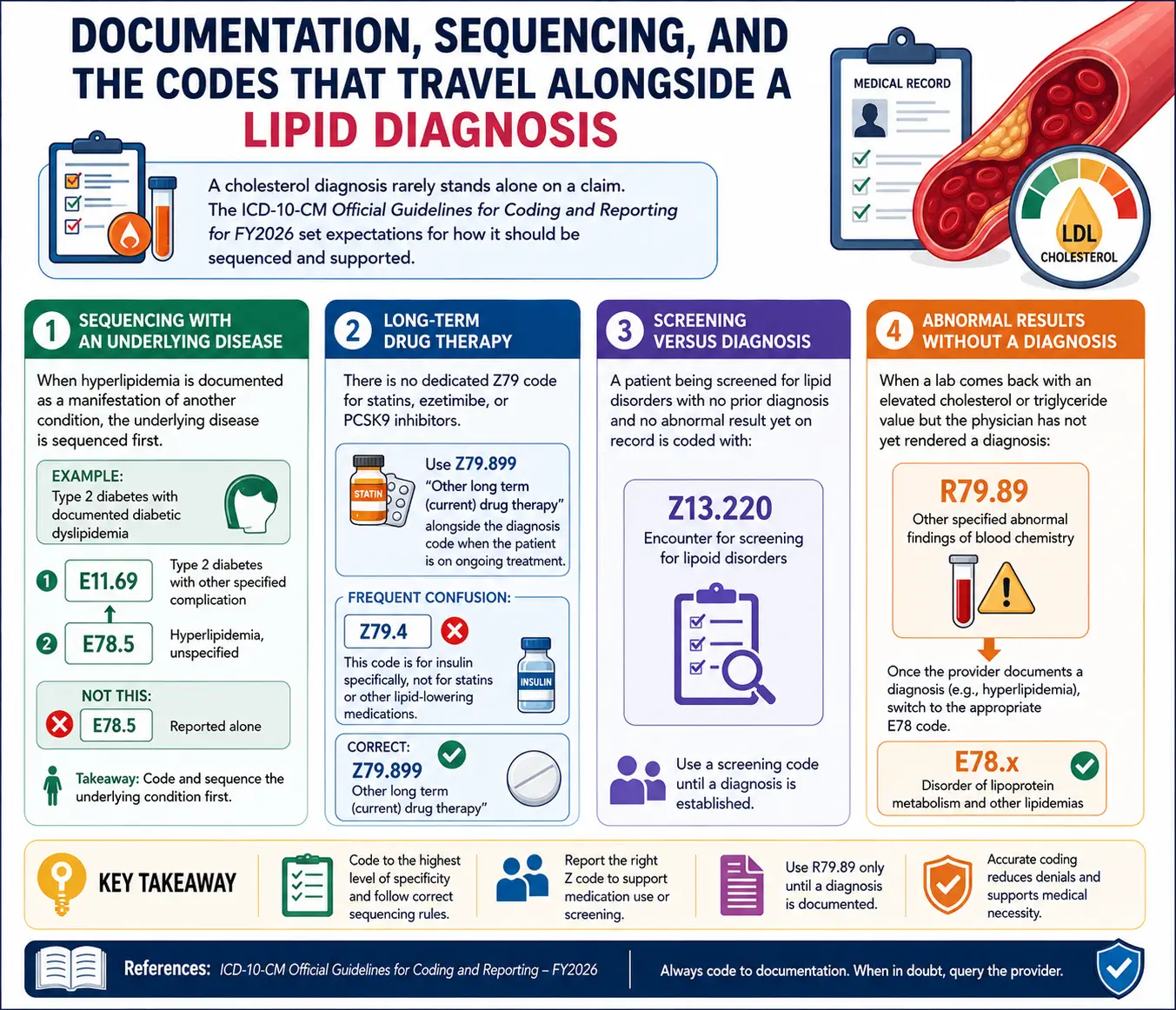
A cholesterol diagnosis rarely stands alone on a claim, and the ICD-10-CM Official Guidelines for Coding and Reporting for FY2026 set expectations for how it should be sequenced and supported.
Sequencing with an underlying disease. When hyperlipidemia is documented as a manifestation of another condition, such as “diabetic dyslipidemia” or “hyperlipidemia due to hypothyroidism,” the underlying disease is sequenced first. For a Type 2 diabetic with documented diabetic dyslipidemia, that means E11.69 (type 2 diabetes with other specified complication) precedes the specific E78.x code, rather than reporting the lipid code alone.
Long-term drug therapy. There is no dedicated Z79 code for statins, ezetimibe, or PCSK9 inhibitors the way there is for insulin (Z79.4) or anticoagulants (Z79.01). Lipid-lowering therapy falls under Z79.899, “other long term (current) drug therapy,” reported alongside the diagnosis code whenever a patient is on ongoing treatment. This is a frequent source of confusion; some online references cite Z79.4 for statin use, but that code is reserved for insulin specifically.
Screening versus diagnosis. A patient being screened for lipid disorders with no prior diagnosis and no abnormal result yet on record is coded with Z13.220 (encounter for screening for lipoid disorders), not an E78 code.
Abnormal results without a diagnosis. When a lab comes back with an elevated cholesterol or triglyceride value but the physician has not yet rendered a diagnosis, R79.89 (other specified abnormal findings of blood chemistry) is the interim code. Once the provider documents a diagnosis such as hyperlipidemia or hypercholesterolemia, the claim should shift to the appropriate E78 code rather than continuing to report the lab-finding code.
Errors that show up most often on audit
A few patterns account for most of the denials and downcoding tied to lipid disorder claims:
- Defaulting to E78.5 when the chart supports more specificity. If LDL and triglyceride values are both documented, E78.5 is the wrong choice even if it’s the fastest one to select.
- Reporting the retired E78.01 parent code instead of E78.010, E78.011, or E78.019. This has been the single biggest change to the category since the FY2026 update took effect, and templates that haven’t caught up will keep generating this error.
- Leaving off Z79.899 when a patient is on ongoing lipid-lowering therapy. This omission understates the clinical picture and can affect risk-adjustment scoring for Medicare Advantage populations.
- Skipping the sequencing rule for secondary hyperlipidemia. Coding E78.5 alone for a diabetic patient with documented diabetic dyslipidemia misses both the required sequence and the specificity a reviewer will look for.
- Confusing E78.6, E78.8, or E78.9 with ordinary high cholesterol. These codes describe distinct lipoprotein disorders, not garden-variety elevated cholesterol, and should not be used as alternates to E78.00 or E78.5.
A worked coding example
Consider a 52-year-old patient seen for a routine follow-up. The note reads: “Lipid panel reviewed: LDL 178 mg/dL, triglycerides 142 mg/dL, HDL 45 mg/dL. Father had a heart attack at 48; patient reports he was told he had ‘high cholesterol’ as a young man. Continuing atorvastatin 20 mg daily. Discussed genetic testing for familial hypercholesterolemia; patient agreeable, will order.”
Working through this line by line: LDL is elevated and triglycerides are within normal range, which points toward the E78.0 branch rather than E78.2 (mixed) or E78.5 (unspecified). The family history raises the question of a familial pattern, but genetic testing has not yet been ordered, let alone resulted, so E78.010 or E78.011 would be premature. That leaves E78.019 as the interim, defensible choice, familial hypercholesterolemia with the type still unspecified, paired with Z79.899 for the ongoing statin therapy. Once the genetic panel returns, the chart should be updated and the next claim should reflect E78.010 or E78.011 depending on the result. A coder who reported E78.5 here, or who left off Z79.899, would technically be coding a real encounter, but would be discarding information the documentation already supports.
What the FY2026 update signals for coding teams
The expansion of familial hypercholesterolemia into three billable subcodes reflects a broader shift toward genetic specificity in lipid disorder coding, one that lines up with how specialty pharmacy prior authorizations already evaluate HoFH and HeFH differently. Coders and providers who update their templates, query physicians when the familial type is undocumented, and resist the pull toward E78.5 as a default will see fewer specificity denials on lipid disorder claims going forward. The next refresh to this code set arrives, as always, on October 1, and category E78 is exactly the kind of frequently billed, frequently updated section worth checking each year before the new fiscal year starts.