


When the National Center for Health Statistics counts asthma deaths in the United States, it pulls the records tagged with two code families, J45 and J46. In 2024, that tally reached 3,279 deaths, according to National Vital Statistics System data. The reliance on those codes explains why ICD-10 codes for asthma carry weight well past a claim form. They feed national mortality data, quality measures, and payer decisions about medical necessity.
Asthma is common. The Asthma and Allergy Foundation of America, drawing on 2024 CDC survey data, put the U.S. figure at about 28 million people in its April 2026 update. Among children under 18, the CDC’s FastStats reported a current asthma rate of 6.5 percent for 2024. A condition that widespread produces a large share of respiratory claims, and a small coding habit repeats across thousands of encounters. The asthma diagnosis code a practice reaches for by default matters more than most people assume.
This guide walks through the J45 category, the logic behind each digit, and the situations that trip up even seasoned coders: status asthmaticus, pregnancy, family history, and the eosinophilic asthma code that now sits outside J45 altogether.
What is the ICD-10 code for asthma?
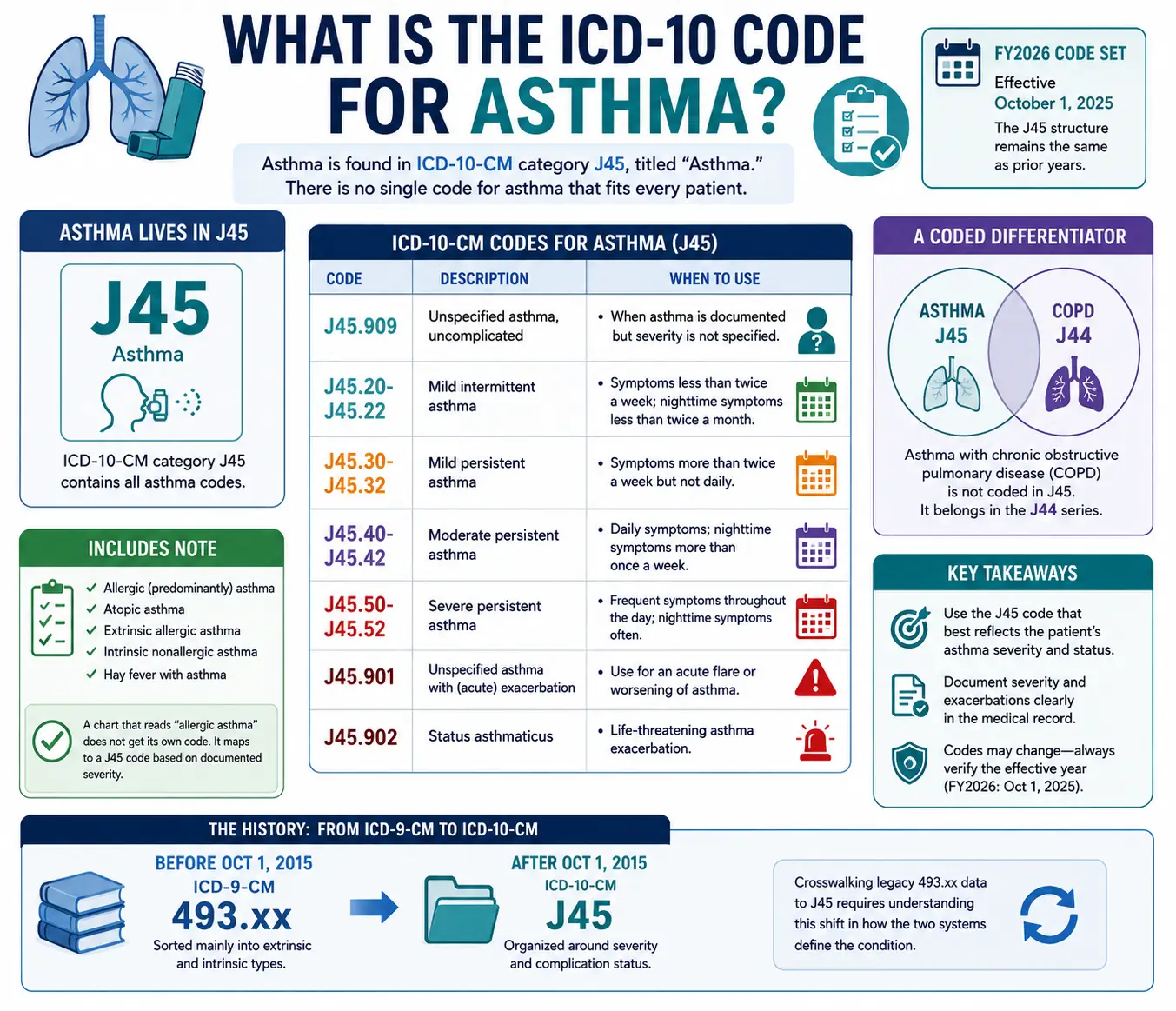
Asthma lives in ICD-10-CM category J45, titled “Asthma.” There is no single ICD-10-CM code for asthma that fits every patient. The category splits by severity and by whether the patient is stable, in an acute flare, or in status asthmaticus. The FY2026 code set, effective October 1, 2025, kept the J45 structure the same as prior years.
The category opens with an Includes note that folds several older terms into J45: allergic (predominantly) asthma, atopic asthma, extrinsic allergic asthma, intrinsic nonallergic asthma, and hay fever with asthma. So a chart that reads “allergic asthma” does not get its own asthma medical code. It maps to a J45 code based on documented severity.
The logic itself is newer than many coders remember. Asthma coding changed shape in the switch from ICD-9-CM to ICD-10-CM on October 1, 2015. The old 493.xx series sorted asthma mainly into extrinsic and intrinsic types. J45 replaced that arrangement with a structure organized around severity and complication status, and it pushed asthma with chronic obstructive pulmonary disease out of the asthma range and into the J44 codes. Anyone crosswalking legacy 493.xx data to J45 has to account for that shift in how the two systems define the condition.
How ICD-10 codes for asthma are built: severity and complication status
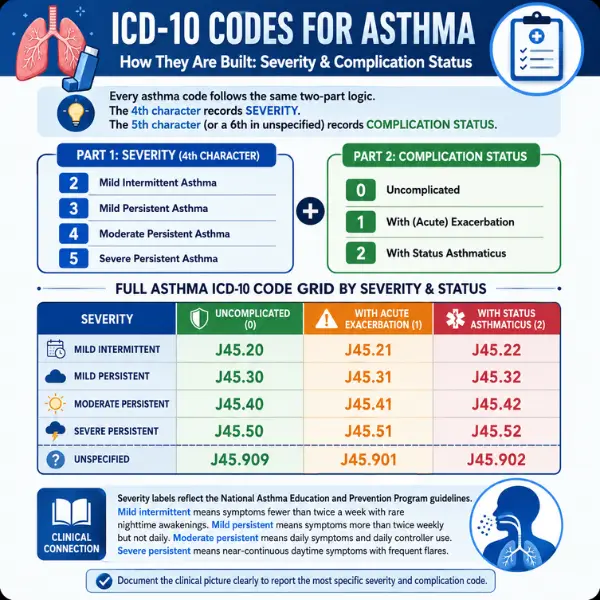
Every asthma code follows the same two-part logic. The fourth character records severity. The fifth character, or a sixth character inside the unspecified subcategory, records the complication status.
Severity runs across four documented levels:
- J45.2, mild intermittent asthma
- J45.3, mild persistent asthma
- J45.4, moderate persistent asthma
- J45.5, severe persistent asthma
Complication status then attaches to each level:
- 0, uncomplicated
- 1, with (acute) exacerbation
- 2, with status asthmaticus
Combine the two and the pattern holds across the category. Mild intermittent asthma with an exacerbation is J45.21. Moderate persistent asthma with status asthmaticus is J45.42. The grid below lays out the full set of asthma ICD-10 codes by severity and status.
Severity | Uncomplicated | With acute exacerbation | With status asthmaticus |
Mild intermittent | J45.20 | J45.21 | J45.22 |
Mild persistent | J45.30 | J45.31 | J45.32 |
Moderate persistent | J45.40 | J45.41 | J45.42 |
Severe persistent | J45.50 | J45.51 | J45.52 |
Unspecified | J45.909 | J45.901 | J45.902 |
The severity labels are not billing inventions. They track the classification long used in the National Asthma Education and Prevention Program guidelines, where mild intermittent asthma means symptoms fewer than twice a week with rare nighttime awakenings, and severe persistent asthma means near-continuous daytime symptoms with frequent flares. Moderate persistent asthma sits between them, with daily symptoms and daily controller use. When a provider documents that clinical picture, the coder can assign a specific severity instead of defaulting to the unspecified block. Mild persistent asthma ICD-10 reporting, for instance, hinges on a note that records symptoms more than twice weekly but not daily.
Asthma ICD-10 code unspecified: J45.901, J45.902, and J45.909
The J45.9 subcategory, “other and unspecified asthma,” exists for records that never pin down severity. It carries three billable options for unspecified asthma:
- J45.901, unspecified asthma with (acute) exacerbation
- J45.902, unspecified asthma with status asthmaticus
- J45.909, unspecified asthma, uncomplicated
J45.909 is a billable ICD-10 code for asthma, and it ranks among the most frequently reported respiratory codes in the country. That popularity is also its weakness. The code tells a payer only that the patient has asthma, with no severity and no complication attached. When a note does document severity, choosing J45.909 anyway leaves specificity, and sometimes reimbursement, on the table. Auditors watch for practices that lean on unspecified asthma ICD-10 codes when the record supports something sharper.
Coding asthma exacerbation and status asthmaticus
Two terms drive the fifth character, and they are not interchangeable.
An acute exacerbation is a worsening of asthma that responds to standard treatment. Picture a patient who arrives at urgent care wheezing, receives bronchodilators and a short steroid course, improves, and goes home. That encounter takes a “1” code, asthma with acute exacerbation, at whatever severity the chart supports.
Status asthmaticus is a step beyond an exacerbation. It describes a severe attack that does not respond to initial bronchodilator therapy and often requires hospital admission, continuous nebulization, and sometimes intubation. It takes a “2” code.
This is where the J46 question comes up. ICD-10-CM does carry a standalone code, J46, “status asthmaticus.” In the U.S. clinical modification, though, status asthmaticus is folded into the severity-specific J45 codes (J45.22, J45.32, J45.42, J45.52, and J45.902). When the record documents severity, those combination codes capture both facts in one entry, which is why an inpatient claim for a severe, treatment-resistant attack usually lands on J45.52 rather than J46. Documentation that states both the severity and the failure to respond to treatment supports the higher-specificity code and holds up better under review. Reserve the plain J46 for status asthmaticus that the record leaves unspecified by severity.
Other asthma types: exercise-induced, cough variant, allergic, and eosinophilic
Beyond the severity grid, J45 holds a short list of named forms under J45.99, “other asthma”:
- J45.990, exercise induced bronchospasm, the code that covers charts labeled exercise-induced asthma
- J45.991, cough variant asthma
- J45.998, other asthma
A few asthma descriptions do not belong in J45 at all, and the category’s Excludes1 note names them: detergent asthma (J69.8), miner’s asthma (J60), and wood asthma (J67.8). Those are occupational lung diseases classified with the pneumoconioses and hypersensitivity codes, not with J45. Wheezing on its own, with no asthma diagnosis, is R06.2. This shapes occupational asthma coding, because ICD-10-CM has no dedicated J45 subcode for it. A work-related case built on a specific named exposure may route to the J60 through J70 range, while a general work-aggravated case is reported with the matching J45 severity plus the appropriate exposure codes.
Allergic asthma, seasonal asthma, viral-triggered asthma, and childhood asthma share a feature worth stating plainly: none has its own code. Each is reported through the J45 severity structure. There is no separate pediatric asthma code, so a 6-year-old and a 60-year-old with the same documented severity carry the same J45 entry. Age lives in the patient record, not in the diagnosis code.
Eosinophilic asthma is the exception that catches coders off guard. It sits outside J45 entirely, at J82.83, “eosinophilic asthma,” under the pulmonary eosinophilia category. That code entered ICD-10-CM in the FY2025 update, effective October 1, 2024, as biologic therapies aimed at eosinophilic disease moved into wider use. J45 now carries a “use additional code” note pointing to J82.83, so when the record confirms the eosinophilic phenotype, the code set can reflect it rather than burying it inside an unspecified asthma code.
Asthma in pregnancy ICD-10
Asthma during pregnancy does not stay in the J45 category as the first-listed code. It moves to Chapter 15. The correct family is O99.51, “diseases of the respiratory system complicating pregnancy,” with the fifth digit set by trimester:
- O99.511, first trimester
- O99.512, second trimester
- O99.513, third trimester
- O99.519, unspecified trimester
These O99.51 codes carry a “use additional code” instruction, so the sequencing runs pregnancy code first, then the specific J45 asthma code to show type and severity. A patient in her second trimester with moderate persistent asthma is reported as O99.512 followed by J45.40. In the code edits, the O99.51 series applies to female maternity patients aged 12 to 55, and only when the asthma actually complicates the pregnancy. If asthma is simply noted and has no bearing on the pregnancy, a plain J45 code is used instead. Parallel subcategories, O99.52 and O99.53, cover asthma complicating childbirth and the puerperium.
Family history and personal history of asthma
Family history of asthma has a dedicated code, Z82.5, “family history of asthma and other chronic lower respiratory diseases.” It is billable but cannot serve as a principal diagnosis, and it is exempt from present-on-admission reporting. Use it as a secondary code to flag risk, for example when a child of two asthmatic parents is evaluated for recurrent wheeze.
Personal history is trickier, and here the safe move is often to skip a history code altogether. Asthma is a chronic condition. A patient whose asthma is quiet or well controlled still has asthma, and that visit is coded with the active J45 code, not a personal history code. History-of codes describe conditions that have resolved. Because asthma rarely disappears the way an acute infection does, tagging a still-affected patient with a personal history of asthma misstates the record.
Documentation and billing tips that reduce denials
The gap between a clean asthma claim and a denied one usually comes down to what the note says, not what the coder does. A handful of checks recur:
- Push for documented severity. “Asthma” alone forces J45.909. “Moderate persistent asthma, stable” earns J45.40 and a stronger claim.
- Keep exacerbation and status asthmaticus separate in the note. The two map to different fifth characters and very different levels of care and payment.
- Add the tobacco codes. J45 carries a “use additional code” note for tobacco use and exposure, including tobacco dependence (F17.-), tobacco use (Z72.0), and exposure to environmental tobacco smoke (Z77.22). Leaving them off understates the clinical picture.
- Respect the Excludes notes. The Excludes2 note under J45 sends asthma with COPD to J44.89, and Excludes2 means the two are reported together only when the record documents each as a distinct condition. Asthma-COPD overlap is coded in the J44 category, not J45.
- Do not pair mutually exclusive codes. J45.909 with wheezing (R06.2), for one, triggers an Excludes1 edit that can deny the entire claim.
A short scenario shows how these pieces stack. A 34-year-old with a history of severe persistent asthma presents to the emergency department in respiratory distress that does not improve after repeated albuterol and ipratropium treatments, and she is admitted. The provider documents severe persistent asthma, treatment resistance, and current tobacco use. That record supports J45.52 for the severe attack in status asthmaticus, with F17.- added for the tobacco dependence. Swap in a note that only says “asthma exacerbation,” and the same visit collapses to J45.901, a weaker and less defensible claim for the level of care delivered.
These are the checks that keep respiratory claims moving. A2Z Billings builds this review into its coding workflow so that documented severity, exacerbation status, and any comorbidity all reach the claim.
Asthma coding rewards specificity. The J45 category encodes severity in the fourth character and complication status in the fifth, status asthmaticus and acute exacerbation take separate codes, pregnancy shifts the primary code to O99.51 with J45 added as detail, and eosinophilic asthma now stands on its own at J82.83. Get the documentation to state severity and complication clearly, follow the Excludes notes, and most asthma claims resolve on the first pass. The codes exist to describe a real difference between a child who wheezes during gym class and an adult in the ICU, and accurate coding is what keeps that distinction visible to payers, to public health data, and to the next clinician who opens the chart.