


Falls send more older Americans to the emergency department than any other injury. The CDC reports that more than one in four adults aged 65 and older falls each year, which produces roughly 3 million emergency department visits annually. Once a patient has fallen, the odds of falling again climb. That single fact is why the ICD 10 code for history of falling (Z91.81) appears on so many claims, and why coders who handle it correctly protect both the patient safety record and reimbursement.
This guide covers what Z91.81 means, when it belongs on a claim, how it differs from the codes that look similar, and what documentation payers expect behind it.
What Z91.81 means
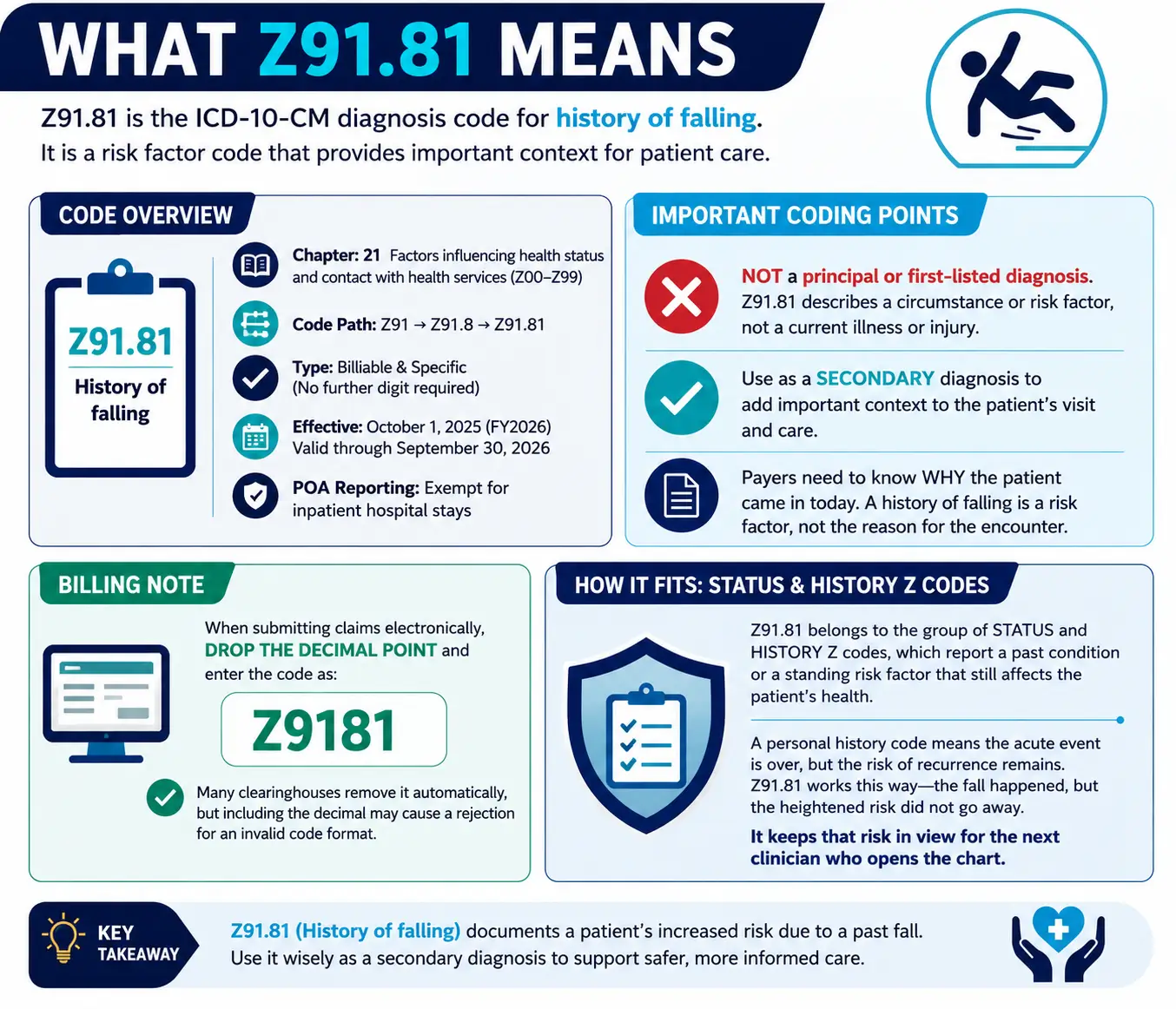
Z91.81 is the ICD-10-CM diagnosis code for history of falling. It sits in Chapter 21 of the code set, the chapter covering factors that influence health status and contact with health services (categories Z00 through Z99). Its full path runs from category Z91 (“Personal risk factors, not elsewhere classified”), through subcategory Z91.8, down to Z91.81.
The code is billable and specific, which means it stands on its own without needing a further digit. The FY2026 version took effect on October 1, 2025, and is valid for HIPAA-covered transactions through September 30, 2026. Z91.81 is also exempt from present-on-admission (POA) reporting for inpatient hospital stays.
One detail trips up newer coders. Z91.81 describes a circumstance that affects a patient’s health status, not a current illness or injury. Because of that, it is not acceptable as a principal or first-listed diagnosis. Payers want to know why the patient came in today, and a history of falling is a risk factor rather than a reason for care. The code earns its place as a secondary diagnosis that adds context to the visit.
A practical billing note: when you submit claims electronically, drop the decimal point and enter the code as Z9181. Many clearinghouses strip it for you, but an included decimal can trigger a rejection for an invalid code format.
How it fits the status and history Z codes
The ICD-10-CM guidelines group codes like this one with status and history Z codes, which report a past condition or a standing risk factor that still bears on care. A personal history code says the acute event is over, but the patient may need continued monitoring because the risk of recurrence remains. Z91.81 works exactly this way. The fall happened. The heightened risk did not go away with it, so the code keeps that risk in view for the next clinician who opens the chart.
When to use Z91.81
Use Z91.81 when the record documents that a patient has fallen in the past and that history has bearing on current care or future risk. The fall itself is over. What remains is the higher risk of another fall that comes with it.
Common scenarios where the code fits:
- A 78-year-old presents for a routine visit and reports two falls in the past year. The clinician documents the history and orders a gait and balance assessment.
- A patient recovering from a hip fracture is referred to physical therapy, and the therapist notes the prior fall history to support the plan of care.
- During a Medicare Annual Wellness Visit, fall risk screening flags a previous fall, and the provider records it to justify counseling and a referral.
- A home health nurse documents fall history to support a home safety evaluation and fall precautions.
In each case the code does specific work. It signals to every downstream provider that this patient carries a known risk, and it links the services ordered (therapy, home assessment, assistive devices) to a documented reason.
Z91.81 vs R29.6: history of falling versus repeated falls
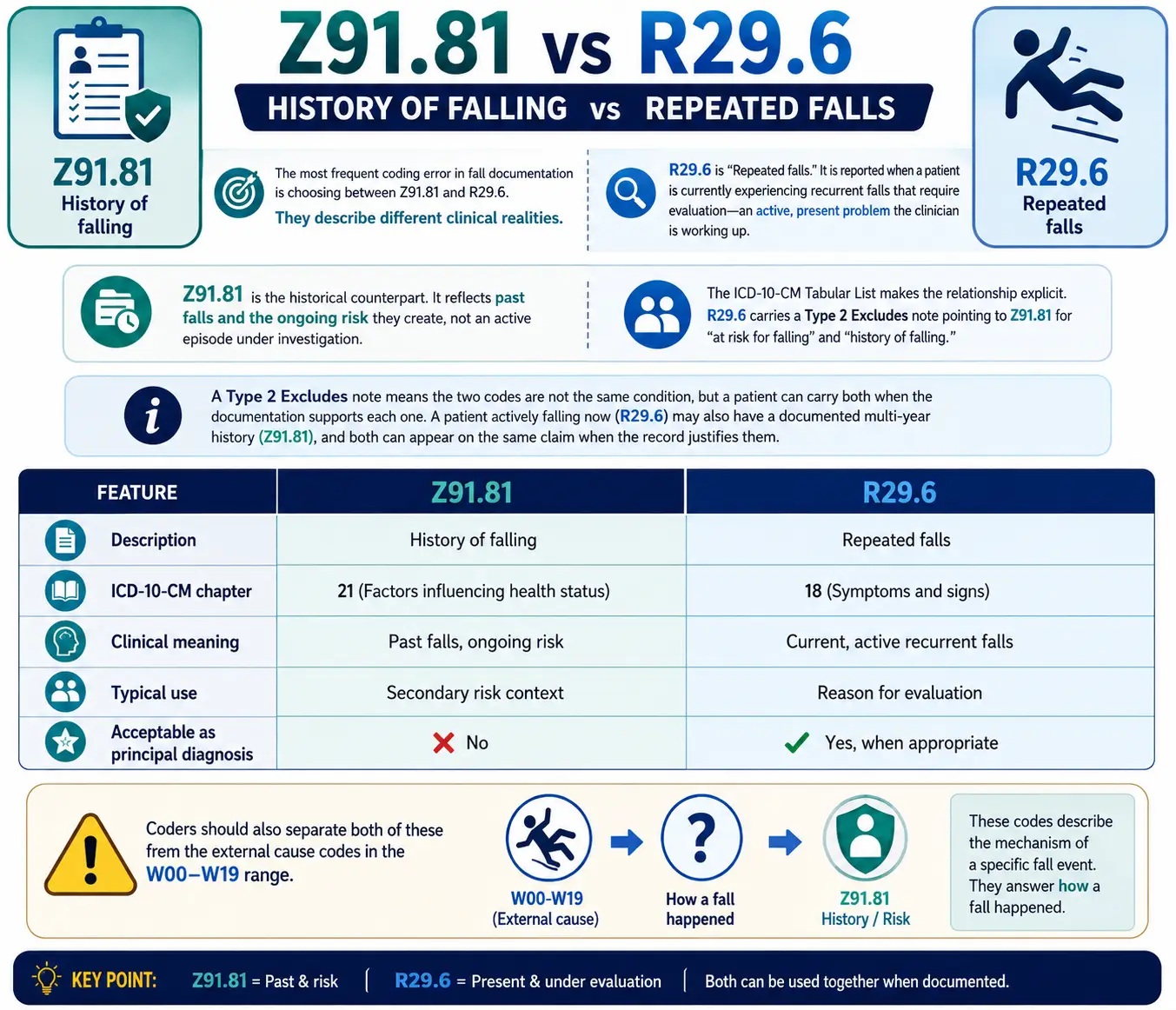
The most frequent coding error in fall documentation is choosing between Z91.81 and R29.6. They describe different clinical realities.
R29.6 is titled “Repeated falls.” It lives in Chapter 18 with the symptom and sign codes. You report it when a patient is currently experiencing recurrent falls that require evaluation, which means the falling is an active, present problem the clinician is working up.
Z91.81 is the historical counterpart. It reflects past falls and the ongoing risk they create, not an active episode under investigation.
The ICD-10-CM Tabular List makes the relationship explicit. R29.6 carries a Type 2 Excludes note pointing to Z91.81 for “at risk for falling” and “history of falling.” A Type 2 Excludes note means the two codes are not the same condition, but a patient can carry both when the documentation supports each one. A patient actively falling now (R29.6) may also have a documented multi-year history (Z91.81), and both can appear on the same claim when the record justifies them.
Here is the distinction in table form.
Feature | Z91.81 | R29.6 |
Description | History of falling | Repeated falls |
ICD-10-CM chapter | 21 (Factors influencing health status) | 18 (Symptoms and signs) |
Clinical meaning | Past falls, ongoing risk | Current, active recurrent falls |
Typical use | Secondary risk context | Reason for evaluation |
Acceptable as principal diagnosis | No | Yes, when appropriate |
Coders should also separate both of these from the external cause codes in the W00 through W19 range. Those codes describe the mechanism of a specific fall event (for example, a fall on the same level from slipping). They answer how a fall happened, while Z91.81 answers whether the patient has a fall history at all.
Is Z91.81 billable, and how it affects reimbursement
Z91.81 is a valid, billable ICD-10-CM code accepted by Medicare, Medicaid, and commercial payers. On its own it rarely drives payment, because it is a status code rather than a treatment diagnosis. Its value shows up when it supports the medical necessity of fall-related services.
Physical and occupational therapy claims rely on it often. Gait training, balance work, strength programs, home safety assessments, and assistive device prescriptions all need a documented reason, and fall history supplies one. When Z91.81 appears alongside the code for the current condition, it helps demonstrate why those services are reasonable and necessary.
Medicare’s Annual Wellness Visit is another common setting. Fall risk screening is a required element of the AWV, and when a fall history surfaces, Z91.81 can be reported with the AWV codes (G0438 for the initial visit, G0439 for subsequent visits).
Two limits are worth knowing. Z91.81 does not map to a CMS Hierarchical Condition Category (HCC), so it does not raise a patient’s risk-adjustment score or capitated payment. And because it cannot serve as a principal diagnosis, it will not, by itself, support a claim that lists no active problem. Despite those limits, accurate fall-risk coding feeds quality reporting under programs such as MIPS, which include fall screening measures, and it strengthens the medical-legal record.
Documentation that supports the code
A code is only as defensible as the note behind it. To support Z91.81, the record should show more than a checkbox. Auditors and payers look for specifics.
Strong documentation usually captures:
- Confirmation that one or more falls occurred, ideally with approximate dates or a timeframe.
- Circumstances of the falls (location, activity, whether an injury resulted).
- Any contributing factors the clinician identified, such as gait instability, balance problems, vision changes, or medications linked to falls.
- The clinical response, meaning the assessment ordered, counseling provided, or referral made.
The CDC’s STEADI initiative gives providers a ready framework for this. STEADI (Stopping Elderly Accidents, Deaths and Injuries) is built on three steps: screen, assess, and intervene. Its screening rests on three key questions, each answered yes or no: Have you fallen in the past year? Do you feel unsteady when standing or walking? Are you worried about falling? A “yes” to any of them flags a patient for a fuller assessment. A documented “yes” to the first question is, in plain terms, a history of falling, and it maps directly to Z91.81.
Tying the code to a recognized screening tool does two useful things. It produces the specific language auditors want, and it connects the diagnosis to a defensible clinical process rather than a stray note.
The assessment step in STEADI also gives coders a checklist of contributing factors worth documenting alongside the fall history. It includes a review of gait, strength, and balance, an orthostatic blood pressure check, a vision screen, a look at feet and footwear, and a medication review. That last item matters, because the CDC identifies several drug classes that raise fall risk, including tranquilizers, sedatives, and antidepressants, along with some over-the-counter products. When a note records both the fall history and a modifiable factor the clinician acted on, it turns Z91.81 from a bare status code into part of a documented care plan, which is exactly what supports the services billed around it.
Common mistakes that lead to denials
A handful of errors account for most fall-related coding problems.
Listing Z91.81 first. Because it is unacceptable as a principal diagnosis, submitting it as the primary code invites a denial. It belongs in a secondary position behind the reason for the encounter.
Confusing history with active falls. Coding Z91.81 when the patient is currently under evaluation for recurrent falls understates the clinical picture, and R29.6 is the correct choice there. The reverse error, coding R29.6 for a patient whose falls are in the past, overstates it.
Coding from a single word. A note that says only “fall history” with no supporting detail gives an auditor little to work with. The circumstances and the clinical response should both appear somewhere in the record.
Adding the decimal on electronic claims. Submit Z9181 without the decimal to avoid a format rejection.
Quick answers to common questions
Is Z91.81 a diagnosis code? Yes. It is a valid, billable ICD-10-CM diagnosis code, though it reports a risk status rather than an active disease.
Can Z91.81 be a primary diagnosis? No. It is unacceptable as a principal or first-listed diagnosis and should be reported as a secondary code.
What code covers recurrent falls happening now? R29.6 (Repeated falls), used when active falling is the problem being evaluated.
Does Z91.81 need a decimal on a claim? No. Enter it as Z9181 for electronic submission.
What the fall data show
The scale of the problem explains the attention coders give this one line. According to the National Safety Council’s Injury Facts, 43,020 people aged 65 and older died from preventable falls in 2024, and fall deaths in that age group have risen 51% over the past decade. CDC mortality data show the age-adjusted fall death rate among older adults climbed from 64.7 per 100,000 in 2018 to 78.4 per 100,000 in 2024. On the cost side, a 2024 study published in the journal Injury Prevention (Haddad and colleagues) estimated health care spending for nonfatal falls among older adults at about $80 billion.
Accurate use of Z91.81 does not lower those numbers by itself. What it does is make fall risk visible in the record, so the services meant to reduce that risk can be justified, tracked, and paid. A patient flagged with a documented fall history is a patient the whole care team can watch more closely.
Z91.81 is a secondary diagnosis code for a personal history of falling, valid through September 30, 2026, billable across major payers, and distinct from both R29.6 (active repeated falls) and the W-series external cause codes. Report it in a secondary position, back it with specific documentation, and pair it with the current reason for the visit. Handled that way, it holds up under review while doing its real job of marking a patient’s fall risk for everyone who reads the chart next.