


Search “J1010 CPT code” and most results call it a CPT code, a HCPCS code, or both, sometimes in the same paragraph. That mix-up rarely stops anyone from finding the right code, but it matters for using it correctly on a claim. J1010 identifies a single milligram of injectable methylprednisolone acetate, the corticosteroid sold under the brand name Depo-Medrol. Since April 1, 2024, it has been the only code Medicare recognizes for this drug, after the Centers for Medicare & Medicaid Services retired three separate dosage-specific codes that had been in use for years. For billers, coders, and clinical staff who administer the injection, using J1010 correctly means knowing how to count units, when a modifier applies, what belongs in the chart, and how the code differs from a similarly named one for a related drug. This guide walks through the J1010 billing guidelines that matter most, using CMS’s current rules.
What is CPT code J1010?
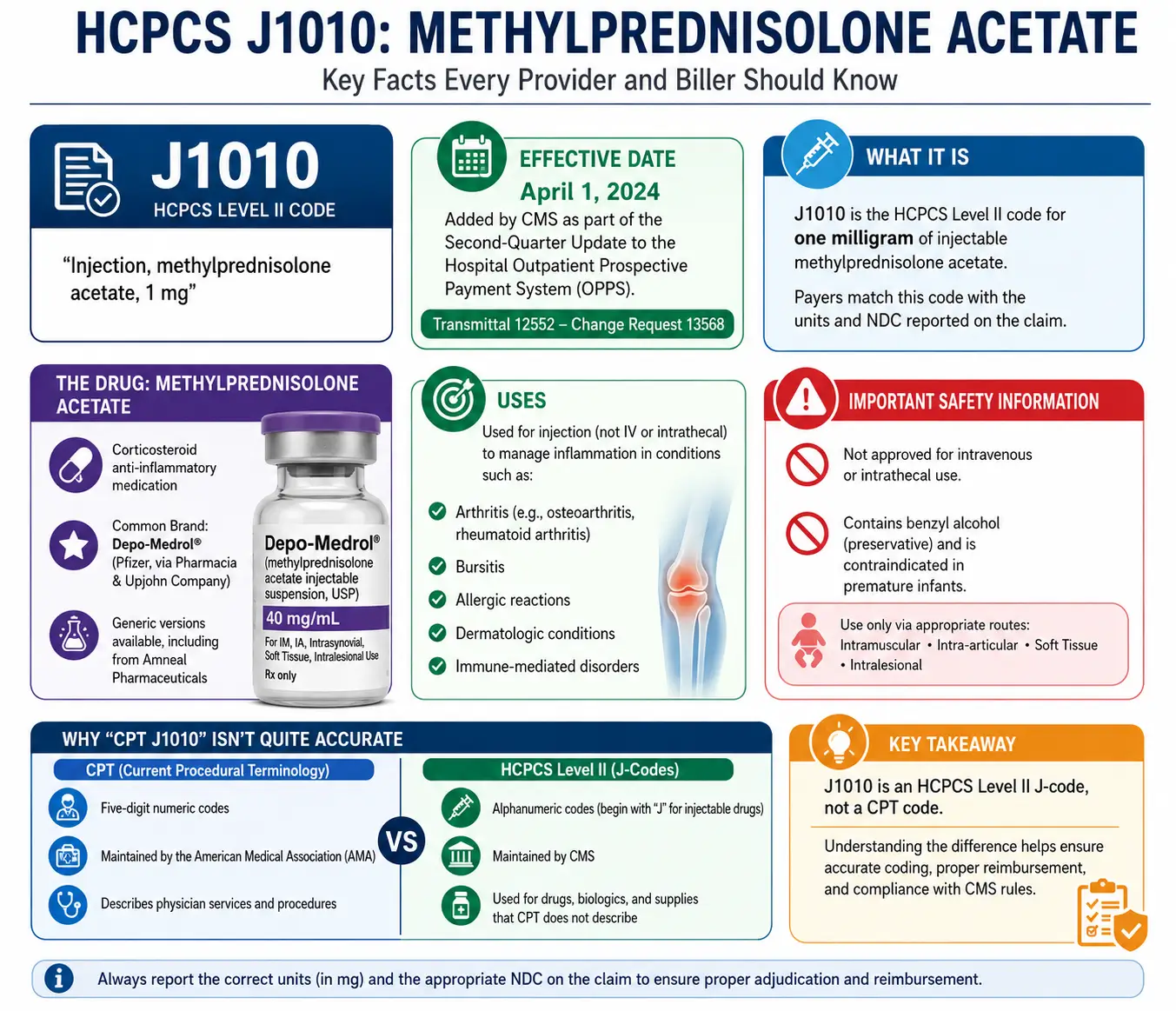
J1010 is the HCPCS Level II code for one milligram of injectable methylprednisolone acetate. CMS added it effective April 1, 2024, as part of the second-quarter update to the Hospital Outpatient Prospective Payment System, documented in Transmittal 12552 (Change Request 13568). The J1010 code description, officially called a long descriptor, reads: “Injection, methylprednisolone acetate, 1 mg.” That single line is what payers match against the units and NDC reported on the claim.
Methylprednisolone acetate is a corticosteroid. The J1010 brand name most clinicians recognize is Depo-Medrol, manufactured by Pfizer through its Pharmacia & Upjohn Company subsidiary; generic versions are also available, including from Amneal Pharmaceuticals. It’s used for intramuscular, intra-articular, soft tissue, and intralesional injection to manage inflammation from arthritis, bursitis, allergic reactions, and several dermatologic and immune conditions. The suspension isn’t approved for intravenous or intrathecal use, and because it contains benzyl alcohol as a preservative, it’s contraindicated in premature infants.
Why “CPT J1010” isn’t quite accurate
A lot of billing software, and even some clinical documentation, refers to J1010 as a CPT code. Strictly, it isn’t. CPT, Current Procedural Terminology, is a set of five-digit numeric codes copyrighted and maintained by the American Medical Association, covering physician services and procedures. J1010 belongs to HCPCS Level II, a separate alphanumeric system CMS maintains for drugs, biologics, and supplies that CPT doesn’t describe, and J-codes specifically cover drugs given by injection or infusion. The confusion is common enough that it rarely causes claim problems by itself, but it’s worth knowing the difference, since HCPCS Level II codes follow their own update and coverage rules, separate from CPT’s.
J1010 vs J1030: why three old codes became one
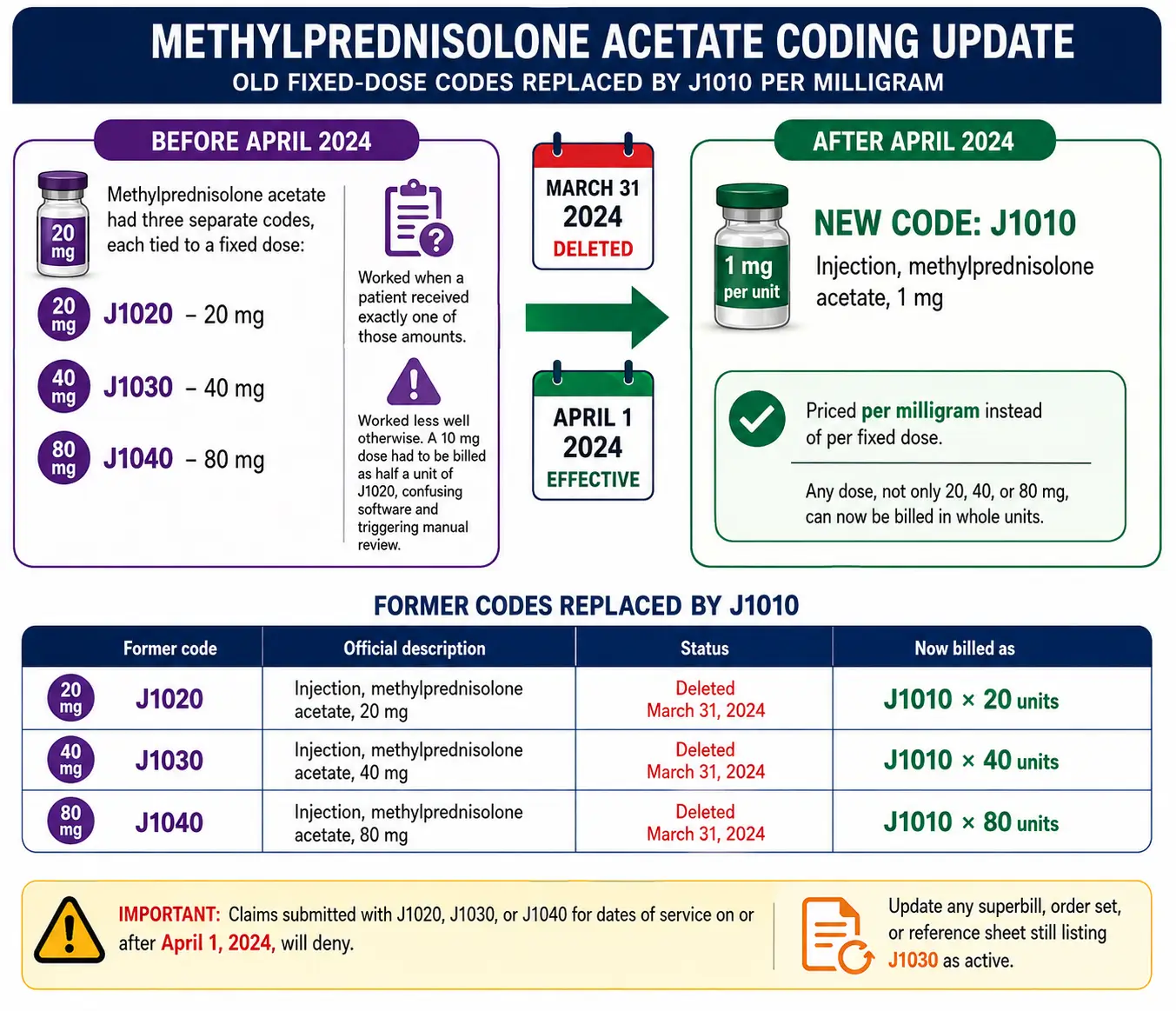
Before April 2024, methylprednisolone acetate had three separate codes, each tied to a fixed dose: J1020 for 20 mg, J1030 for 40 mg, and J1040 for 80 mg. That worked when a patient received exactly one of those amounts. It worked less well otherwise. A 10 mg dose had to be billed as half a unit of J1020, an approach that confused claims software and occasionally triggered manual review.
CMS deleted all three codes effective March 31, 2024, and replaced them the next day with J1010, priced per milligram instead of per fixed dose. Table 13 of Transmittal 12552 lists J1020, J1030, and J1040 among the codes deleted that quarter; Table 12 lists J1010 among the codes created to take their place. The table below shows all three, including J1030’s own official description, next to how each dose is billed today.
Former code | Official description | Status | Now billed as |
J1020 | Injection, methylprednisolone acetate, 20 mg | Deleted March 31, 2024 | J1010 × 20 units |
J1030 | Injection, methylprednisolone acetate, 40 mg | Deleted March 31, 2024 | J1010 × 40 units |
J1040 | Injection, methylprednisolone acetate, 80 mg | Deleted March 31, 2024 | J1010 × 80 units |
Any dose, not only 20, 40, or 80 mg, can now be billed in whole units. Claims still submitted with J1020, J1030, or J1040 for dates of service on or after April 1, 2024, deny. Any superbill, order set, or reference sheet still listing J1030 as active needs an update.
How to bill J1010: calculating units correctly
Because CMS defines J1010 as one unit per milligram, converting a dose to billable units is direct: units billed equals total milligrams administered. A 40 mg intra-articular injection is reported as J1010 with 40 units. An 80 mg dose for a large joint is 80 units. A partial-vial dose of 16 mg is billed as 16 units, no rounding or fractional units required, unlike the old J1020/J1030/J1040 system, which forced fractional billing whenever a dose fell between the fixed amounts those codes represented.
Billers should confirm the total dose from the administration note, not the vial size. A 5 mL, 40 mg per mL Depo-Medrol multidose vial contains 200 mg total, but billable units reflect only what was actually administered, plus any properly documented discarded amount, covered in the modifier section below. Confusing vial concentration with administered dose is one of the more frequent errors on corticosteroid injection claims.
Documentation requirements for J1010 claims
Payers expect the chart to support every unit billed under J1010, not just the fact that an injection took place. At minimum, documentation should include the drug name and formulation administered (methylprednisolone acetate, distinct from methylprednisolone sodium succinate, covered below), the total dose in milligrams, the injection site and route, the date of service, and who administered it.
The NDC of the specific product used belongs in the record too, since it should match what’s reported on the claim. If part of a single-dose vial was drawn up but not used, the discarded amount and the reason for it need separate documentation from the administered amount, because the two get reported differently on the claim line.
Medical necessity documentation carries just as much weight as the drug details. The diagnosis code submitted with the claim needs to align with what the clinical note describes as the reason for the injection. A note reading only “Depo-Medrol given,” without a supporting diagnosis or exam finding, is a common trigger for records requests and denials.
J1010 NDC reporting: which number to use
There’s no single J1010 NDC code, because methylprednisolone acetate is manufactured by more than one company and packaged in several strengths and vial sizes. Depo-Medrol’s 40 mg per mL, 5 mL multidose vial carries NDC 0009-0280-02; its 80 mg per mL single-dose vial carries a different number, 0009-3475-01. Generic methylprednisolone acetate from other manufacturers has its own separate NDCs again.
The correct NDC for a claim is whichever one appears on the vial the clinician actually used, converted to the standard 11-digit, 5-4-2 format most payers expect. Medicaid programs generally require NDC reporting on drug claim lines as a condition of payment, and a growing number of commercial and Medicare Advantage plans do the same, even where traditional Medicare doesn’t always demand it for every J-code. Checking the payer’s companion guide before submission avoids a rejection over a missing or mismatched NDC.
One mix-up worth flagging directly: methylprednisolone acetate (Depo-Medrol, J1010) is a different formulation from methylprednisolone sodium succinate (Solu-Medrol, now billed under J2919 after its own 2024 code consolidation). The acetate form is a slow-release suspension for intramuscular or intra-articular depot injection; the sodium succinate form is water-soluble and used for rapid intravenous effect. The NDCs, and the codes, aren’t interchangeable.
Does J1010 require a modifier? JW and JZ explained
Whether J1010 needs a modifier depends on the type of vial the dose came from. CMS requires either the JW or JZ modifier on claims for separately payable Part B drugs supplied in single-dose, single-use containers. The JW modifier, in place since January 1, 2017, reports the amount of drug drawn up but discarded rather than administered. The JZ modifier, required for dates of service on or after July 1, 2023, attests that nothing was wasted.
CMS has enforced this pairing since October 1, 2023: a claim for a single-dose-container drug that arrives without either modifier can be returned as unprocessable rather than simply denied, which delays payment further than a standard denial. If a clinician draws 80 mg from a single-dose vial and administers all of it, JZ applies. If 20 mg is discarded because the vial doesn’t divide evenly for the ordered dose, JW applies to that 20 mg, along with documentation of the reason.
Methylprednisolone acetate also ships in multidose vials, and the JW/JZ requirement doesn’t apply to those, since a multidose container is expected to serve more than one patient and doesn’t generate the same kind of single-use waste the modifier policy targets. Confirming which vial type the practice actually stocks is worth settling once, in writing, rather than assuming it.
J1010 unit of measure and Medicare’s MUE limit
The unit of measure for J1010 is always 1 mg, but Medicare also caps how many units it will pay on a single date of service through a Medically Unlikely Edit (MUE). J1010 launched in April 2024 without one. CMS later assigned an MUE of 120 units, which created a real problem for practices doing bilateral large-joint injections: an 80 mg dose in each knee totals 160 mg, and claims for 160 units were denied outright for exceeding the cap.
Enough of those denials reached CMS that the MUE was raised to 160 units during 2025, accommodating the bilateral 80 mg scenario without an appeal. J1010’s MUE carries an adjudication indicator of 3, meaning claims that exceed the published limit can still be appealed with supporting documentation rather than being permanently unpayable. Because CMS revises MUE values quarterly, and the 120-to-160 change shows these limits do move, practices that regularly submit high-unit J1010 claims should check the current Practitioner Services MUE table on cms.gov rather than assume last year’s number still applies.
J1010 reimbursement: how Medicare and commercial payers pay
Under Medicare Part B, most non-pass-through drugs, J1010 included, are paid at the average sales price plus 6 percent (ASP + 6%), a formula CMS recalculates every quarter from manufacturer sales data. Because the code is priced per milligram, the per-unit payment is small; total reimbursement scales with however many units the dose required.
As a procedure code, J1010 covers only the drug. Payment for administering it comes from a separate CPT code on the same claim, most often 96372 for a straightforward intramuscular or subcutaneous injection, or one of the joint injection codes (20600 through 20611, depending on joint size and whether ultrasound guidance was used and documented) when the methylprednisolone acetate goes into a joint. Leaving off the administration code is a common way practices under-bill the visit.
Commercial and Medicare Advantage payers aren’t bound to ASP + 6% and often price J1010 differently. Several also require prior authorization for repeat corticosteroid injections within a defined window, so confirming the specific plan’s policy before a scheduled series avoids a retroactive denial.
Common J1010 billing mistakes
A handful of errors show up repeatedly on denied or downcoded J1010 claims:
- Billing the retired codes. J1020, J1030, and J1040 aren’t valid for dates of service on or after April 1, 2024, no matter how familiar they still look in an old superbill.
- Counting units from the vial instead of the dose. A 5 mL vial holding 200 mg doesn’t mean 200 units; only the milligrams actually given count.
- Wrong or missing NDC. The number has to match the vial label, in 11-digit 5-4-2 format, not a placeholder copied from a previous claim.
- Leaving off JW or JZ. Required on single-dose container claims since 2023; a missing modifier can get the claim returned as unprocessable rather than paid.
- Mixing up formulations. Methylprednisolone acetate (J1010, Depo-Medrol) and methylprednisolone sodium succinate (J2919, Solu-Medrol) are different drugs, with different codes and different routes of administration.
- Skipping the administration code. J1010 covers the drug only; the injection itself needs its own CPT code on the claim.
- Thin medical necessity documentation. A diagnosis code that doesn’t match the clinical reason for the injection invites a denial or a records request.
Building J1010 into a clean claims workflow
J1010 replaced a three-code system that hadn’t kept pace with how methylprednisolone acetate is actually dosed, and its per-milligram structure removes most of the guesswork around fractional units. What still takes attention is everything around the code: matching the NDC to the vial in hand, applying JW or JZ based on whether that vial was single-dose or multidose, keeping unit counts inside the current MUE or documenting why they aren’t, and never assuming J1010 and J2919 are interchangeable. Coders who build these checks into their routine for the J1010 CPT code, rather than treating it like any other drug line, tend to see fewer denials tied to this one injection.