


Every autumn, coders brace for a new codebook. Every January, someone in billing asks whether the lumbar puncture CPT code changed again. For 2026, the honest answer is more nuanced than a simple yes or no. The core lumbar puncture codes, 62270 and 62272, along with their image-guided counterparts 62328 and 62329, kept the exact descriptors they’ve carried since 2019. What moved is the money behind them, and that shift deserves as much attention from billers and coding students as any descriptor change would.
This piece walks through what the American Medical Association (AMA) actually revised in the Nervous System section of CPT 2026, why lumbar puncture reporting logic hasn’t budged, and what the Centers for Medicare & Medicaid Services (CMS) changed in the Calendar Year 2026 Physician Fee Schedule that affects how much a lumbar puncture actually pays.
What CPT 2026 actually revised in the nervous system section
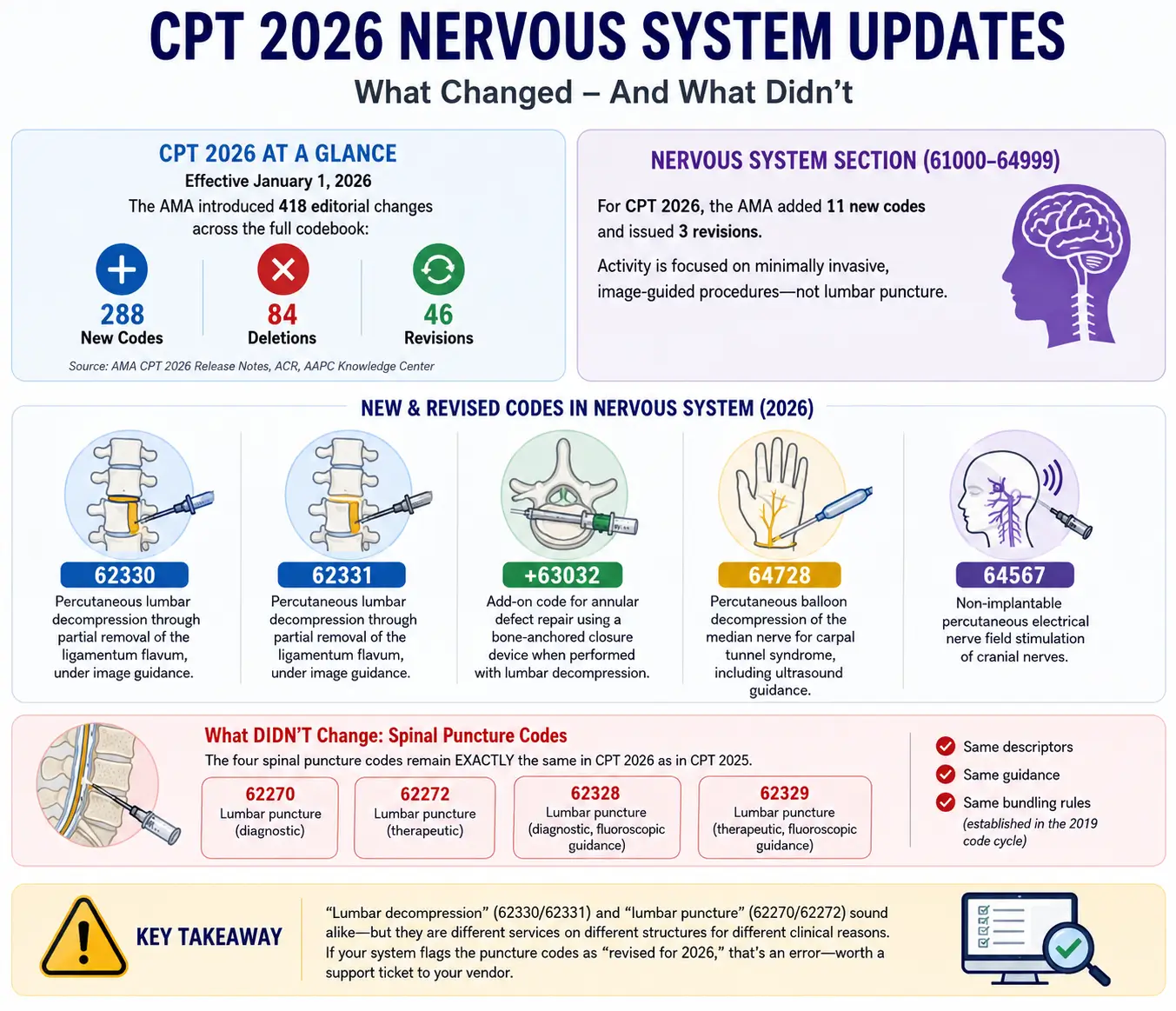
The CPT 2026 code set, effective January 1, 2026, introduced 418 editorial changes across the full codebook: 288 new codes, 84 deletions, and 46 revisions. This information is based on the AMA’s CPT 2026 release notes and is supported by reports from the American College of Radiology and coding education resources such as AAPC’s Knowledge Center.
Within the Nervous System section, which spans codes 61000 through 64999, the AMA added 11 new codes and issued three revisions for 2026. Nearly all of that activity centers on percutaneous, minimally invasive procedures that have nothing to do with diagnostic or therapeutic lumbar puncture:
- Two new codes, 62330 and 62331, describe percutaneous lumbar decompression through partial removal of the ligamentum flavum, performed under image guidance.
- The new add-on code +63032 is used to report annular defect repair with a bone-anchored closure device when it is performed in conjunction with lumbar decompression.
- 64728 covers percutaneous balloon decompression of the median nerve for carpal tunnel syndrome, including ultrasound guidance.
- 64567 reports non-implantable percutaneous electrical nerve field stimulation of cranial nerves.
None of these touch the spinal puncture family. The overlap in language trips up newer coders more often than it should. “Lumbar decompression” (62330/62331) and “lumbar puncture” (62270/62272) sound alike on a crosswalk printout but describe entirely different services, performed on different structures, for different clinical reasons, often by different specialists. A coder scanning a 2026 update summary for anything containing “lumbar” might see 62330 flagged as new and assume the puncture family moved too. It didn’t.
The four spinal puncture codes, 62270, 62272, 62328, and 62329, appear in CPT 2026 exactly as they did in CPT 2025: same descriptors, same parenthetical guidance, same bundling rules established back in the 2019 code cycle. If a practice’s encoder or claims-scrubbing software flags any of these four as “revised for 2026,” that flag is worth a support ticket to the vendor.
The lumbar puncture code family, refreshed
Because the descriptors haven’t changed, an accurate recap for students and newer billers rests on the same logic that’s applied since the 2019 code family revision. The AMA created 62328 and 62329, effective January 1, 2019, specifically to bundle fluoroscopic or CT guidance into the lumbar puncture procedure itself. Before that revision, a physician using fluoroscopy typically reported add-on code 77003 alongside 62270 or 62272. Once 62328 and 62329 existed as standalone, guidance-inclusive codes, that separate billing of 77003 for lumbar puncture stopped being appropriate.
CPT code | What it reports | Guidance included | Selection logic |
62270 | Spinal puncture, lumbar, diagnostic | None (landmark or palpation-based) | Purpose is to collect CSF for testing |
62272 | Spinal puncture, therapeutic, for drainage of CSF | None | Purpose is to relieve pressure or drain fluid |
62328 | Diagnostic lumbar spinal puncture performed under fluoroscopic or CT guidance. | Fluoroscopy or CT (bundled into one code) | Diagnostic LP performed under fluoro/CT |
62329 | Spinal puncture, therapeutic, for drainage of CSF, with fluoroscopic or CT guidance | Fluoroscopy or CT (bundled) | Therapeutic LP performed under fluoro/CT |
76942 | Ultrasonic guidance for needle placement | Ultrasound | Add-on, reported with 62270 or 62272 |
77021 | MR guidance for needle placement | MRI | Add-on, reported with 62270 or 62272 |
62273 | Epidural blood patch | Not applicable | Treats post-dural puncture headache caused by a CSF leak |
The distinction between 62270 and 62272 has never been about needle technique. It’s about intent. The American College of Emergency Physicians’ Reimbursement Committee has framed this plainly in its coding guidance for emergency physicians: choose 62270 when the lumbar puncture is being done to establish a diagnosis, and choose 62272 when the diagnosis is already known and the tap is being done to relieve pressure through drainage. The needle insertion looks identical either way. What differs is why the physician is doing it, and that reasoning needs to appear in the documentation, not just the final CSF cell counts.
Guidance modality decides which code family applies. Fluoroscopy or CT triggers 62328/62329, with the imaging work folded into the base code. Ultrasound or MRI guidance stays outside that bundle: the base code (62270 or 62272) gets reported alongside 76942 for ultrasound or 77021 for MR guidance, and payers generally expect a saved image plus a written interpretation confirming the needle trajectory and final position before they’ll reimburse the guidance code separately.
A related but separate scenario: when a lumbar puncture is performed solely to deliver medication into the cerebrospinal fluid, such as intrathecal chemotherapy, coders typically turn to a drug-administration code like 96450 rather than 62270 or 62272, since the clinical purpose of the puncture in that case is delivery, not collection or drainage.
Lumbar puncture CPT codes for 2026: the same descriptors, a different payment picture
If the descriptors didn’t change, where’s the actual 2026 story? It sits in the CY 2026 Medicare Physician Fee Schedule (MPFS) final rule, which CMS released October 31, 2025, effective for dates of service on or after January 1, 2026.
For the first time, CMS is applying two separate conversion factors instead of one, a change required by statute. Practitioners who qualify as participants in an advanced alternative payment model get a conversion factor of $33.5675, a 3.77 percent increase over the CY 2025 conversion factor of $32.35. Everyone else, which covers most physicians billing lumbar punctures, works under a conversion factor of $33.4009, a 3.26 percent increase. Part of that bump is a temporary, one-year 2.5 percent payment increase written into the One Big Beautiful Bill Act (H.R. 1), layered on top of a smaller statutory update and a 0.49 percent budget-neutrality adjustment.
CY 2025 | CY 2026 | |
Qualifying APM participant conversion factor | $32.35 | $33.5675 (+3.77%) |
Non-qualifying APM (most physicians) conversion factor | $32.35 | $33.4009 (+3.26%) |
A rising conversion factor sounds like straightforward good news, but CMS paired it with two changes that pull in the other direction for procedural codes like lumbar puncture. First, the agency finalized an efficiency adjustment of negative 2.5 percent applied to the work relative value units, and the associated physician time, for roughly 7,700 non-time-based codes, a category that includes most surgical and procedural CPT codes rather than time-based evaluation and management services. CMS says it intends to repeat this adjustment on a three-year cycle going forward. Second, CMS reduced how much indirect practice expense gets allocated to services performed in facility settings such as hospitals, reasoning that those overhead costs increasingly sit with the facility rather than the physician, given how many physicians are now hospital-employed rather than running independent practices.
The net effect shows up clearly in CPT 62270’s own numbers. Based on the CMS 2026 National Physician Fee Schedule Relative Value File, 62270 carries a work RVU of 1.19 for 2026, a total non-facility RVU of 4.94, and a total facility RVU of only 1.76.
Metric | Non-facility (office) | Facility (hospital/ASC) |
Work RVU | 1.19 | 1.19 |
Total RVU | 4.94 | 1.76 |
Estimated national Medicare payment | $165.00 | $58.79 |
Multiplying total RVUs by the $33.4009 non-QP conversion factor produces those national payment estimates almost exactly. The non-facility figure represents roughly a 16 percent increase in the national average office payment for 62270 compared with the prior year, according to fee-schedule tracking site MedFeeSchedule. That jump doesn’t reflect a documentation change or a more generous descriptor. It reflects the practice-expense reallocation CMS finalized for 2026, which shifts indirect costs away from facility-based billing and toward office-based billing. A practice performing lumbar punctures in an outpatient office will see a meaningfully different national average than one performing the same procedure in a hospital outpatient department, and that gap widened for 2026.
These figures are national averages before any geographic adjustment. Actual reimbursement in any given locality depends on the Geographic Practice Cost Indices CMS applies on top of the RVUs, and commercial payer rates follow their own contracted fee schedules entirely. Anyone billing lumbar punctures for a specific practice should confirm current, locality-adjusted rates through the CMS Physician Fee Schedule Look-Up Tool rather than relying on a national average for financial planning.
Documentation and modifiers that still matter
Because CPT hasn’t changed the puncture codes, the documentation habits that supported clean claims in 2025 still apply in 2026. The American College of Emergency Physicians’ Lumbar Puncture FAQ notes that CPT itself doesn’t spell out rigid documentation requirements for a lumbar puncture, but the medical record needs to clearly show that the procedure occurred and identify who performed it. In practice, that means recording patient positioning, the entry site, the preparation technique, and the findings, along with the clinical reason the tap was ordered in the first place, since that reason is what separates 62270 from 62272.
Incomplete procedures still need a modifier, and payers still expect one. When a physician reduces or stops a lumbar puncture before completion by choice, ACEP’s guidance points to modifier 52 for reduced services. When the procedure gets cut short by something outside the physician’s control, such as a threat to the patient’s stability, modifier 53 for a discontinued procedure applies instead. Either way, the chart should note how much of the procedure was completed and why it stopped, since both modifiers typically reduce the payment a payer will issue, and vague documentation invites a denial rather than a reduced payment.
Practical takeaways for coders and billers
The lumbar puncture CPT code story for 2026 isn’t really about new codes. It’s about two conversion factors instead of one, an across-the-board efficiency cut to work RVUs on procedural codes, and a facility-versus-office payment gap that widened because of how CMS now allocates indirect practice expense. Coders who assume “CPT 2026 changes” automatically means new descriptors for lumbar puncture will miss the part that actually affects revenue this year: the fee schedule math sitting underneath codes that look identical to how they read in 2025.
Before submitting claims under the new fee schedule, it’s worth running each lumbar puncture code, including the guidance add-ons, through the CMS Physician Fee Schedule Look-Up Tool for the specific locality and place of service involved, checking current National Correct Coding Initiative edits for the guidance codes, and confirming that documentation ties the code selection (diagnostic versus therapeutic, with or without imaging) directly to what the physician wrote in the note. The codes are stable. The payment behind them is where the real update for 2026 lives.