

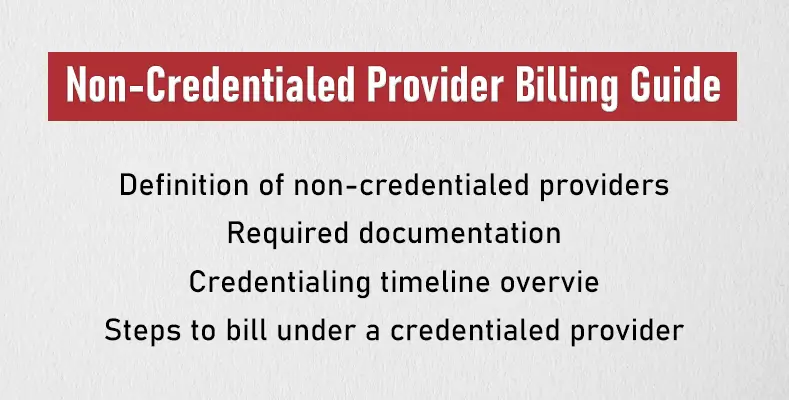
Getting credentialed with insurance networks can be lengthy and very frustrating. Providers often have to wait weeks and sometimes months to be able to bill the payers while using their own name. Meanwhile patients keep coming in and the revenue clock is still ticking.
So what happens when you are ready to treat patients but haven’t gotten credentialed yet? Should you wait until the process is complete or is there a compliant way to bill and get paid during that time?
This guide gives you the basics of how to bill as a non-credentialed provider without jeopardizing compliance, while avoiding common mistakes that could cost you time, money, and the future of your payer relationships.
At A2Z Billings, we’ve helped healthcare providers for over a decade keep their billing compliant and streamline cash flow during this tricky credentialing period.
What Does “Non-Credentialed” Mean?
A non-credentialed provider is someone who hasn’t yet been approved by an insurance payer (like Medicare, Medicaid, or commercial plans) to bill for services under their own name or NPI. This situation typically happens when:- You’ve recently joined a new practice.
- You’re a new graduate starting out.
- You’ve switched from one payer network to another.
- You’re waiting for credentialing paperwork to process.
The Problem: Cash Flow Freeze During Credentialing
The credentialing process can take 60 to 120 days or longer depending on the payer. That’s months of work without guaranteed reimbursement if you’re not billing correctly. Some providers try to:- Hold all claims until credentialing is complete (causing major cash flow gaps), or
- Submit claims under their name prematurely (risking denials or fraud flags).
The Solution: How to Bill During Credentialing (Compliantly)
There are several approved billing pathways for non-credentialed providers — depending on your setup, payer, and state rules. Let’s break that into a separate category:1. Incident-To Billing (For Supervising Providers)
Best Utilized by: Physicians, NPs or PAs being credentialed under a supervising provider. Incident-To services are billed under the supervising physicians NPI while the physician is waiting on your credentialing. Requirements:- The supervising provider must be on-site during the service.
- The supervising provider must be involved in the patient’s care plan.
- Documentation must clearly show their oversight.
2. Substitute Billing
Best for: Temporary coverage or provider transitions. If a credentialed provider is temporarily unavailable (e.g., on leave), a non-credentialed provider can work as a substitute, billing under the credentialed provider’s NPI for up to 60 continuous days. Requirements:- Must use modifier Q6 when billing.
- The credentialed provider must be returning.
- Proper documentation of substitution is mandatory.
3. Retroactive Billing After Credentialing
Some payers allow retroactive effective dates, meaning once you’re approved, your credentialing can backdate to the application submission date. Requirements:- You must have submitted your credentialing application before seeing patients.
- Keep thorough records and dates of service.
4. Out-of-Network (OON) Billing
If you’re not yet in-network, you can still bill out-of-network. Patients will often have higher out-of-pocket costs, but this allows you to keep billing ethically. Requirements:- Patients must sign an acknowledgment of OON status.
- Clearly disclose estimated costs.
5. Cash-Pay Model During Credentialing
For short credentialing gaps or new practices, consider a temporary cash-pay model. Requirements:- Post clear pricing.
- Offer itemized receipts (patients can self-submit claims).
Avoid These Common Compliance Mistakes
Even experienced providers slip up during the credentialing gap. Here are key pitfalls to avoid: Billing under someone else’s NPI without supervision — a compliance red flag. Changing NPIs after claim submission — leads to rejections and audits. Skipping documentation of supervision — leaves no proof for “incident-to” claims. Failing to verify payer-specific rules — every payer handles credentialing differently. Remember: Staying compliant is not optional — it protects your reputation, license, and revenue.Locum Tenens Billing During Credentialing: What Providers Must Know
Locum tenens billing refers to billing for services provided by a temporary or substitute provider while a credentialed provider is absent. In medical billing, locum tenens physician billing allows a non-credentialed provider to render services and bill under the regular provider’s NPI—only when CMS rules are followed. Under locum tenens billing guidelines (CMS), claims must include modifier Q6, and the substitute must be filling in temporarily. This applies to physicians and, in some cases, billing for locum tenens nurse practitioners, depending on payer rules. Importantly, many practices ask: can you bill locum tenens while credentialing? Yes—but only within CMS-approved limits and with proper documentation. Incorrect locum tenens billing is a frequent audit trigger, so strict adherence is essential.CMS Locum Tenens Rules, Time Limits, and Payer Policies
According to CMS locum tenens billing guidelines, services may only be billed for a maximum of 60 continuous days per provider absence. This answers a critical question: What is the time limit for billing locum tenens? Once that limit is exceeded, claims become non-compliant and are subject to recoupment. Additionally, UnitedHealthcare locum tenens policy and other commercial payers may impose stricter requirements, including written agreements and provider credential verification. While CMS rules are federal, commercial insurers may differ—making payer-specific verification essential. A key misconception is whether locum tenens need to be credentialed with insurance companies; generally, they do not, as long as billing is done under the credentialed provider’s NPI and within allowed timeframes.Credentialing Delays, Locum Coverage, and Income Considerations
When there is a delay in the process of credential evaluation, practices often rely on locum tenens coverage to maintain access to care and revenue. If your credentialing status is delayed, options include locum tenens billing, incident-to billing, or temporary out-of-network models—each with different compliance risks. From an industry standpoint, many providers also ask: What is the highest paid locum tenens specialty? Currently, specialties such as anesthesiology, psychiatry, radiology, and emergency medicine command the highest locum tenens rates due to nationwide shortages. While compensation varies, billing compliance—not pay rate—is what determines whether revenue is retained or later recouped.How a Professional Billing Partner Helps
Credentialing and billing are two different beasts — and both can eat up your time. A professional billing team ensures you:- Bill under the right NPI every time.
- Track claim timelines and payer updates.
- Submit retroactive claims properly once you have been credentialed.
- Be 100% compliant with Medicare, Medicaid, and commercial plans.
Real Results: What Providers Experience When They Get It Right
When providers handle non-credentialed billing correctly, here’s what happens: Zero cash-flow gaps – patient visits stay consistent, and revenue keeps moving. Fewer denials – claims are clean and compliant from day one. Faster reimbursements – no resubmission delays after approval. Peace of mind – focus on your patients, not on claim errors. That’s the real win — confident billing, even before full credentialing.Action Plan: Step-by-Step Checklist for Non-Credentialed Billing
Here’s a quick implementation guide to keep your practice compliant and cash-positive:- Confirm credentialing submission date.
- Check payer policies for retroactive billing or incident-to allowances.
- Choose your billing pathway:
- Incident-to
- Retroactive
- ONN
- Cash-pay
- Document everything (supervision, visit notes, service details).
- Communicate with patients about billing status if applicable.
- Work with a billing expert to manage submissions and tracking.
FAQs
Yes, they can — as long as billing and supervision follow payer compliance rules such as “incident-to” guidelines.
You can bill under a supervising provider’s NPI or hold claims for retroactive submission once credentialing is approved.
Typically it takes 60–120 days, according to the payer and proper documentation.
Most likely your claims will be denied, and if you keep doing this, it could create compliance flags or audits.
Yes, Medicare typically allows backdate credentialing to the application date if everything is properly documented with timelines.
No. With compliant billing structures in place, you can continue seeing patients and maintain cash flow.