


Search the ICD-10-CM tabular list for “positive Cologuard” and nothing comes back. That’s the root of most of the coding confusion around this test. There is no code built specifically for an abnormal stool DNA result, so billing staff often default to whatever code was used for the original screening order, usually Z12.11, and carry it forward into visits where it no longer fits. The accurate answer involves at least two codes, a shift in how the encounter gets classified once the result comes back abnormal, and a modifier that has nothing to do with the diagnosis code at all.
Getting positive Cologuard ICD-10 coding right matters beyond producing a clean claim. Colorectal cancer is now the leading cause of cancer death in adults under 50, a reversal significant enough that the American Cancer Society highlighted it in its most recent statistics report, and a delayed or denied follow-up colonoscopy after a positive screening test is exactly the kind of gap that shows up in those numbers. This piece walks through which code belongs at each stage of a Cologuard-driven screening episode, why Medicare and most commercial plans still cover the colonoscopy at no cost even though the diagnosis code on that claim is technically diagnostic, and what the documentation needs to say to support it.
What a Cologuard result actually tests for
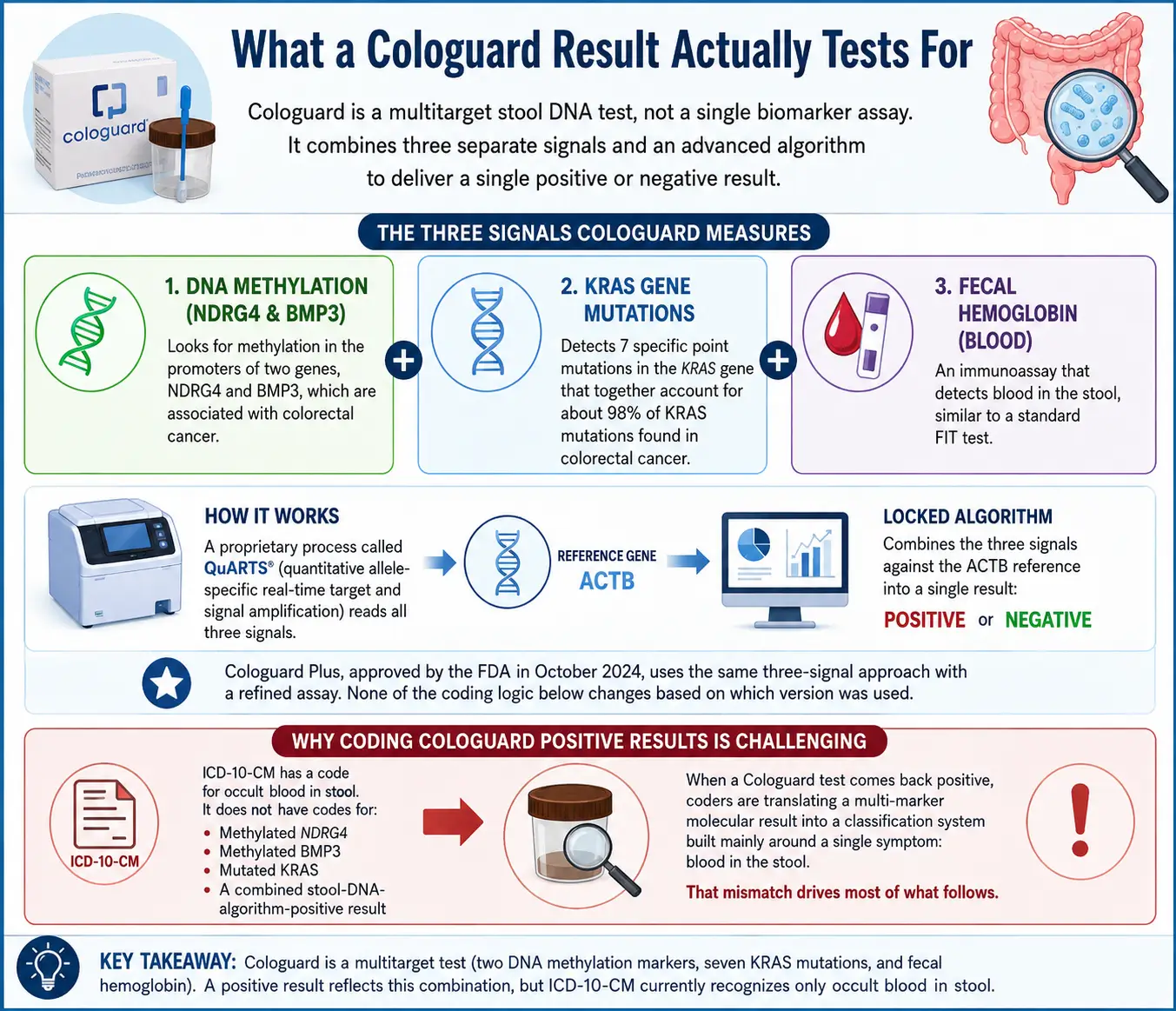
Cologuard is a multitarget stool DNA test, not a single biomarker assay. Exact Sciences, the Madison, Wisconsin company that makes it, built the test around three separate signals: methylation of the NDRG4 and BMP3 gene promoters, seven specific point mutations in the KRAS gene that together account for roughly 98% of the KRAS mutations found in colorectal cancer, and a fecal hemoglobin immunoassay that checks for blood much like a standard FIT test does. A proprietary process called QuARTS (quantitative allele-specific real-time target and signal amplification) reads all three signals against a reference gene, ACTB, and a locked algorithm combines them into a single positive or negative result. A newer version, Cologuard Plus, received FDA approval in October 2024 and uses the same three-signal approach with a refined assay; none of the coding logic below changes based on which version was used.
That combination is why the coding gets messy. ICD-10-CM has a code for occult blood in stool. It does not have one for methylated NDRG4, mutated KRAS, or a combined stool-DNA-algorithm-positive result. When a Cologuard test comes back positive, coders are translating a multi-marker molecular result into a classification system built mainly around a single symptom: blood in the stool. That mismatch drives most of what follows.
Z12.11 covers the order, not the result
Z12.11, encounter for screening for malignant neoplasm of colon, belongs on the claim when a clinician orders Cologuard in the first place. It sits in the Z12 category, under the broader Z00-Z13 block for persons encountering health services for examinations, and it’s valid for reporting purposes through September 30, 2026, under the current fiscal-year ICD-10-CM file. The code fits when the patient is asymptomatic, has no personal history of colorectal cancer or adenomas, and is being tested because average-risk screening guidelines call for it, not because of any complaint. On the lab order, it pairs with CPT 81528, the code for the stool DNA test itself.
The U.S. Preventive Services Task Force expanded who qualifies for that screening in May 2021, lowering the recommended starting age from 50 to 45 for average-risk adults (a grade B recommendation, with continued grade A support for ages 50 through 75). That change is part of why Cologuard volume, and the coding questions attached to it, has grown: a wider population is now eligible, and a larger number of results, in absolute terms, come back positive each year.
Z12.11 describes intent. It tells the payer the patient was well and being checked, not sick and being worked up. Once the result is positive, that description stops being accurate for anything that happens next.
R19.5 is the code most coders reach for
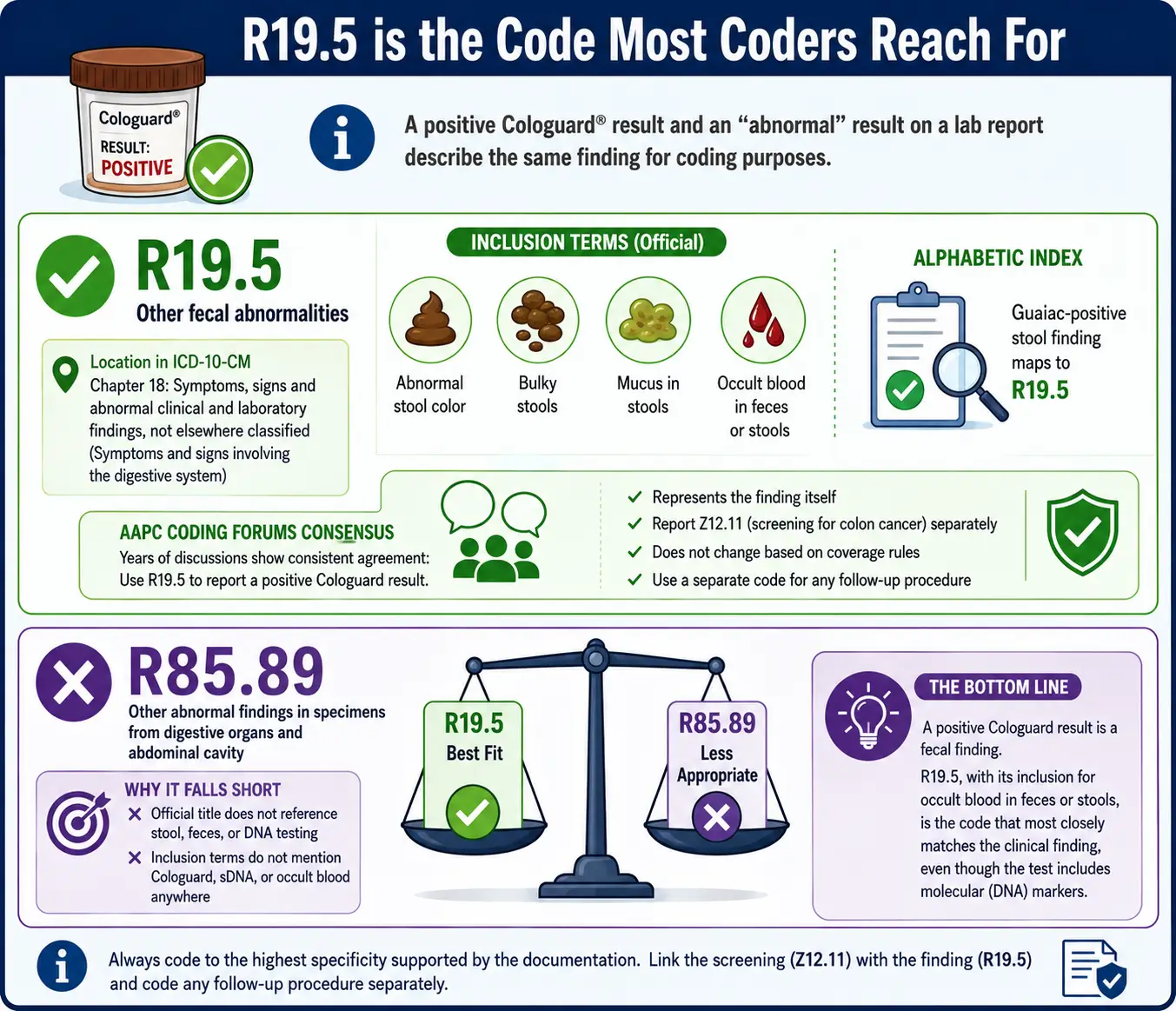
R19.5, other fecal abnormalities, is where most practices land once a Cologuard result comes back positive. Lab reports and patient portals often label the same result “abnormal,” and coders should treat the two terms as describing the same finding for coding purposes. The code sits in Chapter 18 of ICD-10-CM, under symptoms and signs involving the digestive system, and its inclusion terms cover abnormal stool color, bulky stools, mucus in stools, and, most relevantly, occult blood in feces or stools. In the Alphabetic Index, a guaiac-positive stool finding also maps to R19.5, which is the closest official language ICD-10-CM has for a positive fecal-based cancer screen, DNA markers included.
Coding forums hosted by AAPC show this has been a live question since Cologuard’s early years on the market. Threads going back years ask a version of the same thing on a rolling basis: does a positive result get billed with R19.5, does Z12.11 stay attached, and does the answer change once a new coverage rule takes effect. The consistent answer from experienced coders in those threads is that R19.5 is the code that best represents the finding itself, separate from whatever code ends up describing the follow-up procedure.
Why R85.89 falls short
Some practices use R85.89, other abnormal findings in specimens from digestive organs and abdominal cavity, on the theory that it sounds more specific to a lab-based test. It’s a valid, billable code, but its official title makes no reference to stool, feces, or DNA testing, and its inclusion terms don’t mention Cologuard, sDNA, or occult blood anywhere. R19.5 remains the better fit precisely because its inclusion terms were written around fecal findings, which is what a positive Cologuard result clinically is, even though the test adds a molecular layer the code doesn’t spell out.
Positive Cologuard ICD-10 coding for the follow-up colonoscopy
The harder question is what happens to the colonoscopy that follows a positive result, and this is where positive Cologuard ICD-10 coding actually gets contested. The ICD-10-CM Official Guidelines for Coding and Reporting define screening as testing performed on seemingly well individuals, and define a diagnostic exam as one performed to rule out or confirm a condition because the patient has a sign. A positive Cologuard result is, by that definition, a sign. Read strictly, the colonoscopy that follows is a diagnostic procedure, not a screening one, and R19.5 (or a more specific finding, once one exists) becomes the first-listed diagnosis for that encounter rather than Z12.11.
This isn’t a fringe interpretation. Coders on AAPC’s forums have referenced AHA Coding Clinic guidance classifying a colonoscopy after a positive Cologuard result as diagnostic, and the confusion running through those same threads (coders still asking whether to bill it as screening, years after the guidance was published) shows how often the classification gets overridden in practice anyway. The override comes from the payer side, not from the coding rules.
Medicare pays through a modifier, not a new diagnosis code
Before 2023, Medicare treated a colonoscopy following a positive non-invasive stool-based test as diagnostic for cost-sharing purposes too, on the reasoning, as CMS put it in its own Medicare Claims Processing Manual transmittal on the change, that the positive result “represented a sign of illness.” A patient who did everything asked of them, took a stool test, got a positive result, and had the recommended colonoscopy, still walked into deductible and coinsurance exposure on the follow-up.
The CY 2023 Physician Fee Schedule final rule (87 FR 69404, published in the Federal Register on November 18, 2022) changed that. Effective for dates of service on and after January 1, 2023, CMS expanded the regulatory definition of a colorectal cancer screening test to include a follow-on screening colonoscopy after a Medicare-covered non-invasive stool-based test, gFOBT, FIT, or sDNA, comes back positive. The mechanism is a KX modifier appended to the colonoscopy HCPCS code (G0105 or G0121), not a change to the ICD-10-CM diagnosis code. R19.5 still describes why the colonoscopy is happening. The modifier is what tells Medicare’s claims system to process it at the no-cost preventive rate anyway.
Research published in Cancer Prevention Research by A. Mark Fendrick and colleagues in 2022 helps explain why CMS made the change: a follow-up colonoscopy after a positive stool-based test finds advanced neoplasia or cancer at roughly twice the rate of a routine screening colonoscopy, which supports treating it as the second half of one screening episode rather than a fresh diagnostic workup.
Commercial plans followed a similar, separate path
Most commercial ACA-compliant plans reached the same outcome earlier, through different guidance. The Departments of Labor, Health and Human Services, and Treasury addressed it in FAQs About Affordable Care Act Implementation Part 51 (2022), stating that plans and issuers must cover a colonoscopy performed after a positive non-invasive stool-based screening test without cost-sharing, for plan years beginning on or after May 31, 2022. Commercial claims typically carry modifier 33 to flag the service as preventive, where Medicare uses KX. Either way, the pattern holds: the diagnosis code reflects clinical reality (a positive result prompted the exam), and a procedure-level modifier reflects a benefit-design decision layered on top of it.
When the colonoscopy finds something
If the colonoscopy is clean, R19.5 remains the appropriate first-listed diagnosis. The abnormal screening result has been worked up and explained, and no further code is needed. If the procedure finds and removes a polyp, the ICD-10-CM guidelines are direct about what happens next: once a definitive diagnosis is established, it replaces the sign or symptom that prompted the workup rather than sitting alongside it. A benign adenomatous polyp gets coded to the appropriate D12 subcategory by location; a confirmed malignancy gets coded to C18 by site. R19.5 drops off the claim once the pathology report gives coders something more specific, and Z12.11 was already gone by that point.
Medicare cost-sharing still applies to a polypectomy performed during that colonoscopy, though it’s shrinking on a fixed schedule. Under Section 122 of the Consolidated Appropriations Act, 2021, coinsurance on the physician and facility fee for a colonoscopy that converts from screening to therapeutic runs at 15% through 2026, drops to 10% for 2027 through 2029, and reaches zero starting in 2030. The Part B deductible is waived regardless, under a separate ACA provision. None of this changes the diagnosis coding logic above; it only affects what shows up on the patient’s bill for the procedure itself.
Cologuard coding at a glance
The sequence below summarizes how the first-listed diagnosis shifts across a typical episode:
Point in the episode | First-listed ICD-10-CM code | What it reflects |
Cologuard ordered (asymptomatic, average risk) | Z12.11 | Screening intent; no signs or symptoms present |
Cologuard result comes back positive | R19.5 | Abnormal fecal finding; no confirmed diagnosis yet |
Colonoscopy performed because of the positive result | R19.5 | Diagnostic workup of the abnormal screening result |
Colonoscopy finds and removes a polyp | D12.- (by colon subsite) | Confirmed benign finding replaces the symptom code |
Colonoscopy confirms cancer | C18.- (by site) | Confirmed malignancy replaces the symptom code |
Colonoscopy is negative | R19.5 | Abnormal result investigated and explained |
Documentation that keeps the claim intact
Every code above depends on documentation a reviewer can actually trace back to the chart. Records that support positive Cologuard ICD-10 coding through an audit generally need:
- A clear statement of average-risk versus increased-risk status at the time Cologuard was ordered, since that status affects both the screening code and which HCPCS colonoscopy code applies later
- Confirmation the patient was asymptomatic when the test was ordered, supporting Z12.11 on the original lab order
- The Cologuard result itself, positive or negative, along with the collection date and result date, recorded in the note rather than left to the lab report alone
- An explicit line connecting the colonoscopy referral to the positive result, since this is what supports R19.5 as first-listed and what a payer’s system checks before applying KX or modifier 33
- Confirmation that the diagnosis code on the colonoscopy claim was reconciled against the final pathology report, not just the pre-procedure indication, whenever tissue was removed
Missing any one of these tends to produce the same two outcomes: a denial that gets appealed weeks later, or an approved claim that doesn’t hold up if it’s ever audited.
Keeping Z12.11 and R19.5 in their lanes
Z12.11 and R19.5 answer two different questions, and neither substitutes for the other at any point in a Cologuard-driven screening episode. Z12.11 documents why the test was ordered: an asymptomatic, average-risk patient due for screening. R19.5 documents why everything after the result exists: an abnormal fecal finding that needs a diagnostic answer. Positive Cologuard ICD-10 coding goes wrong most often when one of those codes gets carried into a visit it no longer describes, or when a modifier that governs payment gets mistaken for a signal that should change the diagnosis code itself. It doesn’t. The diagnosis code tracks the clinical story. The modifier tracks how the payer has agreed to treat that story for cost-sharing purposes. Keeping the two separate is most of what accurate coding on this test comes down to.