


Search for a PRRJK code description, and you’ll find numerous websites confidently presenting definitions even though many of them are inaccurate or unsupported. Those definitions contradict each other, and none of them traces back to an official code set. That gap matters. A biller who acts on an invented definition can post adjustments to the wrong bucket, send patients statements for money they do not owe, or write off revenue a payer should have paid. This guide clarifies what the PRRJK string actually represents, explains how to interpret unfamiliar codes that appear on claim rejection reports, and covers the PR (Patient Responsibility) group code used in medical billing. You’ll also learn what common PR codes such as PR1, PR2, PR3, and other patient responsibility adjustment codes mean when they appear on remittance advice. The information in this guide is based on X12 standards for claim adjustment codes, guidance from CMS contractors, and other authoritative industry sources.
What the PRRJK code description actually is
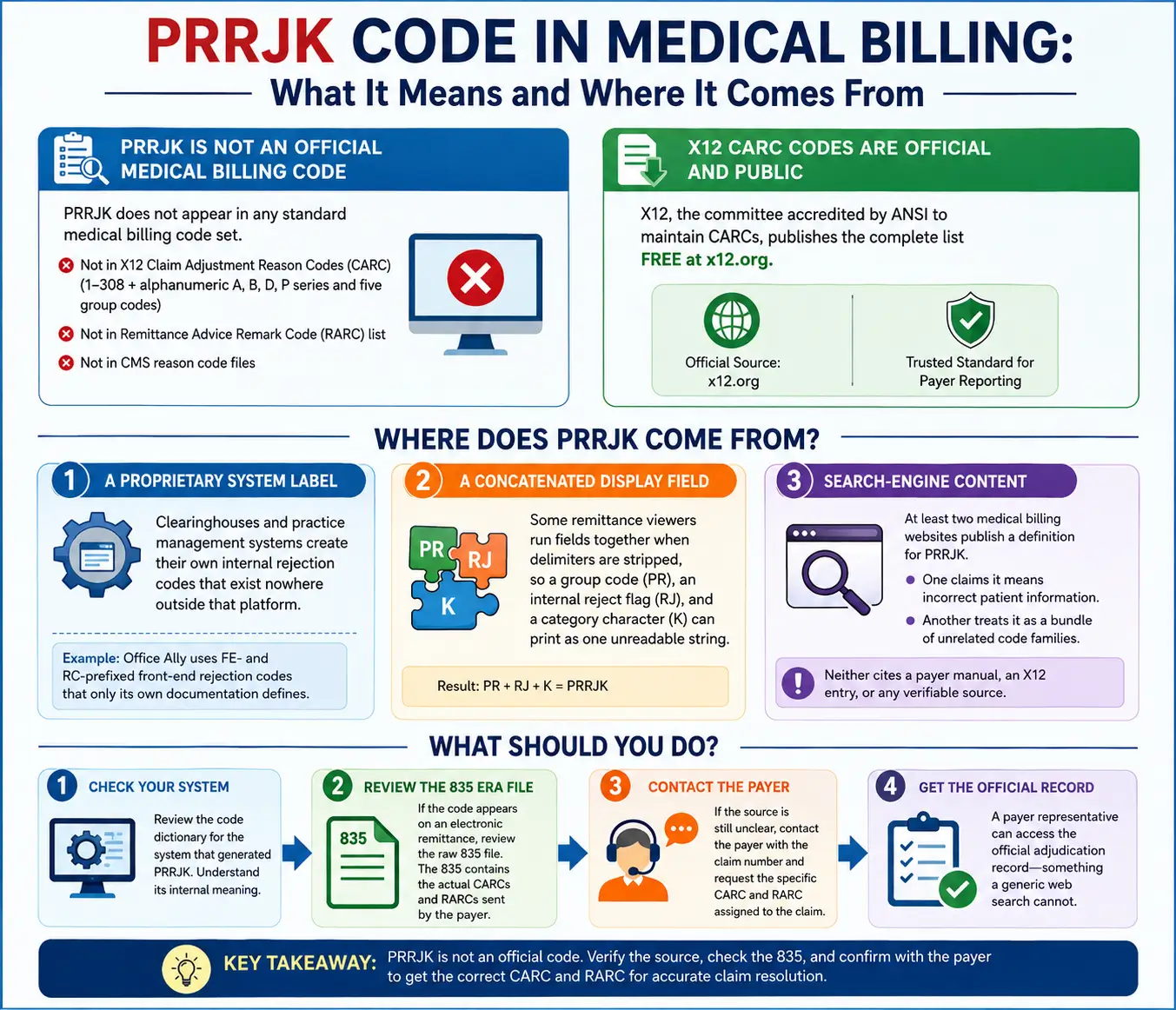
PRRJK does not appear in any standard medical billing code set. X12, the committee accredited by the American National Standards Institute to maintain Claim Adjustment Reason Codes (CARC), publishes its complete list free of charge at x12.org. The list runs from code 1 through code 308, plus a small set of alphanumeric codes (the A, B, D, and P series) and five two-letter group codes. PRRJK is not on it. It also does not appear on the Remittance Advice Remark Code (RARC) list or in CMS reason code files.
So where does the string come from when it shows up on a report or in a search box? Three explanations account for most sightings:
- A proprietary system label. Clearinghouses and practice management systems generate their own internal rejection codes that exist nowhere outside that platform. Office Ally, for instance, uses FE- and RC-prefixed front-end rejection codes that only its own documentation defines.
- A concatenated display field. Some remittance viewers run fields together when delimiters are stripped, so a group code (PR), an internal reject flag (RJ is a common software abbreviation for reject), and a category character can print as one unreadable string.
- Search-engine content. At least two medical billing websites currently publish a definition for the PRRJK code. One claims it means incorrect patient information; the other treats it as a bundle of unrelated code families. Neither cites a payer manual, an X12 entry, or any verifiable source.
The appropriate next step depends less on the code itself than on where it originated. Start by checking the code dictionary for the system that generated it. If the code appears on an electronic remittance, review the raw 835 ERA file instead of relying on your billing software’s summary, as the 835 contains the actual Claim Adjustment Reason Codes (CARCs) and Remittance Advice Remark Codes (RARCs) transmitted by the payer. If the source is still unclear, contact the payer with the claim number and request the specific CARC and RARC assigned to the claim. A payer representative can access the official adjudication record, whereas a generic web search cannot.
What PR means in medical billing
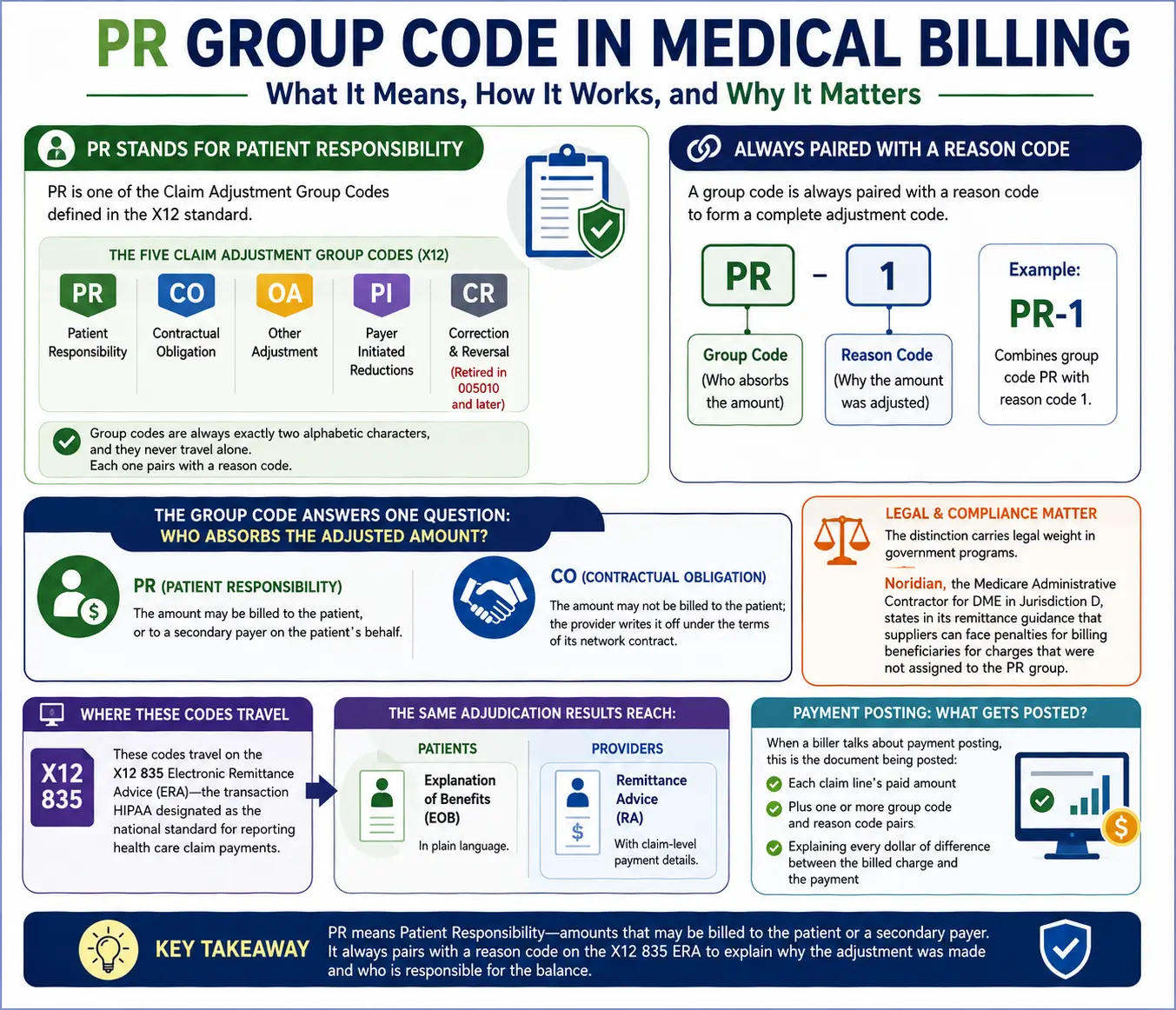
PR stands for Patient Responsibility. It is one of the Claim Adjustment Group Codes defined inside the X12 standard, alongside CO (Contractual Obligation), OA (Other Adjustment), PI (Payer Initiated Reductions), and CR (Correction and Reversal, which X12 retired for transaction version 005010 and later). Group codes are always exactly two alphabetic characters, and they never travel alone. Each one pairs with a reason code, so a remittance entry of PR-1 combines group code PR with reason code 1.
The group code answers a single question: who absorbs the adjusted amount. A PR amount may be billed to the patient, or to a secondary payer on the patient’s behalf. A CO amount may not; the provider writes it off under the terms of its network contract. The distinction carries legal weight in government programs. Noridian, the Medicare Administrative Contractor for durable medical equipment in Jurisdiction D, states in its remittance guidance that suppliers can face penalties for billing beneficiaries for charges that were not assigned to the PR group.
These codes travel on the X12 835 electronic remittance advice, the transaction HIPAA designated as the national standard for reporting health care claim payments. The same adjudication results reach patients in plain language as the Explanation of Benefits (EOB) and reach providers as the Remittance Advice (RA). When a biller talks about payment posting, this is the document being posted: each claim line’s paid amount, plus one or more group code and reason code pairs explaining every dollar of difference between the billed charge and the payment.
PR1, PR2, and PR3: the three core patient responsibility codes
Reason codes 1, 2, and 3 have carried the same meanings since X12 activated them on January 1, 1995. Paired with the PR group code, they describe the three standard forms of cost sharing.
Code | Official X12 description | Active since | What the patient owes |
PR-1 | Deductible Amount | January 1, 1995 | The annual amount paid out of pocket before the plan begins paying |
PR-2 | Coinsurance Amount | January 1, 1995 | A percentage of the allowed amount after the deductible is met |
PR-3 | Co-payment Amount | January 1, 1995 | A fixed dollar amount per visit or service |
PR-1, the deductible code in medical billing, has grown in financial weight as plan designs have shifted. KFF’s 2025 Employer Health Benefits Survey, published in October 2025, found the average general annual deductible for single coverage was $1,886 among covered workers who face one, and that 34 percent of covered workers now carry a single-coverage deductible of $2,000 or more. Workers at firms with fewer than 200 employees averaged $2,631. The operational consequence is seasonal: deductibles reset with the calendar or plan year, so first-quarter remittances carry the heaviest PR-1 volumes, and eligibility checks should return the remaining deductible before high-dollar services are scheduled.
PR-2 covers coinsurance. For example, if a payer allows $180 for a procedure and the health plan covers 80% of the allowed amount after the deductible has been met, the remaining $36 patient coinsurance is reported on the remittance as a PR-2 adjustment. Medicare Part B works this way for most covered services, leaving beneficiaries responsible for 20 percent of the approved amount once the annual Part B deductible is satisfied, which is why PR-2 appears on nearly every Part B professional remittance.
PR-3 is the copay code in medical billing. Copays are fixed by the benefit design, printed on most insurance cards, and usually collected at check-in. Because the amount is known before adjudication, PR-3 is the one patient responsibility type a front desk can collect on the date of service rather than through a statement cycle. Under the Affordable Care Act’s cost-sharing rules, in-network copayments for essential health benefits count toward the plan’s annual out-of-pocket maximum, so a patient who has hit that maximum should generate no PR-3 at all; a remittance that shows one anyway is worth questioning.
Posting discipline ties the three together. PR-1, PR-2, and PR-3 amounts move to the patient’s balance and into the statement cycle. They are never written off as contractual adjustments, because the payer has explicitly stated the money is collectible from the patient.
Other PR denial codes you will see on remittances
Beyond the core three, a working knowledge of roughly a dozen PR pairings covers most of what lands in a denial queue.
Coverage-window codes: PR-26, PR-27, and PR-200. These three look similar and get confused constantly, but they point to different failures. PR-26 means the service predates the coverage effective date. PR-27 means coverage had already terminated. PR-200, added to the X12 list on October 31, 2006, means coverage lapsed, usually for nonpayment of premium, and the service fell inside the gap. The fix starts the same way for all three: a 270/271 eligibility check for the actual date of service, then a claim to whichever payer was active, or a bill to the patient. PR-200 deserves one extra step, a repeat eligibility check about thirty days later, because a lapse can be cured retroactively once back premiums are paid.
Identification codes: PR-31 and PR-32. PR-31 (patient cannot be identified as the payer’s insured) is usually a data problem rather than a coverage problem: a transposed member ID, a maiden name, a date of birth keyed wrong. PR-32 (patient is not an eligible dependent) surfaces after divorces, dependents aging out, and employer plan changes. Both codes deserve fast action because the timely filing clock keeps running while staff research the correct policy. Rebilling with corrected subscriber data resolves most PR-31 denials without patient involvement.
Benefit design codes: PR-204, PR-40, and PR-55. PR-204 states that the service, equipment, or drug is not covered under the patient’s current benefit plan, a code X12 activated on February 28, 2007. It is the signal to invoke whatever financial waiver or advance notice the patient signed. PR-40 (charges do not meet emergent or urgent care qualifications) and PR-55 (the payer deems the treatment experimental or investigational) are different animals: both are judgment calls by the payer, and both are appealable. For PR-40, the appeal should document the presenting symptoms, since prudent layperson standards evaluate what a reasonable patient believed at the time, not the discharge diagnosis. For PR-55, peer-reviewed literature and FDA status carry the argument.
The secondary-claim pair: PR-275 and CARC 303. X12 added code 275 on November 1, 2015, with a usage note restricting it to the PR group. It reports that a secondary payer does not cover the prior payer’s deductible, coinsurance, or copayment, which is common when a commercial secondary plan receives a Medicare crossover claim. The patient owes that balance. Its counterpart, code 303, added July 1, 2021, addresses the identical scenario for Qualified Medicare Beneficiaries and is restricted to the CO group instead, because federal law prohibits collecting Medicare cost sharing from QMB patients. A team that treats 275 and 303 the same way will either leave lawful revenue uncollected or bill protected patients illegally.
PR-100 reports that payment went to the patient, the insured, or another responsible party, which happens on unassigned claims. The provider’s remedy is a bill to the patient who received the funds, not an appeal to the payer.
Two pairings that should raise an eyebrow: PR-16 and PR-23. X12’s usage note on code 23, the code for prior payer adjudication impact, restricts it to group OA. A remittance showing PR-23 is out of compliance with the code list, and the amount should not be posted to the patient until the payer explains itself. Code 16 reports that the claim lacked information or contained a submission error, a provider-side clerical problem. When it arrives under PR, the practical effect is a patient being charged for a fixable typo. The correct response is a corrected claim, not a statement.
When PR is the wrong group code, and why it matters
Group code assignment decides who pays, so a wrong group code is never cosmetic. Miscoded as PR, a contractual write-off becomes an improper patient bill. Miscoded as CO, a collectible patient balance becomes lost revenue.
X12 builds guardrails directly into the code list. Code 45 (charge exceeds the fee schedule) may use PR or CO depending on liability. Code 209 is restricted to OA and states outright that the amount cannot be collected from the patient and must be refunded if it was. CAQH CORE adds another layer, publishing required combinations of group codes, CARCs, and RARCs for common business scenarios so payers report the same event the same way.
Federal law adds a hard boundary. The No Surprises Act, in effect since January 1, 2022, limits patient cost sharing to in-network amounts for most out-of-network emergency care and for out-of-network clinicians working at in-network facilities. A remittance that loads the full out-of-network balance into PR on a protected claim conflicts with the statute. The provider’s move is to hold patient billing, dispute the adjudication, and request a corrected 835.
Reading PR codes on the ERA, and what denials cost
Inside the 835 file, adjustments live in the CAS segment. A segment reading CASPR1*250 tells the posting system: group code PR, reason code 1, $250. Remark codes in a separate segment add detail when the reason code alone is too vague; X12 requires an accompanying remark code for several CARCs, including 16 and 96.
Accurate posting matters because the denial volumes behind these codes are large. A Premier, Inc. survey published in February 2025, covering calendar-year 2023 claims from 280 hospitals across 23 states, found private payers initially denied nearly 15 percent of claims, that working a single denied claim cost an average of $57.23, and that providers spent $25.7 billion on claims adjudication for the year, a 23 percent increase over the $19.7 billion reported for 2022. Roughly 70 percent of those denials were eventually overturned and paid. On the marketplace side, a KFF analysis of federal transparency data released in January 2025 found HealthCare.gov insurers denied 19 percent of in-network claims in 2023, with insurer-level rates ranging from 1 percent to 54 percent, and that patients appealed fewer than 1 percent of those denials. Every one of those adjudications reached a provider as a group code and reason code pair, and the posting decision made at that moment determined whether the balance went to a patient statement, an appeal queue, or a write-off.
How to verify any code description at the source
A short verification routine prevents the confusion that produces search terms like PRRJK in the first place.
- Look up CARCs and RARCs at x12.org, where the lists are free to read and updated on a March, July, and November cycle, with start dates, deactivation dates, and usage notes for every code.
- Check the payer’s companion guide or provider manual for payer-specific remark codes and proprietary rejection codes.
- For Medicare claims, use the reason code lookup tools on your Medicare Administrative Contractor’s site, such as Noridian’s remittance advice pages.
- For clearinghouse rejections, use that clearinghouse’s own code database, since front-end codes are defined nowhere else.
If a code string does not exist in any of those places, treat every web definition of it as unverified, no matter how confident the wording sounds.
Key facts to keep on file
The honest PRRJK code description is that no such code exists in the X12 standard, the RARC list, or CMS files, and any amount attached to an unrecognized string should be traced through the raw 835 or confirmed with the payer before posting. The PR group code, by contrast, is precisely defined: it marks amounts a patient can lawfully be billed, it has paired with reason codes 1, 2, and 3 for deductibles, coinsurance, and copayments since January 1, 1995, and its boundaries carry regulatory force, from Medicare’s penalties for billing non-PR amounts to the No Surprises Act’s cost-sharing caps. With single-coverage deductibles averaging $1,886 in KFF’s 2025 survey and nearly one in five marketplace in-network claims denied, the difference between reading these codes correctly and guessing at them is measured in real dollars, on both the practice’s ledger and the patient’s statement.