


A patient walks into urgent care and the chart notes that speech is slurred. That single line can turn into any of six or seven different ICD-10-CM codes, depending on what else is documented and what happens after the visit. Picking the right one from the slurred speech ICD-10 codes available in the R47 category has less to do with memorizing a number and more with reading the note the way the coding guidelines intend: as a statement about certainty, not just a symptom.
Speech complaints sit in an unusual spot in the classification system. They can be the entire reason for a visit, an early flag for a stroke, or a detail already absorbed into a diagnosis that accounts for them. A coder who defaults to one familiar code regardless of context ends up either losing specificity or, worse, billing a symptom that should never have appeared on the claim at all.
Slurred speech ICD-10 codes at a glance
Code | Descriptor | Billable |
R47.0 | Dysphasia and aphasia | No, use R47.01 or R47.02 |
R47.01 | Aphasia | Yes |
R47.02 | Dysphasia | Yes |
R47.1 | Dysarthria and anarthria | Yes |
R47.81 | Slurred speech | Yes |
R47.82 | Fluency disorder in conditions classified elsewhere | Yes |
R47.89 | Other speech disturbances | Yes |
R47.9 | Unspecified speech disturbances | Yes |
All eight codes carried through into the current ICD-10-CM fiscal year, which runs through September 30, 2026, without revision. That stability matters, because it means any confusion around these codes traces back to documentation and sequencing decisions, not to a recent classification change.
Where speech disturbance codes sit in ICD-10-CM
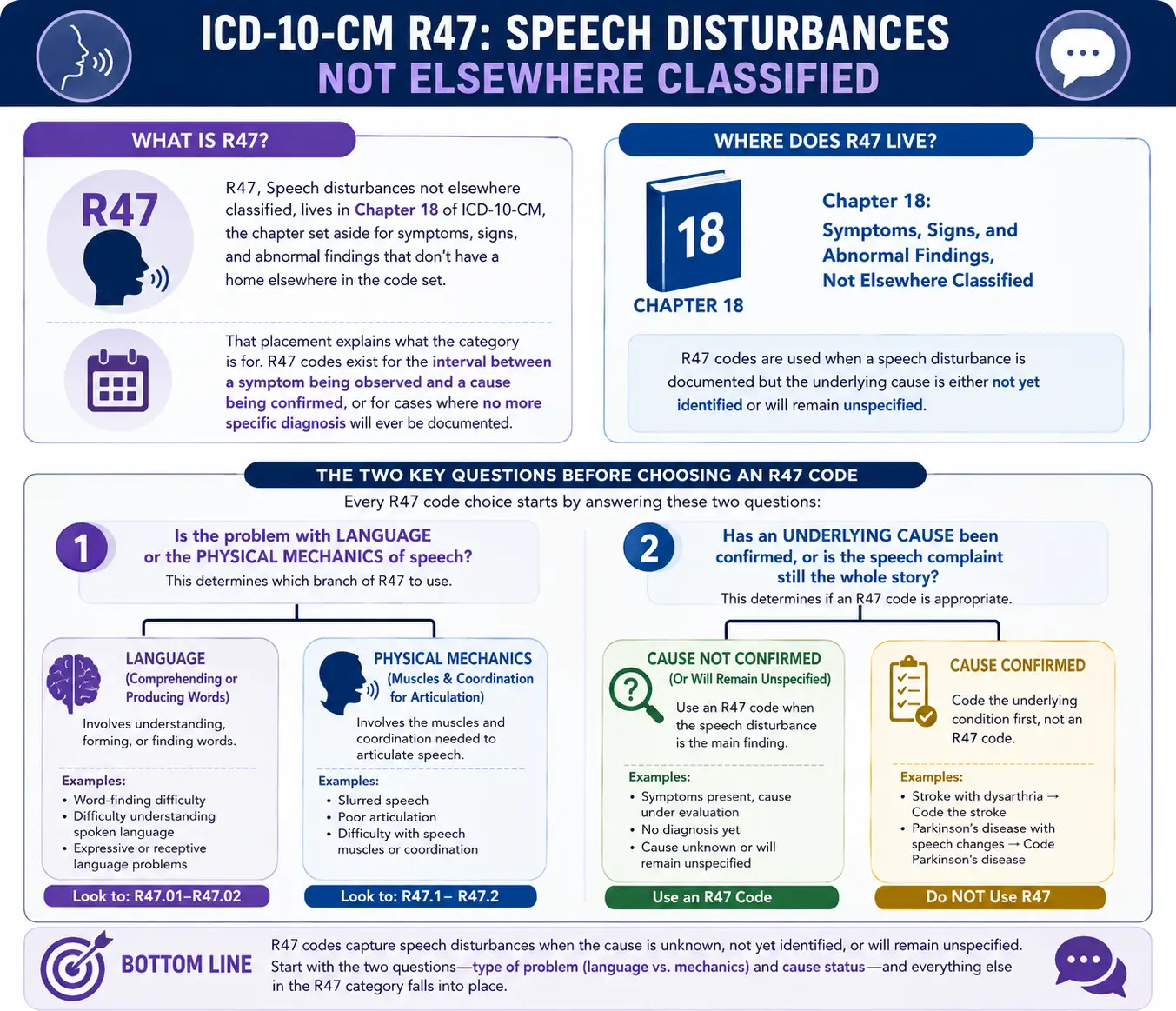
R47, Speech disturbances not elsewhere classified, lives in Chapter 18 of ICD-10-CM, the chapter set aside for symptoms, signs, and abnormal findings that don’t have a home elsewhere in the code set. That placement explains what the category is for. R47 codes exist for the interval between a symptom being observed and a cause being confirmed, or for cases where no more specific diagnosis will ever be documented.
Within R47, the codes split around two questions a coder needs to answer before picking one. Is the problem with language (comprehending or producing words) or with the physical mechanics of speech (the muscles and coordination needed to articulate)? And has an underlying cause been confirmed, or is the speech complaint still the whole story? Everything below follows from those two questions.
R47.81: the code most searches are looking for
R47.81, Slurred speech, matches the lay term almost exactly, which is likely why it shows up in so many searches for an ICD-10 code for slurred speech. It’s billable, sits under the broader R47.8 (Other speech disturbances) subcategory, and excludes speech disorders that belong to childhood development, such as stuttering, which are coded under F80 instead.
The catch is that “slurred speech” written in a chart doesn’t always signal the specific clinical diagnosis a coder might assume. A triage note might use the word loosely, before the physician’s own assessment settles on more precise language further down the record. The rule of thumb: follow the most specific and most clinically authoritative documentation available, not just the first mention of the word.
R47.1: dysarthria and anarthria, the code clinicians write more often
R47.1, Dysarthria and anarthria, gets used more often in practice than R47.81, because dysarthria is the term physicians and speech-language pathologists actually write in their notes. Dysarthria describes a motor speech disorder: weakness, paralysis, or poor coordination in the muscles responsible for producing speech, rather than a breakdown in language itself. Anarthria is its most severe form, where articulation is effectively absent. Severity words like mild or chronic that sometimes accompany the diagnosis don’t change the code; ICD-10-CM doesn’t split dysarthria by severity, though those details still belong in the documentation for clinical purposes.
R47.1 carries one important exclusion. Dysarthria documented as following a stroke isn’t coded here. The American Speech-Language-Hearing Association’s own coding guidance for speech, language, and swallowing disorders directs coders to the I69.3 sequela series instead, once the stroke is confirmed and the deficit is being reported as a lasting effect rather than an active symptom. That series is covered further down.
Aphasia is a different problem: R47.0, R47.01, R47.02
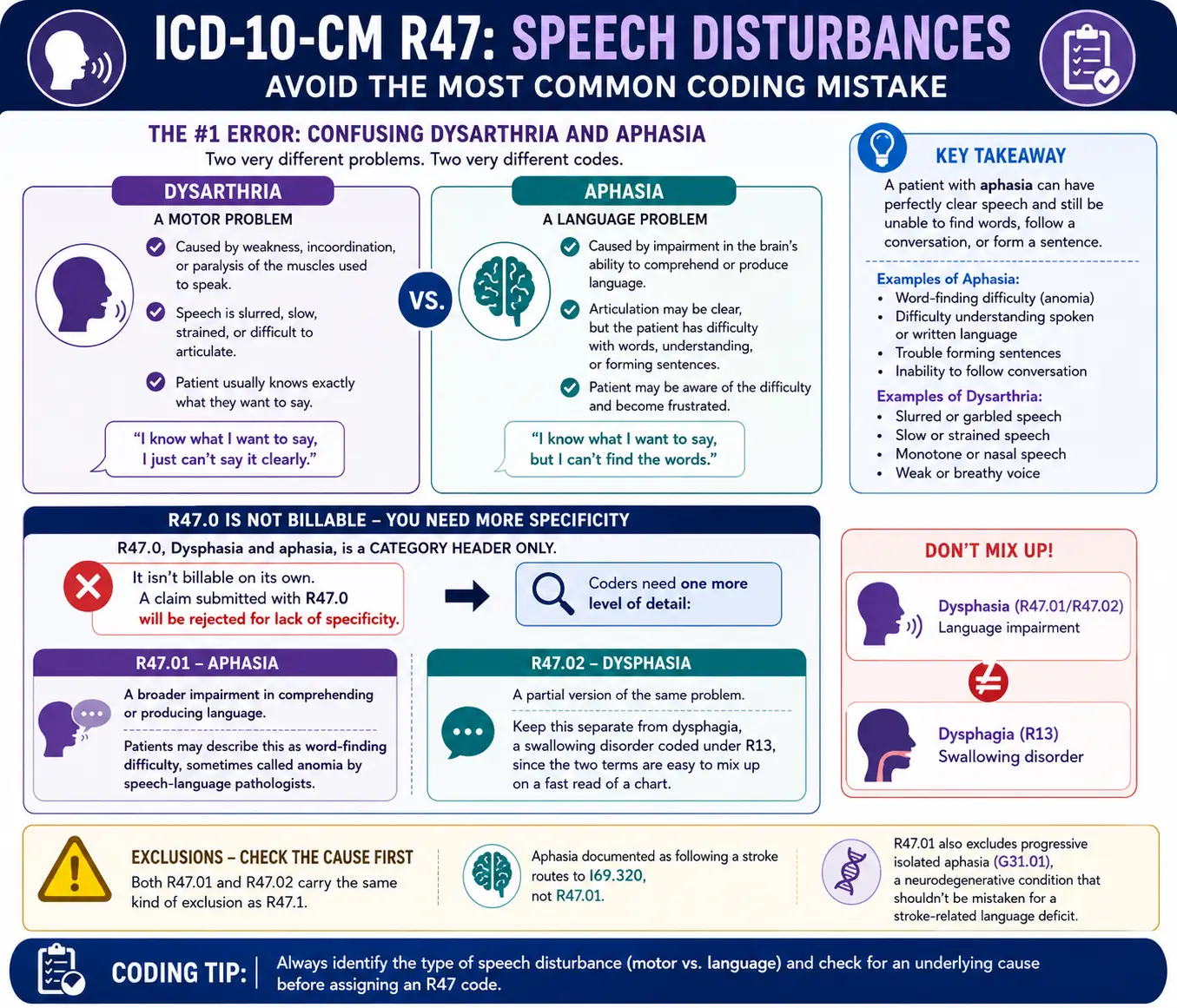
Mixing up dysarthria and aphasia is arguably the most common error in this part of the code set. Dysarthria is a motor problem. Aphasia is a language problem. A patient with aphasia can have perfectly clear articulation and still be unable to find words, follow a conversation, or form a sentence. A patient with dysarthria usually knows exactly what they want to say and simply can’t produce it clearly.
R47.0, Dysphasia and aphasia, is a category header only. It isn’t billable on its own, and a claim submitted with R47.0 will be rejected for lack of specificity. Coders need one more level of detail:
- R47.01 (Aphasia), for a broader impairment in comprehending or producing language. Patients may describe this as word-finding difficulty, sometimes called anomia by speech-language pathologists.
- R47.02 (Dysphasia), for a partial version of the same problem. It’s worth keeping this separate from dysphagia, a swallowing disorder coded under R13, since the two terms are easy to mix up on a fast read of a chart.
Both R47.01 and R47.02 carry the same kind of exclusion as R47.1. Aphasia documented as following a stroke routes to I69.320, not R47.01, and R47.01 also excludes progressive isolated aphasia (G31.01), a neurodegenerative condition that shouldn’t be mistaken for a stroke-related language deficit.
The rest of the R47.8 and R47.9 codes
Three more codes round out the category, and they’re the ones coders reach for when a chart doesn’t use “dysarthria” or “aphasia” at all. R47.82, Fluency disorder in conditions classified elsewhere, applies when a fluency problem is secondary to a condition already coded under a different chapter. R47.89, Other speech disturbances, is the catch-all for documented complaints, such as slowed or garbled speech, that don’t match any of the more specific terms above. R47.9, Unspecified speech disturbances, is the code of last resort, appropriate only when the documentation genuinely doesn’t support anything more precise.
That hierarchy matters at the claims level. Payers and internal auditors tend to treat R47.9 as a marker of thin documentation. A pattern of unspecified codes across speech-related claims is a common trigger for a documentation improvement request, so it’s worth a second look at the note before defaulting to R47.9 out of convenience rather than necessity.
When a stroke has already been confirmed
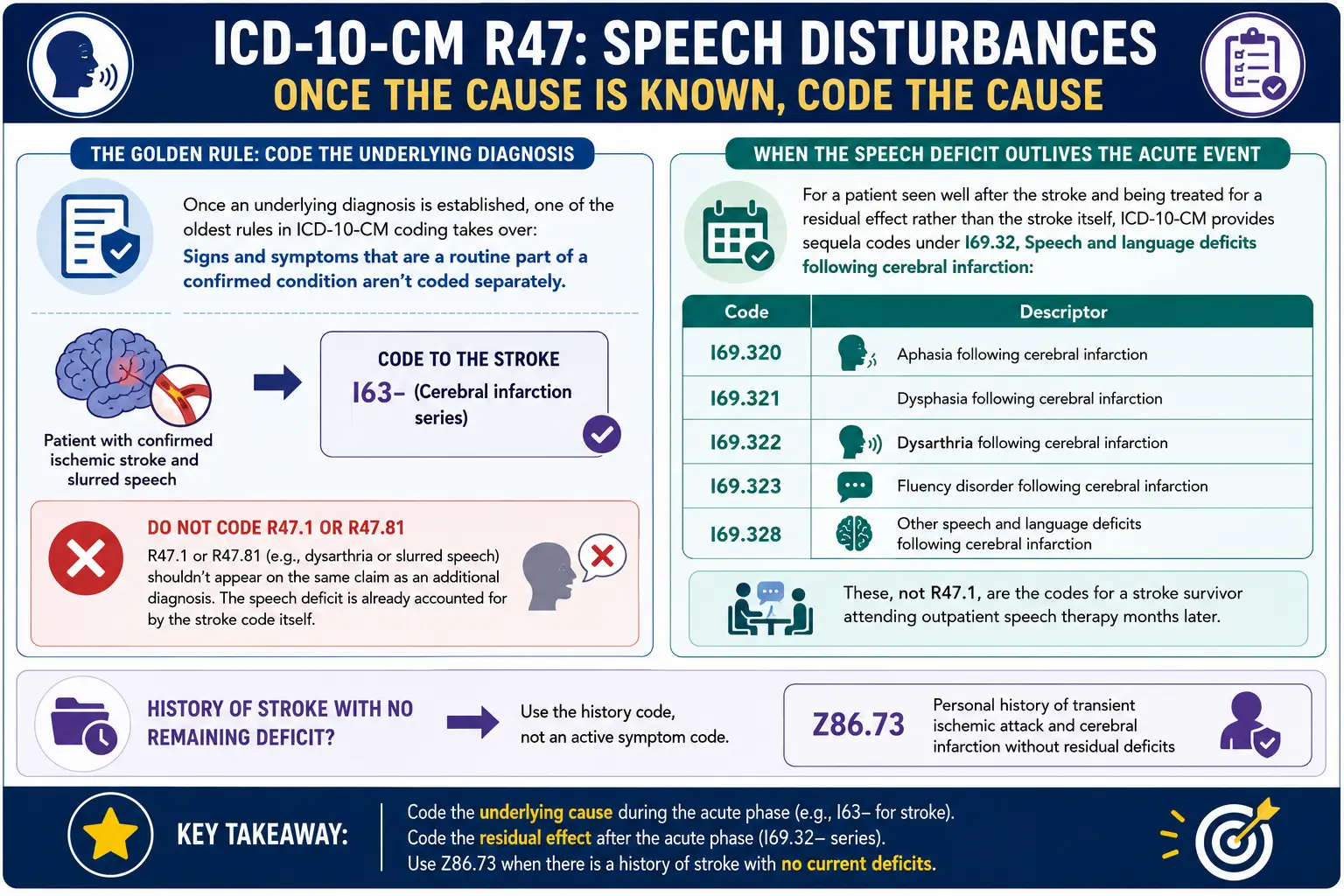
Once an underlying diagnosis is established, one of the oldest rules in ICD-10-CM coding takes over: signs and symptoms that are a routine part of a confirmed condition aren’t coded separately. A patient with a confirmed ischemic stroke and slurred speech gets coded to the stroke, from the I63 (Cerebral infarction) series. R47.1 or R47.81 shouldn’t appear on that same claim as an additional diagnosis, because the speech deficit is already accounted for by the stroke code itself.
This changes once the speech deficit outlives the acute event. For a patient seen well after the stroke, being treated for a residual effect rather than the stroke itself, ICD-10-CM has a dedicated set of sequela codes under I69.32, Speech and language deficits following cerebral infarction:
Code | Descriptor |
I69.320 | Aphasia following cerebral infarction |
I69.321 | Dysphasia following cerebral infarction |
I69.322 | Dysarthria following cerebral infarction |
I69.323 | Fluency disorder following cerebral infarction |
I69.328 | Other speech and language deficits following cerebral infarction |
These, not R47.1, are the codes for a stroke survivor attending outpatient speech therapy months later. And for a patient with a documented history of stroke and no remaining deficit at all, the correct code is Z86.73, Personal history of transient ischemic attack and cerebral infarction without residual deficits, rather than an active symptom code.
Suspected stroke and the rule-out problem
A large share of the searches behind slurred speech ICD-10 codes revolve around variations on suspected CVA and rule out stroke, and for good reason. This is where inpatient and outpatient coding genuinely diverge, and getting it backward is an easy way to fail an audit.
The ICD-10-CM Official Guidelines for Coding and Reporting, maintained jointly by the Centers for Medicare & Medicaid Services and the National Center for Health Statistics, draw a hard line between the two settings. Section II.H allows inpatient coders to report a condition documented at discharge as probable, suspected, likely, or still to be ruled out as though it were confirmed, but only for admissions to short-term, acute-care, long-term care, and psychiatric hospitals. Section IV.H does the opposite for outpatient encounters: diagnoses documented as suspected, rule out, or questionable are never coded as if confirmed. The instruction instead is to code to the highest degree of certainty actually supported by the visit, which usually means the presenting signs and symptoms.
In practice, that means an emergency department patient sent home with rule out stroke documented, and no imaging result confirming one before the encounter closes, gets coded to R47.1 or R47.81, plus any other presenting findings such as facial droop or limb weakness, not to a cerebrovascular code. If a later encounter confirms the stroke, that later claim carries the I63 code, and the earlier symptom-based claim stands as originally submitted.
What documentation needs to support the code
Coders can only work with what’s on the page, and speech complaints get documented inconsistently enough that gaps show up constantly. A note that actually supports clean code selection tends to specify:
- Whether the provider means dysarthria, aphasia, or a more general speech change
- Onset and duration, sudden versus gradual, resolved versus ongoing
- Associated findings, such as facial droop, limb weakness, or altered mental status
- Whether a cause is confirmed, suspected, or entirely undetermined
Nursing notes and other non-physician entries aren’t a valid basis for code selection on their own. If a nurse’s note mentions slurred speech but the physician’s own assessment never addresses it, that detail generally shouldn’t drive the code without a provider query to close the gap.
How this connects to speech-language pathology billing
R47.01, R47.02, R47.1, R47.81, and R47.89 don’t only matter in the emergency department. They’re also the diagnosis codes that establish medical necessity for speech-language pathology claims. A Medicare coverage article published by the Centers for Medicare & Medicaid Services (CMS) identifies the ICD-10-CM diagnosis codes that support medical necessity for standard speech-language pathology (SLP) evaluation and treatment services, including CPT codes 92507 (individual speech-language treatment) and 92523 (evaluation of speech sound production with language comprehension and expression). Without a supporting diagnosis code from that list attached to the claim, those CPT codes are considerably more likely to deny for lack of medical necessity, no matter how well the session itself was documented.
Common mistakes worth double-checking
A handful of errors show up repeatedly across speech-disturbance claims:
- Using R47.1 when the documentation actually describes a language problem rather than a motor one, which belongs under R47.01
- Reporting a symptom code alongside a confirmed diagnosis that already accounts for it
- Defaulting to R47.9 when the chart supports a more specific code
- Coding an acute cerebrovascular symptom instead of the matching I69.32 sequela code for a patient well past the acute event
- Treating rule-out documentation in an outpatient chart as though it were a confirmed diagnosis
Most of these trace back to the same root cause: coding from a single line in the note instead of the full clinical picture, including the provider’s final assessment.
Choosing the correct code
Slurred speech ICD-10 codes span four related but distinct categories, and the right one depends on two questions: is this a language problem or a motor one, and is the underlying cause confirmed, suspected, or still unknown. A coder who works through both questions from the actual documentation, rather than from memory of whichever code came up last time, lands on the right answer far more consistently.
Stroke and speech deficits show up together often enough that this sequencing decision carries real weight. The Centers for Disease Control and Prevention reports that someone in the United States has a stroke roughly every 40 seconds, and more than 795,000 people have one every year. With that volume moving through emergency departments and inpatient units, a speech-disturbance claim coded to the wrong side of the confirmed-versus-suspected line isn’t a minor slip. It’s the difference between a clean claim and one that draws a payer’s attention for the wrong reason.