


Texas unpaid medical bills come with more protection than most states provide, and the same rules shape how providers and billing teams can pursue a balance. Three state laws do most of the work: the timely billing requirement, the four-year statute of limitations on debt, and the constitutional protection of wages. Federal rules on collector conduct and credit reporting sit on top of them. This guide explains how each rule works, what a collector or hospital can legally do with an unpaid account, and where the limits fall. It is written for billing and coding professionals, providers, and anyone who needs to read a Texas account correctly.
What Texas law says about unpaid medical bills
Medical debt in Texas is a civil obligation, usually treated as a contract or an open account. That classification matters. It means no one goes to jail over a hospital bill, and it means the four-year limit that applies to credit card debt also applies to a medical balance. A March 2022 report from the Consumer Financial Protection Bureau found that roughly $88 billion in medical bills appeared on consumer credit reports nationwide, more than any other single category of collections. A 2022 analysis by KFF (Kaiser Family Foundation) estimated that about 100 million people in the United States carry some form of health care debt. Texas patients are well represented in those totals, which is why the state’s protections come up so often in billing offices.
The Texas timely billing law
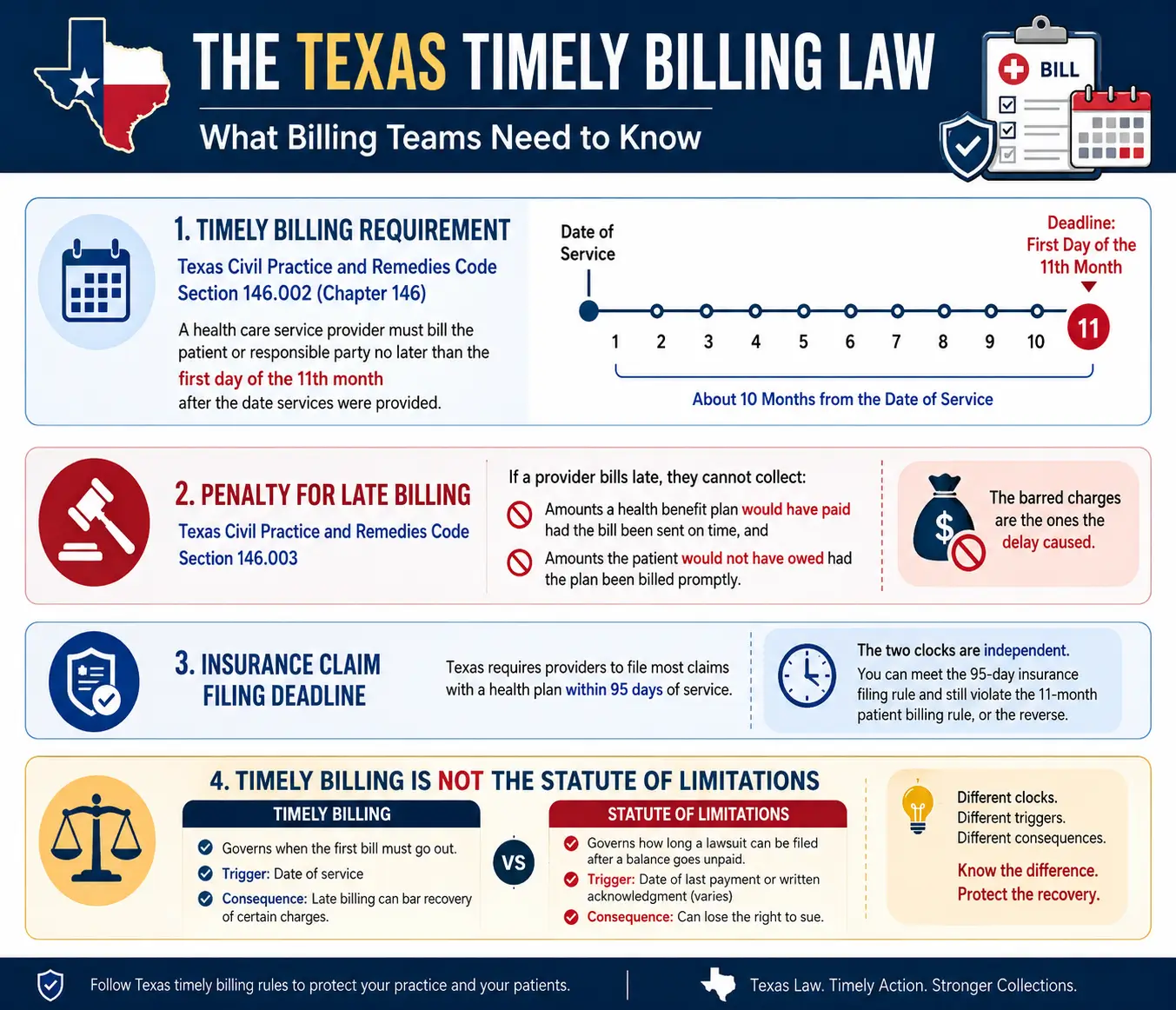
The rule billing teams should know first is the timely billing requirement in Texas Civil Practice and Remedies Code Section 146.002, part of Chapter 146, added by the Legislature in 1999. It requires a health care service provider to bill the patient or responsible party no later than the first day of the 11th month after the date services were provided. In practice, that is about ten months from the date of service.
Miss the deadline and there is a real penalty. Under Section 146.003, a provider who bills late cannot collect amounts a health benefit plan would have paid had the bill gone out on time, and cannot collect amounts the patient would not have owed had the plan been billed promptly. The barred charges are the ones the delay caused.
A separate deadline applies to insurance. Texas requires providers to file most claims with a health plan within 95 days of service. The two clocks are independent. A biller can satisfy the 95-day insurance filing rule and still violate the 11-month patient billing rule, or the reverse.
Timely billing is not the statute of limitations
People confuse these two constantly. Timely billing governs when the first bill must go out. The statute of limitations governs how long a lawsuit can be filed after a balance goes unpaid. Different clocks, different triggers, different consequences.
The four-year statute of limitations on medical debt
Texas sets a four-year statute of limitations on debt collection lawsuits under Civil Practice and Remedies Code Section 16.004. A provider or a collection agency has four years from the date the cause of action accrues (generally the date the balance became due and went unpaid) to file suit. After that, the debt is time-barred. It does not disappear, and a collector may still request payment, but a court can no longer be used to force it.
One catch trips up patients and works in a collector’s favor. A partial payment, a written acknowledgment of the debt, or a new payment agreement can restart the four-year clock. A patient who makes a small payment on a nearly expired balance can revive the whole amount. Anyone negotiating an old account should confirm its status before sending a dollar or signing anything.
How medical debt collection works in Texas
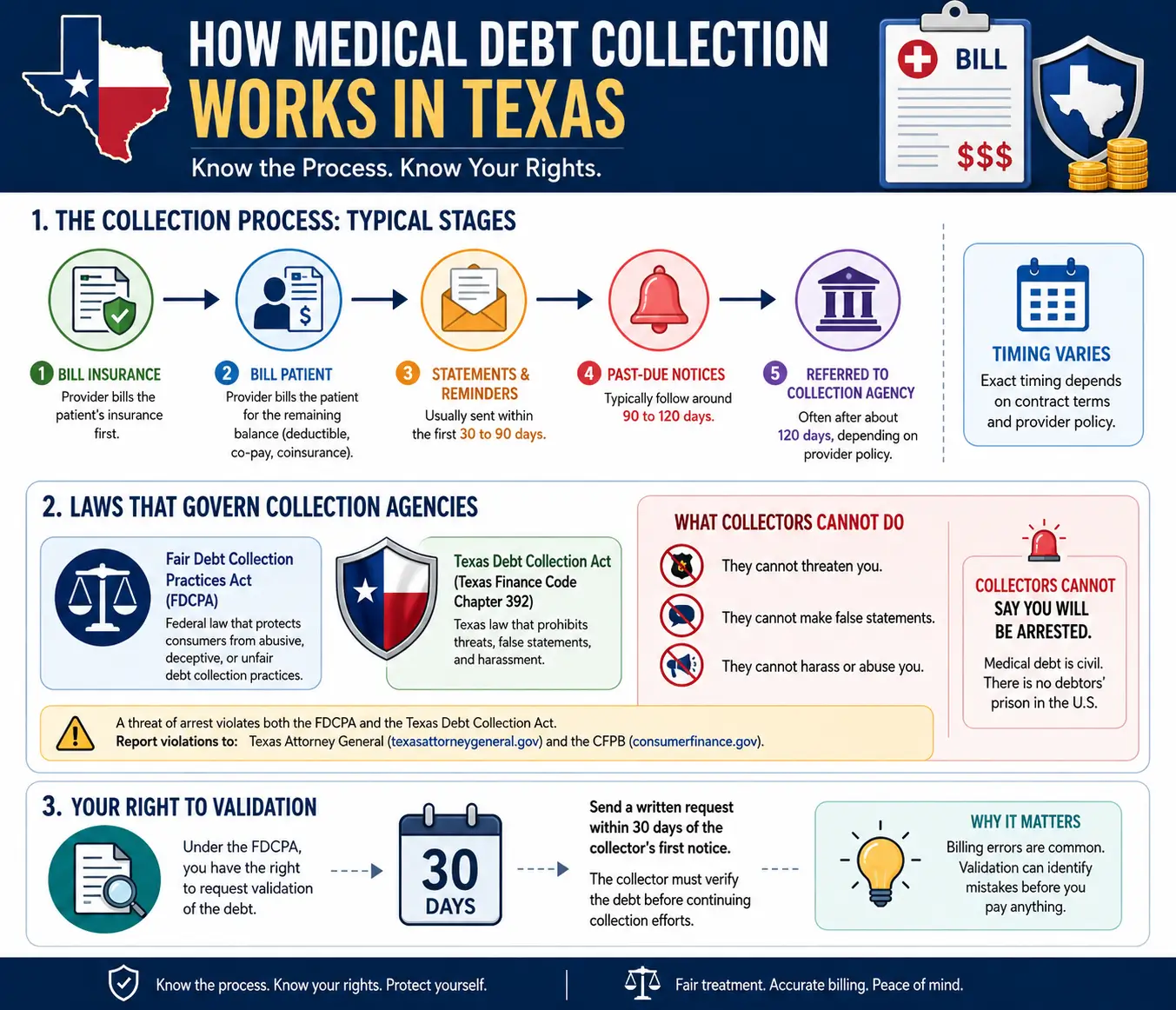
A typical account moves in stages. The provider bills insurance, then bills the patient for the remaining balance. Statements and reminders usually run through the first 30 to 90 days. Past-due notices tend to follow around 90 to 120 days. Many providers refer accounts to a collection agency after roughly 120 days, though the exact timing depends on contract and policy.
Once an agency is involved, two laws govern its conduct. The federal Fair Debt Collection Practices Act and the Texas Debt Collection Act (Texas Finance Code Chapter 392) both prohibit threats, false statements, and harassment. A collector cannot claim you will be arrested over the debt. No one can. Medical debt is civil, and there is no debtors’ prison in the United States. A threat of arrest violates both statutes, and it can be reported to the Texas Attorney General and the CFPB.
Patients can also demand validation. Under the FDCPA, a written request within 30 days of the collector’s first notice requires the collector to verify the debt before continuing. Billing errors are common, so verification often catches a problem before any payment is made.
Can a hospital sue you, and what can a judgment reach?
Yes. A hospital, physician group, or collection agency can file suit on an unpaid balance within the four-year window, and if it wins, the court issues a judgment. What the creditor can do with that judgment is where Texas stands apart.
Texas does not allow wage garnishment for ordinary consumer debt, including medical bills. The protection comes from Article 16, Section 28 of the Texas Constitution, which shields current wages for personal services. Only a narrow set of obligations can reach a paycheck: child support, spousal maintenance, unpaid taxes, and federal debts such as student loans. Texas is one of only about four states with a wage protection this strong.
The homestead protection is just as unusual. Texas writes an unlimited-value homestead exemption into its constitution, so a primary residence generally cannot be forced into sale to satisfy medical debt, regardless of equity. Retirement accounts such as 401(k)s and IRAs are also exempt.
That does not make a judgment toothless. A judgment creditor can attempt to freeze or levy a bank account, and wages lose their protection once deposited and mixed with other funds. A creditor can also place a lien on non-exempt real property. This is why ignoring a lawsuit is the costliest mistake, since a default judgment hands the creditor those tools without a fight.
Generally protected in Texas | Potentially reachable after a judgment |
Current wages for personal services | Funds sitting in a bank account |
Primary homestead (unlimited value) | Non-exempt real estate and land |
401(k), IRA, and pension funds | Non-exempt personal property |
Texas hospital liens
A hospital lien is a separate tool, and it is narrower than most people fear. Governed by Chapter 55 of the Texas Property Code, it does not attach to a home, a paycheck, or a bank account. It attaches to one thing: a personal injury claim or settlement against a third party who caused the patient’s injuries, such as an at-fault driver.
Several conditions limit it. The patient must be admitted to the hospital within 72 hours of the accident. The lien must be filed with the county clerk in the county where the care was provided. It covers only reasonable and necessary charges for the accident-related care (generally the first 100 days of hospitalization). It does not attach to the patient’s own health insurance benefits or workers’ compensation. For emergency medical services providers in counties with populations of 800,000 or less, the lien is capped at $1,000.
The practical point for billing staff: a hospital lien is relevant only when an accident and a liable third party exist. It is not a general lien on a patient’s assets.
Do unpaid medical bills affect your credit in Texas?
They can, but the rules have shifted twice in recent years, and one widely reported change did not survive.
In 2022, Equifax, Experian, and TransUnion agreed to voluntary changes. They stopped reporting paid medical collections, extended the waiting period before a medical collection can appear to one year (365 days), and in 2023 removed medical collections under $500 entirely. The bureaus estimated those steps would clear roughly 70% of medical debt tradelines from consumer reports.
Then came a federal rule, and its reversal. On January 7, 2025, the CFPB finalized a rule that would have removed medical debt from credit reports altogether and barred lenders from using it in credit decisions. On July 11, 2025, the U.S. District Court for the Eastern District of Texas vacated that rule in Cornerstone Credit Union League v. CFPB. Judge Sean Jordan held that the rule exceeded the agency’s authority under the Fair Credit Reporting Act, and the opinion also cast doubt on state laws that try to bar medical debt reporting.
So the current picture reflects the 2022 and 2023 bureau policies, not the vacated federal rule. Medical collections of $500 or more can still be reported, generally after the one-year waiting period, and can remain for up to seven years. Patients keep the right to dispute inaccurate items under the FCRA, which remains one of the most effective ways to remove an incorrect medical collection.
Financial assistance and medical bill forgiveness in Texas
Before an account reaches collections, several routes can lower or clear it.
Nonprofit hospitals are required under federal law (Section 501(r) of the Internal Revenue Code) to maintain written financial assistance policies and to make reasonable efforts to determine eligibility before taking extraordinary collection actions. Many Texas hospitals offer charity care or sliding-scale discounts for patients under set income thresholds. Ask for the financial assistance policy by name.
Other options worth checking:
- Payment plans. Most Texas providers will set up interest-free or low-interest installments. No law forces a provider to grant one, so terms are negotiable.
- Itemized bill review. Request an itemized statement and check it against the care received. Duplicate charges and coding errors turn up often.
- Balance billing protection. For emergency and certain out-of-network care, the federal No Surprises Act (effective January 1, 2022) and Texas Senate Bill 1264 (2019) limit surprise balance bills for many patients.
- Bankruptcy. Medical debt is unsecured and can be discharged in Chapter 7 or reorganized in Chapter 13. It is a last resort, but it is available.
How these rules fit together
An unpaid medical bill in Texas is a civil debt with firm boundaries. Providers must bill within about ten months or lose the charges the delay caused. Collectors and hospitals have four years to sue, and that window can restart with a single payment. Wages and a homestead are largely shielded, while bank accounts and non-exempt property are not. Hospital liens reach only third-party accident settlements. And after the July 2025 court ruling, medical collections of $500 or more can again appear on credit reports under the bureaus’ own policies. Reading each account against these rules is what separates a collectible balance from one the law has already limited.