


A radiology department sees the order come through: MRI, right shoulder, no contrast, rule out rotator cuff tear. The technologist knows exactly what to do. The coder still has to translate that order into a number a payer will accept without a fight. For upper extremity joint studies performed without contrast material, that number is CPT code 73221.
This code shows up constantly in orthopedic, sports medicine, and rheumatology billing, yet it gets confused with five neighboring codes more often than almost any other entry in the diagnostic radiology section. The mix-ups are predictable: joint versus non-joint anatomy, contrast versus no contrast, and laterality that never made it into the note. Getting each of those right is the difference between a clean claim and a resubmission.
What CPT code 73221 describes
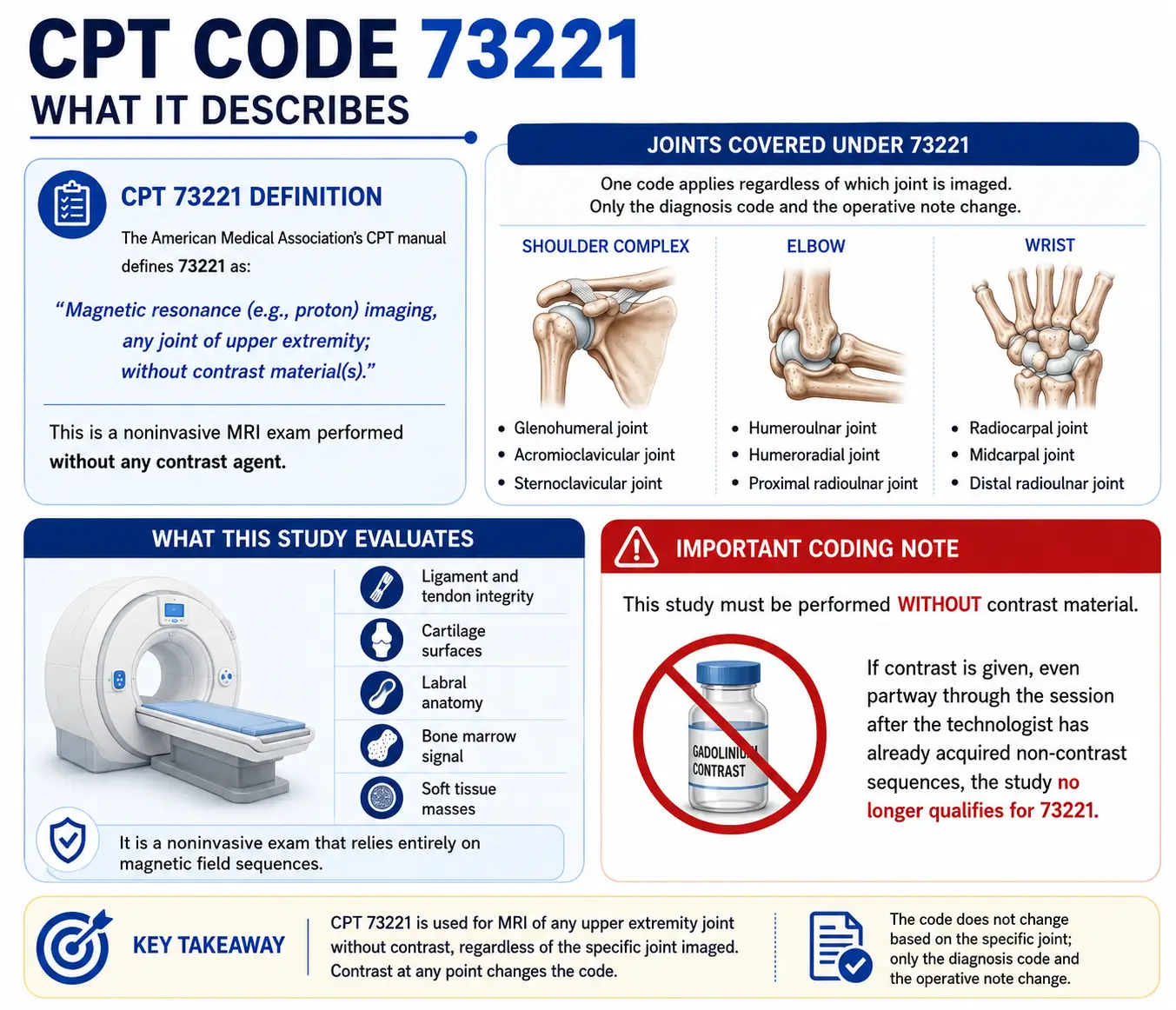
The American Medical Association’s CPT manual defines 73221 as “magnetic resonance (e.g., proton) imaging, any joint of upper extremity; without contrast material(s).” That single sentence covers a wide range of anatomy. The shoulder complex is made up of the glenohumeral, acromioclavicular, and sternoclavicular joints. The elbow includes the humeroulnar, humeroradial, and proximal radioulnar joints. The wrist includes the radiocarpal, midcarpal, and distal radioulnar joints. One code applies regardless of which of these joints was imaged, which is a detail coders new to musculoskeletal radiology tend to miss. The code does not change based on the specific joint; only the diagnosis code and the operative note change.
Radiologists order this study to evaluate ligament and tendon integrity, cartilage surfaces, labral anatomy, bone marrow signal, and soft tissue masses. It is a noninvasive exam that relies entirely on magnetic field sequences, with no gadolinium or other contrast agent injected at any point. If contrast is given, even partway through the session after the technologist has already acquired non-contrast sequences, the study no longer qualifies for 73221.
Where 73221 fits among the upper extremity MRI codes
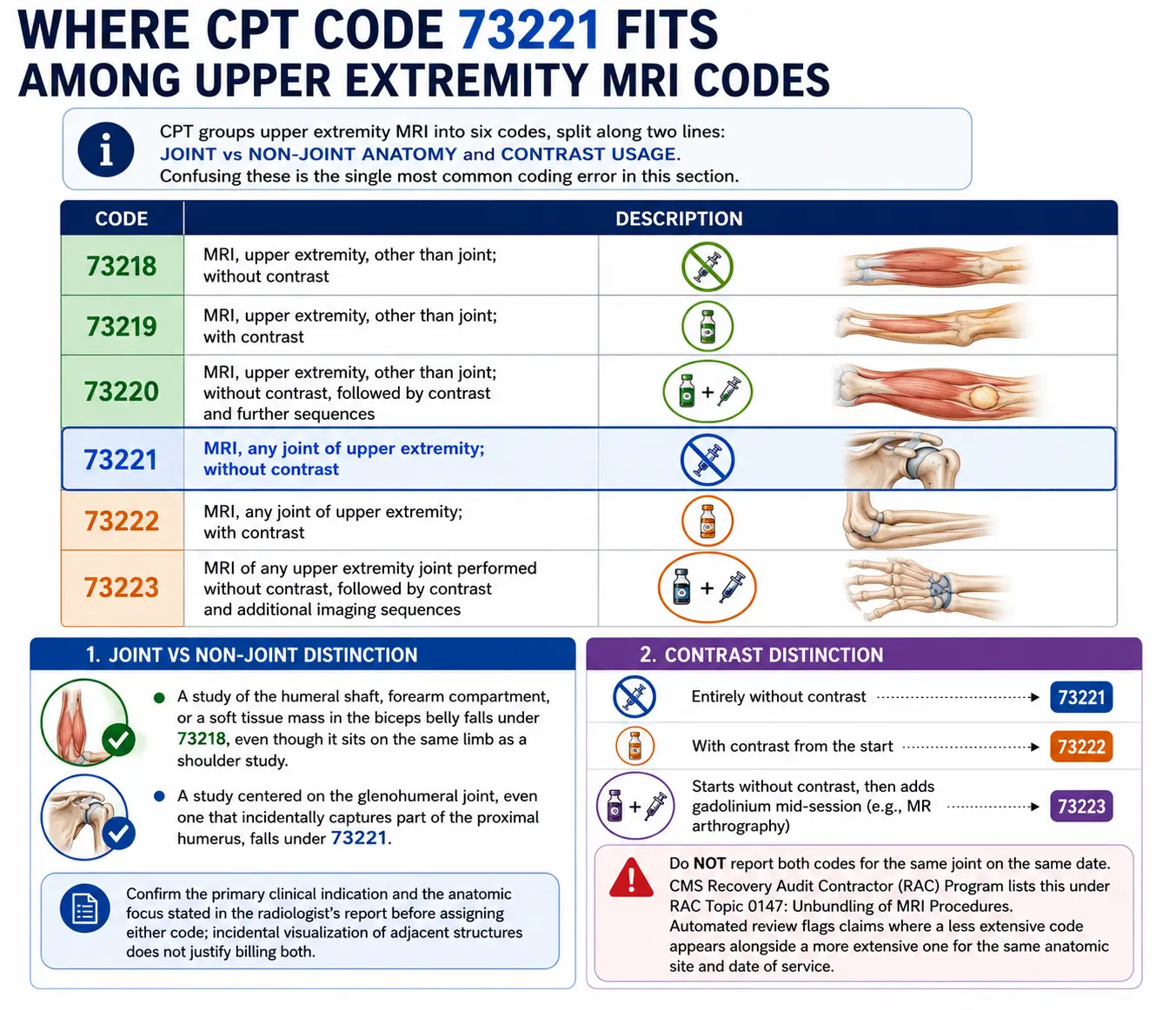
CPT groups upper extremity MRI into six codes, split along two lines: joint versus non-joint anatomy, and contrast usage. Confusing these is the single most common coding error tied to this section.
Code | Description |
73218 | MRI, upper extremity, other than joint; without contrast |
73219 | MRI, upper extremity, other than joint; with contrast |
73220 | MRI, upper extremity, other than joint; without contrast, followed by contrast and further sequences |
73221 | MRI, any joint of upper extremity; without contrast |
73222 | MRI, any joint of upper extremity; with contrast |
73223 | MRI of any upper extremity joint performed without contrast, followed by contrast administration and additional imaging sequences |
The joint versus non-joint distinction is anatomical, not a matter of severity or clinical urgency. A study of the humeral shaft, forearm compartment, or a soft tissue mass in the biceps belly falls under 73218, even though it sits on the same limb as a shoulder study. A study centered on the glenohumeral joint, even one that incidentally captures part of the proximal humerus, falls under 73221. Coders should confirm the primary clinical indication and the anatomic focus stated in the radiologist’s report before assigning either code; incidental visualization of adjacent structures does not justify billing both.
The contrast distinction is more straightforward. A study performed entirely without contrast is 73221. One performed with contrast from the start is 73222. One that starts without contrast and then adds gadolinium mid-session, a protocol sometimes used for MR arthrography, is 73223, not a combination of 73221 and 73222 billed separately. Reporting both codes for the same joint on the same date is a documented audit target. The CMS Recovery Audit Contractor program lists this pattern under RAC topic 0147, unbundling of MRI procedures, and automated review specifically flags claims where a less extensive code appears alongside a more extensive one for the same anatomic site and date of service.
When clinicians order a non-contrast joint MRI
Ordering patterns for 73221 follow published imaging guidelines more closely than many coders realize, which matters when a payer questions medical necessity. The American College of Radiology’s Appropriateness Criteria, most recently updated for acute shoulder pain in 2025 and chronic shoulder pain in 2022, place radiography first for suspected fracture or degenerative change. When radiographs come back normal or inconclusive, and the clinical picture points toward a soft tissue problem such as a rotator cuff tear, labral injury, or ligament sprain, MRI without IV contrast becomes the next appropriate study rather than an automatic add-on.
The ACR criteria are specific about when non-contrast imaging suffices versus when arthrography (contrast injected directly into the joint) is preferred. Non-contrast MRI is generally favored in the setting of acute trauma, where a post-traumatic joint effusion provides enough natural fluid to outline soft tissue structures. In chronic or subacute presentations, that effusion is often too small, and MR arthrography becomes the reference standard for structures like the labrum. This distinction has direct billing consequences: a study ordered as a routine non-contrast exam that a radiologist decides mid-session needs arthrographic contrast is no longer 73221.
Common clinical scenarios that lead to a 73221 order include unresolved joint pain lasting several weeks despite conservative treatment, suspected rotator cuff or labral tears, clinical suspicion of ligament or cartilage injury following a fall or sports injury, evaluation of a palpable mass, and follow-up imaging to assess whether a condition has progressed since a prior study. Documentation supporting any of these should specify the joint, the laterality, and the clinical question the study is meant to answer. General language like “shoulder pain, rule out pathology” invites a medical necessity denial even when the underlying indication was reasonable.
Modifiers and documentation that claims actually need
Every 73221 claim depends on a small set of modifiers and a note that supports them.
- RT or LT: required on nearly every claim for a unilateral joint. Missing laterality is one of the most common reasons claims for this code are returned without processing.
- 26: appended when a radiologist bills only the professional (interpretation) component, typically because a hospital or imaging center owns the equipment and bills the technical component separately.
- TC: appended by the facility or equipment owner when billing only the technical component.
- 59: distinguishes a separate procedural service, for example when both a shoulder and an elbow MRI are performed on the same date and NCCI edits would otherwise bundle the second study.
- 52: indicates a reduced service, used when the exam was discontinued or limited compared to the standard protocol.
- 76 or 77: identifies a repeat procedure by the same physician (76) or a different physician (77), relevant when a joint is re-imaged within a short window.
For bilateral imaging performed on the same date, the more consistent approach across payers is to report each side as a separate line item with its own RT or LT modifier rather than relying on modifier 50, since 50 was built for surgical bilateral procedures and its application to diagnostic radiology varies by payer policy. Checking the specific payer’s radiology billing guide before submitting bilateral claims avoids a preventable rejection.
Documentation should identify the exact joint (not just “upper extremity”), confirm no contrast was administered, and, for independent diagnostic testing facilities, record the supervising physician’s credentials and the technologist’s certification (ARRT-MR or ARMRIT are the certifications payers commonly ask for). The radiologist’s final report should include comparison with any prior imaging and a clearly stated impression, since vague or unsigned reports are a frequent target of post-payment review.
What Medicare pays for CPT 73221
Under the 2026 Medicare Physician Fee Schedule, CPT 73221 carries a work RVU of 1.32 and a total RVU of 6.14 (work 1.32, practice expense 4.73, malpractice 0.09), which translates to a national non-facility payment of approximately $205.08 before geographic adjustment. Actual reimbursement varies by locality once the Geographic Practice Cost Index is applied, so the figure functions as a baseline rather than a fixed national rate.
Site of service changes the number substantially. Under the Hospital Outpatient Prospective Payment System, 73221 groups to Ambulatory Payment Classification 5523, which paid approximately $243.77 nationally in 2026, roughly 19% more than the office-based non-facility rate. This gap is one reason freestanding imaging centers can often price a shoulder or elbow MRI more competitively than a hospital outpatient department, and it is worth knowing when a patient asks why the same study costs different amounts at different locations.
Diagnostic radiology codes like 73221 do not carry a global surgical period. There is no 10-day or 90-day postoperative window to track, unlike orthopedic procedure codes that share a chart with this study. Commercial payer rates for the same code vary widely and are typically negotiated separately from Medicare’s schedule, so practices working with multiple payers should not assume Medicare’s rate as a proxy for expected commercial reimbursement.
Where the Appropriate Use Criteria program actually stands
A fair amount of billing content published in the last two years still tells providers that Medicare requires Appropriate Use Criteria (AUC) consultation through a Clinical Decision Support Mechanism before ordering an advanced imaging study like 73221. That requirement, created under the Protecting Access to Medicare Act of 2014, spent several years in an educational testing phase with no payment penalties attached. In the CY 2024 Physician Fee Schedule final rule, CMS paused the AUC program for reevaluation and rescinded the underlying regulation at 42 CFR 414.94, effective January 1, 2024. Providers and suppliers were instructed to stop including AUC consultation information on Medicare fee-for-service claims as of that date, and CMS has not published a timeline for restarting the program.
For a practice still budgeting staff time to log AUC consultation numbers on every MRI order, that time is no longer required for Medicare claims. Commercial payers are a separate matter; several still run their own prior authorization or decision-support requirements for advanced imaging, and those obligations have nothing to do with the now-paused federal AUC program. Coders and billing managers should verify current requirements with each payer directly rather than relying on older articles that describe the AUC program as active.
Common reasons 73221 claims get denied
Payers reject claims for this code for a handful of recurring reasons, most of them preventable at the documentation stage rather than the claims-submission stage.
Missing laterality tops the list. A claim for “MRI shoulder” without RT or LT gets flagged by automated payer edits before a human reviewer ever sees it. Unbundling is the second most common issue: billing 73221 alongside 73222 or 73223 for the same joint and date, which NCCI edits and RAC topic 0147 both target directly. Wrong code family selection follows close behind, typically 73221 billed for a non-joint structure like the humeral shaft or forearm that should have been 73218. Inadequate medical necessity documentation, particularly notes that describe symptoms without a specific clinical question the imaging is meant to answer, also drives denials. Finally, IDTF claims are frequently denied over missing or incomplete credentialing documentation for the supervising physician or the MR technologist.
Right shoulder, left shoulder, and same-day bilateral studies
Because so many searches for this code specify a side, it is worth stating the mechanics plainly. A right shoulder MRI without contrast is billed as 73221-RT. A left shoulder MRI without contrast is billed as 73221-LT. If a patient undergoes MRI of both shoulders on the same date, most payers expect two separate line items, 73221-RT and 73221-LT, rather than a single line with modifier 50, though the specific payer’s radiology policy should be the final word. If a patient has a shoulder MRI and an elbow MRI on the same date, the second study typically needs modifier 59 to indicate a distinct anatomic site and avoid an NCCI bundling edit, for example 73221-RT for the shoulder and 73221-59-RT for the elbow, with documentation supporting medical necessity for imaging both joints.
Getting this code right comes down to three checks every time: confirm the study was joint anatomy rather than non-joint, confirm no contrast was given at any point in the session, and confirm the laterality modifier matches the order and the report. Coders who build those three checks into their workflow catch most of the errors that generate denials for this code before a claim ever leaves the building.
Daily Links
very interesting info ! .