


A patient comes in complaining of pain between the shoulder blades. The provider writes “thoracic back pain” in the assessment, and the claim goes out with a single four-character code attached: M54.6. That code carries more weight than its length suggests. Whether it’s used correctly often decides if a claim clears on the first pass or comes back with a request for more documentation.
The upper back pain ICD-10 code M54.6 describes pain in the thoracic spine, and it’s one of the more frequently submitted codes in outpatient orthopedics, chiropractic care, physical therapy, and primary care. This guide covers what the code includes, what documentation supports it, where it sits inside the dorsalgia (M54) family, and the errors that most often trigger denials or audit flags.
What the ICD-10 code for upper back pain actually covers
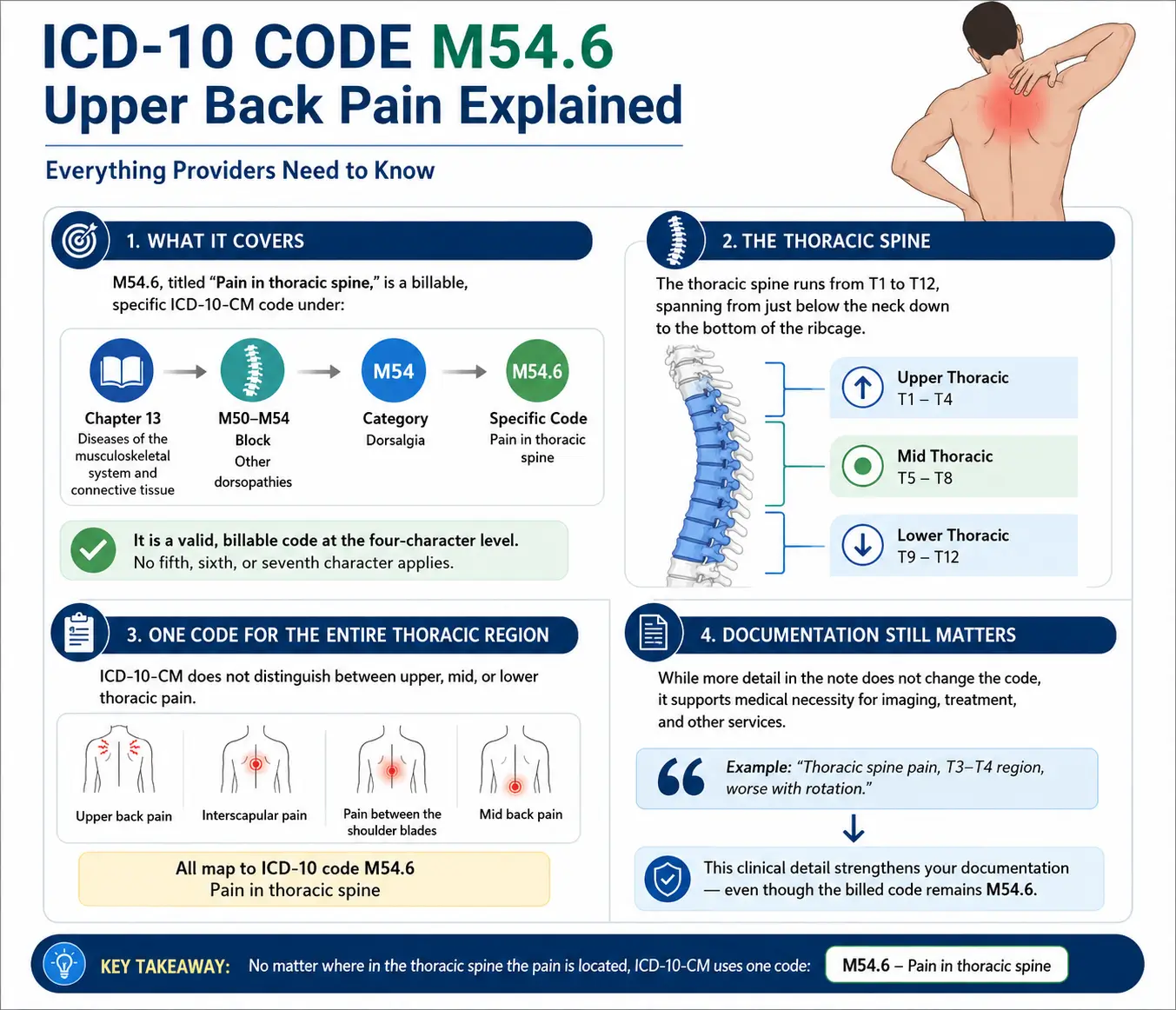
M54.6, titled “Pain in thoracic spine,” sits inside Chapter 13 of ICD-10-CM (Diseases of the musculoskeletal system and connective tissue), within the M50-M54 block (Other dorsopathies), within category M54 (Dorsalgia). It’s a billable, specific code at the four-character level. No fifth, sixth, or seventh character applies.
The thoracic spine runs from T1 to T12, spanning the region from just below the neck down to the bottom of the ribcage. Clinically, providers often split that territory into upper thoracic (roughly T1-T4), mid thoracic (T5-T8), and lower thoracic (T9-T12). ICD-10-CM doesn’t make that distinction. Whether a note says “upper back pain,” “interscapular pain,” “pain between the shoulder blades,” or “mid back pain,” it maps to the same code. There is no separate ICD-10 code for mid back pain, and there’s no additional character within M54.6 to flag which portion of the thoracic spine is involved.
That lack of granularity is worth mentioning to providers directly, since it’s a common point of confusion. A note reading “thoracic spine pain, T3-T4 region, worse with rotation” still lands on M54.6, but the added detail supports medical necessity for imaging or treatment even though it doesn’t change which code gets billed.
Where M54.6 sits inside the dorsalgia (M54) family
M54 groups back pain codes by spinal region. Seeing them side by side makes it easier to spot when a coder has reached for the wrong one.
Code | Region | Billable | Notes |
M54.2 | Cervicalgia (neck pain) | Yes | Distinct from thoracic pain that extends upward past the cervicothoracic junction |
M54.50 | Low back pain, unspecified | Yes | Replaced the non-billable parent M54.5, effective October 1, 2021 |
M54.51 | Vertebrogenic low back pain | Yes | Requires imaging-confirmed vertebral endplate changes, typically Modic type 1 or 2 |
M54.59 | Other low back pain | Yes | Used for a specified, non-vertebrogenic source |
M54.6 | Pain in thoracic spine | Yes | Covers T1 through T12; no further subdivision available |
M54.9 | Dorsalgia, unspecified | Yes | Reserved for cases where the spinal region genuinely isn’t documented |
That M54.50/M54.51/M54.59 split is worth knowing as historical context, because coders sometimes assume the thoracic code will eventually see the same treatment. It hasn’t. The former parent code M54.5 was deleted and broken into three region-specific low back codes in the FY2022 update, but M54.6 has never been split the same way, despite covering three clinically distinct segments of the spine. Coders occasionally search for a nonexistent “upper thoracic” or “mid thoracic” subcode; none exists as of FY2026.
Documentation that supports the code
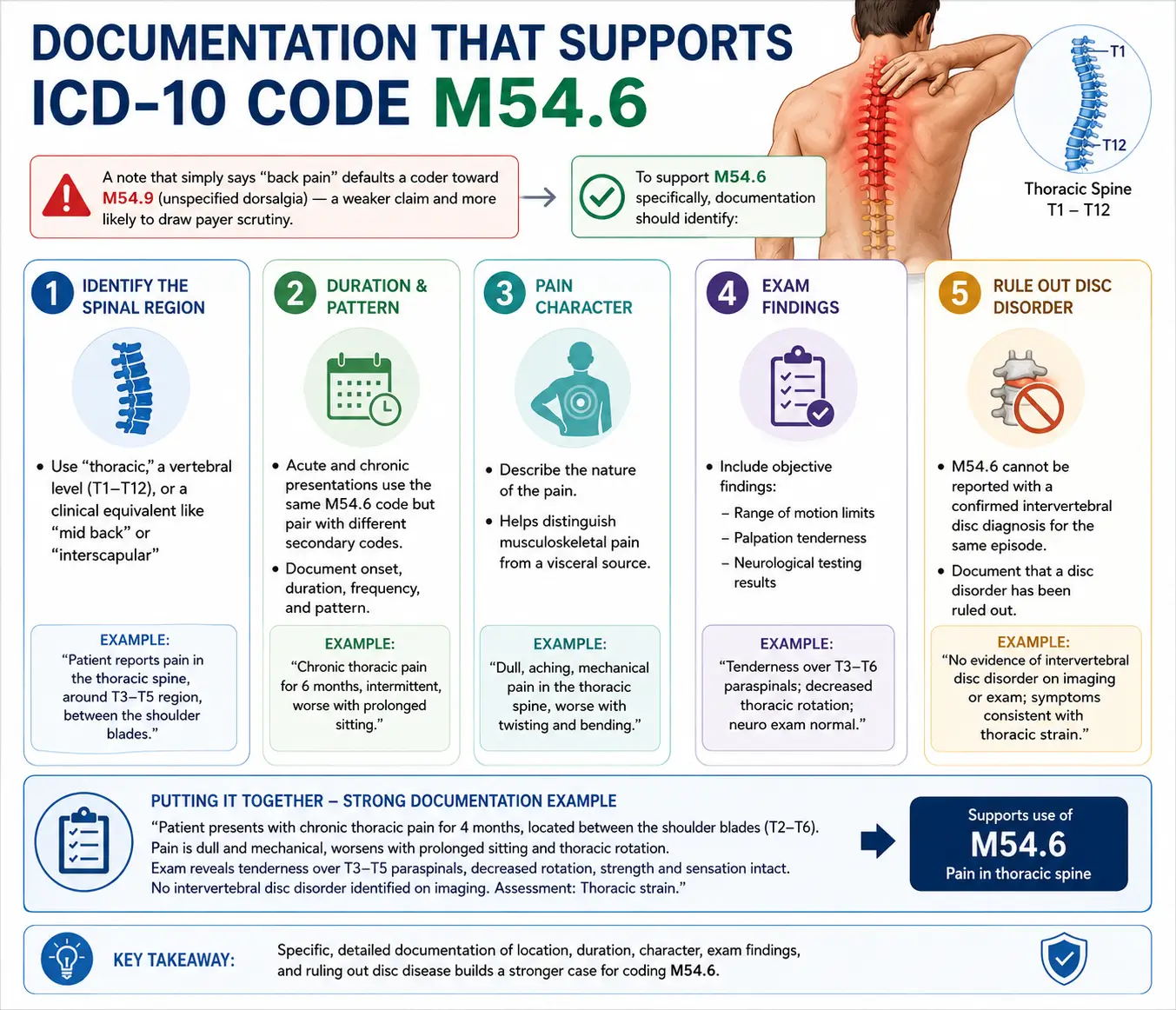
A note that simply says “back pain” defaults a coder toward M54.9, the unspecified dorsalgia code, which is a weaker claim and more likely to draw payer scrutiny. To support M54.6 specifically, documentation should identify:
- The spinal region, using “thoracic,” a vertebral level (T1-T12), or a clinical equivalent like “mid back” or “interscapular”
- Duration and pattern, since acute and chronic presentations use the same M54.6 code but pair with different secondary codes
- Pain character, such as mechanical, positional, or reproducible on palpation, which helps distinguish musculoskeletal pain from a visceral source
- Exam findings, including range of motion limits, palpation tenderness, or neurological testing results
- Whether a disc disorder has been ruled out, since M54.6 cannot be reported alongside a confirmed intervertebral disc diagnosis for the same episode
When M54.6 is the wrong choice
M54.6 carries a type 1 Excludes note for pain in the thoracic spine due to an intervertebral disc disorder, coded to category M51. A type 1 exclusion means the two codes cannot be reported together for the same condition; if imaging confirms a herniated or degenerated thoracic disc as the source of the pain, the disc code (M51.-) replaces M54.6 rather than accompanying it.
A few other situations call for a different code entirely:
- Chest pain of uncertain origin. Interscapular or upper thoracic pain can occasionally signal a cardiac or pulmonary problem rather than a musculoskeletal one. If the workup doesn’t confirm a mechanical cause, R07.1 through R07.9 (chest pain) may be more accurate than M54.6, and documentation should reflect why a musculoskeletal source was or wasn’t ruled in.
- Acute trauma. A new thoracic spine injury from a fall, collision, or other trauma is coded with the relevant injury category (such as S23 for a sprain of thoracic spine ligaments) and a seventh-character encounter designator, not M54.6.
- Psychogenic pain. The M54 category as a whole excludes psychogenic dorsalgia, coded to F45.41, so a diagnosis of pain with a documented psychiatric or somatoform basis doesn’t belong under M54.6.
Pairing M54.6 with G89 pain codes
ICD-10-CM guidelines treat G89 (pain, not elsewhere classified) codes as additional codes that describe the nature of pain rather than its location. According to guidance summarized by the AAPC Knowledge Center, when a provider documents chronic thoracic pain without a specific causative diagnosis, the coder reports M54.6 as the site-specific code and adds G89.29 (other chronic pain) as a secondary code. If the encounter’s stated purpose is chronic pain management itself, rather than evaluation of the thoracic spine, G89.29 moves to the primary position and M54.6 becomes secondary.
M54.6 doesn’t distinguish acute from chronic presentations on its own; the same code applies either way. Chronicity is captured through the G89 pairing, not through a different version of M54.6, which means the pain-duration language in the note (generally, three months or longer for “chronic”) is what drives whether G89.29 gets added at all.
Coding errors that keep showing up in audits
A handful of mistakes recur often enough in the M54.6 record to be worth naming directly:
- Reporting M54.6 alongside an M51 disc disorder code for the same episode, which violates the Excludes1 note.
- Defaulting to M54.9 (unspecified dorsalgia) when the chart already documents “thoracic” or a specific vertebral level.
- Leaving off G89.29 when the provider has explicitly written “chronic” in the assessment.
- Coding a fresh traumatic injury under M54.6 instead of the appropriate S-code with an encounter character.
- Treating interscapular pain as automatically musculoskeletal without documentation ruling out a cardiac or pulmonary cause.
CPT codes typically billed alongside M54.6
These pairings vary by payer and clinical scenario, and none of them guarantees reimbursement on their own; medical necessity still has to be documented.
CPT code | Description |
72070 | Radiologic exam, thoracic spine, 2 views |
72072 | Radiologic exam, thoracic spine, 3 views |
72074 | Radiologic exam, thoracic spine, minimum of 4 views |
72146 | MRI, thoracic spinal canal, without contrast |
72147 | MRI, thoracic spinal canal, with contrast |
72157 | MRI, thoracic spinal canal, without and with contrast |
97110 | Therapeutic exercise |
97140 | Manual therapy techniques |
98940-98942 | Chiropractic manipulative treatment (spinal, 1-2 to 5 regions) |
What changed for M54.6 in FY2026
The FY2026 ICD-10-CM update, effective October 1, 2025, added 487 new diagnosis codes, revised 38, and deleted 28, according to the AAPC Knowledge Center’s summary of the release. The M54 dorsalgia category itself wasn’t part of that structural churn this cycle; M54.6 carries forward unchanged, and it remains valid and billable for encounters through September 30, 2026.
Some industry coding commentary published in 2026 has referenced a possible new code, M54.A6, as a more granular alternative for non-specific thoracic spine pain. That reference hasn’t been confirmed against the official CMS ICD-10-CM tabular list, and multiple code-lookup sources that mirror CMS data, including ICD10Data.com and Find-A-Code, continue to list M54.6 as the active, billable code for pain in thoracic spine through the current fiscal year. Practices that have seen this reference in a vendor tool or training material should verify it against their EHR’s official code table and the CMS tabular addenda before changing how they code thoracic pain.
How common is thoracic spine pain, and why the coding stakes are real
Thoracic spine pain hasn’t been studied as thoroughly as neck or low back pain, which is itself part of why documentation quality matters. A systematic review published in 2009 in BMC Musculoskeletal Disorders by Briggs, Smith, Straker, and Bragge noted that the epidemiological picture for thoracic spine pain is thinner than for the cervical and lumbar regions, even though the condition is common across all age groups. A 2021 cohort study in Frontiers in Pain Research, citing that review, put the annual prevalence of thoracic spine pain at roughly 15 to 35 percent in the general adult population, rising as high as 55 percent in working populations, and reported that women are about 2.5 times more likely than men to be affected.
Those numbers translate directly into claim volume for family practice, internal medicine, orthopedics, physical therapy, and chiropractic offices, which is exactly where M54.6 gets used most. A code covering a condition with that much prevalence variability, and that little regional specificity built into the classification itself, puts more weight on the clinical note to do the work the code can’t.
Coding M54.6 correctly
The code itself is simple: one four-character diagnosis, no extensions, no laterality. The documentation behind it is where accuracy or inaccuracy actually shows up. A chart that names the thoracic spine, rules out a disc disorder, and states whether the pain is acute or chronic gives a coder everything needed to select M54.6 confidently and pair it correctly with G89.29 or the right imaging code. A chart that just says “back pain” leaves the coder guessing, and guessing is what turns into a denial three weeks later.