


A physician opening a solo medical practice faces immediate administrative and financial hurdles. The most pressing challenge involves negotiating favorable contracts with major health insurance companies. Single-physician practices lack the bargaining leverage to secure high reimbursement rates from large insurers. An independent practice association solves this problem.
What is an IPA in healthcare? It is a legal business entity organized and owned by a network of independent physicians. These doctors join together to negotiate contracts with managed care organizations and health maintenance organizations (HMOs). The physicians do not merge their practices. They maintain ownership of their individual clinics, hire their own staff, and keep their own clinical autonomy. The IPA acts as a contracting intermediary between the independent physicians and the payer.
The history and regulatory framework of IPAs
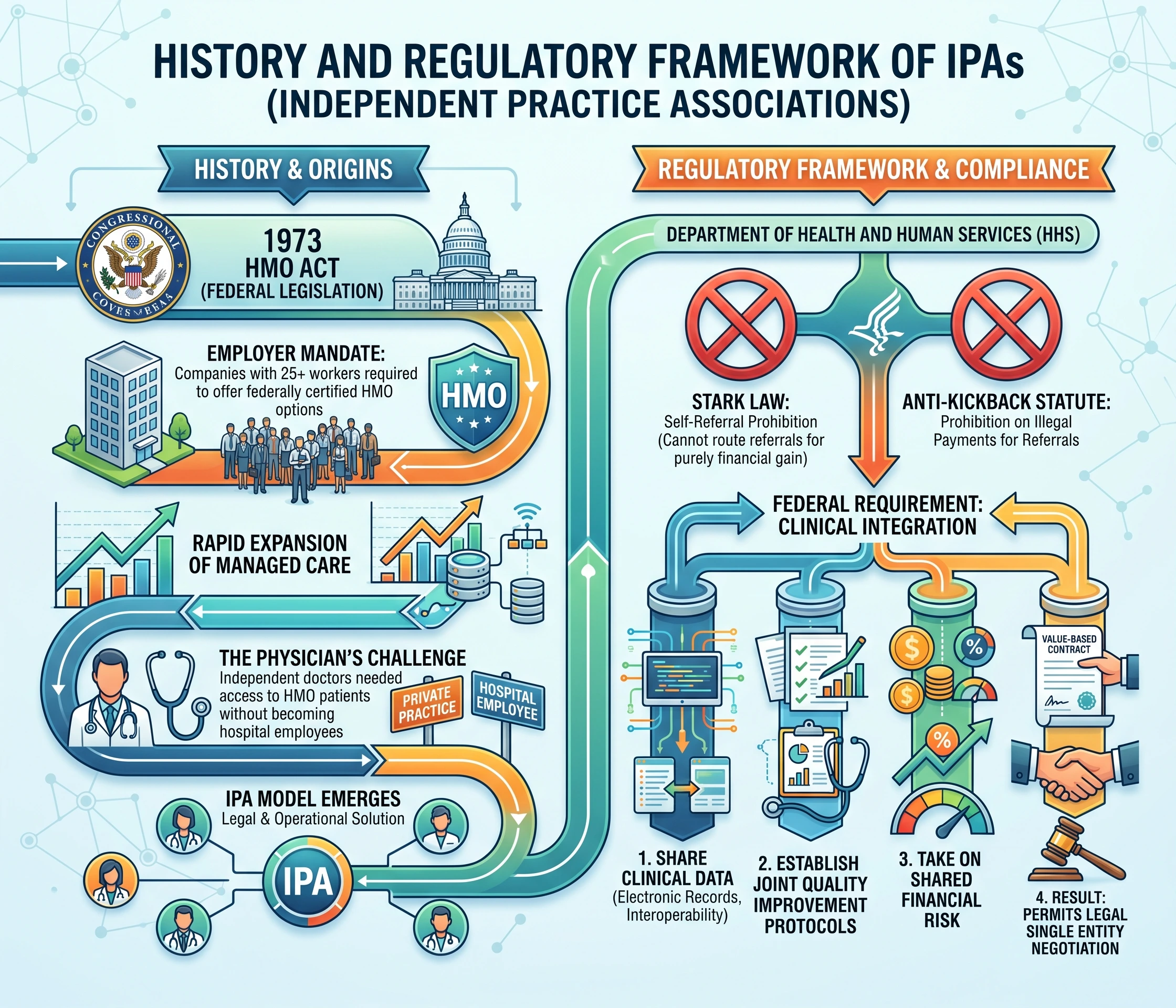
The modern structure of the IPA originated from federal legislation. Congress passed the Health Maintenance Organization Act in 1973. This law required employers with 25 or more workers to offer federally certified HMO options alongside traditional indemnity health insurance.
This legislation caused a rapid expansion of managed care. Independent doctors realized they needed a mechanism to treat HMO patients without abandoning their private practices and becoming hospital employees. The IPA model emerged as the legal and operational solution.
When forming an IPA, healthcare providers must navigate strict federal regulations. The Department of Health and Human Services (HHS) requires compliance with the Stark Law and the Anti-Kickback Statute. An IPA cannot legally exist simply to route patient referrals among its members for financial gain. The federal government requires IPAs to demonstrate clinical integration. This means the participating providers must share clinical data, establish joint quality improvement protocols, and take on shared financial risk to legally negotiate as a single entity.
How does an independent practice association work?
An independent practice association operates by establishing a centralized administrative infrastructure for its members. The primary functions include credentialing, payer contracting, and utilization management.
The process begins with provider credentialing. Before an IPA allows a primary care physician or specialist into its network, it must verify their qualifications. Most IPAs follow guidelines set by the National Committee for Quality Assurance (NCQA). The credentialing department verifies the doctor’s medical school transcripts, state medical licenses, and Drug Enforcement Administration (DEA) certificates directly with the issuing bodies. The IPA also queries the National Practitioner Data Bank (NPDB) to check for a history of malpractice payouts or license suspensions.
Once the physician network is established, the IPA management team negotiates health plan contracts. These payer contracts dictate how the physicians receive reimbursement for patient care.
In certain states, health plans use a delegated model. The California Medical Association notes that in a fully delegated model, the insurance company transfers the responsibility of claims processing, credentialing, and medical management entirely to the IPA. The insurance company simply provides the patients and the funding, while the IPA manages the actual healthcare delivery system.
IPA medical billing and claims processing
Medical billing within an IPA operates differently than traditional fee-for-service billing. Medical coders and billers working for an IPA provider must understand the mechanics of capitation.
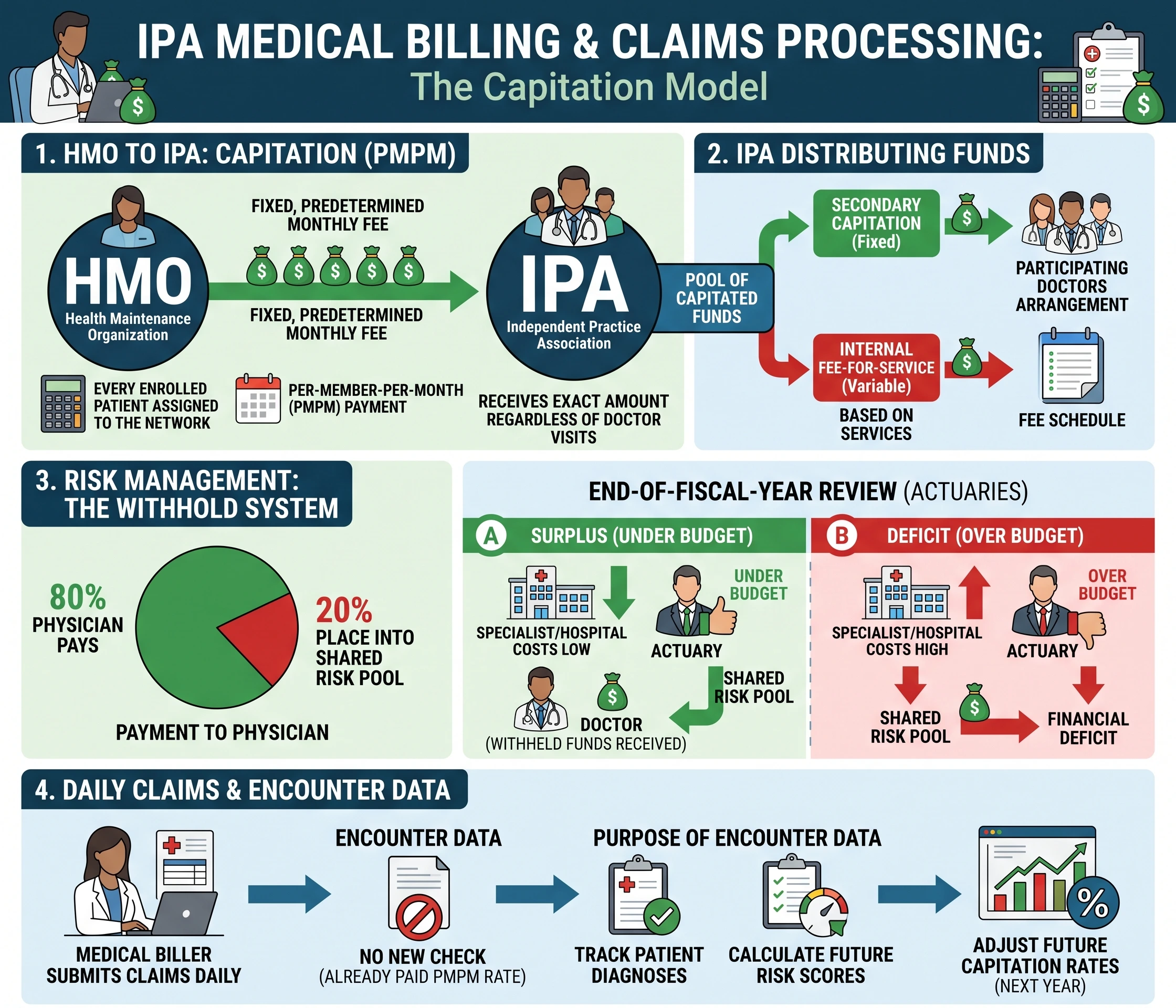
Under a capitated IPA model, an HMO pays the IPA a fixed, predetermined monthly fee for every enrolled patient assigned to the network. This is called a per-member-per-month (PMPM) payment. The IPA receives this exact amount regardless of whether the patient visits the doctor zero times or five times in a given month.
The IPA receives the bulk PMPM payment and must then distribute funds to its participating providers. Some IPAs pay their doctors via a secondary capitation arrangement. Others pay their doctors on an internal fee-for-service schedule using the pool of capitated funds.
To manage financial risk, many IPAs utilize a withhold system. The IPA pays the physician a percentage (often 80 percent) of the agreed fee schedule and places the remaining 20 percent into a shared risk pool. At the end of the fiscal year, actuaries review the IPA’s total medical expenses. If the physician network kept specialist referrals and hospitalizations under budget, the doctors receive their withheld funds. If the group exceeded the budget, the IPA uses the risk pool money to cover the financial deficit.
Medical billers submit IPA claims daily. In a capitated environment, these claims are classified as encounter data. Because the health plan already paid the IPA the monthly PMPM rate, the biller does not expect a new check for the specific office visit. However, the health insurance network requires the encounter data to track patient diagnoses and calculate future risk scores. Accurate medical coding ensures the insurance company adjusts the following year’s capitation rates to match the actual sickness level of the patient population.
Comparing healthcare models: IPA vs ACO vs MSO
Healthcare administrators and medical students frequently confuse IPAs with Accountable Care Organizations (ACOs) and Management Services Organizations (MSOs). While they all support medical groups, they serve distinct operational functions.
Feature | Independent Practice Association (IPA) | Accountable Care Organization (ACO) | Management Services Organization (MSO) |
Primary function | Payer contracting and risk management | Quality improvement and shared savings | Non-clinical administrative support |
Payer focus | Commercial HMOs and managed care | Medicare and government health plans | Not applicable (serves the practice) |
Financial risk | Accepts capitated downside risk | Accepts upside and downside risk | Takes no clinical financial risk |
Legal structure | Owned by independent physicians | Often involves hospitals and doctors | Third-party corporate entity |
An ACO focuses on Medicare patient populations. The Centers for Medicare and Medicaid Services (CMS) launched the Medicare Shared Savings Program in 2012 to establish formal rules for ACOs. While an IPA focuses on securing commercial HMO contracts, an ACO attempts to meet specific federal quality metrics to earn financial bonuses from the government.
An MSO does not negotiate insurance contracts or assume medical risk. It is purely a business vendor. A physician organization hires an MSO to handle payroll, human resources, IT support, and physical facility maintenance.
Advantages and financial realities for physicians
Physicians join an IPA to survive the ongoing consolidation of the medical industry. The American Medical Association published a physician practice benchmark study using 2022 data showing that only 46.7 percent of physicians worked in private practices. This represented a steady decline driven by hospital system acquisitions.
The IPA healthcare model offers a financial alternative to hospital employment. By joining an IPA network, independent physicians gain immediate access to large patient populations tied to specific HMOs. Solo doctors cannot secure these patients on their own because large HMOs prefer contracting with a single 500-doctor IPA rather than managing 500 separate solo contracts.
The centralized care coordination provided by an IPA also helps doctors manage patients with chronic diseases. IPAs hire care coordinators, pharmacists, and social workers to assist the physicians. This population health approach improves patient outcomes while reducing the individual doctor’s workload.
The primary disadvantage for physicians involves strict utilization management. IPA contracts require doctors to follow specific clinical guidelines to control costs. A primary care physician cannot simply send a patient to any specialist. The doctor must refer the patient to a specialist within the IPA network. Furthermore, the doctor must obtain prior authorization from the IPA’s medical director before ordering expensive procedures like MRI scans or complex surgeries.
If the medical director denies the authorization because the procedure falls outside the established clinical guidelines, the physician must appeal the decision. This creates friction. Doctors frequently cite utilization management as a restriction on their clinical autonomy.
Quality improvement and value-based care
IPAs evaluate their member physicians based on objective performance metrics. The industry standard is the Healthcare Effectiveness Data and Information Set (HEDIS).
HEDIS measures track whether physicians are providing appropriate preventive care. The IPA tracks data points such as the percentage of diabetic patients receiving annual eye exams, the rate of childhood immunizations, and the frequency of breast cancer screenings.
When physicians meet these quality benchmarks, the IPA receives financial bonuses from the health insurance companies. The IPA then distributes these bonuses to the top-performing doctors. This aligns the financial incentives of the insurance company, the IPA, and the individual physician toward value-based care rather than volume-based billing.
The function of IPAs in modern medicine
Understanding what is an IPA in healthcare requires looking closely at how money flows from an insurance payer to a treating physician. Independent practice associations act as the necessary bridge between a solo practitioner and a massive managed care organization. They allow neighborhood doctors to participate in complex capitation contracts and quality incentive programs. For professionals handling medical billing, operating within an IPA requires specialized knowledge of encounter data, risk pools, and PMPM structures. As the medical industry continues moving away from simple fee-for-service payments, the IPA provides a functional business structure for independent doctors to remain financially viable without selling their practices to corporate hospital systems.