


A 53-minute therapy session and a 52-minute therapy session are clinically almost identical. Financially, they are not. One supports CPT 90837, the other supports 90834, and the difference in payment across a full panel of patients runs into thousands of dollars a year. The person who decides which code lands on the claim, and who attaches the right units, modifiers, place of service, and rendering provider ID, is doing charge entry.
This guide explains what charge entry in medical billing involves, how the charge entry process works step by step, where it differs from charge capture, and what goes wrong when it is rushed.
What is charge entry in medical billing?
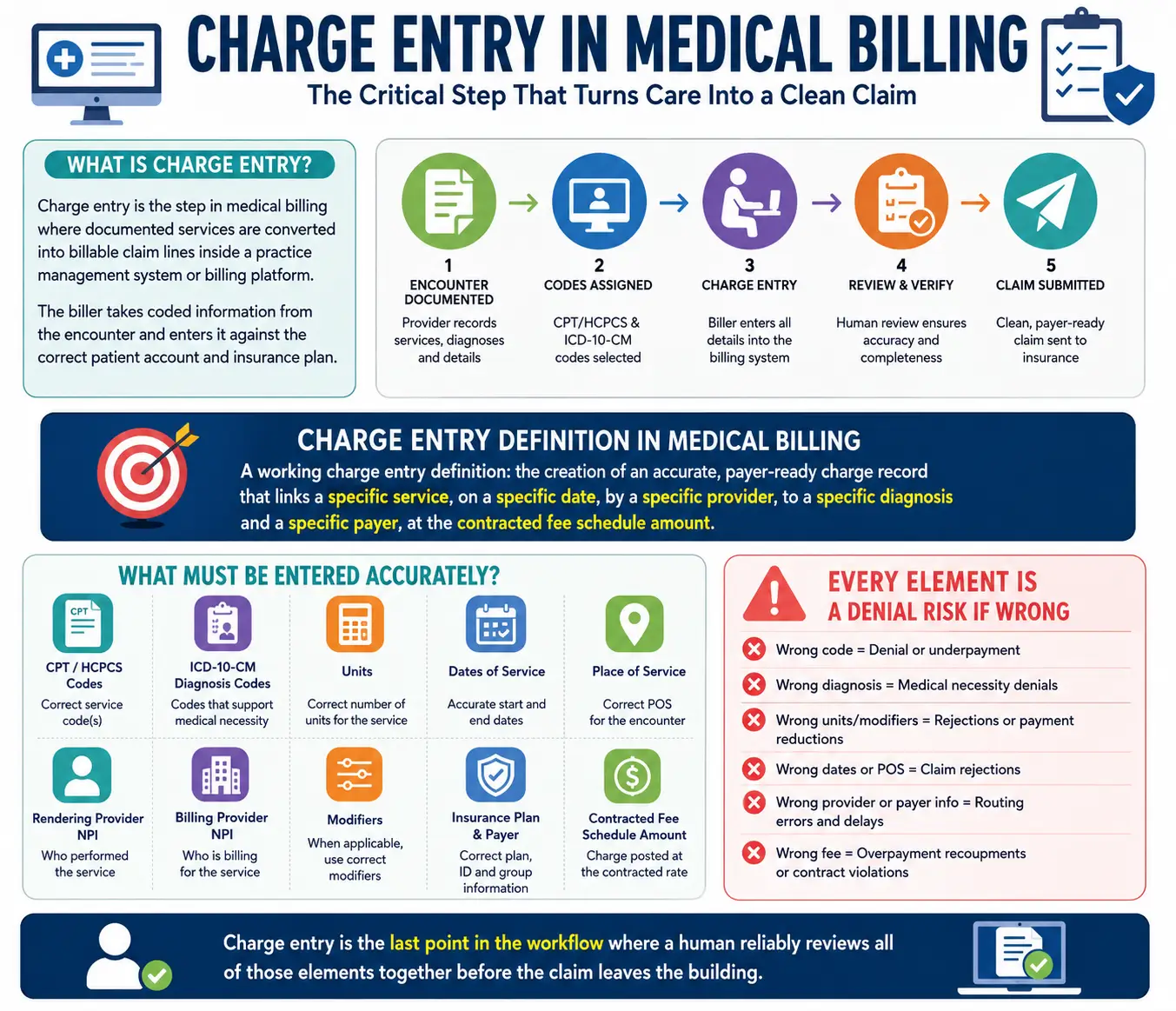
Charge entry is the step in medical billing where documented services are converted into billable claim lines inside a practice management system or billing platform. The biller takes coded information from the encounter (CPT or HCPCS codes, ICD-10-CM diagnosis codes, units, modifiers, dates of service, place of service, rendering and billing provider identifiers) and enters it against the correct patient account and insurance plan.
Charge entry definition in medical billing
A working charge entry definition: the creation of an accurate, payer-ready charge record that links a specific service, on a specific date, by a specific provider, to a specific diagnosis and a specific payer, at the contracted fee schedule amount.
Every element in that sentence is a denial risk if it is wrong. Charge entry is the last point in the workflow where a human reliably reviews all of those elements together before the claim leaves the building.
Where charge entry sits in the revenue cycle
Revenue cycle management is usually described in three zones: front end (scheduling, registration, eligibility, prior authorization), middle (documentation, coding, charge entry), and back end (claim submission, payment posting, denial management, patient collections).
Charge entry in RCM sits at the handoff point. It inherits whatever the front end produced. If insurance verification captured a stale member ID, or if the patient’s plan changed on January 1 and nobody updated the payer record, charge entry is where that mistake gets locked into a claim.
The reverse is also true. A charge entry team that reviews eligibility notes and authorization units before posting will catch problems that would otherwise surface 30 days later as a denial, by which time the appeal clock has already started running.
Charge capture vs charge entry
The two terms are used interchangeably in job listings, which causes real confusion for students. They describe different activities.
Charge capture | Charge entry | |
What it is | Recording that a billable service happened | Converting that record into a claim line |
Who performs it | Clinician, front desk, or EHR automation | Biller, coder, or charge entry specialist |
Typical source | Encounter form, superbill, charge slip, EHR order | Coded documentation plus payer and demographic data |
Primary failure mode | Missed charges (services never recorded) | Incorrect charges (services recorded wrong) |
Detection method | Reconciliation against the appointment schedule | Claim scrubber edits, pre-bill audit, denial trends |
A charge slip (also called a superbill or encounter form) is the paper or electronic sheet listing the practice’s most-used procedure and diagnosis codes, marked at the point of service. Many behavioral health practices still use one, either because their EHR does not push charges automatically or because supervising clinicians review student and associate notes before charges release.
Missed charge capture and faulty charge entry produce the same result on a bank statement. They require different fixes. Reconciling the day’s completed appointments against the day’s posted charges catches the first. Pre-bill auditing catches the second.
The charge entry process in medical billing, step by step
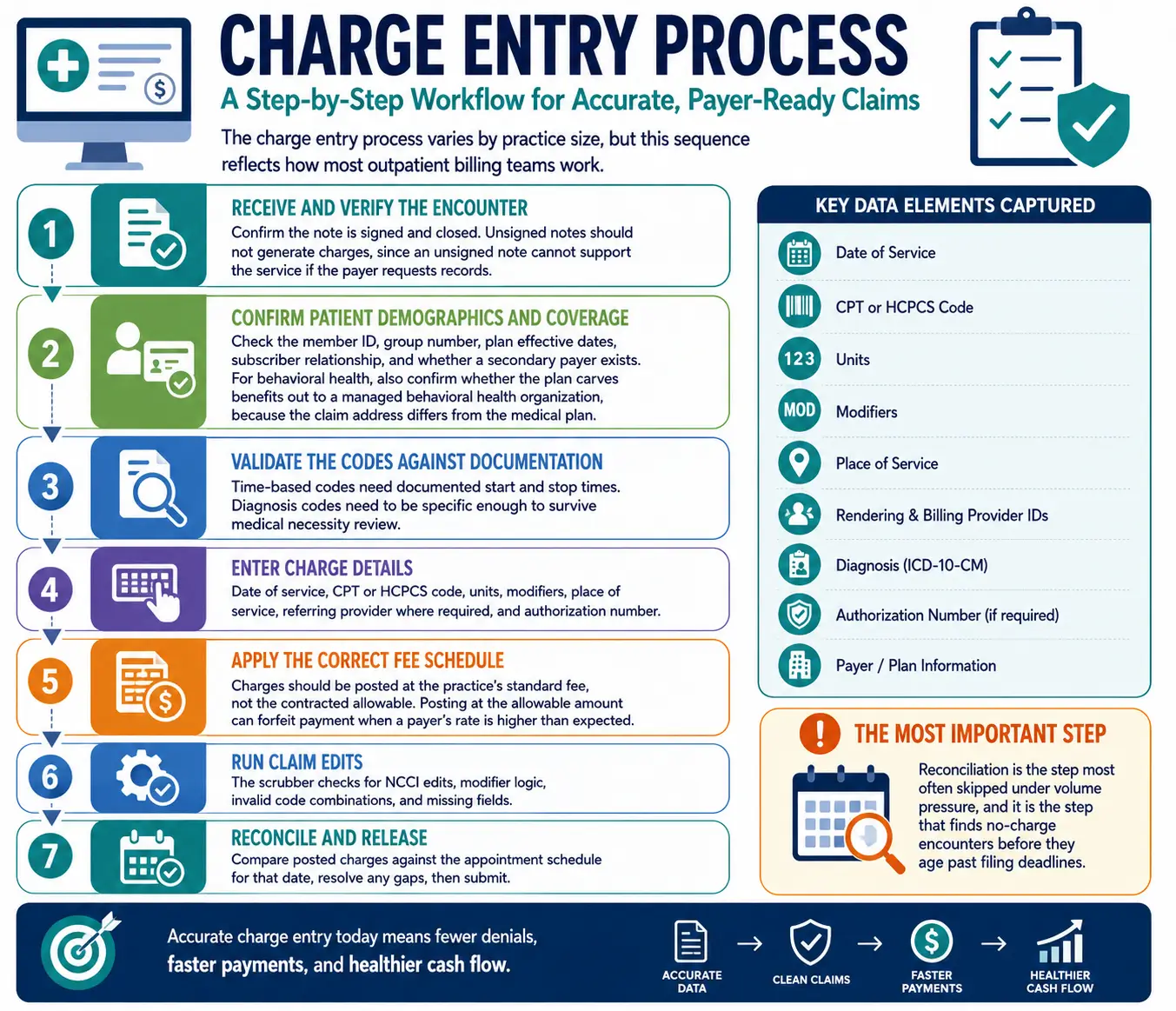
The charge entry process varies by practice size, but the sequence below reflects how most outpatient billing teams work.
- Receive and verify the encounter. Confirm the note is signed and closed. Unsigned notes should not generate charges, since an unsigned note cannot support the service if the payer requests records.
- Confirm patient demographics and coverage. Check the member ID, group number, plan effective dates, subscriber relationship, and whether a secondary payer exists. For behavioral health, also confirm whether the plan carves benefits out to a managed behavioral health organization, because the claim address differs from the medical plan.
- Validate the codes against documentation. Time-based codes need documented start and stop times. Diagnosis codes need to be specific enough to survive medical necessity review.
- Enter charge details. Date of service, CPT or HCPCS code, units, modifiers, place of service, referring provider where required, and authorization number.
- Apply the correct fee schedule. Charges should be posted at the practice’s standard fee, not the contracted allowable. Posting at the allowable amount can forfeit payment when a payer’s rate is higher than expected.
- Run claim edits. The scrubber checks for NCCI edits, modifier logic, invalid code combinations, and missing fields.
- Reconcile and release. Compare posted charges against the appointment schedule for that date, resolve any gaps, then submit.
Reconciliation is the step most often skipped under volume pressure, and it is the step that finds no-charge encounters before they age past filing deadlines.
What is charge entry in medical billing with example
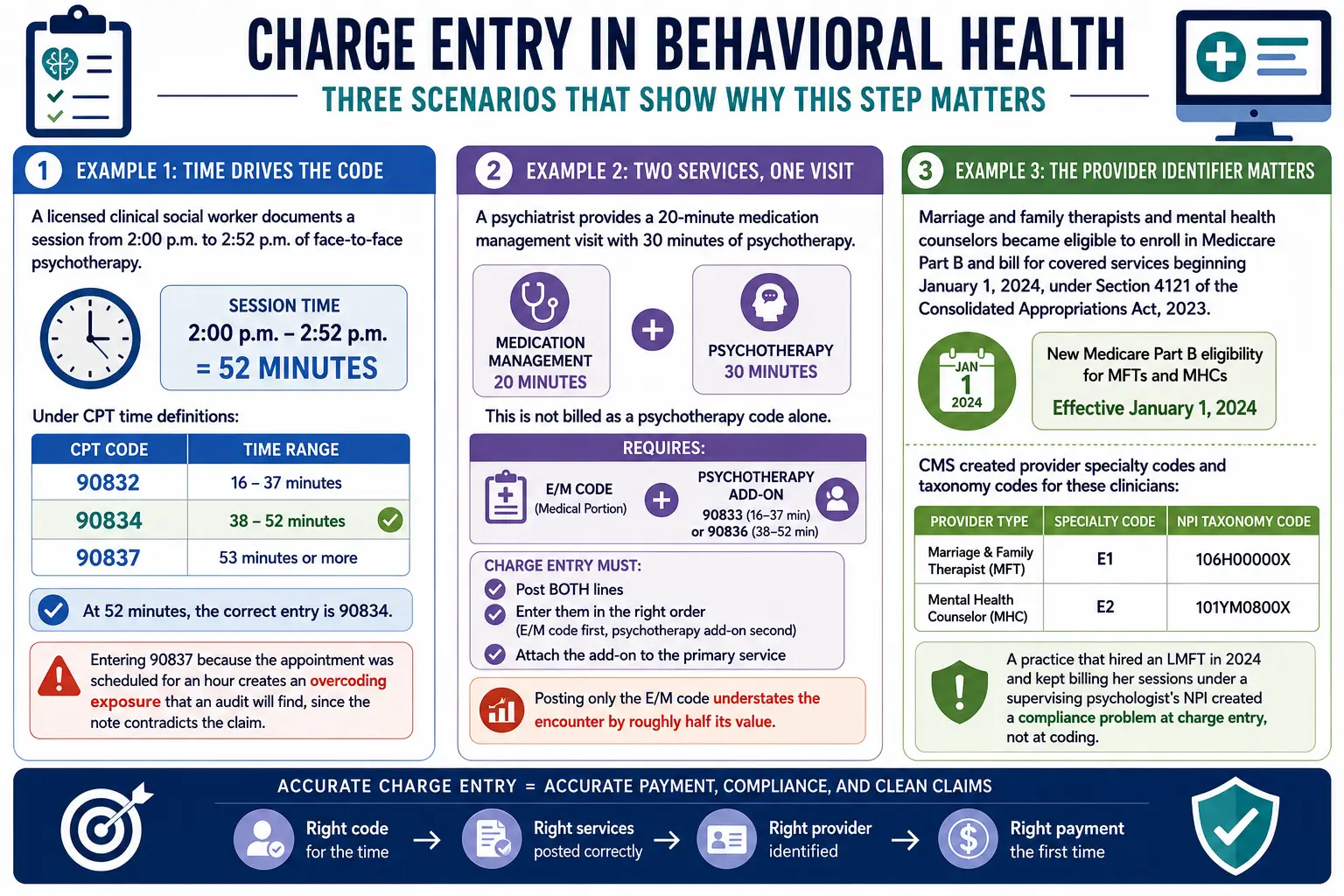
Three behavioral health scenarios show how much depends on this step.
Example 1: Time drives the code. A licensed clinical social worker documents a session from 2:00 p.m. to 2:52 p.m. of face-to-face psychotherapy. Under CPT time definitions, 90832 covers 16 to 37 minutes, 90834 covers 38 to 52 minutes, and 90837 applies at 53 minutes or more. At 52 minutes, the correct entry is 90834. Entering 90837 because the appointment was scheduled for an hour creates an overcoding exposure that an audit will find, since the note contradicts the claim.
Example 2: Two services, one visit. A psychiatrist provides a 20-minute medication management visit with 30 minutes of psychotherapy. This is not billed as a psychotherapy code alone. It requires an E/M code for the medical portion plus the psychotherapy add-on (90833 for 16 to 37 minutes of therapy, 90836 for 38 to 52). Charge entry has to post both lines, in the right order, with the add-on attached to the primary service. Posting only the E/M code understates the encounter by roughly half its value.
Example 3: The provider identifier matters. Marriage and family therapists and mental health counselors became eligible to enroll in Medicare Part B and bill for covered services beginning January 1, 2024, under Section 4121 of the Consolidated Appropriations Act, 2023. CMS created provider specialty codes E1 and E2 for these clinicians, with NPI taxonomy codes 106H00000X for MFTs and 101YM0800X for MHCs. A practice that hired an LMFT in 2024 and kept billing her sessions under a supervising psychologist’s NPI created a compliance problem at charge entry, not at coding.
Charge lag: what delayed charge entry actually costs
Charge lag is the average number of days between the date of service and the date the charge is posted. It is measurable, it is controllable, and it is one of the few billing metrics where improvement produces cash within a single month.
The Healthcare Financial Management Association identifies charge lag as a core revenue cycle KPI and points to a working target of capturing complete charges within three to five days of service, with late charges held to no more than 2% of total charges.
Delayed charge entry compounds in three ways. Cash arrives later, since every day of lag adds a day to accounts receivable. Correction windows shrink, because a claim posted on day 40 that rejects on day 45 leaves less runway before a 90-day commercial filing deadline. And recall fades, so clinicians asked about a session six weeks later produce weaker documentation than they would have produced the same afternoon.
The hard outer boundary is timely filing. Under 42 CFR 424.44, and following Section 6404 of the Affordable Care Act, Medicare fee-for-service claims must be filed no later than 12 months (one calendar year) after the date of service, a rule effective for services furnished on or after January 1, 2010. Commercial and Medicaid managed care limits are frequently much shorter, often 90 to 180 days, and are set by contract rather than by statute.
Common charge entry errors and how to correct them
Denial rates continue to put growing pressure on healthcare revenue cycles. In its March 2026 State of the Healthcare Revenue Cycle report, Kodiak Solutions, based on data from more than 2,300 hospitals and 350,000 physicians, found that the average initial denial rate increased from 11.4% in 2024 to 11.6% in 2025, while the median final denial rate rose from 2.5% to 2.7%. The report also estimated that net revenue leakage across the participating organisations surpassed $48 billion in 2025, up from $38.6 billion in 2024. The same analysis found Medicare Advantage initial and final denial rates more than double those of traditional Medicare.
Errors that originate in charge entry tend to cluster:
- Stale code sets. The AMA’s CPT 2026 update carried 418 changes, including 288 new codes, 84 deletions, and 46 revisions, all effective January 1, 2026. The FY 2026 ICD-10-CM update added 487 new diagnosis codes, revised 38, and deleted 28, effective October 1, 2025. Charge templates and favorites lists built two years ago will contain invalid codes.
- Modifier omissions. Telehealth place of service, modifier 95, and interactive complexity add-on 90785 are routinely dropped in high-volume behavioral health entry.
- Diagnosis pointing. A claim with four diagnosis codes and no pointers, or with pointers aimed at the wrong line, fails medical necessity review even when the coding is correct.
- Duplicate posting. Group therapy rosters entered twice, or an add-on posted as a standalone line, generate duplicate denials that require reversal rather than resubmission.
Charge correction is the formal fix. A posted charge should be reversed or adjusted through the billing system’s correction function, with the original entry retained, rather than deleted. Deleting charges destroys the audit trail that a payer or auditor will later ask to see.
Charge entry and payment posting are different jobs
Charge posting and charge entry describe the same activity in most practices, which is why “what is charge posting in medical billing” returns the same answer. Payment posting is a separate function that happens after adjudication, when remittance advice is applied against the open charge. Keeping the two roles distinct matters for internal control. The person who creates a charge should not be the only person who can write it off.
Charge entry services: in-house or outsourced
Outsourced charge entry services are particularly valuable for practices with fluctuating claim volumes, weekend clinic schedules, or limited access to certified coding staff. Vendors typically price per claim or as a percentage of collections, and many bundle charge entry and verification services with pre-bill audits.
The limitation is knowledge transfer. An external team will not know that a particular commercial plan in your state requires a specific authorization format for intensive outpatient programs unless someone documents it. Practices that outsource successfully maintain a payer-specific rules document and review a monthly denial report by root cause, rather than treating the vendor relationship as fully hands-off.
Whichever model a practice uses, three numbers tell you whether charge entry is working: average charge lag in days, first-pass clean claim rate, and the percentage of scheduled appointments with no posted charge 72 hours after service. Practices that review those three weekly find revenue leaks while they are still small enough to fix.