


A patient arrives at the emergency department with chest pain. Fifteen minutes later, her heart stops. The team doesn’t pause to ask what she would want done, because it’s already written on her chart: full code.
Full code is the default resuscitation status in nearly every hospital, skilled nursing facility, and emergency department in the United States. Full code in medical terms means that if a patient’s heart or breathing stops, the care team will attempt every standard resuscitative measure available, including chest compressions, defibrillation, intubation, mechanical ventilation, and emergency medications. Unless a patient or their surrogate has specifically requested otherwise, this is the status assumed the moment a patient is admitted.
For clinicians, full code status is a directive that triggers an immediate, rehearsed response. For medical billing and coding students, it also shapes what gets documented in the chart and which codes eventually apply to the claim. This article covers both sides: the clinical meaning of full code status, and what it looks like once it reaches a biller’s desk.
What does full code mean in medical terms
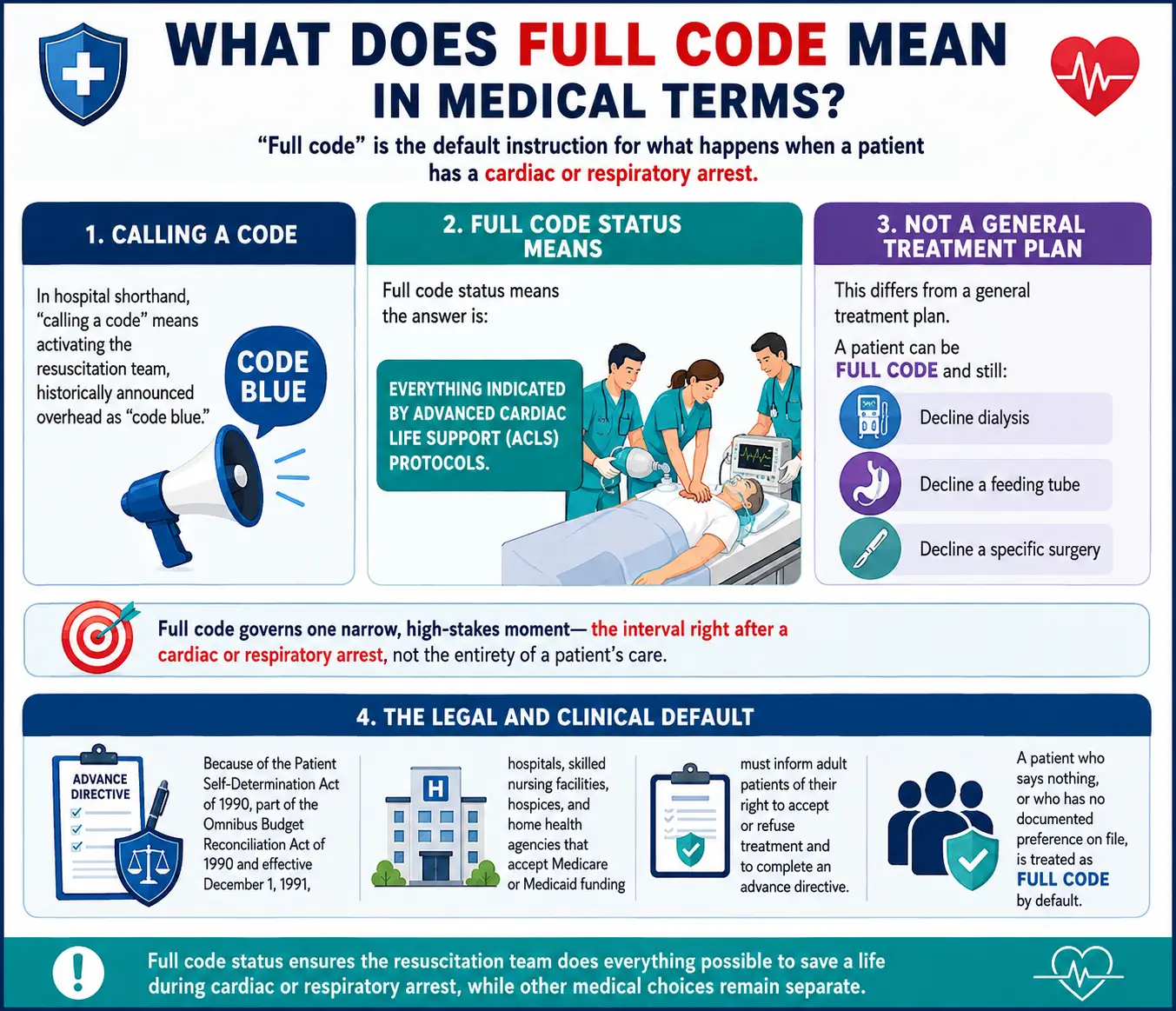
In hospital shorthand, “calling a code” means activating the resuscitation team, historically announced overhead as “code blue.” A patient’s code status is the standing instruction for what that team should do when the page goes out. Full code status means the answer is: everything indicated by advanced cardiac life support (ACLS) protocols.
This differs from a general treatment plan. A patient can be full code and still decline dialysis, decline a feeding tube, or decline a specific surgery. Full code governs one narrow, high-stakes moment, the interval right after a cardiac or respiratory arrest, not the entirety of a patient’s care.
Full code status is also the legal and clinical default. Because of the Patient Self-Determination Act of 1990, part of the Omnibus Budget Reconciliation Act of that year and effective December 1, 1991, hospitals, skilled nursing facilities, hospices, and home health agencies that accept Medicare or Medicaid funding must inform adult patients of their right to accept or refuse treatment and to complete an advance directive. A patient who says nothing, or who has no documented preference on file, is treated as full code by default.
What’s included in a full code order
A full code order isn’t a single action. It authorizes a bundle of interventions, applied in whatever sequence the arrest calls for:
- Cardiopulmonary resuscitation (CPR): chest compressions paired with rescue breathing to maintain circulation
- Defibrillation: an electrical shock delivered when the heart rhythm is shockable, such as ventricular fibrillation
- Endotracheal intubation: placement of a breathing tube to secure the airway
- Mechanical ventilation: a ventilator taking over or supporting breathing
- IV or IO medications: drugs such as epinephrine or amiodarone, given under ACLS protocols
- ICU-level supportive care: ongoing monitoring, vasopressors, and organ support once circulation is restored
Not every full code arrest involves all of these. A patient who loses their pulse from a shockable rhythm may respond to defibrillation and medications without ever needing a breathing tube. Full code simply means none of these options are taken off the table in advance.
How code status gets determined and documented
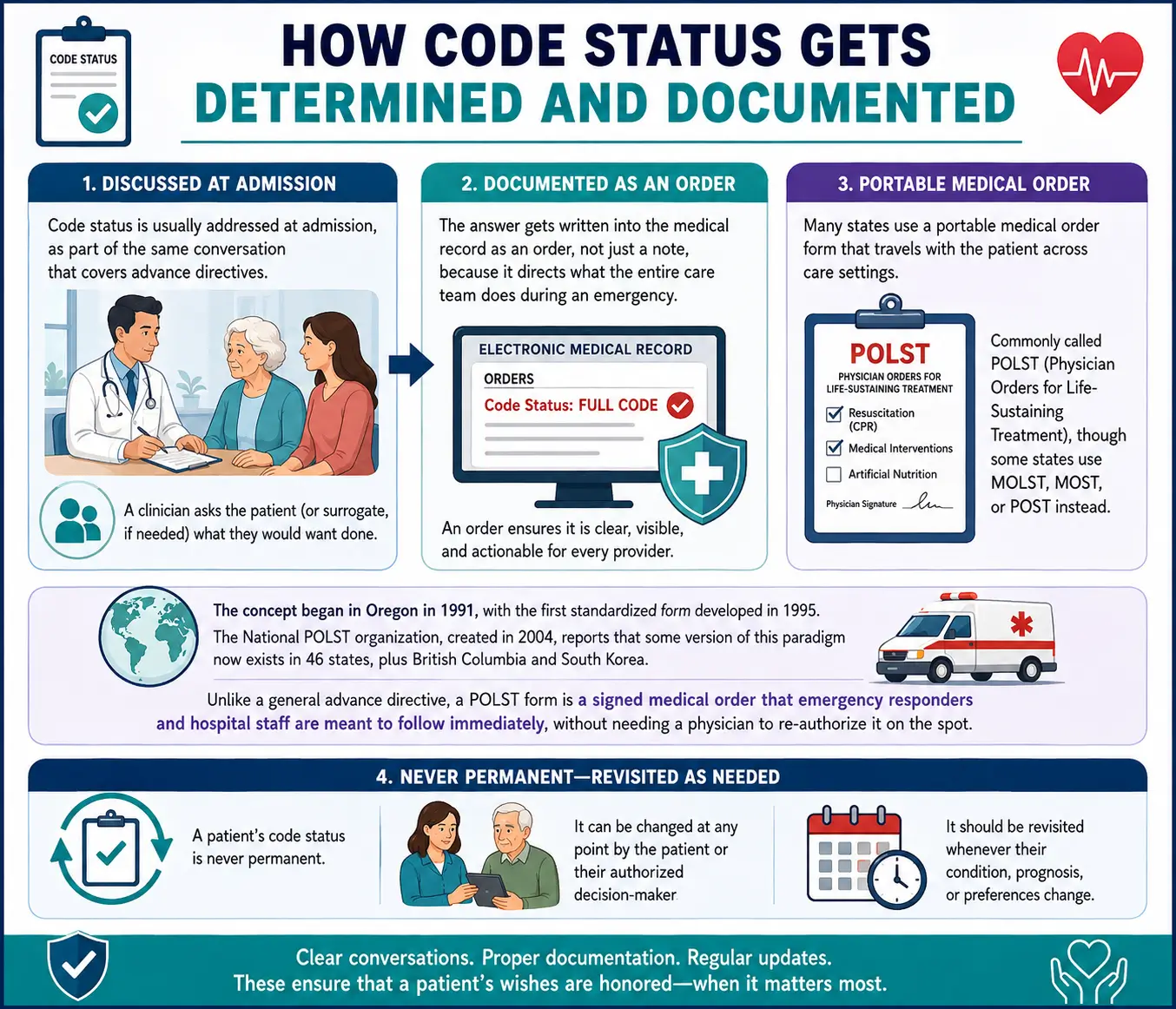
Code status is usually addressed at admission, as part of the same conversation that covers advance directives. A physician, nurse practitioner, or physician assistant asks the patient (or the surrogate, if the patient lacks decision-making capacity) what they would want done. The answer gets written into the medical record as an order, not just a note, because it directs what the entire care team does during an emergency.
Many states also use a portable medical order form that travels with the patient across care settings, commonly called POLST (Physician Orders for Life-Sustaining Treatment), though some states use the terms MOLST, MOST, or POST instead. The concept began in Oregon in 1991, with the first standardized form developed there in 1995. The National POLST organization, created in 2004 to coordinate state programs, reports that some version of the paradigm now exists in 46 states, plus British Columbia and South Korea. Unlike a general advance directive, a POLST form is a signed medical order that emergency responders and hospital staff are meant to follow immediately, without needing a physician to re-authorize it on the spot.
A patient’s code status is never permanent. It can be changed at any point by the patient or their authorized decision-maker, and it should be revisited whenever their condition, prognosis, or preferences change.
Full code vs DNR vs DNI
Full code sits at one end of a spectrum of resuscitation orders. The other common options are DNR (do not resuscitate) and DNI (do not intubate), and they are not interchangeable, despite how often they get lumped together.
Intervention | Full code | DNR | DNI |
Chest compressions | Yes | No | Yes (if not also DNR) |
Defibrillation | Yes | No | Yes (if not also DNR) |
Endotracheal intubation | Yes | Depends on documentation | No |
Mechanical ventilation | Yes | Depends on documentation | No |
Emergency medications (ACLS) | Yes | Depends on documentation | Yes, short of intubation |
Default status without documentation | Yes | No | No |
A patient can carry a DNR order without a DNI order, and vice versa. Someone might decline chest compressions and defibrillation but still want a breathing tube if they develop respiratory failure from a treatable pneumonia. Someone else might accept CPR but refuse long-term ventilator support. These combinations exist precisely because code status is meant to reflect individual values, not a single package deal.
Some institutions also permit what’s called a limited or partial code, where a patient accepts specific interventions while declining others outside the standard DNR/DNI framework. Clinicians have raised concerns about this approach, since picking individual components out of a bundle designed to work together can produce a resuscitation attempt that is neither fully effective nor fully in line with the patient’s goals.
What the survival data actually shows
Full code status is a request to attempt resuscitation, not a guarantee that it will work. The numbers make that distinction clear.
According to the 2025 American Heart Association Guidelines for Cardiopulmonary Resuscitation and Emergency Cardiovascular Care, published in October 2025 in Circulation, adult survival to hospital discharge after in-hospital cardiac arrest was 23.6% based on 2023 data, and 45.2% for pediatric patients. Among adult survivors, 79.2% had a favorable neurologic outcome by discharge. The guidelines, drawing on the Get With The Guidelines-Resuscitation registry, estimate roughly 292,000 adult in-hospital cardiac arrests occur annually in the United States, with about 60% happening in acute care areas such as ICUs, emergency departments, and operating rooms, and the remaining 40% on general inpatient units.
Survival trends have moved over time. The AHA reports that in-hospital survival to discharge fell to a pandemic-era low of 18.8% before recovering to 23.6% by 2023. Out-of-hospital cardiac arrest carries lower odds: the 2024 Cardiac Arrest Registry to Enhance Survival (CARES) data cited in the same guidelines put survival to hospital discharge at 10.5% for adults, out of an estimated 263,711 EMS-treated cases that year.
These figures vary widely by circumstance. Arrests that are witnessed, occur in a monitored setting, or involve a shockable rhythm carry meaningfully better odds than arrests in patients with advanced illness or multi-organ failure at the time their heart stops. That variation is part of why code status conversations are individualized rather than automatic.
When full code status gets reconsidered
Full code status generally travels with the patient without needing to be re-examined at every step of care. DNR and DNI orders don’t get the same pass, particularly before surgery.
The American Society of Anesthesiologists first addressed this in 1993 and reaffirmed its position in October 2023, in a statement recommending “required reconsideration” of DNR orders before any procedure requiring anesthesia, rather than automatically suspending them. Because many routine components of anesthesia care, such as airway management and vasoactive medications, overlap with resuscitation itself, the surgical team, anesthesiologist, and patient (or surrogate) are expected to have a specific conversation about what should happen if the patient’s heart stops during the procedure. The patient can choose to suspend the DNR temporarily, keep it fully in place, or limit it to specific interventions, and the plan is expected to be documented, communicated to every team involved, and reinstated at a defined point after surgery. A full code patient heading into the same operating room needs no equivalent conversation, since the default authorization already covers whatever the anesthesia and surgical teams might need to do.
Full code in medical billing and coding
Code status itself doesn’t generate a diagnosis code. There is no ICD-10-CM entry for full code, and that’s not an oversight. Under the Z00 to Z99 classification range for factors influencing health status, the only code addressing resuscitation preference is Z66, do not resuscitate. Coding guidelines note that Z66 may be reported when a provider documents that a patient carries DNR status at any point during the stay. Because full code is the unflagged default, the classification system has no reason to mark it; it only marks the exception.
Billing enters the picture once resuscitation actually happens. CPR performed on a full code patient is reported using CPT 92950, cardiopulmonary resuscitation, which per American College of Emergency Physicians coding guidance covers chest compressions and rescue breathing to restore circulation and respiration after cessation of heartbeat and breathing. Defibrillation delivered as part of that same resuscitation episode is bundled into 92950 rather than billed separately under the cardioversion codes (92960 or 92961), and the physician does not have to personally perform compressions to bill the code, only to direct the resuscitation. Only one physician can report 92950 per arrest episode, regardless of how many providers were in the room. The claim is typically linked to an ICD-10 diagnosis code describing the underlying event, such as I46.9 for cardiac arrest of unspecified type, and coders are expected to see start and stop times, medications given, and outcome documented before the code gets billed.
Full code in practice: three scenarios
A 68-year-old admitted for pneumonia has never discussed code status with his care team. He develops respiratory failure overnight. Because no advance directive or DNR order exists on file, staff intubate him and start mechanical ventilation without pausing to seek additional consent, because his default full code status already authorizes it.
A 45-year-old in for elective knee surgery is asked her code status during pre-operative screening. She’s healthy, has no chronic illness, and confirms she is full code, as most surgical patients are. No special reconsideration process is triggered, since full code requires none.
A 79-year-old with metastatic cancer is admitted for symptom management. During a goals-of-care conversation, she decides she wants CPR attempted if her heart stops but does not want to be placed on a ventilator long-term. Her chart is updated to reflect a code status that is not fully full code and not a standard DNR/DNI combination, illustrating why these orders exist on a spectrum rather than as two fixed options.
Common misunderstandings about full code
Full code does not mean unlimited care in every sense. A patient can be full code and still decline chemotherapy, refuse a specific surgery, or choose not to start dialysis. It applies specifically to what happens during a resuscitation event, not to every treatment decision that follows.
It also isn’t automatically the right choice for every patient. Survival following in-hospital CPR varies considerably based on a patient’s underlying condition, and outcomes tend to be worse among patients with advanced cancer, sepsis, or existing multi-organ failure at the time of arrest. Shared decision-making between the patient, family, and care team is meant to weigh that variability rather than assume full code is always the default worth keeping.
Finally, full code is not a one-time decision. Because circumstances change, and because the patient (or their surrogate) retains the right to revise it, code status is meant to be revisited whenever a patient’s prognosis shifts meaningfully, not treated as a box checked once at admission and forgotten.
Full code status, in the end, is a documented answer to one specific question: if this patient’s heart or breathing stops, should the team attempt to bring them back. Everything else, from the ICD-10 code that never gets used to the CPT code that eventually does, follows from how that single answer gets recorded.