


Most physician visits map cleanly onto an existing E/M code. A small number don’t, and that’s where CPT code 99499 comes in. It’s the unlisted evaluation and management service code, the option a provider turns to only after every specific office visit, hospital care, or consultation code has already been ruled out.
For students preparing for a coding exam, 99499 CPT code questions tend to show up more in review guides than in daily claims work. For billers already in practice, that same rarity is what makes the code confusing whenever it appears on a chart. This guide covers what the 99499 CPT code description means, when CPT 99499 is appropriate, what documentation a payer expects, and how reimbursement gets worked out when there’s no fee schedule number to start from.
What is CPT code 99499?
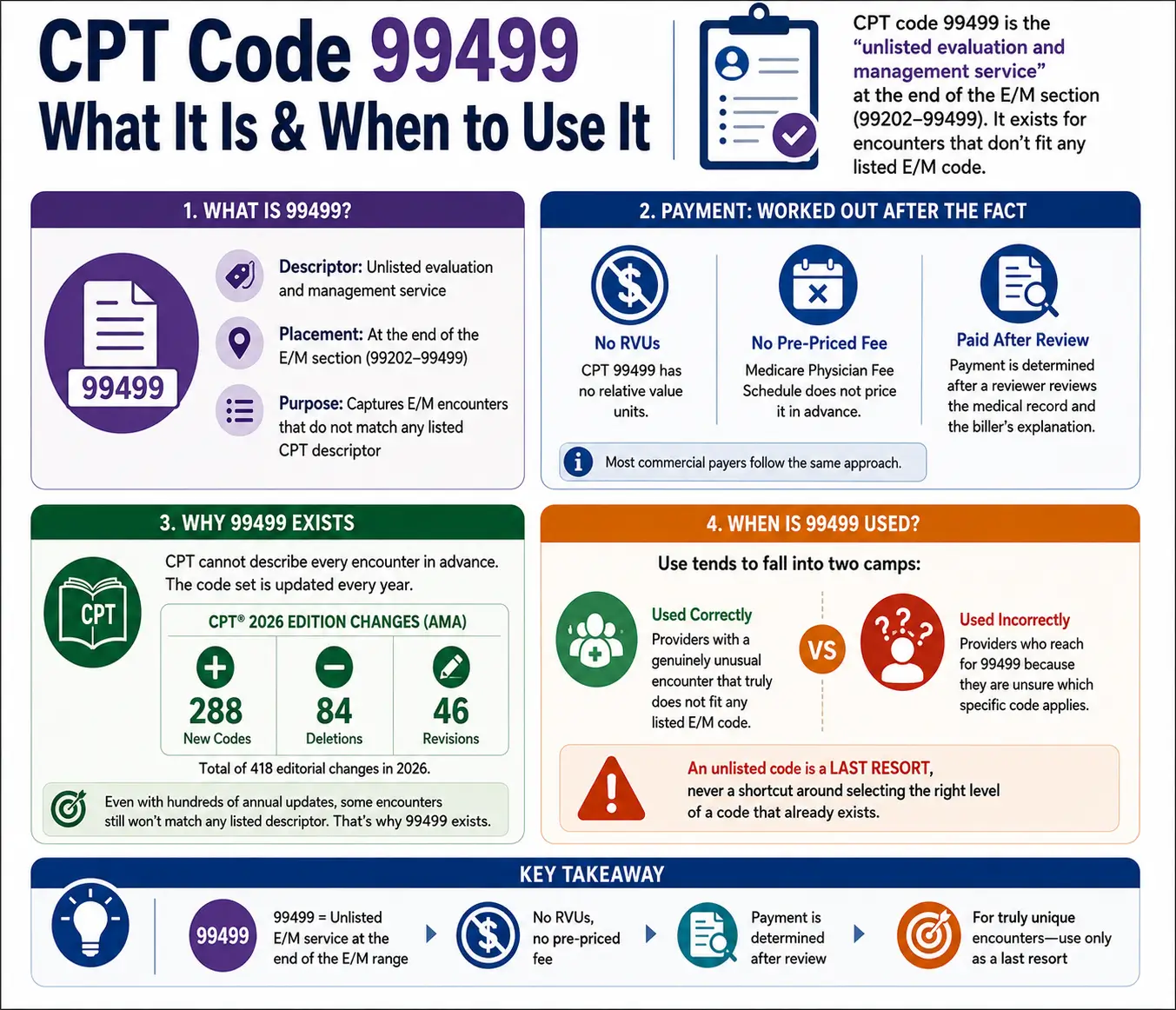
CPT code 99499 carries the descriptor “unlisted evaluation and management service” in the CPT code set maintained by the American Medical Association. It sits at the tail end of the E/M section, the range that runs from 99202 through 99499 and covers office visits, hospital care, consultations, preventive visits, and care management services.
Unlike a standard E/M code, 99499 carries no relative value units and no fee schedule amount. Medicare’s Physician Fee Schedule doesn’t price it in advance, and neither do most commercial payers. When a claim for 99499 is paid, the amount gets worked out after the fact, once a reviewer has read the medical record and the biller’s explanation of what happened during the visit.
That structure exists because CPT can’t describe every encounter in advance. The code set changes every year. The 2026 edition alone brought 418 editorial changes, including 288 new codes, 84 deletions, and 46 revisions, according to the American Medical Association’s own release notes. Even at that pace of revision, some encounters still won’t match any listed descriptor, and 99499 exists to capture the ones that don’t.
99499 CPT code use tends to fall into two camps: providers with a genuinely unusual encounter, and providers who reach for it because they’re unsure which specific code applies. Only the first group is using it correctly. An unlisted code is a last resort, never a shortcut around picking the right level of a code that already exists.
When should CPT 99499 be reported?
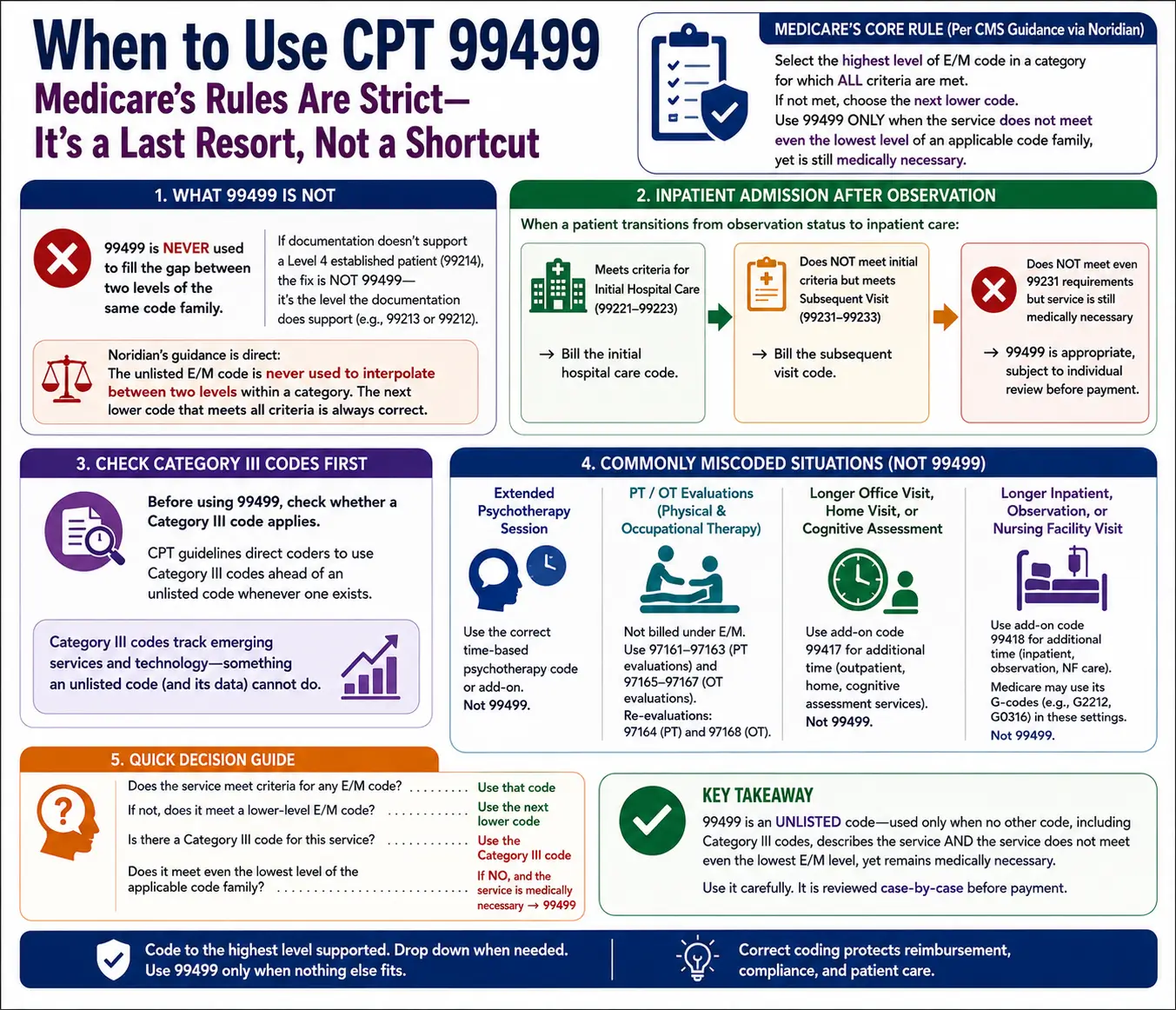
Medicare’s own claims processing manual sets the bar plainly. Per CMS guidance summarized by Medicare Administrative Contractor Noridian, physicians and other billing practitioners are expected to select the highest level of E/M code within a category for which all criteria are met. If a code’s criteria aren’t met, the next lower code applies instead, not 99499. Only when a visit fails to reach even the lowest level of an applicable code family, while still being medically necessary, does the unlisted code become appropriate.
That’s a narrower standard than it sounds.
CPT 99499 is never meant to fill the gap between two levels of the same code family. If a documented office visit doesn’t support a level 4 established patient code, for example, the fix is to bill the level the documentation does support, not to escalate to 99499. Noridian’s published guidance for physicians is direct about this: the unlisted E/M code is never used to interpolate between two levels of service within a category, and the next lower code for which all criteria are met is always the correct choice instead.
One scenario Medicare Administrative Contractors point to directly involves inpatient admissions that happen after a stay in observation status. If a patient moves from observation to inpatient care and the encounter meets the criteria for initial hospital care (CPT 99221-99223), that’s the code to bill. If it falls short of that but still meets a subsequent visit code’s criteria (99231-99233), that lower code applies, even though the visit is technically an admission. Only if the documented service doesn’t meet even 99231’s requirements, while still representing medically necessary care, does 99499 become the right call, and even then it’s subject to individual review before payment.
Before reaching for 99499 at all, check whether a Category III code applies. CPT guidelines direct coders toward Category III codes ahead of an unlisted code whenever one exists, since Category III codes track emerging services and technology in a way an unlisted code, and the data collected from it, cannot.
A few situations commonly get miscoded as 99499. A psychotherapy session that ran long doesn’t call for an unlisted code; it calls for the correct time-based psychotherapy code or add-on. A physical or occupational therapy evaluation isn’t billed under the E/M range at all: since 2017, those services use codes 97161-97163 (physical therapy evaluation, tiered by complexity) and 97165-97167 (the occupational therapy equivalent), with 97164 and 97168 covering re-evaluations. An office visit or hospital stay that simply ran longer than the base code’s typical time has its own add-on codes instead, 99417 for outpatient, home, and cognitive assessment services or 99418 for inpatient, observation, and nursing facility care (Medicare uses its own G-codes, including G2212 and G0316, in some of these settings). None of those scenarios call for 99499.
Documentation requirements for CPT 99499
Every unlisted code in the CPT code set is tied to the same underlying instruction: submit a special report. The CPT codebook describes this requirement in its guidelines for services that are rarely provided, unusual, variable, or new, calling for a description of the nature, extent, and need for the service, along with the time, effort, and equipment it required. That language sits in the radiology guidelines specifically, but coding educators, including AAPC, apply the same standard to every CPT section with an unlisted code, evaluation and management included.
In practice, the documentation a payer wants for a 99499 CPT code claim breaks down by claim type. On a professional claim (the CMS-1500 form), Medicare’s Claims Processing Manual instructs billers to enter a narrative description in Item 19 whenever it fits within the space allowed. If it doesn’t fit, an attachment goes with the claim instead. On an institutional claim (the UB-04, or CMS-1450), the same concise description goes in Form Locator 80, or its electronic equivalent, which typically allows around 80 characters. If a fuller explanation is needed, providers submit it as a separate attachment.
Medicare’s process for the unlisted E/M code specifically has one detail that catches billers off guard. According to guidance Noridian publishes for Jurisdiction E Part B, providers should not send medical records with the initial 99499 claim. The Medicare Administrative Contractor reviews the brief description first (the place of service and a short statement of why no other E/M code applies) and only requests the full medical record afterward, through a documentation request letter, if it’s needed to price the claim. Sending records unprompted doesn’t speed anything up; it just means paperwork the contractor didn’t ask for yet.
For claims outside Medicare, a written cover letter comparing the service to a similar, already-priced code tends to move a 99499 claim through review faster. AAPC’s coding guidance recommends noting where the work took more time, more complexity, or carried more risk than that comparison code represents, in plain language rather than dense clinical shorthand. A description a non-clinician reviewer can actually follow, with diagrams or images attached where relevant, tends to resolve faster than one written strictly for another physician.
Billing and reimbursement for CPT 99499
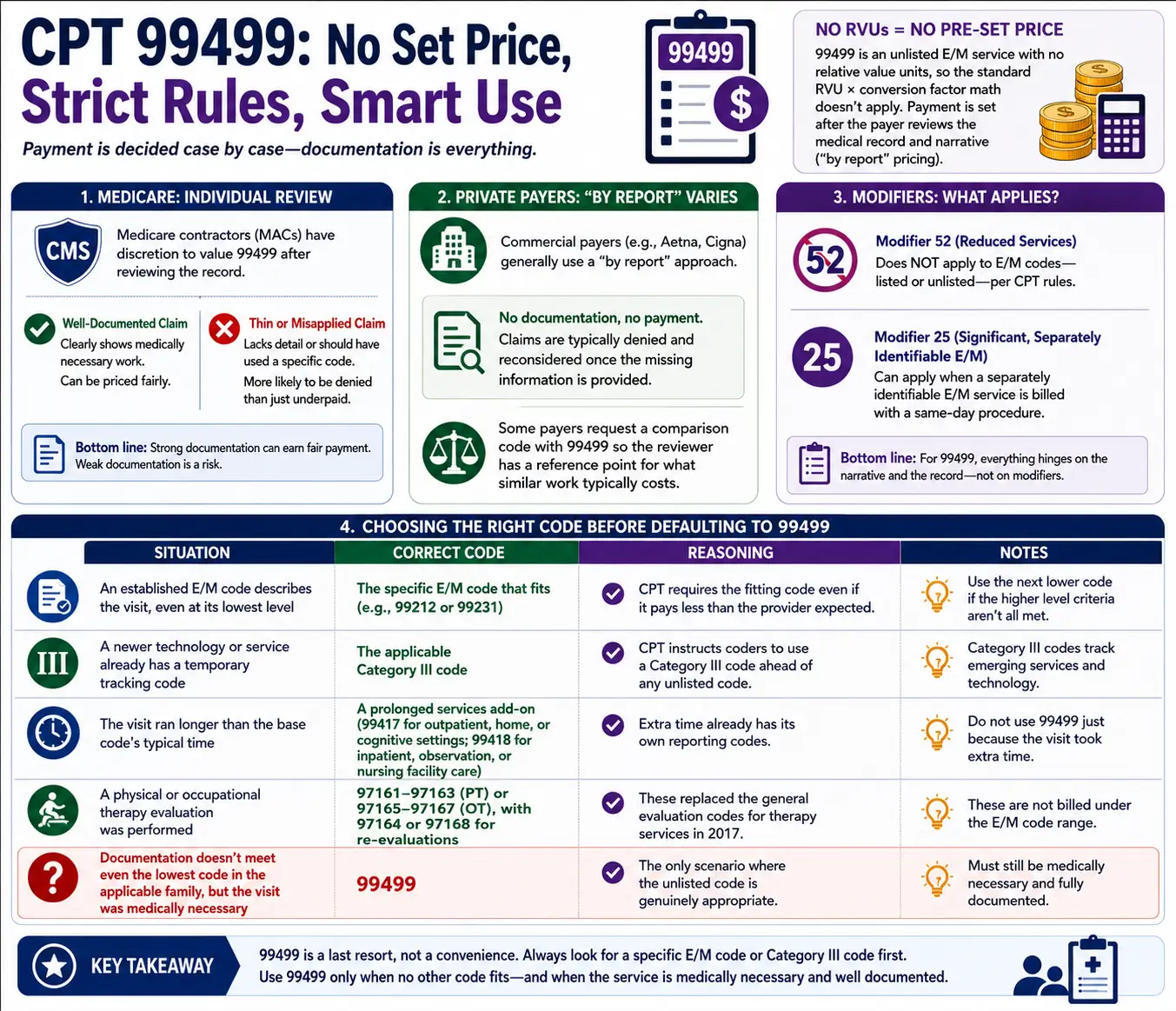
There’s no set 99499 CPT code price, and that’s the detail most new billers find hardest to plan around. Unlisted codes carry no relative value units, so the standard math that prices most Medicare claims (RVUs multiplied by a conversion factor) doesn’t apply here. Payment gets determined individually, sometimes called “by report” pricing, where the payer sets an amount after reviewing what was actually documented.
Medicare’s contractors have discretion to value a 99499 claim once they’ve reviewed the record, and that discretion cuts both ways. A well-documented claim that clearly shows medically necessary work can be priced fairly. A thin claim, or one where a specific code would have applied anyway, is more likely to be denied than simply underpaid.
Private payers handle 99499 with more variation. Commercial carriers, including Aetna and Cigna, describe a broadly similar “by report” posture in their reimbursement policies: no documentation, no payment, with a denial that gets revisited once the missing information arrives. Some payers ask billers to submit a comparison code alongside the unlisted one, specifically so the reviewer has a reference point for what similar work typically costs.
Modifiers matter less here than on a standard E/M claim. Reduced services modifier 52 doesn’t apply to evaluation and management codes at all, unlisted or otherwise, under longstanding CPT rules. Modifier 25 can still apply if a separately identifiable E/M service is billed alongside a same-day procedure, but otherwise the claim lives or dies on the narrative and the record behind it, not on which modifier gets attached.
Choosing the right code before defaulting to 99499
Situation | Correct code | Reasoning |
An established E/M code describes the visit, even at its lowest level | The specific E/M code that fits (for example, 99212 or 99231) | CPT requires the fitting code even if it pays less than the provider expected |
A newer technology or service already has a temporary tracking code | The applicable Category III code | CPT instructs coders to use a Category III code ahead of any unlisted code |
The visit ran longer than the base code’s typical time | A prolonged services add-on (99417 for outpatient, home, or cognitive settings; 99418 for inpatient, observation, or nursing facility care) | Extra time already has its own reporting codes |
A physical or occupational therapy evaluation was performed | 97161-97163 (PT) or 97165-97167 (OT), with 97164 or 97168 for re-evaluations | These replaced the general evaluation codes for therapy services in 2017 |
Documentation doesn’t meet even the lowest code in the applicable family, but the visit was medically necessary | 99499 | The only scenario where the unlisted code is genuinely appropriate |
Common denial reasons and how to appeal a CPT 99499 claim
Most 99499 denials trace back to one of three causes. The narrative is missing or too vague to explain what happened during the visit. A specific E/M code actually existed and should have been billed instead, which payers can usually tell from the same documentation submitted with the claim. Or the record doesn’t establish medical necessity clearly enough to justify payment at any level, regardless of which code was used.
None of these are usually fatal to the claim long term. If a Medicare Administrative Contractor denies a 99499 claim, the first step is a redetermination request, filed with the contractor within 120 days of the initial determination notice, with a decision generally issued within 60 days. If that doesn’t resolve it, the next step is reconsideration by a Qualified Independent Contractor, filed within 180 days of the redetermination decision, with another 60-day decision window. Later levels, including an administrative law judge hearing and the Medicare Appeals Council, exist for higher-value disputes, though few unlisted E/M claims escalate that far.
Commercial payers usually mirror this structure at a smaller scale: an internal appeal with the missing documentation attached, then an external review if the payer’s policy allows one. The fix for a denied 99499 claim is rarely a legal argument. It’s usually the same missing piece: a clearer statement of why no listed code applied, tied to what’s already in the chart.
Frequently asked questions about CPT code 99499
What is CPT code 99499?
CPT code 99499 is the unlisted evaluation and management service code in the CPT code set published by the American Medical Association. It reports an E/M encounter that doesn’t match the descriptor of any other code in that section.
What is CPT code 99499 used for?
It’s used only when a documented, medically necessary E/M service doesn’t meet the criteria of any specific code, including the lowest level in the applicable family. It isn’t a substitute for choosing the correct level of an existing code.
When should CPT 99499 be reported?
Only after confirming that no listed E/M code, and no Category III code, describes the service. CMS guidance treats this as a rare circumstance, not a routine billing option.
Does Medicare reimburse CPT 99499?
Yes, but not on a fixed fee schedule. Medicare Administrative Contractors review the submitted description and, if needed, the medical record, then price the claim individually based on the documented work.
How do you bill CPT code 99499?
Submit the claim with a concise description of the service in Item 19 of the CMS-1500 form, or Form Locator 80 on an institutional claim, stating the place of service and why no other E/M code applies. For Medicare, don’t send full documentation until the contractor requests it.
What documentation is required for CPT 99499?
A clear explanation of the nature, extent, and medical necessity of the service, along with the time and effort involved. Comparing the service to a similar, already-priced code helps the payer gauge what level of work to expect.
Is CPT 99499 an unlisted E/M code?
Yes. It’s the only unlisted code in the evaluation and management section of CPT, covering encounters that fall outside every other E/M code’s description.
How is reimbursement determined for CPT 99499?
Case by case. Because the code carries no relative value units, payers set a rate after review, often by comparing the documented work to a similar, listed procedure’s typical time and complexity.
CPT code 99499 stays useful precisely because it’s rarely the right answer. Providers who bill it correctly do so only after ruling out every specific E/M code and any applicable Category III code, and they back the claim with a description a reviewer who wasn’t in the room can still follow. Get that part right, and a code with no preset price still has a real chance of being paid what the visit was actually worth.