Follow Us On :

Reversal vs Recoupment in Medical Billing: Complete Comparison Guide

Reversal vs Recoupment in Medical Billing
 Essential RCM Knowledge: This comprehensive guide explains the critical differences between reversals and recoupments—two billing adjustment processes that impact healthcare provider revenue cycles differently. Understanding both is essential for maintaining accurate cash flow and preventing financial disruptions.
Executive Summary:

Reversal and recoupment are two distinct billing processes: A reversal cancels an entire claim or payment immediately—typically due to billing errors, duplicate claims, or incorrect patient information—and the claim must be resubmitted with corrections. A recoupment occurs when an insurance company recovers overpaid funds after the claim has been processed and paid—often discovered during audits or due to coding errors—and the payer reclaims money by offsetting future payments. Key difference: Reversals happen early and stop payment before finalization; recoupments happen late and force financial recovery from funds already received. Understanding these processes helps practices prevent revenue loss, manage cash flow, and respond effectively to payer actions. A2Z Billings helps providers implement proactive monitoring and denial management strategies to minimize both reversals and recoupments.

Introduction to Medical Billing Adjustments: The Foundation

Medical billing operates in a complex ecosystem where claims move between healthcare providers, insurance companies, clearinghouses, and patients. Throughout this journey, claims are subject to review, verification, and adjustment. Understanding how and why these adjustments occur is critical for maintaining a healthy revenue cycle.

Two of the most misunderstood billing adjustment processes are reversals and recoupments. While they sound similar and both involve claim adjustments, they represent fundamentally different situations with distinct consequences for healthcare providers. Confusing the two can lead to poor financial decision-making and unnecessary cash flow disruptions.

This guide breaks down both processes, explains their key differences, and provides actionable strategies to prevent and manage them effectively.

What Is Reversal in Medical Billing?

Definition and Purpose

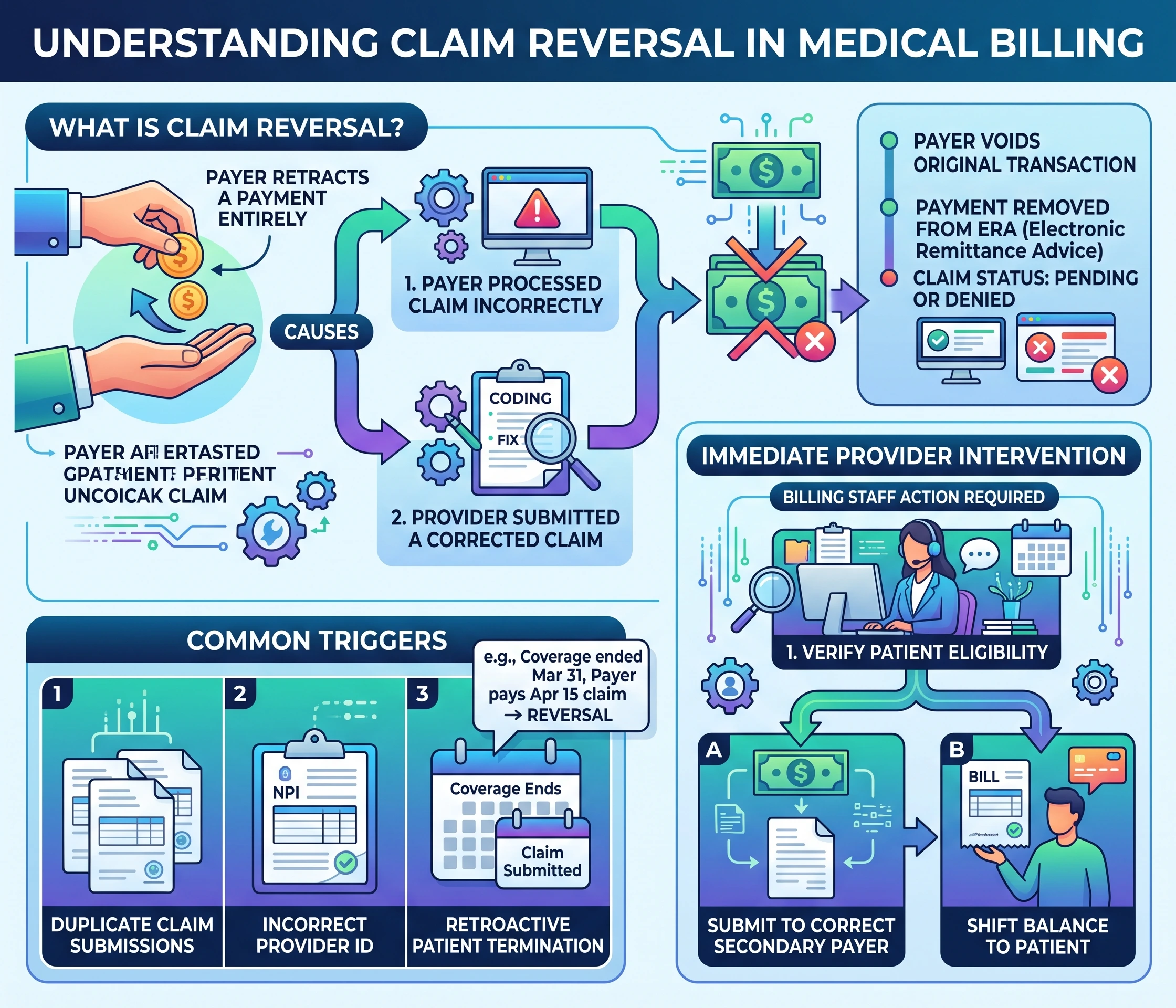
reversal is the cancellation of a claim or payment that stops the payment process before or immediately after processing. Think of it as an “undo” function—the claim transaction is reversed, returning the claim to a pending or void status. The original payment is not processed, or if it was already processed, it is taken back.

The key characteristic of a reversal is that it happens early in the claims lifecycle. It stops payment from being finalized, allowing the provider to correct the error and resubmit a corrected claim.

Common Reasons for Reversal

Reason for ReversalDescriptionProvider’s Required Action
Duplicate ClaimsThe same claim is submitted multiple times (identical CPT codes, patient, date of service)Investigate which submission was accurate; contact payer to request reversal of duplicate
Incorrect Patient InformationPatient name, date of birth, or insurance ID is incorrect or mismatchedCorrect patient information; resubmit with accurate demographics
Coding ErrorsWrong CPT code, ICD-10 code, or modifier is usedVerify correct codes; submit corrected claim
Eligibility IssuesService was rendered when patient’s insurance was not activeVerify coverage dates; appeal or resubmit if coverage was active
Technical ErrorsTransmission errors, EFT glitches, or clearinghouse processing issuesResubmit claim through proper channels

The Reversal Process: Step-by-Step

  1. Error Identification: Billing staff, providers, or payers detect an error in the claim
  2. Documentation: Gather all relevant records: service dates, payment amounts, claim IDs
  3. Reversal Request: Submit reversal request to payer through ERA, clearinghouse, or payer portal
  4. Claim Correction: Correct the error in your billing system
  5. Resubmission: Resubmit corrected claim
  6. Payment: Payer processes corrected claim and issues payment

Impact of Reversal on Claims and Cash Flow

Reversals have a moderate impact on cash flow. While they delay payment, the impact is usually temporary if caught quickly. The original payment is canceled or never finalized, but once the corrected claim is resubmitted and processed, payment flows normally.

However, reversals discovered weeks or months after initial submission can cause significant delays. Industry standard: Reversals should be identified and corrected within 30 days of submission to minimize cash flow disruption.

What Is Recoupment in Medical Billing?

Definition and Purpose

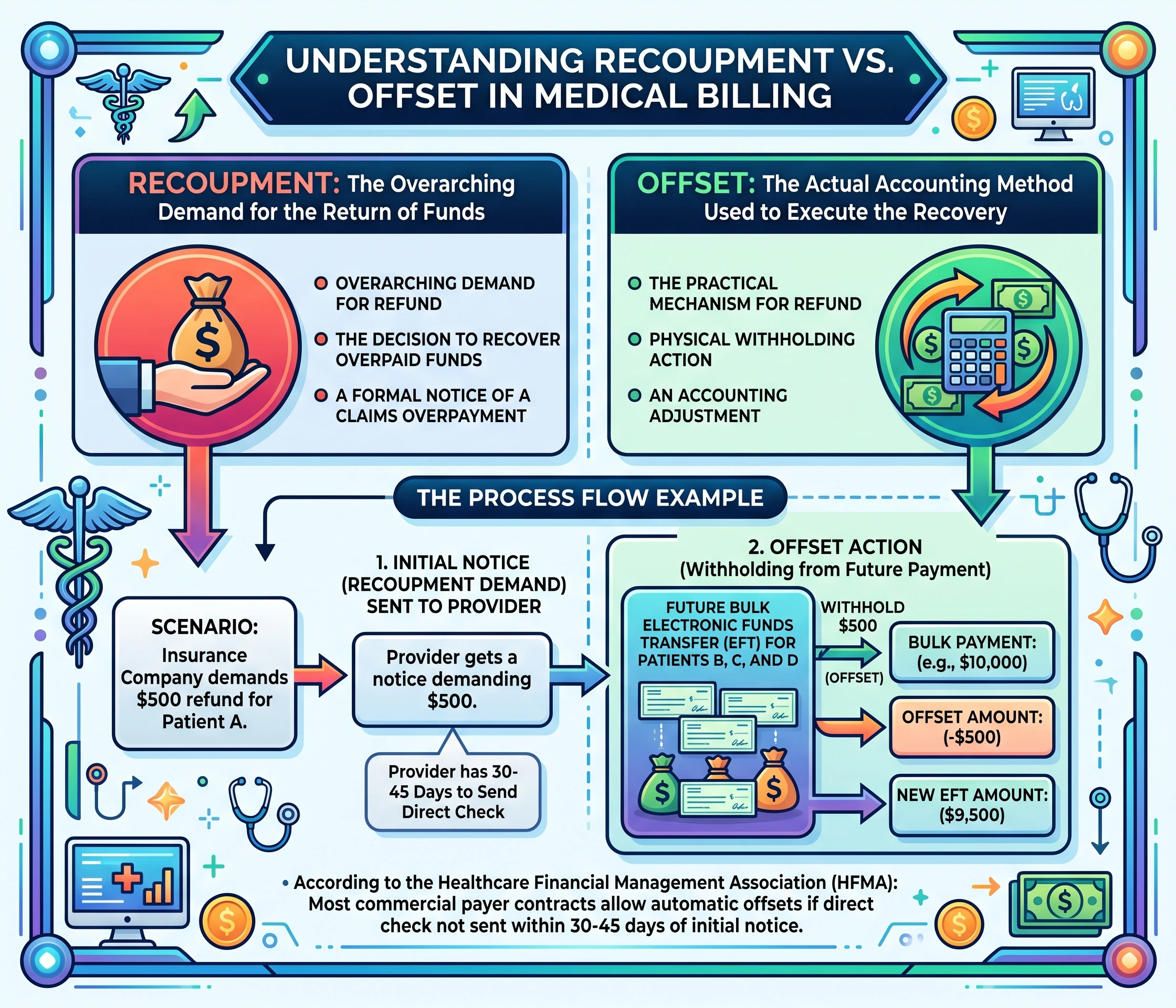
recoupment is the process by which an insurance company recovers overpaid funds that were already paid to a healthcare provider. Unlike a reversal, recoupment occurs after the claim has been fully processed and payment has been made. The payer identifies an overpayment (often during post-payment audits) and takes action to recover the excess funds.

In a recoupment, the original claim remains in the system as paid, but an adjustment is made to recover the overpayment. This is typically done by withholding or offsetting amounts from future claim payments.

Common Reasons for Recoupment

  • Overpayments due to billing errors: Incorrect coding, modifiers, or duplicate claims discovered during audit
  • Medical necessity denials after payment: Payer reviews the claim and determines service wasn’t medically necessary per their guidelines
  • Coverage denials: Service found to be non-covered or excluded under the patient’s plan (discovered after payment)
  • Contractual rate changes: Provider’s contract rates change; prior payments exceeded new rates
  • Retrospective eligibility changes: Patient’s eligibility status changes retroactively, affecting coverage for previously paid claims
  • Audit findings: Comprehensive payer audits uncover overpayments across multiple claims

The Recoupment Process: Step-by-Step

  1. Claim Review & Audit: Payer reviews claims (usually months after payment) to verify accuracy
  2. Overpayment Identification: Payer determines overpayment occurred and calculates amount owed
  3. Notification: Payer sends formal recoupment notice via remittance advice or EOB
  4. Appeal Opportunity: Provider has defined timeframe (typically 30-90 days) to appeal recoupment
  5. Recovery: If not appealed successfully, payer offsets or withholds amount from future claim payments
  6. Verification: Provider verifies recoupment application and reconciles accounts

Impact of Recoupment on Claims and Cash Flow

Recoupments have a significant negative impact on cash flow. Because the funds were already received, recoupment represents an unexpected financial recovery that reduces future reimbursements. For practices with tight cash flow, large recoupments can create serious liquidity challenges.

Real-world example: A practice receives $50,000 in payments over a month. Two weeks later, a payer issues a recoupment letter stating $8,000 was overpaid. The payer then withholds $8,000 from the practice’s next $15,000 claim payment, leaving only $7,000—a 50% payment reduction that disrupts cash flow and payroll timing.

Key Differences: Reversal vs Recoupment

AspectReversalRecoupment
DefinitionCancellation of a claim or payment to correct an errorRecovery of overpaid funds by insurance company
TimingOccurs immediately or shortly after claim submission (days to weeks)Occurs months or even years after payment (post-payment audit)
Initiated ByProvider or payerInsurance company/payer only
Payment StatusPayment is stopped before finalization or taken back immediatelyPayment has been finalized and received; payer reclaims it
Claim StatusClaim is voided and must be resubmittedOriginal claim remains paid; adjustment made
Root CauseError in claim submission (coding, patient info, duplication)Overpayment (audit findings, medical necessity, coverage issues)
Cash Flow ImpactModerate—delays payment until corrected claim is reprocessedSignificant—reduces future reimbursements unexpectedly
Recovery MethodResubmit corrected claimOffset against future claim payments or direct billing
Prevention FocusAccurate coding, patient verification, duplicate preventionCompliance audits, documentation accuracy, coverage verification
AppealabilityCan appeal if reversal was incorrectCan appeal with supporting documentation and clinical justification

Real-World Examples: When Reversals and Recoupments Occur

Case Study 1: Duplicate Claim Reversal

Scenario: A busy orthopedic practice submits a claim for knee arthroscopy (CPT 29881) for patient John Smith on January 15. Due to a billing software glitch, the claim is submitted twice. Medicare processes both claims and approves payment for both. The payer later identifies the duplicate and reverses one payment.

Timeline: Claim submitted January 15 → Payment received January 30 → Duplicate identified February 3 → Reversal issued February 5

Impact: Practice loses $2,500 (one claim value). However, since reversal occurred within days, the impact is minimal. The practice can quickly contact the payer, verify the duplicate, confirm reversal legitimacy, and resubmit if appropriate.

Lesson: Implement a duplicate detection system in your billing software to catch these before submission, reducing reversals from 2–5% of claims to <1%.

Case Study 2: Medical Necessity Recoupment

Scenario: A primary care physician orders an MRI of the lumbar spine for a patient with chronic back pain. The claim is submitted with diagnosis code M54.5 (Low back pain). The payer processes and pays the claim ($2,200) in February. In July (5 months later), the payer conducts a medical necessity audit and determines that the MRI didn’t meet their coverage criteria for that diagnosis code alone—additional imaging or specialist referral documentation was required. The payer issues a recoupment notice.

Timeline: Claim submitted January 20 → Payment received February 10 → Payer audit July 1 → Recoupment issued July 15 → Offset from August claim payment

Impact: Practice must refund $2,200 by offsetting future claim payments. If August claim payments total $8,000, the practice receives only $5,800. This creates significant cash flow disruption for a solo practice or small group.

Lesson: Maintain robust documentation supporting medical necessity. If the provider had documented that imaging was ordered per evidence-based guidelines or specialist recommendation, the appeal would have strong support.

Best Practices for Managing Reversals and Recoupments

Prevention Strategy 1: Proactive Monitoring & Claims Audits

  • Implement real-time claim scrubbing: Use billing software to validate claims against payer rules before submission
  • Duplicate detection: Set up automated systems to flag identical claims submitted within 24 hours
  • Patient eligibility verification: Verify coverage at time of service, not after billing
  • Regular claim audits: Monthly review of 5–10% of submitted claims for accuracy

Prevention Strategy 2: Accurate Coding & Documentation

  • Code accuracy: Use current CPT/ICD-10 codes; update references quarterly
  • Modifier usage: Apply correct modifiers (e.g., -76 for repeat procedure, -50 for bilateral)
  • Medical necessity documentation: Ensure clinical notes support the service billed
  • Diagnosis specificity: Use most specific diagnosis code to support coverage

Prevention Strategy 3: Payer Communication & Contract Knowledge

  • Understand payer policies: Know each payer’s coverage rules, medical necessity criteria, and documentation requirements
  • Prior authorization: Obtain authorizations for services requiring them
  • Establish contact: Build relationships with payer account managers and billing specialists
  • Review updates: Stay informed of payer policy changes affecting your specialty

Management Strategy: Reversal Handling

If a reversal occurs:

  1. Identify the specific error causing the reversal
  2. Correct the claim in your billing system immediately
  3. Resubmit corrected claim within 5 business days
  4. Track resubmission status; follow up if not processed within 30 days
  5. Update your claim denial log with root cause to prevent future occurrences

Management Strategy: Recoupment Handling & Appeals

If you receive a recoupment notice:

  1. Understand the reason: Request detailed explanation if recoupment notice is unclear
  2. Assess legitimacy: Review original claim, verify if overpayment actually occurred
  3. Gather documentation: Compile clinical notes, medical records, supporting evidence
  4. Determine appealability: Some recoupments (contractual, clear errors) can’t be appealed; others can
  5. File appeal if justified: Submit formal appeal with supporting documentation within payer’s timeframe
  6. Monitor offset: Track recoupment application to future claim payments; verify accuracy
✓ Appeals Tip: Recoupments for medical necessity, coverage, or coding errors are often appealable with proper documentation. Success rates on appeals with clinical evidence supporting medical necessity average 30–50%, making appeals worthwhile for amounts >$500.

Frequently Asked Questions

1. Can you appeal a reversal?
Yes, but only if the reversal was incorrect. If the payer reversed a legitimate claim due to their error, you can appeal by providing documentation proving the claim was accurate. However, if the reversal was correct (duplicate claim, wrong code, etc.), the solution is to resubmit the corrected claim, not appeal.
2. What’s the difference between recoupment and offset?
Recoupment is the overall process of recovering overpaid funds. Offset is one method of recoupment—the payer applies the overpaid amount against future claim payments. Other recoupment methods include direct billing (requesting repayment) or lump-sum deductions.
3. How long does a reversal typically take?
Reversals should be identified and completed within 5–30 days of initial claim submission. If a reversal takes longer than 30 days, contact the payer to expedite correction and resubmission.
4. How long after payment can a payer issue a recoupment?
There is no universal standard, but most payers conduct post-payment audits within 6–12 months. However, recoupments can be issued years after payment in cases of fraud or major compliance violations. Your contract with the payer may specify recoupment timeframes—always review contracts.
5. Is recoupment the same as reimbursement?
No. Reimbursement is the payment made by insurance to providers for services. Recoupment is recovery of overpaid reimbursement. They’re opposite processes.
6. What should I do if I disagree with a recoupment?
File a formal appeal within the payer’s specified timeframe (typically 30–90 days). Include documentation supporting why you believe the recoupment is incorrect: clinical evidence, coding justification, contract language supporting coverage, or proof that payment was accurate. Many recoupments are reversed or reduced upon appeal with strong documentation.
7. How can I prevent duplicate claims?
Implement: (1) billing software with duplicate detection, (2) claim tracking system to avoid resubmission of already-submitted claims, (3) staff training on claim submission procedures, (4) daily review of submitted claims to catch errors before processing.

Conclusion: Protecting Your Practice Revenue Cycle

Reversals and recoupments are inevitable in healthcare billing, but they don’t have to be unpredictable. By understanding the differences between these two processes, implementing proactive prevention strategies, and responding effectively when they occur, healthcare providers can minimize financial disruption and maintain healthier revenue cycles.

Key takeaway: Reversals are about catching and correcting errors early; recoupments are about managing unexpected financial recovery demands. Prevention requires accurate coding, robust documentation, and clear payer communication. When either occurs, swift, documented responses protect your practice’s financial interests.

Struggling With Reversals, Recoupments, or Claim Adjustments?

A2Z Billings specializes in proactive claims management, denial prevention, and recoupment appeal strategies. Our team identifies and prevents reversals before submission and helps you appeal recoupments effectively.

Schedule Your Free RCM Audit See Our Claims Monitoring Platform

Ready to Optimize Your Claims Management?

A2Z Billings helps healthcare practices implement proactive monitoring systems, prevent claim adjustments, and manage appeals effectively to protect revenue cycle integrity.

Book Your Consultation Today

Article Update Notice: This article will be updated quarterly to reflect changes in payer policies, regulatory updates, and RCM best practices affecting reversals and recoupments.

Leave A Comment

Your email address will not be published. Required fields are marked *