

Medicare Part B limits the chiropractic benefit to manual manipulation of the spine to correct a subluxation, reported with CPT 98940, 98941 or 98942. That single covered service, paired with a modifier that federal auditors have questioned for two decades, defines what the best medical billing software for chiropractic practices in 2026 has to do. A scheduler with an invoice button will not meet it.
This guide covers the Medicare rules your software must enforce, the features worth testing in a demo, and how four platforms differ: ChiroTouch, ClinicMind (Genesis), Jane with Claim.MD, and Tebra. It is written for providers and for students of medical billing and coding.
Medicare rules that chiropractic billing software has to handle
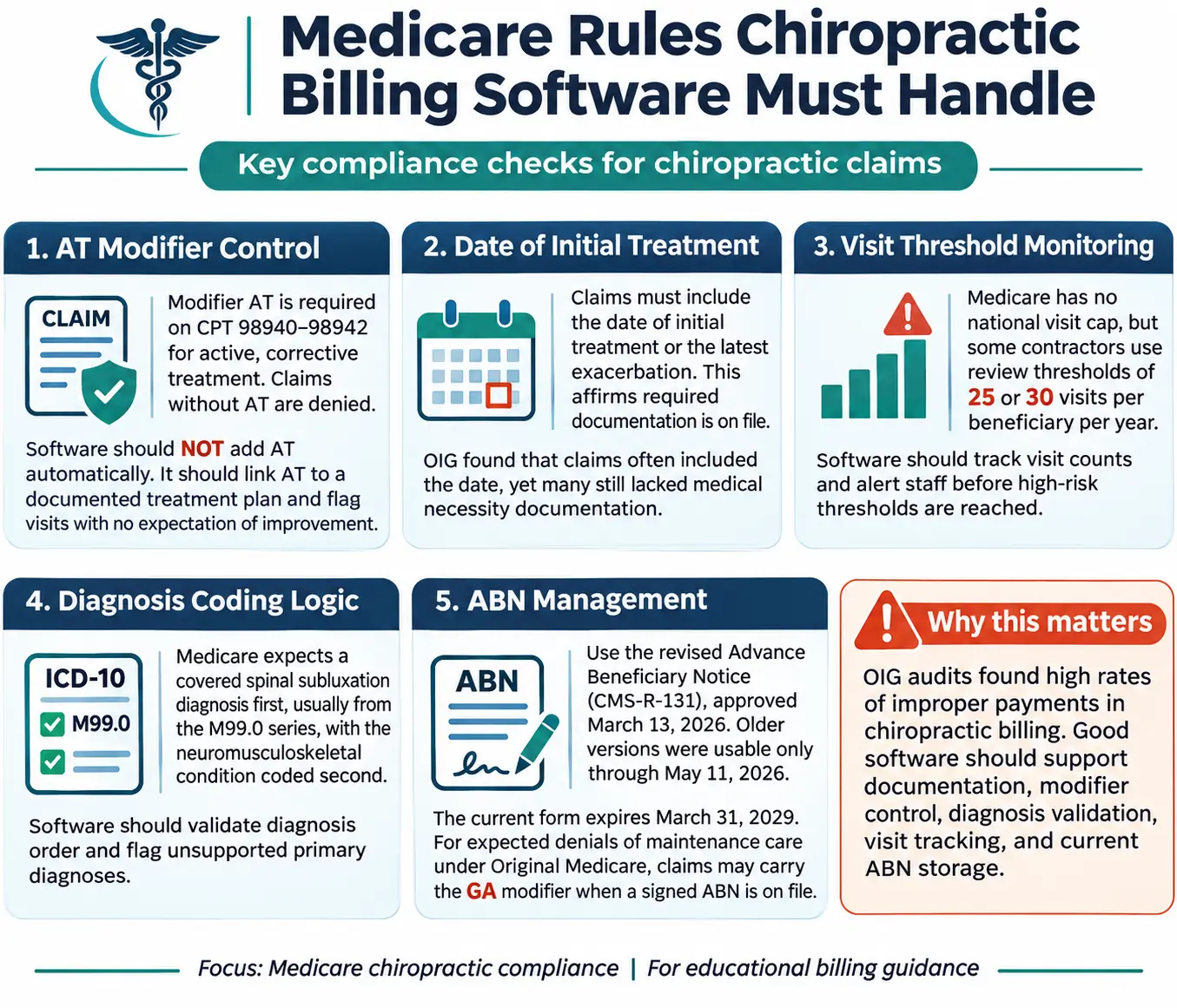
Since October 1, 2004, Medicare has required the AT modifier on 98940 through 98942 when treatment is active and corrective. A claim without it is denied, according to the billing article for chiropractic services in the Medicare Coverage Database. The modifier was meant to separate covered care from maintenance therapy, which Medicare does not pay for.
It has not worked as a filter. A February 2018 portfolio from the HHS Office of Inspector General (OIG), report A-09-16-02042, found that all but 30 of the nearly 14 million chiropractic services Medicare paid in 2015 carried AT. OIG’s 2016 audit of 2013 payments (A-09-14-02033) found an 82 percent improper payment rate, or $358.8 million. Every one of the 105 sampled services had the modifier, and 94 were not medically necessary.
One detail in that portfolio bears directly on software. A biller who had worked for one audited chiropractor told OIG that the clinic’s billing program added AT to claims automatically. That turns a clinical attestation into a default setting. Look for chiropractic billing software that links the modifier to a documented treatment plan and flags visits where the note shows no expectation of improvement.
Claims must also carry the date of initial treatment or of the latest exacerbation, which OIG describes as the chiropractor’s affirmation that required documentation is on file. Across the 652 services OIG sampled in six reviews, every claim carried the date, yet 559 services (86 percent) lacked documented medical necessity.
Medicare sets no national visit cap. As of the 2018 portfolio, though, two Medicare contractors used review thresholds of 25 or 30 visits per beneficiary per year, and in OIG’s 2013 sample every service beyond the 30th was unallowable.
Diagnosis coding carries its own risk. Medicare expects a primary diagnosis for the spinal subluxation (the M99.0 series in ICD-10-CM), with the neuromusculoskeletal condition coded second. In a 2015 report (OEI-01-14-00200), OIG found that Medicare paid $21 million in 2013 for chiropractic services lacking a primary diagnosis the program covers.
Paperwork changed in 2026 too. OMB approved the revised Advance Beneficiary Notice, Form CMS-R-131, on March 13, 2026, and CGS Administrators told providers the older version was usable only through May 11. The new form expires March 31, 2029. It applies to Original Medicare, not Medicare Advantage. When a practice expects Medicare to deny maintenance care and holds a signed ABN, the claim carries the GA modifier. Software that stores ABNs should be using the current form.
Features to test before you sign
Feature lists look alike across chiropractic EHR and billing software. These checks separate them:
- Region-to-code logic. CPT 98940 covers one or two spinal regions, 98941 covers three or four, and 98942 covers five (cervical, thoracic, lumbar, sacral, pelvic). Enter a visit with three documented regions and confirm the system suggests 98941.
- AT modifier behavior. Ask whether it is applied by default and whether the provider can remove it visit by visit.
- ERA and EOB auto-posting. Check that remittances post automatically, including secondary claims, and that payments which fail to match a claim land in a worklist.
- Eligibility and visit tracking. OIG’s 2018 portfolio reviewed 2014 plans in the Federal Employees Health Benefits program and found that 61 percent capped chiropractic visits, averaging 21 per year, with 20 as the most common cap. Software should run insurance eligibility verification and count visits against each plan’s limit.
- Cash and hybrid billing. For uninsured or self-pay patients, the No Surprises Act has required a written good faith estimate since January 1, 2022. CMS describes a dispute process for bills that run $400 or more above that estimate. Check that the system produces one.
- Clearinghouse terms. Ask which clearinghouse handles claim submission, what it charges, and whether that fee sits inside the quote.
Best medical billing software for chiropractic practices in 2026: four options compared
The entries below summarize vendor announcements, vendor documentation and the review sites named in each. No performance testing was done, so confirm current terms in a demo.
Platform | Built for | Claim handling | Detail worth checking |
ChiroTouch | Chiropractic-only clinics | Billing and claims inside the EHR | Rheo AI scribe (August 2025) and Compliance Scan |
ClinicMind (Genesis) | Billing-heavy clinics | Self-service automation or full-service billing team | Genesis acquisition announced January 4, 2024 |
Jane with Claim.MD | Small and hybrid cash-and-insurance clinics | Insurance add-on sends claims through Claim.MD | Claim.MD unlimited plan at $108 a month with Jane discount |
Tebra | Practices inside multi-specialty groups | Kareo-origin billing module | Quote-based pricing |
ChiroTouch
ChiroTouch is backed by PracticeTek and lists more than 12,500 practices and 36,000 providers on its SourceForge vendor profile. Those figures come from the company, not an independent count. The cloud version combines scheduling, SOAP notes, billing and claims. On August 19, 2025, it introduced Rheo, an AI assistant that builds notes from the visit conversation, and it has since announced Compliance Scan, which uses AI to review documentation for denial and audit risk. Both address the documentation gaps OIG keeps finding. Neither replaces a clinician’s judgment about medical necessity.
ClinicMind (Genesis Chiropractic Software)
ClinicMind announced its acquisition of Genesis Chiropractic Software on January 4, 2024. Chiropractic clinics can buy it two ways: a self-service plan with automated claim submission, ERA posting and claim scrubbing, or a full-service plan that adds hands-on billing and documentation support from ClinicMind’s billing team. That split suits a clinic deciding whether to keep a biller on staff. Capterra shows Genesis at 4.5 out of 5 from 310 reviews (page updated March 9, 2026).
Jane with Claim.MD
Jane started as scheduling, charting and payments software. Its US insurance billing is an add-on, offered on the Practice and Thrive plans according to Jane’s help guide. Claims travel through Claim.MD, a separate account with its own fees. Jane recommends it as the integrated clearinghouse, says submitted claims appear there within 10 minutes, and gives Jane users 10 percent off. Claim.MD lists an unlimited-claims plan, aimed at practices filing more than 100 claims a month, at $120, or $108 with the Jane discount. Jane’s guide also documents a good faith estimate workflow for cash patients.
Tebra
Kareo and PatientPop announced their merger into Tebra on November 2, 2021. Tebra serves independent practices across specialties rather than chiropractors specifically, so test CMT code logic and AT handling in the demo instead of assuming them. A Fitgap listing reports module-based subscriptions without published pricing. Ask for a quote that separates EHR, billing and marketing modules.
Matching software to your payer mix
Payer mix should drive the choice. A clinic where Medicare patients fill a large share of the schedule needs documentation checks and ABN handling before it needs a patient app. A cash-based or hybrid solo practice may fit lighter software with an insurance add-on, provided clearinghouse fees are counted. A practice that cannot staff a dedicated biller can price ClinicMind’s full-service plan against a hire. A chiropractor joining a multi-specialty group will usually inherit the group’s platform and should ask how it handles CMT codes.
Request a written quote that lists per-provider fees, clearinghouse charges and payment-processing rates. Then run three sample visits through every demo: a Medicare visit with three documented regions, a commercial visit near its plan cap, and a cash visit with an estimate. OIG’s audit gives the standard to meet. Of 105 sampled services, all carried AT and 94 were not medically necessary, so the best medical billing software for chiropractic practices in 2026 is the system that makes those errors harder to commit.