

Most billing references still list $3.00 as the Medicare payment for a routine blood draw. That figure has been out of date since January 1, 2023. For calendar year 2026, CMS pays a general specimen collection fee of $9.34 for all specimens collected in one patient encounter, and $11.34 when a laboratory collects the specimen from a skilled nursing facility resident or on behalf of a home health agency. Across a few hundred draws a month, the gap between the old number and the current one is worth tracking. It is also only the first of several details that decide whether CPT code 36415 is paid or denied.
What is CPT code 36415?
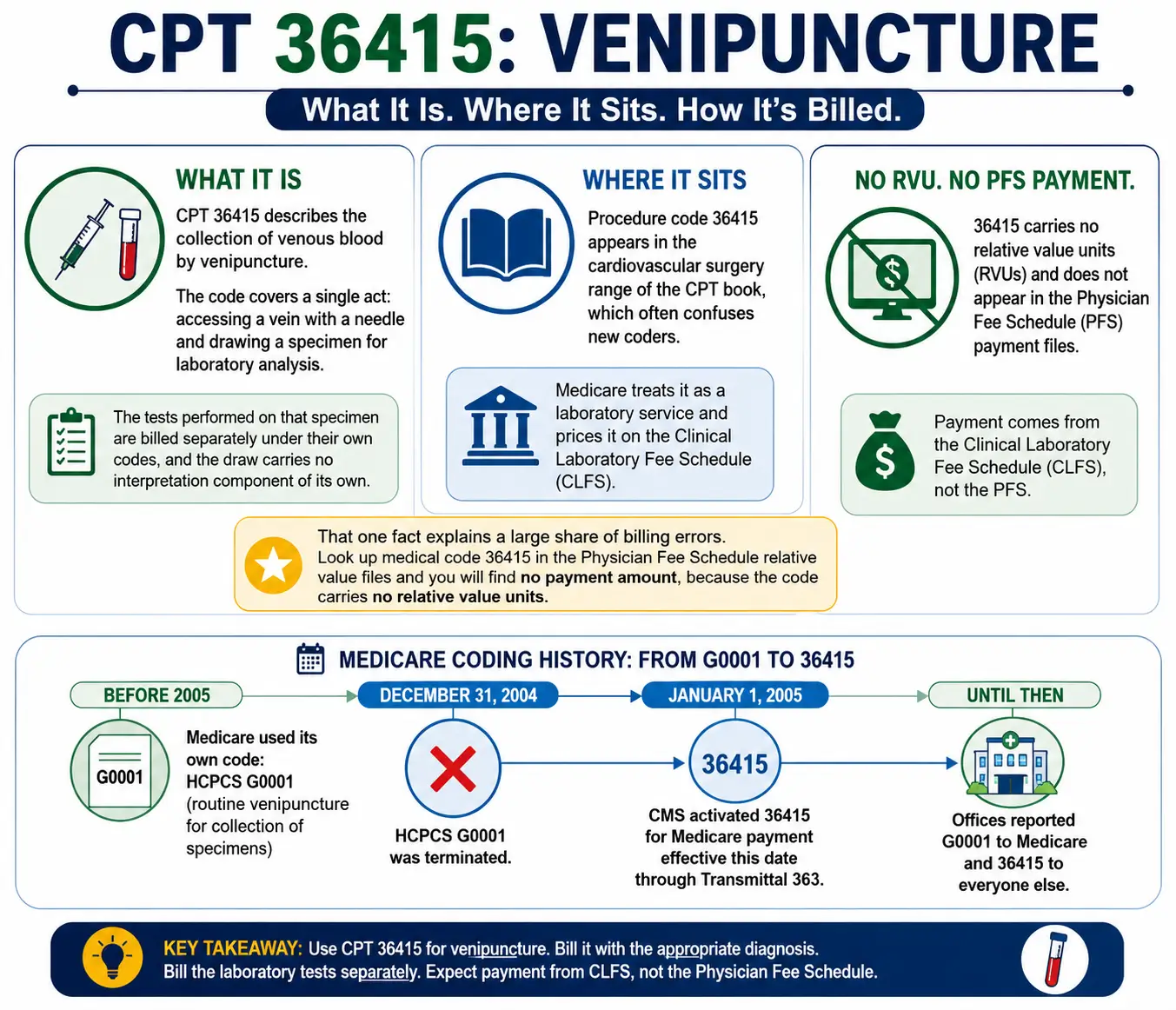
CPT 36415 describes the collection of venous blood by venipuncture. The code covers a single act: accessing a vein with a needle and drawing a specimen for laboratory analysis. The tests performed on that specimen are billed separately under their own codes, and the draw carries no interpretation component of its own.
Where the code sits in the CPT book confuses new coders. Procedure code 36415 appears in the cardiovascular surgery range, yet Medicare treats it as a laboratory service and prices it on the Clinical Laboratory Fee Schedule (CLFS). That one fact explains a large share of billing errors. Look up medical code 36415 in the Physician Fee Schedule relative value files and you will find no payment amount, because the code carries no relative value units.
Medicare used its own code for years. HCPCS code G0001 (routine venipuncture for collection of specimens) was terminated December 31, 2004, and CMS activated 36415 for Medicare payment effective January 1, 2005 through Transmittal 363. Until then, offices reported G0001 to Medicare and 36415 to everyone else.
What is routine venipuncture?
The word “routine” carries a specific meaning in Medicare policy. CGS Administrators, the Medicare Administrative Contractor for Kentucky and Ohio, instructs providers in billing and coding article A52470 (revision effective August 7, 2025) to report 36415 for all routine venipunctures that do not require a physician’s skill, including every draw performed on superficial peripheral veins of the upper and lower extremities. The credential of the person holding the needle does not change the code. A phlebotomist, medical assistant, nurse, or physician performing the same peripheral draw all report service code 36415.
How 36415 compares with the other blood collection codes
Code | What it describes | Medicare payment treatment |
36415 | Collection of venous blood by venipuncture | Paid as a specimen collection fee on the CLFS |
36416 | Capillary collection (finger, heel, or ear stick) | Not payable; CMS considers the collection cost minimal |
36410 | Venipuncture requiring physician skill, age 3 and older | Paid on the Physician Fee Schedule, with narrow diagnosis rules |
G0471 | Venous blood by venipuncture, or urine by catheterization, for a SNF resident or on behalf of an HHA | General collection fee plus $2 |
P9612, P9615 | Catheterization for specimen collection, single or multiple patients | Separate specimen collection codes on the CLFS |
36600 | Arterial puncture for withdrawal of blood | Not a routine venipuncture code |
The boundary between 36415 and 36410 is tighter than most practices assume. Article A52470 limits 36410 to venipunctures performed by a physician on veins of the neck (external or internal jugular), deep central veins of the thorax such as the subclavian, or the groin such as the femoral, plus superficial extremity veins where the skill of a properly trained nurse, phlebotomist, or technician has been clearly demonstrated to be insufficient. CGS also requires ICD-10-CM code I87.8, I99.8, or R68.89 on every 36410 claim in its jurisdiction. That last requirement is local guidance rather than national policy, so check your own MAC’s article before assuming the same three codes apply. Moda Health’s reimbursement policy applies the same principle from the commercial side, treating “requires the skill” as meaning a routine draw by clinical staff was attempted and failed, and instructing that 36400 through 36410 should not be reported simply because a phlebotomist was unavailable. A difficult stick, on its own, does not convert a routine draw into a physician-skill draw.
Capillary collection sits on the other side of the line. Section 60.1 of Chapter 16 of the Medicare Claims Processing Manual makes no collection fee payable where the cost of collection is minimal, naming routine capillary puncture as an example. State Medicaid programs sometimes disagree: Indiana Health Coverage Programs bulletin BT2025160, published November 13, 2025, set outpatient rates of $9.09 for 36415 and $3.77 for 36416 effective January 1, 2026.
CPT code 36415 reimbursement under Medicare
Section 1833(h)(3) of the Social Security Act directs CMS to pay a nominal fee, in addition to the payment for the test itself, to cover the cost of collecting the sample. That fee is codified at 42 CFR 414.523, which set the amount at $8.57 beginning January 1, 2023 and provided for an annual update.
Calendar year | General specimen collection fee | SNF or HHA collection (G0471) |
2023 | $8.57 | $10.57 |
2024 | $8.83 | $10.83 |
2025 | $9.09 | $11.09 |
2026 | $9.34 | $11.34 |
The 2026 figure comes from MLN Matters article MM14345 (Transmittal R13576CP, released January 8, 2026). CMS applied the CPI-U for the 12 months ending June 30, 2025, which was 2.7 percent, to the 2025 fee of $9.09. The $2 add-on for SNF and home health agency collections is required by the Protecting Access to Medicare Act of 2014.
Two payment details are worth committing to memory. Neither the annual deductible nor the 20 percent coinsurance applies to specimen collection fees, so patient responsibility for the draw is zero (Chapter 16, Section 30.2). And the collection fee is a nominal fee updated by CPI-U, not a weighted median of private payer rates. Section 6226 of the Consolidated Appropriations Act, 2026, passed February 3, 2026, held CLFS payment reductions at zero for the year and set a data reporting period of May 1 through July 31, 2026 drawn from private payer data collected between January 1 and June 30, 2025. Reductions capped at 15 percent per year resume January 1, 2027 and run through 2029. Those reductions hit test codes priced from private payer data. The 36415 collection fee follows its own update path.
Laboratories that travel to the patient bill the collection fee plus a travel allowance. The 2026 mileage rate is $1.25, built from the IRS standard rate of $0.725 plus $0.52 for personnel expense, which CMS derives by dividing the Bureau of Labor Statistics median hourly wage for phlebotomists ($20.99) by an assumed 40 miles per hour. Trips of 20 eligible miles or less to one location use the flat rate under P9604, which spreads $12.50 across the patients seen; longer and multi-stop trips use P9603 per mile. Effective April 1, 2026, Transmittal 13746 allows P9603 to be reported to the tenth of a mile on trips under 100 eligible miles.
CPT 36415 billing guidelines: one unit, one encounter
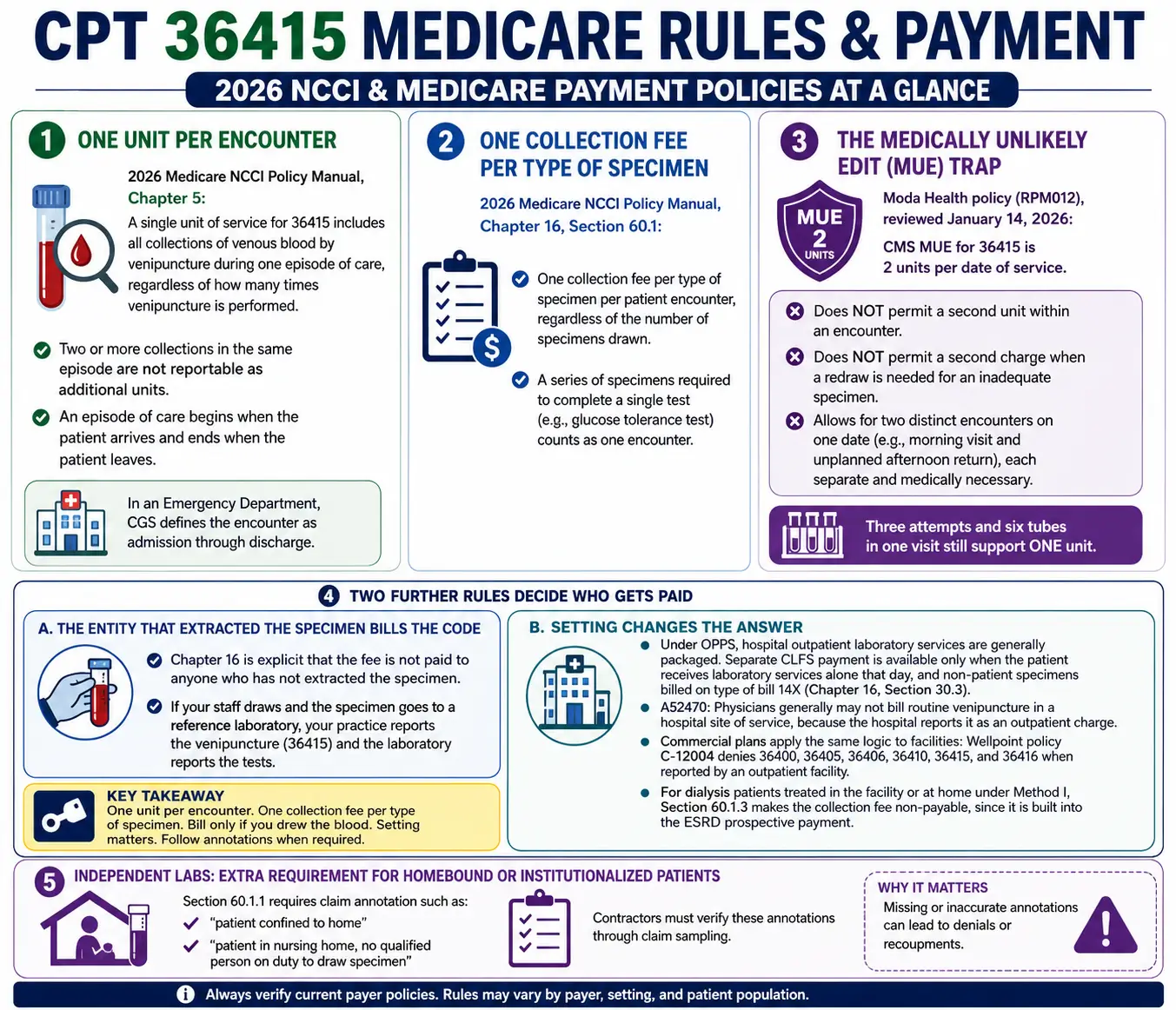
The 2026 Medicare NCCI Policy Manual, Chapter 5, states that a single unit of service for 36415 includes all collections of venous blood by venipuncture during one episode of care, regardless of how many times venipuncture is performed. Two or more collections in the same episode are not reportable as additional units. An episode of care begins when the patient arrives and ends when the patient leaves. In an emergency department, CGS defines the encounter as admission through discharge.
Chapter 16, Section 60.1 reaches the same result from the payment side: one collection fee per type of specimen per patient encounter, regardless of the number of specimens drawn, and a series of specimens required to complete a single test (a glucose tolerance test, for example) counts as one encounter.
The Medically Unlikely Edit creates a trap here. Moda Health’s routine venipuncture policy (RPM012, reviewed January 14, 2026) notes that the CMS MUE for 36415 is 2 units per date of service, then warns that the value does not permit a second unit within an encounter or a second charge when a redraw is needed for an inadequate specimen. What it allows for is two distinct encounters on one date, such as a morning visit and an unplanned afternoon return, each separate and medically necessary. Three attempts and six tubes in one visit still support one unit.
Two further rules decide who gets paid:
- The entity that extracted the specimen bills the code. Chapter 16 is explicit that the fee is not paid to anyone who has not extracted the specimen. If your staff draws and the specimen goes to a reference laboratory, your practice reports the venipuncture and the laboratory reports the tests.
- Setting changes the answer. Under OPPS, hospital outpatient laboratory services are generally packaged, with separate CLFS payment available only when the patient receives laboratory services alone that day, and non-patient specimens billed on type of bill 14X (Chapter 16, Section 30.3). A52470 adds that physicians generally may not bill routine venipuncture in a hospital site of service, because the hospital reports it as an outpatient charge. Commercial plans apply the same logic to facilities: Wellpoint’s policy C-12004 denies 36400, 36405, 36406, 36410, 36415, and 36416 when reported by an outpatient facility. For dialysis patients treated in the facility or at home under Method I, Section 60.1.3 makes the collection fee non-payable, since it is built into the ESRD prospective payment.
Independent laboratories drawing from homebound or institutionalized patients carry one more requirement. Section 60.1.1 asks for claim annotation such as “patient confined to home” or “patient in nursing home, no qualified person on duty to draw specimen,” and instructs contractors to verify those annotations through claim sampling.
Does CPT code 36415 need a modifier?
In most cases, no. The draw is a standalone service with no professional or technical split, so modifiers 26 and TC never apply, and CPT instructs that modifier 63 (procedures on infants under 4 kg) is inappropriate with 36415. The modifiers that do come up:
- Modifier 25 belongs on the evaluation and management code, never on the venipuncture line, when the visit is significant and separately identifiable.
- Modifier 59 or XU applies only when a second draw belongs to a genuinely separate encounter on the same date. It will not override an edit triggered by two sticks in one visit, and acceptance varies by payer.
- Modifier 90 identifies a referred test on an independent laboratory’s claim. It describes the test, not the collection.
- Modifiers GA, GX, GY, and GZ apply when an Advance Beneficiary Notice is or is not on file for a service expected to be denied.
Reaching for a modifier is usually the wrong response to a bundling denial, because the bundling is written into payer policy rather than into a national edit. Moda Health’s policy RPM012 (reviewed January 14, 2026) denies 36415 as a subset of the laboratory test when the same provider bills blood or serum tests in the 80048 to 89399 range on the same date, and states plainly that modifiers 59, XE, XS, XP, XU, and 90 are not valid in that scenario. Wellpoint’s commercial laboratory and venipuncture policy C-12004 (last approved January 1, 2026) goes further on the professional side: when 36415 is reported with office visit codes 99202 through 99205 or 99211 through 99215, the draw is treated as included in the visit, and modifiers will not override the edit. Kaiser Permanente Washington’s venipuncture payment policy, effective July 1, 2026, limits the code to once per member, per practitioner, per date of service and no longer reimburses independent laboratories for it. Rules like these belong in your billing edits, not in a monthly appeal queue.
Medical necessity and diagnosis codes for CPT 36415
The blood draw has no independent medical necessity. It is payable in conjunction with a covered laboratory test, which means the diagnosis that justifies the test also justifies the collection. When the test denies, the draw denies with it.
A claim submitted without a valid ICD-10-CM code is returned as incomplete under Section 1833(e) of the Social Security Act, and A52470 requires the ordering physician’s name and NPI on the claim. Report the condition that prompted the testing: E11.9 for diabetes monitoring, for instance, or Z01.812 (encounter for preprocedural laboratory examination), valid from October 1, 2025 through September 30, 2026. A general examination code such as Z00.00 will not support a diagnostic panel.
Twenty-three national coverage determinations for clinical laboratory services, published in the Federal Register on November 23, 2001 under negotiated rulemaking, carry their own lists of covered ICD-10 codes and codes that do not support medical necessity. If a scheduled test falls outside those lists, issue an ABN before the needle goes in.
Documentation requirements for venipuncture
Start with the order. Because 36415 is a laboratory service, it requires a physician order or a progress note documenting intent, and CERT reviewers do not accept an attestation statement in place of a signature. Without a valid order for the test, the related venipuncture is denied as not medically necessary.
A defensible record for a blood draw contains the date, the collection site, the method (venous blood collected by venipuncture, not drawn from an existing line), the tests ordered, who performed the collection, and where the specimen went. One line does the job: “10/14, two tubes drawn by venipuncture, left antecubital, for lipid panel and TSH ordered by Dr. Ramirez; specimen sent to reference laboratory.”
Scrutiny on this code is not theoretical. The Texas Medical Association reported in October 2019 that CMS was distributing comparative billing reports on venipuncture, built from claims dated April 1, 2018 through March 31, 2019, to physicians who billed at least 423 visits with 36415 and two other laboratory codes.
FAQs
Can you bill 36415 with an office visit?
Yes for Medicare, with modifier 25 on the E/M when the visit is significant and separately identifiable. Commercial rules vary and several are stricter: Wellpoint’s policy C-12004 folds the draw into office visit codes 99202 through 99205 and 99211 through 99215 outright, and states that modifiers will not override the edit. Check the payer’s policy before writing off the denial.
Is CPT code 36415 covered by Medicare?
Yes. Medicare pays it under the Clinical Laboratory Fee Schedule at $9.34 nationally in 2026, with no deductible or coinsurance, provided the associated test is covered and the collection is not packaged into a facility payment.
Does 36415 need modifier 59?
Rarely. It applies only to a second, distinct encounter on the same date, and it will not rescue a second unit billed for repeated attempts during one visit.
What is the difference between venipuncture and phlebotomy?
Venipuncture is the procedure of puncturing a vein to obtain a specimen. Phlebotomy is the broader practice of drawing blood, including therapeutic removal of blood, which is reported with 99195 rather than 36415.
What documentation is required for CPT 36415?
A signed order for the test, the ordering physician’s name and NPI on the claim, and a record of the collection itself including method, site, and specimen disposition.
The economics of CPT code 36415 are entirely a function of volume and clean submission. At roughly nine dollars, no single claim justifies a phone call to a payer, which is exactly why the fixes belong upstream: a hard edit capping the code at one unit per encounter, a payer matrix flagging plans that bundle the draw into the test, and an order-signature check before the specimen leaves the building. Practices that build those three controls stop losing venipuncture revenue in amounts too small to notice and too frequent to ignore.