


A coder opens a chart for an 82-year-old woman who has lost twelve pounds in four months, eats less than half of what’s put in front of her, and now needs help getting from her bed to the bathroom. No oncologist has confirmed cancer. No psychiatrist has documented depression. The physician’s note reads, simply, “failure to thrive.” One code covers that presentation in an adult patient: R62.7.
The code itself is short. Using it correctly is not. Adult failure to thrive ICD-10 coding trips up experienced coders because R62.7 sits in an unusual part of the classification system, carries specific documentation expectations, and follows a different billing rule depending on the care setting, hospice claims in particular.
Clinical literature and CMS coverage documents often shorten the name to FTT, or AFTT when the writer wants to flag the adult version specifically, since a nearly identical phrase covers pediatric patients under a separate code entirely. This piece walks through what R62.7 covers, what a chart needs to contain to support it, and how it compares with codes coders often reach for instead. It also covers where the code runs into trouble on hospice claims. Coding students and the providers who write the underlying notes should both find something useful here.
What R62.7 actually represents
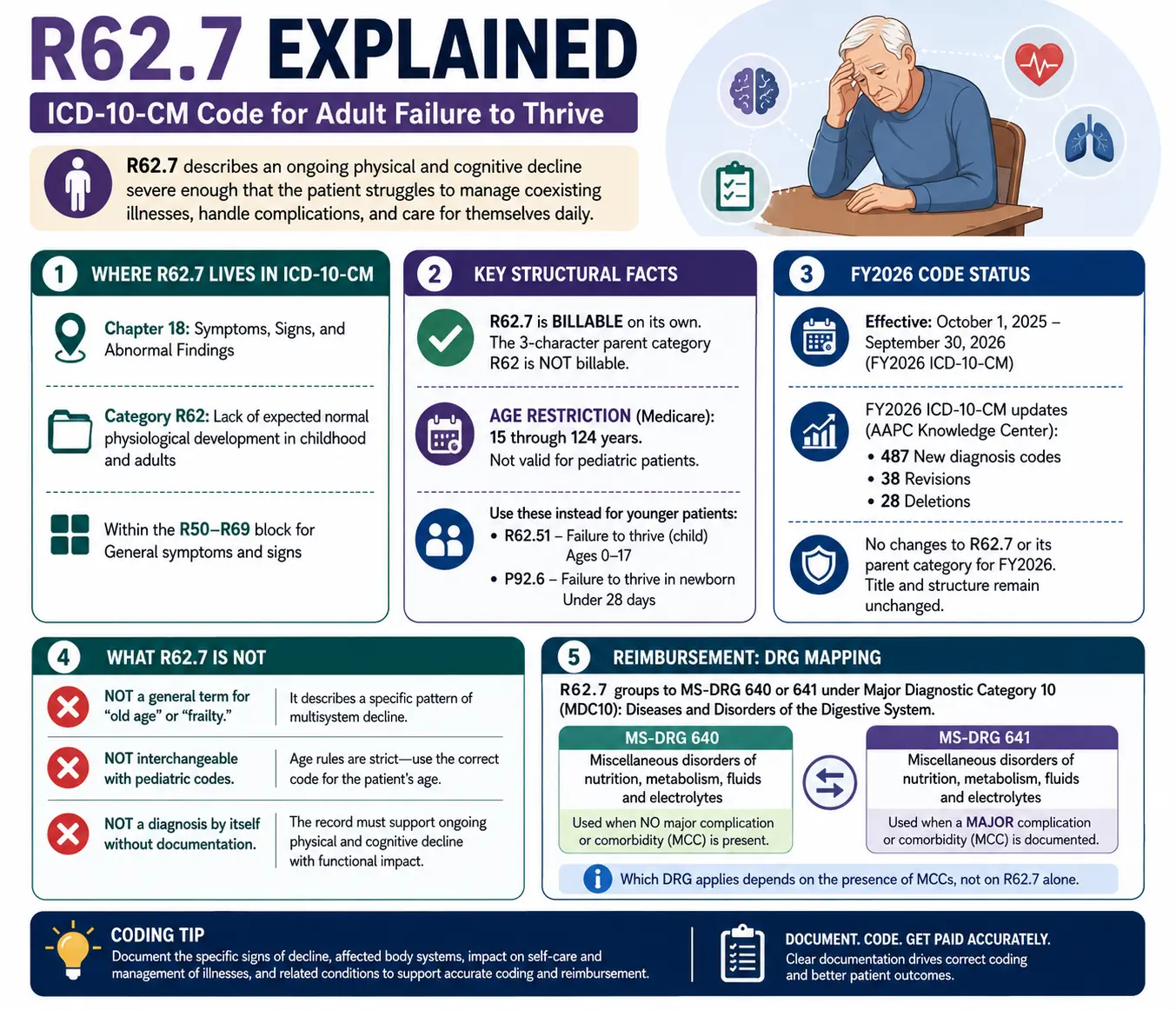
R62.7 is the ICD-10-CM code for adult failure to thrive. It sits inside Chapter 18 of the classification, the chapter reserved for symptoms, signs, and abnormal findings that don’t fit neatly under a named disease elsewhere in the system. More precisely, it falls under category R62, “Lack of expected normal physiological development in childhood and adults,” within the R50-R69 block covering general symptoms and signs.
The official tabular description frames the condition as an ongoing physical and cognitive decline severe enough that the patient struggles to manage coexisting illnesses, handle the complications those illnesses create, and care for themselves day to day. That framing matters for coders. R62.7 is not shorthand for “old and frail.” It describes a specific pattern of multisystem deterioration, and documentation should reflect that specificity rather than assume it.
Two structural details are worth knowing. R62.7 is billable on its own; the three-character parent category R62 is not, and a claim submitted with just that bare code gets rejected automatically. The code also carries a firm age restriction: Medicare’s code editor applies it only to patients aged 15 through 124. Coders working pediatric or adolescent charts need R62.51, “Failure to thrive (child),” which covers ages 0 through 17, or P92.6 for infants under 28 days old.
For the current fiscal year, R62.7 runs from October 1, 2025 through September 30, 2026 as part of the FY2026 ICD-10-CM code set. That update was a large one across the board. AAPC’s Knowledge Center reported 487 new diagnosis codes, 38 revisions, and 28 deletions for FY2026, but none of those changes touched R62.7 or its parent category. The code’s title and structure have stayed stable for several coding cycles running.
On the reimbursement side, R62.7 groups to MS-DRG 640 or 641, both labeled “miscellaneous disorders of nutrition, metabolism, fluids and electrolytes,” under Major Diagnostic Category 10. Which of the two DRGs a claim lands in depends on whether a major complication or comorbidity is also documented on the encounter, not on R62.7 by itself.
The clinical picture behind the code
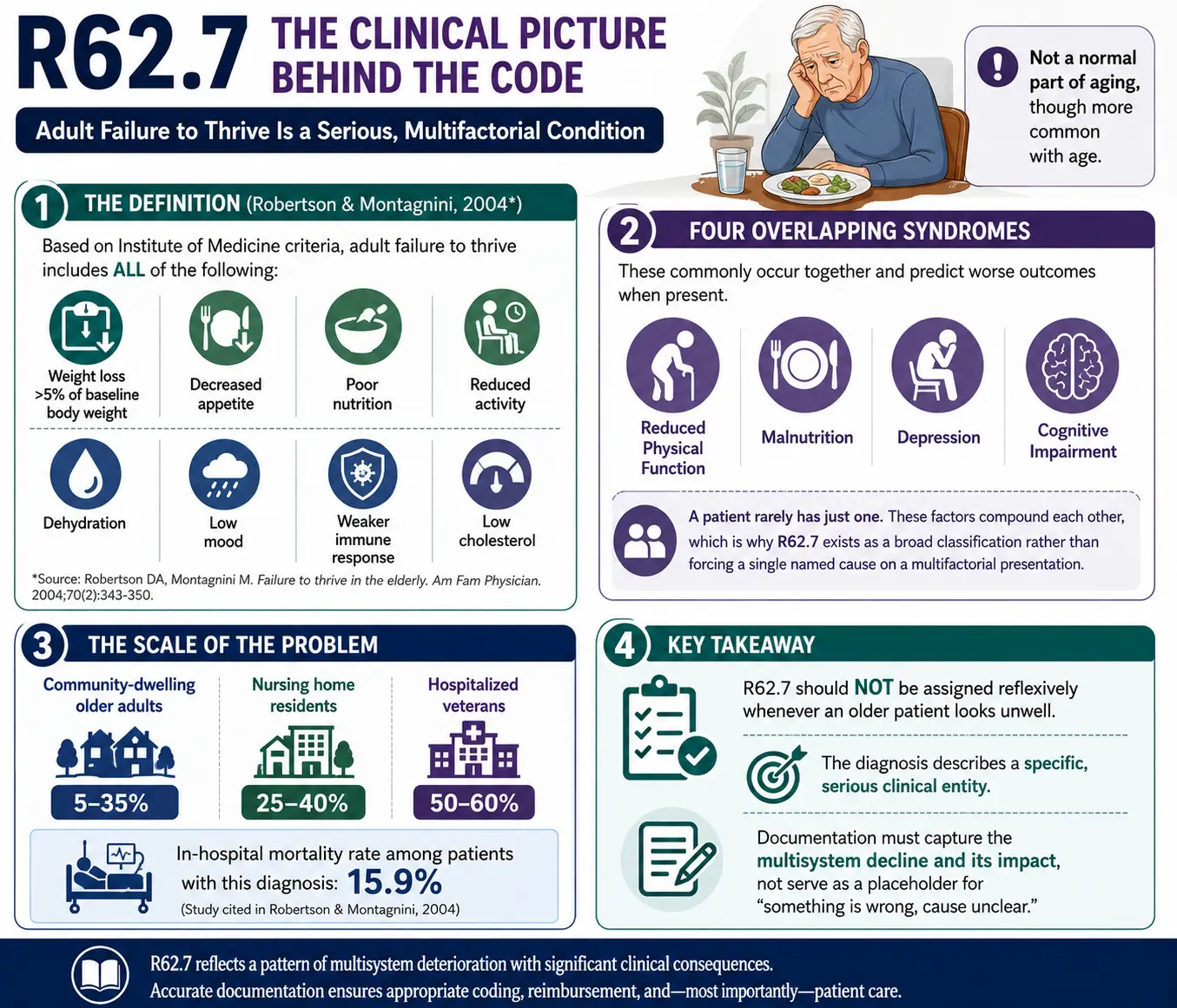
Adult failure to thrive is not a normal part of aging, though it becomes more likely with age. The definition still cited most often traces back to a 2004 article in American Family Physician by Robertson and Montagnini, which drew on Institute of Medicine criteria: weight loss exceeding 5 percent of a patient’s baseline body weight, a drop in appetite, poor nutrition, and reduced activity, frequently paired with dehydration, low mood, weaker immune response, and low cholesterol.
That same article identified four overlapping syndromes that predict worse outcomes when they show up together: reduced physical function, malnutrition, depression, and cognitive impairment. A patient rarely has just one. Adult failure to thrive tends to appear when several of these compound each other, which is part of why R62.7 exists as a broad classification rather than forcing a single named cause onto a genuinely multifactorial presentation.
The scale of the problem is not small. Robertson and Montagnini put prevalence at 5 to 35 percent among older adults still living in the community, 25 to 40 percent among nursing home residents, and 50 to 60 percent among hospitalized veterans, figures still cited in geriatric medicine literature two decades later. The same article cited a separate study reporting an in-hospital mortality rate of 15.9 percent among patients carrying the diagnosis.
None of this means R62.7 should be assigned reflexively whenever an older patient looks unwell. The diagnosis describes a specific, serious clinical entity. Documentation needs to reflect that seriousness rather than function as a placeholder for “something is wrong, cause unclear.”
Sequencing rules for adult failure to thrive ICD-10 coding
A large share of the search traffic around “R62.7 code first underlying condition” comes from a reasonable but mistaken assumption. Unlike some codes elsewhere in ICD-10-CM (E88.A, cachexia due to underlying condition, is a nearby example), R62.7 does not carry a tabular “code first” note printed underneath it. What governs its sequencing instead is the general Chapter 18 guideline published in the ICD-10-CM Official Guidelines for Coding and Reporting, maintained jointly by CMS and the National Center for Health Statistics.
That guideline works like this. Symptom and sign codes, R62.7 included, are appropriate when a provider has not pinned the presentation on a definitive diagnosis. Once a definitive diagnosis is confirmed and it explains the decline, that diagnosis gets sequenced first. R62.7 can still appear on the claim as a secondary code, but only when the failure-to-thrive presentation is not simply an expected feature of the confirmed diagnosis already reported.
A patient with confirmed metastatic pancreatic cancer who is losing weight and functional capacity because of the cancer would not typically need R62.7 added on top of the cancer code; the decline is already accounted for. A patient with unexplained multisystem decline, where no single condition explains the full clinical picture even after a work-up, fits R62.7 as the primary description of what’s happening. In practice, R62.7 works best as a diagnosis of exclusion, and the physician’s note should show an actual attempt to rule out a dominant cause, not just an absence of testing.
Documentation that holds up under review
Because R62.7 sits in the symptom-and-sign chapter rather than describing a named disease, payers tend to scrutinize it more closely than a code like type 2 diabetes or osteoarthritis. A chart that supports R62.7 through an audit generally has several elements documented together, not just one:
- Objective weight data: current weight, baseline weight, timeframe, and percentage change, ideally paired with a body mass index code from the Z68 category
- A functional status assessment using a named, validated tool, such as the Karnofsky Performance Status scale, the Palliative Performance Scale, the Barthel Index, or the Functional Independence Measure, rather than a general impression of “weaker than before”
- Nutritional findings: appetite change, oral intake, and relevant labs such as albumin or prealbumin where they were ordered
- Psychosocial and social context: living situation, caregiver support, isolation, cognitive status
- Clinical reasoning showing that other specific diagnoses were considered and, where appropriate, ruled out or found insufficient to explain the decline on their own
Missing one of these is usually survivable on audit. Missing several at once tends to be what turns a routine chart review into a denial. Reviewers are not looking for perfect documentation. They’re looking for evidence that the diagnosis reflects an actual clinical judgment rather than a phrase copied forward from a previous note.
How R62.7 compares with nearby codes
Coders sometimes reach for R62.7 when a more specific code would serve the claim better, or the other way around. The table below lays out the codes most often confused with adult failure to thrive.
Code | Official title | Applies to | What sets it apart |
R62.7 | Adult failure to thrive | Ages 15-124 | Multisystem physical and cognitive decline without one dominant confirmed cause |
R62.51 | Failure to thrive (child) | Ages 0-17 | Pediatric growth or developmental failure; excludes HIV-related failure to thrive and malnutrition-related physical retardation, which carry their own codes |
P92.6 | Failure to thrive, newborn | Under 28 days old | Feeding and weight-gain problems specific to the newborn period |
R63.4 | Abnormal weight loss | Any age | Weight loss on its own, without the functional and cognitive decline that defines adult failure to thrive |
R64 | Cachexia | Any age | Involuntary weight loss over 10 percent of baseline with muscle wasting, and no named underlying disease driving it |
E88.A | Cachexia due to underlying condition | Any age | Same wasting pattern as R64, tied to a documented disease; this code does carry a code first instruction |
E46 | Unspecified protein-calorie malnutrition | Any age | A nutritional deficiency confirmed through intake history or labs, apart from the broader decline R62.7 describes |
One detail worth flagging for coders working oncology or palliative charts: E88.A carries a type 2 excludes note referencing R62.51 and R62.7, meaning cachexia tied to a named condition and failure to thrive are not treated as the same thing in the classification. Both codes can appear on one claim when the documentation supports each of them separately.
Hospice claims follow a different rule
R62.7 is billable in most settings, but hospice is a clear exception. CMS bars R62.7, along with debility (R53.81) and certain unspecified dementia codes, from serving as the principal diagnosis on a hospice claim. This is not a recent change. It dates to a CMS transmittal tied to the FY2014 hospice wage index final rule, effective October 1, 2014, and it remains in force through Local Coverage Determination L34558, “Hospice: The Adult Failure To Thrive Syndrome,” and its companion billing and coding article.
The logic follows the Chapter 18 principle already covered: symptom codes cannot serve as a principal diagnosis once a more definitive diagnosis exists, and CMS expects hospices to identify the condition most responsible for a patient’s terminal prognosis rather than defaulting to a general decline code. A claim listing R62.7 as the principal diagnosis gets returned for a more specific one.
None of this means patients with adult failure to thrive lose access to hospice care. LCD L34558 lays out clinical thresholds for exactly this population: significant disability demonstrated by a Karnofsky or Palliative Performance Scale score at or below 40 percent, with both that score and the patient’s body mass index documented within six months of the certification or recertification date. The syndrome, in CMS’s own coverage language, always involves two elements together: measurable nutritional impairment and measurable disability. A hospice physician can still certify a patient under this framework. The diagnosis simply gets listed as secondary, with whatever condition is most directly driving the terminal prognosis (advanced dementia, a specific organ failure, frailty tied to a documented illness) listed first.
Errors that show up again and again
Using R62.7 without ruling anything out. If the chart shows no evidence that the provider considered depression, malnutrition, thyroid disease, medication effects, or other common contributors, reviewers tend to read that as an incomplete work-up rather than a genuinely undifferentiated presentation.
Skipping the functional assessment. Weight loss alone supports R63.4 or E46, not R62.7. The code specifically requires a functional and cognitive component, so a chart with weight data but no assessment of the patient’s ability to function is missing half of what the diagnosis needs.
Sequencing it ahead of a known cause. When a definitive diagnosis already explains the decline, R62.7 should not be listed first, and in many cases doesn’t need to be listed at all if the decline is simply an expected feature of that diagnosis.
Using it as a hospice principal diagnosis. As covered above, this gets the claim returned automatically, regardless of how well-documented the rest of the chart is.
Confusing R62.51 and R62.7. AAPC’s code forum for R62.7 includes a recurring version of this exact question, coders spotting a pediatric code applied to an adult chart or the reverse. The Medicare Code Editor catches age-range mismatches on both codes automatically, so the claim fails either way, but the mix-up still costs time a five-second age check would have avoided.
Most of these errors are easy to prevent once a team knows to look for them. Practices that handle a meaningful volume of geriatric or palliative charts often build a short documentation prompt directly into their EHR templates: current weight and baseline, a named functional scale, a nutrition note, and a line confirming that other causes were considered. That single addition tends to close most of the gaps described above before a claim ever reaches a coder’s desk, which is what accurate adult failure to thrive ICD-10 coding comes down to in practice: documentation that matches the clinical reality, not just the name of the diagnosis.