


A clean claim with accurate coding still gets denied if it arrives one day late. That single fact drives more preventable revenue loss in healthcare than almost any coding error. The timely filing limit for medical billing claims is the deadline a payer sets for receiving a claim after a patient’s date of service, and once that window closes, the money is usually gone for good.
This guide walks through how timely filing works for Medicare, Medicaid, and the major commercial payers, what separates an initial claim deadline from a corrected claim or appeal deadline, and what a billing team can actually do when a claim is denied for filing late.
What is the timely filing limit for medical billing claims
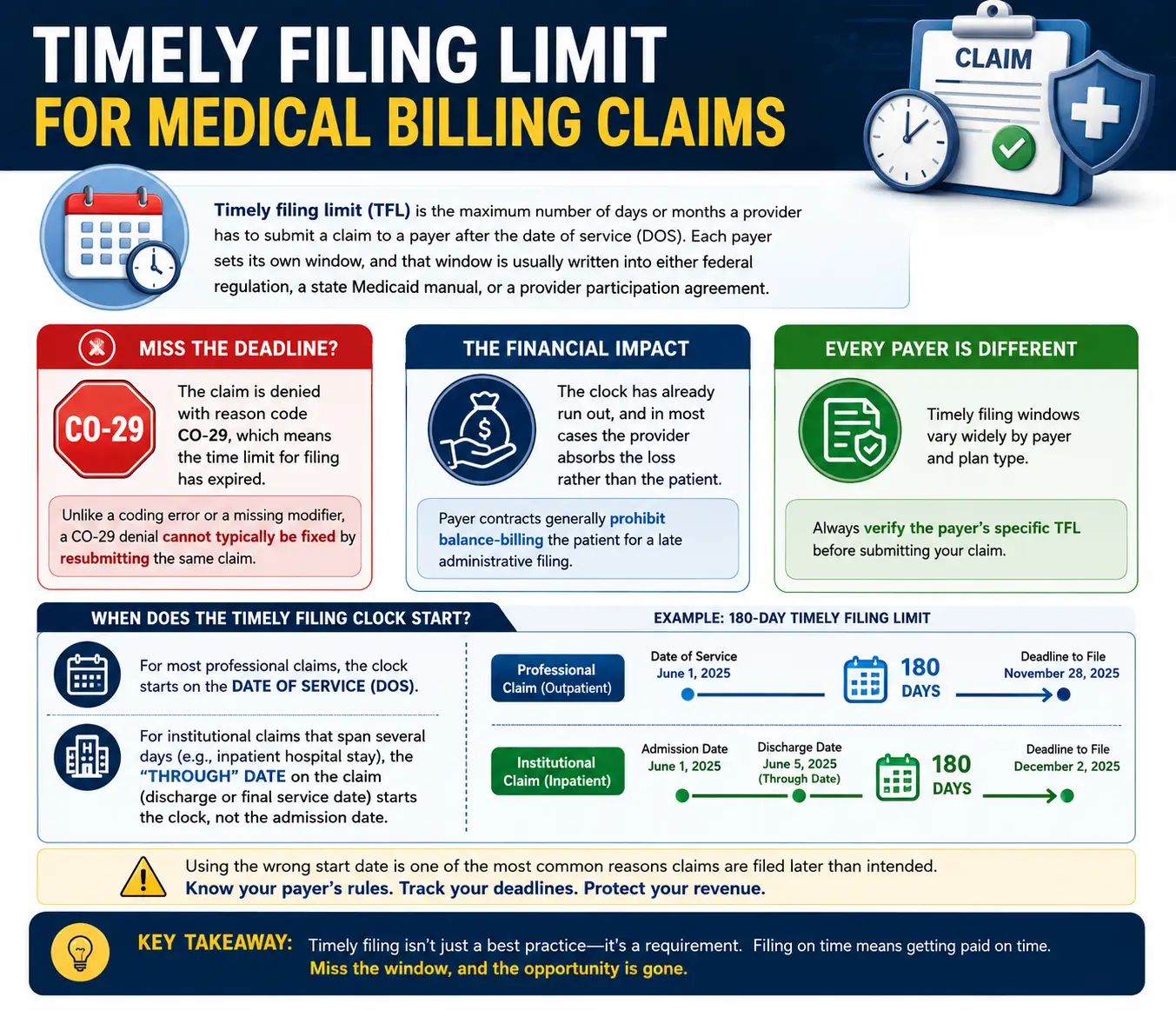
Timely filing limit, often shortened to TFL, refers to the maximum number of days or months a provider has to submit a claim to a payer after the date of service (DOS). Each payer sets its own window, and that window is usually written into either federal regulation, a state Medicaid manual, or a provider participation agreement.
Miss it, and the claim is denied with reason code CO-29, which means the time limit for filing has expired. Unlike a coding error or a missing modifier, a CO-29 denial cannot typically be fixed by resubmitting the same claim. The clock has already run out, and in most cases the provider absorbs the loss rather than the patient, since payer contracts generally prohibit balance-billing the patient for a late administrative filing.
The deadline usually starts on the date of service. For institutional claims that span several days, such as an inpatient hospital stay, the “through” date on the claim (the discharge or final service date) is what starts the clock, not the admission date. Billing teams that use the wrong start date are, in practice, one of the more common reasons a claim gets filed later than intended.
Why the deadline exists and how payers enforce it
Timely filing rules exist so payers can close their books, forecast reserves, and process claims while documentation and provider notes are still fresh. For Medicare, the requirement is set in federal regulation, not just internal policy. Under 42 CFR § 424.44, claims for services furnished on or after January 1, 2010 must reach the Medicare Administrative Contractor (MAC) no later than one calendar year from the date of service. Before that rule took effect, providers had between 15 and 27 months to file, depending on when in the calendar year the service occurred. The Affordable Care Act shortened that window, and the current 12-month standard has held steady since 2010.
A claim only “stops the clock” once it is accepted into a payer’s processing system. A rejected claim, meaning one bounced back for missing or invalid data before it ever entered the adjudication system, does not count as filed. That is a distinction many billing staff miss: a rejection and a denial are not the same event, and only a properly accepted claim satisfies the filing requirement.
Medicare timely filing limit
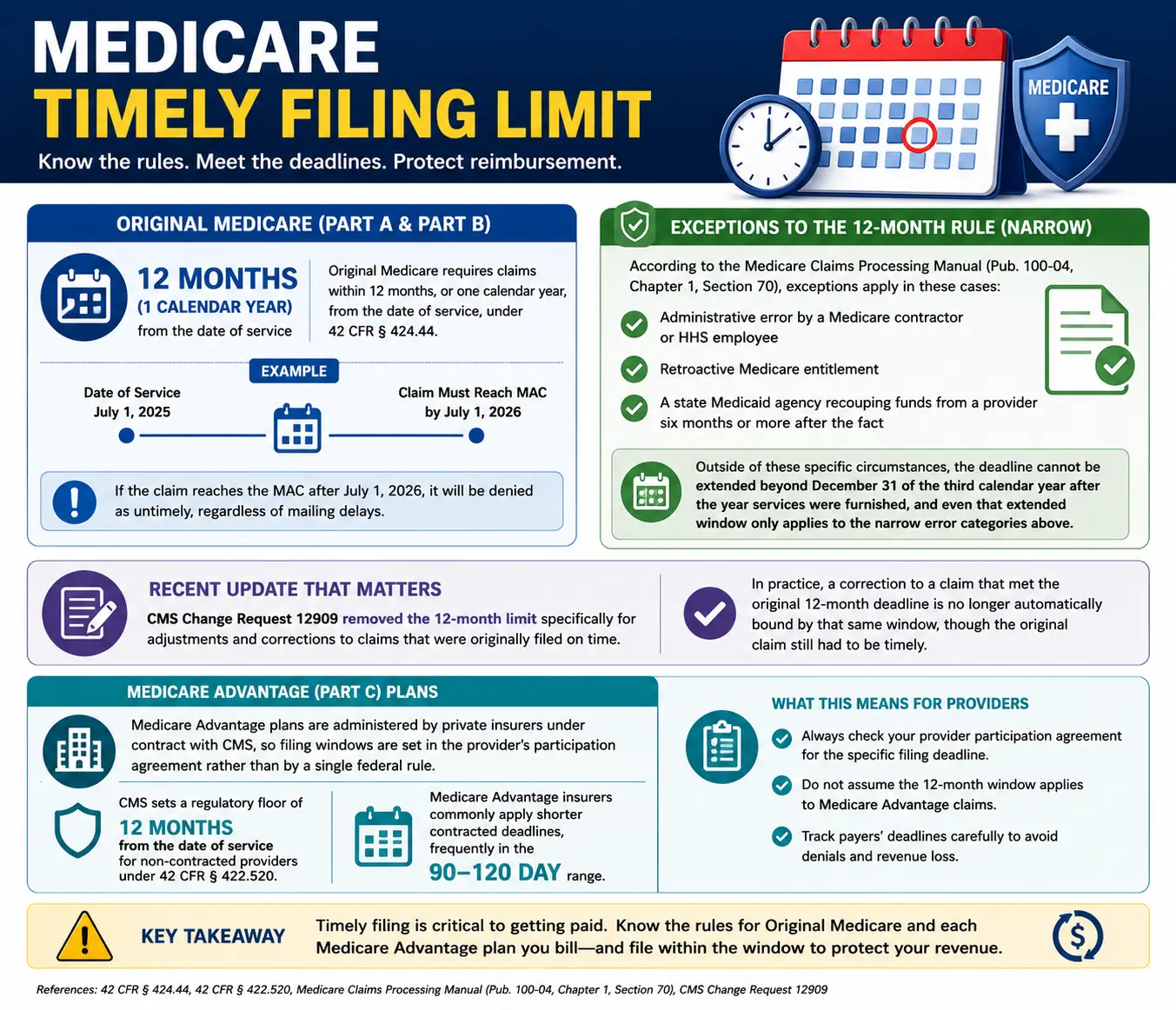
Original Medicare (Part A and Part B) requires claims within 12 months, or one calendar year, from the date of service, under 42 CFR § 424.44. A service performed on July 1, 2025 must reach the MAC by July 1, 2026, or it will be denied as untimely regardless of mailing delays.
Exceptions to the 12-month rule are narrow. According to the Centers for Medicare & Medicaid Services, in the Medicare Claims Processing Manual (Pub. 100-04, Chapter 1, Section 70), exceptions apply in cases such as administrative error by a Medicare contractor or HHS employee, retroactive Medicare entitlement, or a state Medicaid agency recouping funds from a provider six months or more after the fact. Outside of these specific circumstances, the deadline cannot be extended beyond December 31 of the third calendar year after the year services were furnished, and even that extended window only applies to the narrow error categories described above.
One recent update matters for billing teams: CMS Change Request 12909 removed the 12-month limit specifically for adjustments and corrections to claims that were originally filed on time. In practice, a correction to a claim that met the original 12-month deadline is no longer automatically bound by that same window, though the original claim still had to be timely.
Medicare Advantage plans operate differently from Original Medicare. Because they are administered by private insurers under contract with CMS, filing windows are set in the provider’s participation agreement rather than by a single federal rule. CMS sets a regulatory floor of 12 months from the date of service for non-contracted providers under 42 CFR § 422.520, but Medicare Advantage insurers commonly apply shorter contracted deadlines, frequently in the 90 to 120 day range, and provider manuals for specific carriers should be checked directly rather than assumed.
Medicaid timely filing limit by state
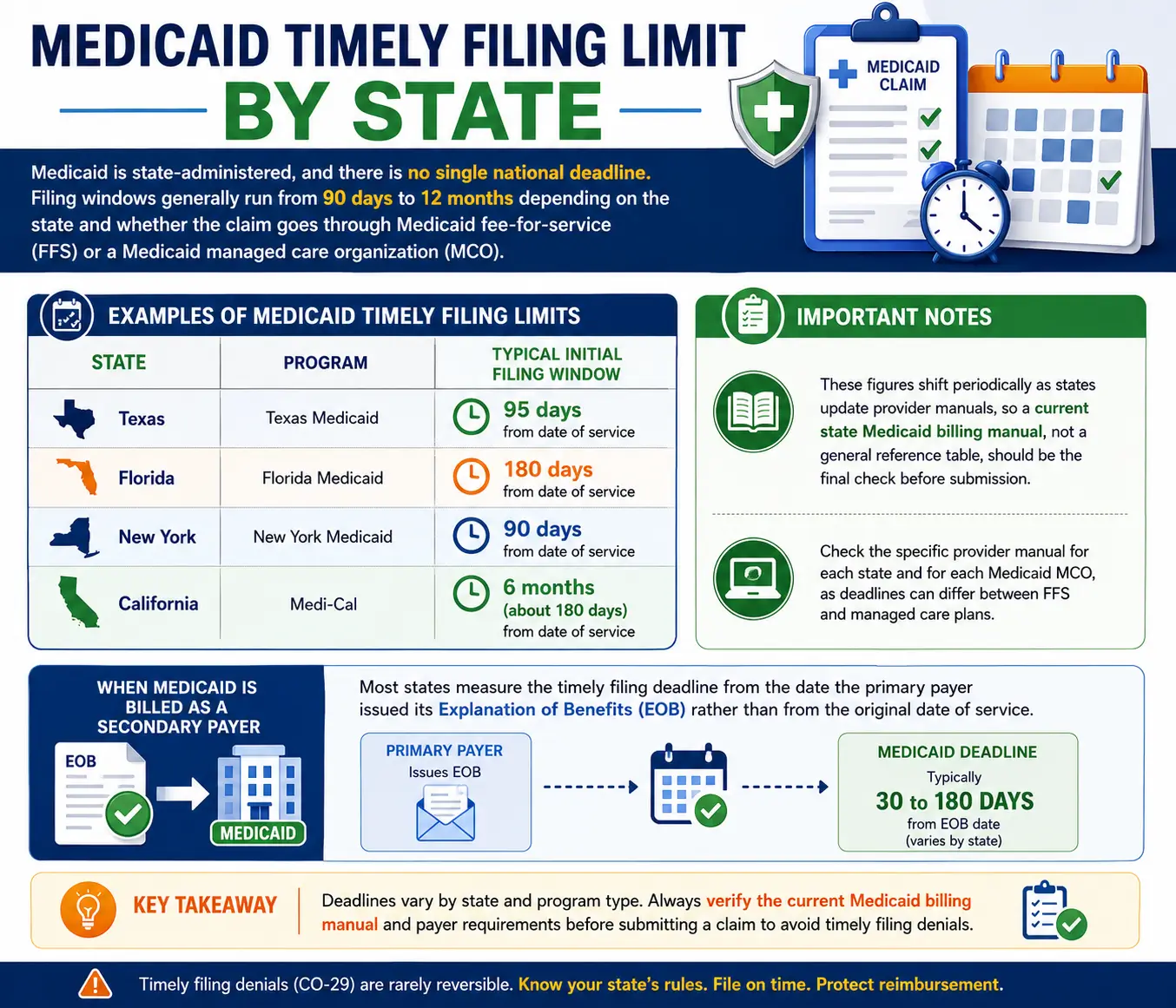
Medicaid is state-administered, and there is no single national deadline. Filing windows generally run from 90 days to 12 months depending on the state and whether the claim goes through Medicaid fee-for-service or a Medicaid managed care organization (MCO). A few examples illustrate the range:
State | Program | Typical initial filing window |
Texas | Texas Medicaid | 95 days from date of service |
Florida | Florida Medicaid | 180 days from date of service |
New York | New York Medicaid | 90 days from date of service |
California | Medi-Cal | 6 months (about 180 days) from date of service |
These figures shift periodically as states update provider manuals, so a current state Medicaid billing manual, not a general reference table, should be the final check before submission. When Medicaid is billed as a secondary payer, most states measure the deadline from the date the primary payer issued its Explanation of Benefits (EOB) rather than from the original date of service, and that window commonly runs from 30 to 180 days depending on the state.
Commercial insurance timely filing limits
Commercial payers set their own deadlines through provider contracts, and these vary by network status, plan type, and sometimes by state supplement to the national provider manual. The table below reflects standard, in-network commercial timelines reported in payer provider manuals as of mid-2026. Individual contracts can differ, so this is a starting point rather than a final answer for any specific claim.
Payer | Initial claim (in-network, commercial) | Notes |
UnitedHealthcare | Typically 90 days, up to 180 in some contracts | Medicare Advantage plans commonly use a 365-day window |
Blue Cross Blue Shield | Ranges from 90 days to 365 days | BCBS operates as a group of independently run companies by state, so the deadline depends entirely on which affiliate holds the member’s coverage |
Cigna | 90 days in-network; 180 days out-of-network | California requires an extended 365-day window under state law |
Aetna | Most commonly 90 days in-network; some contracts and Medicare Advantage lines extend further | Out-of-network non-participating claims moved to a 12-month (365-day) window effective January 1, 2022, down from a previous 27-month allowance |
Two things explain why these numbers look inconsistent across different billing resources. First, Blue Cross Blue Shield is not one insurer. It operates through a network of independently run, locally operated companies across different states, so a filing deadline confirmed for one BCBS affiliate does not necessarily apply to another. Second, participation agreements can and do override the “standard” figure published in a general provider manual, which is why experienced billing teams keep a payer-specific reference sheet built from actual signed contracts rather than relying on secondhand summaries.
Corrected claim timely filing limit
A corrected claim is not the same as a resubmission of a rejected claim, and payers treat the two differently. A correction fixes an error on a claim that was already accepted into the payer’s system, such as a wrong procedure code or an incorrect date span. Most payers require corrected claims to meet the same deadline as the original claim, though a few build in a separate window measured from the remittance advice date instead of the date of service.
Cigna, for example, generally requires corrected in-network claims within 90 days of the original remittance advice date, and 180 days for out-of-network claims. Resubmitting a claim that was denied outright, rather than correcting one that was accepted with an error, typically does not reset the timely filing clock. Billing departments run into this distinction often: treating a denial as a fresh 90 or 180-day window, instead of a continuation of the original one, is a frequent and avoidable source of CO-29 denials.
Appeal timely filing limit
The appeal deadline and the initial claim filing deadline are two separate clocks, and mixing them up costs providers money. The claim filing deadline measures from the date of service. The appeal deadline measures from the date of the denial notice.
Commercial appeal windows generally run longer than initial filing windows. Aetna, Blue Cross Blue Shield, and Cigna commonly allow 180 days from the denial date for a standard commercial appeal. UnitedHealthcare’s commercial appeal deadline is notably shorter, at 65 calendar days from the denial date, which is a frequent trap for billing teams used to the 180-day standard at other payers. Medicare Advantage appeals across insurers generally follow a 60-day CMS-set standard, while traditional Medicare redeterminations under Part A and Part B allow 120 days from the initial claim determination.
A CO-29 denial itself can be appealed if the provider can prove the original claim was actually submitted on time. The strongest evidence is an electronic submission confirmation or acknowledgment report from a clearinghouse, since it carries a timestamped record independent of the payer’s own system. Without that kind of documented proof, a timely filing appeal is difficult to win, even when the underlying claim was medically appropriate and coded correctly.
Proving timely filing after a denial
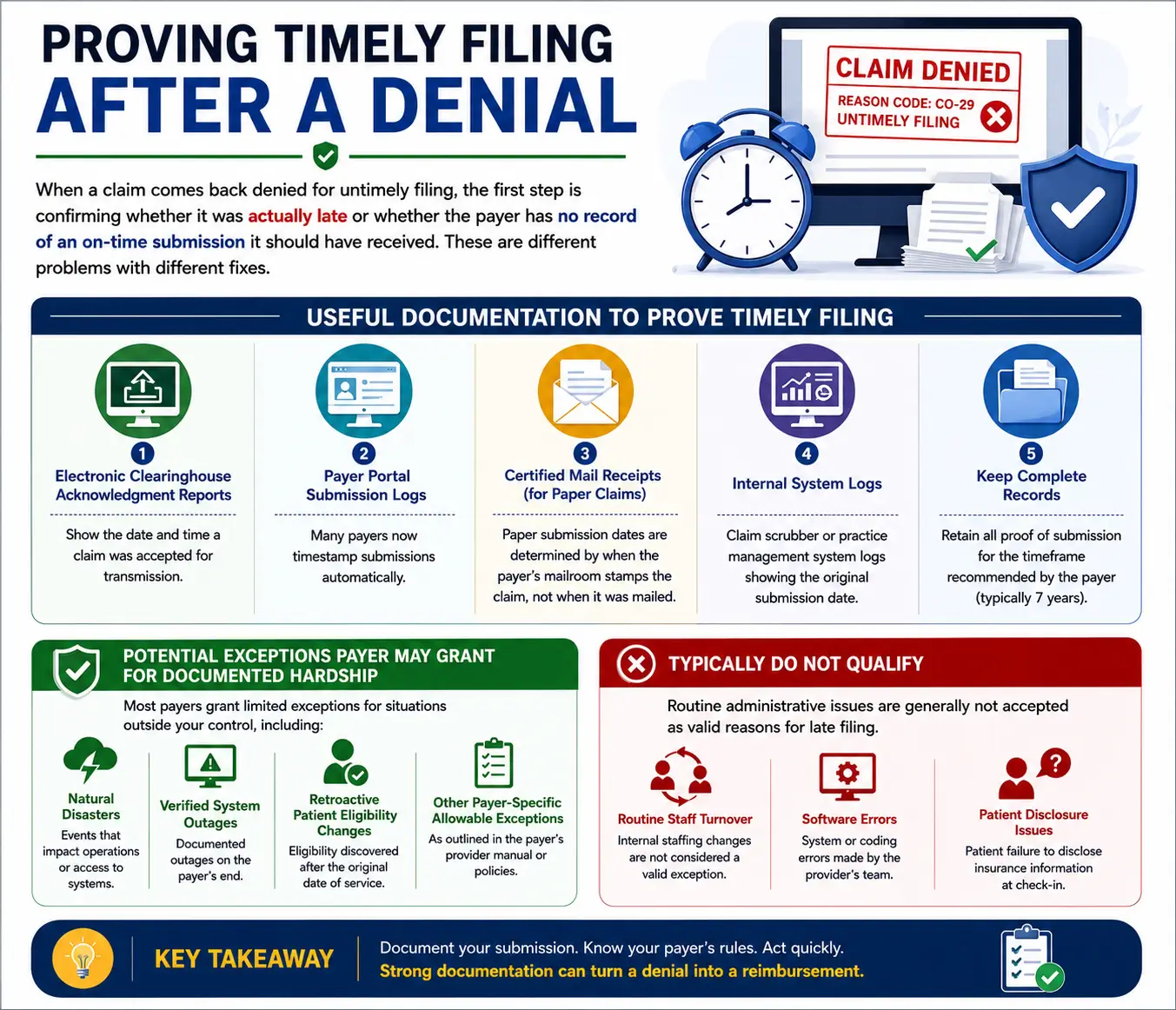
When a claim comes back denied for untimely filing, the first step is confirming whether it was actually late or whether the payer has no record of an on-time submission it should have received. These are different problems with different fixes.
Useful documentation includes:
- Electronic clearinghouse acknowledgment reports showing the date and time a claim was accepted for transmission
- Payer portal submission logs, which many payers now timestamp automatically
- Certified mail receipts for paper claims, since paper submission dates are determined by when the payer’s mailroom stamps the claim, not when it was mailed
- Internal claim scrubber or practice management system logs showing the original submission date
Providers should also understand that most payers grant limited exceptions for documented hardship, including natural disasters, verified system outages on the payer’s end, or retroactive patient eligibility changes discovered after the original date of service. Routine staff turnover, software errors, or a patient’s failure to disclose insurance information at check-in generally do not qualify.
Practical steps that reduce timely filing denials
Reducing CO-29 denials comes down to process discipline. Most billing teams already know the deadlines; what they lack is a system that flags claims before those deadlines arrive.
A few habits make the biggest difference:
- Build a payer reference sheet from actual signed contracts, not general online summaries, since participation agreements frequently override standard published timelines
- Set an internal submission goal well inside the payer’s actual deadline, such as 30 days for a 90-day payer, to leave room for coding review and clearinghouse rejections
- Review clearinghouse rejection reports daily, since a rejected claim does not stop the filing clock and can quietly eat weeks of the available window
- Separate claim filing deadlines from appeal deadlines in whatever tracking system the practice uses, since treating them as the same date leads directly to missed appeals
- Keep dated proof of every submission, since that proof is the only real defense if a payer later claims a claim arrived late or never arrived at all
The timely filing limit for medical billing claims is an administrative rule, but it carries real financial consequences once a deadline slips. Medicare’s 12-month standard under 42 CFR § 424.44 gives providers the most room of any major payer. Medicaid and commercial insurers compress that window considerably, sometimes down to 90 days, which leaves far less margin for coding delays, documentation gaps, or a claim that sits untouched in a queue. Within revenue cycle management, treating the date of service as the start of a countdown, rather than a formality to note and move past, is what separates billing operations that protect their revenue from those that write it off.