


The short answer is I10, Essential (primary) hypertension. It is the code you will reach for most often, and for many patients it is the only hypertension code you need. But I10 is also one of the most miscoded diagnoses in outpatient billing, because the moment a patient’s chart mentions the heart or the kidneys, the correct code usually changes. This guide walks through when I10 applies, when it does not, and the documentation that decides the difference.
Hypertension is worth getting right for a simple reason: volume. The CDC’s National Center for Health Statistics reported in NCHS Data Brief No. 511 (October 2024) that 47.7 percent of U.S. adults had hypertension during August 2021 to August 2023, based on NHANES measurements. Prevalence climbed with age, reaching more than 70 percent among adults 60 and older. The National Ambulatory Medical Care Survey recorded essential hypertension as the primary diagnosis at roughly 56.8 million physician office visits in its 2019 national summary. Few diagnosis codes cross a coder’s desk as often as I10.
What is hypertension’s ICD-10 code, exactly?
I10 is a billable, three-character ICD-10-CM code in Chapter 9, Diseases of the circulatory system, within the hypertensive diseases block (I10 through I1A). It is valid for the current fiscal year, which runs October 1, 2025 through September 30, 2026 under the FY2026 code set.
The Alphabetic Index makes the scope of I10 unusually broad. Look up “Hypertension” and the main term carries a string of nonessential modifiers in parentheses: accelerated, benign, essential, idiopathic, malignant, and systemic. All of them route to I10. In plain terms, I10 covers high blood pressure without documented heart, kidney, or secondary cause, whether the provider calls it primary hypertension, essential hypertension, or simply “HTN.”
A few conditions that sound related are carved out. I10 excludes hypertension affecting the vessels of the brain (I60 through I69) and the vessels of the eye (H35.0-). It also excludes hypertension complicating pregnancy, childbirth, and the puerperium, which belongs to the O10 through O16 codes in Chapter 15 rather than anywhere in the I-series. Coding a pregnant patient’s blood pressure with I10 is a recurring error worth flagging early.
What I10 replaced
If you trained on ICD-9-CM, the collapse of detail can feel strange. ICD-9 used category 401 and split essential hypertension three ways: 401.0 for malignant, 401.1 for benign, and 401.9 for unspecified. ICD-10-CM, adopted for U.S. claims on October 1, 2015, dropped that clinical distinction entirely. Benign, malignant, and unspecified all map to the single code I10.
This matters in practice, not just in history. Some electronic health records imported legacy 401.x problem lists at the transition and kept the old benign or malignant descriptions attached to the underlying code field. If your practice still sees “benign hypertension” language surfacing in the chart, confirm the record resolves to I10 and not to a stale mapping.
The rule that decides everything: the “with” convention
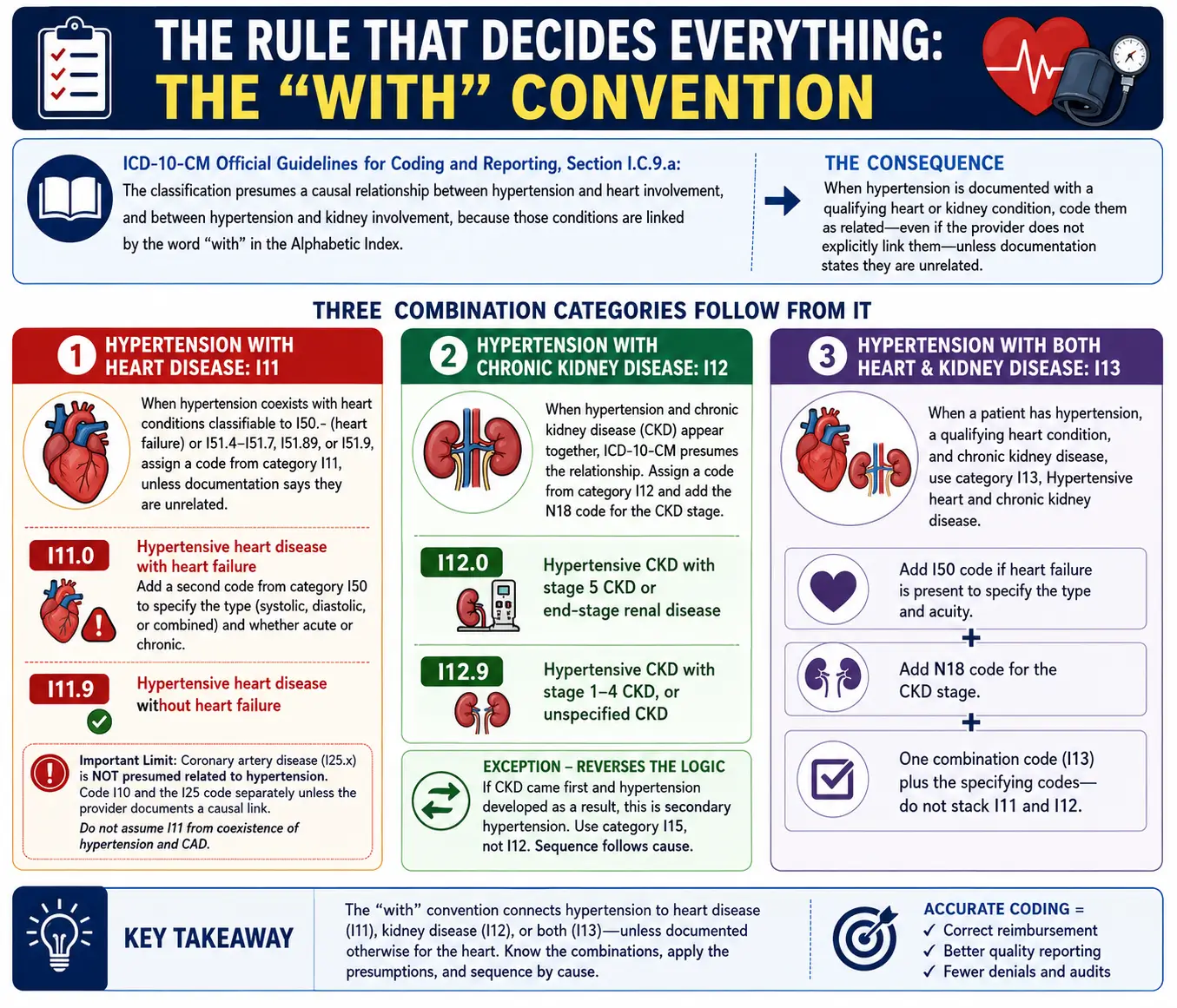
Most I10 errors trace back to one guideline. Section I.C.9.a of the ICD-10-CM Official Guidelines for Coding and Reporting states that the classification presumes a causal relationship between hypertension and heart involvement, and between hypertension and kidney involvement, because those conditions are linked by the word “with” in the Alphabetic Index.
The consequence is direct. When a chart documents hypertension alongside a qualifying heart or kidney condition, you code them as related even without the provider explicitly linking them, unless the documentation states they are unrelated. That single sentence changes how you handle a large share of hypertensive patients.
Three combination categories follow from it.
Hypertension with heart disease: I11
When hypertension coexists with heart conditions classifiable to I50.- (heart failure) or I51.4 through I51.7, I51.89, or I51.9, assign a code from category I11, Hypertensive heart disease, unless documentation says the two are unrelated.
- I11.0 applies when heart failure is present. You add a second code from category I50 to specify the type, such as systolic, diastolic, or combined, and whether it is acute or chronic.
- I11.9 applies to hypertensive heart disease without heart failure.
An important limit: coronary artery disease (I25.x) is not presumed related to hypertension. The “with” convention does not extend to it. If a patient has both hypertension and coronary atherosclerosis, you code I10 and the I25 code separately unless the provider documents a causal link. Assuming an I11 relationship from the mere coexistence of hypertension and CAD is a common overcoding mistake.
Hypertension with chronic kidney disease: I12
The kidney rule is stricter than the heart rule. When hypertension and chronic kidney disease appear together, ICD-10-CM presumes the relationship, and there is no clinical judgment call for the provider to make the way there is with the heart. Assign a code from category I12, Hypertensive chronic kidney disease, and add the N18 code for the CKD stage.
- I12.0 covers hypertensive CKD with stage 5 CKD or end-stage renal disease.
- I12.9 covers stage 1 through stage 4, or unspecified CKD.
There is one exception that reverses the logic. If the chronic kidney disease came first and the hypertension developed as a result, the combination becomes secondary hypertension, which belongs in category I15 rather than I12. Sequence follows cause.
Hypertension with both heart and kidney disease: I13
When a patient has hypertension, a qualifying heart condition, and chronic kidney disease, you do not stack I11 and I12. You use the combination category I13, Hypertensive heart and chronic kidney disease. Add the heart failure type from I50 if heart failure is present, and add the N18 code for the CKD stage. One combination code, then the specifying codes.
A subtle point from the guidelines: in the three-condition scenario, the causal connection still has to hold for the heart involvement, while the kidney involvement is presumed automatically. The I13 category already bundles the presumed relationships.
I10 versus I15: primary versus secondary hypertension
I10 is essential, meaning primary, meaning no identifiable underlying cause. Category I15 is secondary hypertension, where an identifiable condition drives the blood pressure. The distinction is not cosmetic. Secondary hypertension is potentially correctable by treating its cause, and it changes the codes on the claim.
I15 breaks down by cause:
- I15.0 hypertension secondary to renovascular disease
- I15.1 hypertension secondary to other renal disorders
- I15.2 hypertension secondary to endocrine disorders
- I15.8 other secondary hypertension
- I15.9 secondary hypertension, unspecified
Secondary hypertension takes two codes: the underlying etiology and the I15 code that identifies the hypertension as secondary. Sequencing depends on the reason for the encounter. Use I10 only when the record supports primary hypertension with no documented cause.
Hypertensive crisis: the I16 category
A dangerously high reading is coded on its own axis. Category I16 captures hypertensive crisis:
- I16.0 hypertensive urgency
- I16.1 hypertensive emergency
- I16.9 hypertensive crisis, unspecified
I16 codes do not stand in for I10. The guidelines direct you to also assign the code for the underlying hypertension type. A patient in hypertensive emergency with underlying essential hypertension is coded I16.1 and I10, with the crisis code sequenced according to the circumstances of the encounter. The distinction between the two crisis codes is clinical: emergency (I16.1) involves acute target-organ damage, while urgency (I16.0) is a severe elevation without it, and the documentation should support whichever is chosen.
Resistant hypertension: I1A.0
One of the more useful recent additions is easy to miss. The FY2024 update, effective October 1, 2023, created a new subcategory, I1A, Other hypertension, and with it I1A.0, Resistant hypertension. Before this code existed, coders documenting resistant hypertension typically defaulted to I10 with narrative notes, which left the patient population invisible in claims data.
The AHA Coding Clinic describes resistant hypertension as blood pressure that stays above goal despite the concurrent use of at least three antihypertensive medications of different pharmacologic classes, commonly including a diuretic. The Tabular List folds three inclusion terms into I1A.0: apparent treatment resistant hypertension, treatment resistant hypertension, and true resistant hypertension. Pseudoresistant, or white coat, hypertension is specifically excluded from this definition.
I1A.0 carries a “code first” instruction. Sequence the specific hypertension type ahead of it. For a patient with essential hypertension that meets the resistant criteria, the assignment is I10 first, then I1A.0. For resistant secondary hypertension, an I15 code would lead instead. The resistant code supplements the underlying type; it never replaces it.
Documentation that determines the code
The code that lands on the claim is only as good as the note behind it. A handful of documentation elements decide which hypertension code is correct:
- Whether heart failure or another qualifying heart condition is present, and its type.
- Whether chronic kidney disease is present, and its stage.
- Whether the provider has documented that a heart or kidney condition is unrelated to the hypertension, which is the only way to break the presumed relationship.
- Whether an identifiable secondary cause exists.
- Whether the patient meets the three-drug threshold for resistant hypertension.
- For inpatient work, note that I10 is flagged as questionable when used as a principal diagnosis; uncomplicated essential hypertension is rarely sufficient on its own to justify an acute inpatient admission.
When the chart is ambiguous, a clinical documentation query is more defensible than an assumption. The presumed-relationship rule cuts both ways: it can push you toward a combination code you might otherwise miss, and it can trap you into linking conditions a provider intended to keep separate.
Common hypertension coding errors
The mistakes cluster in predictable places:
- Coding I10 plus a separate heart failure or CKD code when the “with” convention calls for a single combination code (I11, I12, or I13). This fragments a condition the classification wants bundled.
- Assuming coronary artery disease relates to hypertension. I25.x is not covered by the presumed-relationship rule and needs explicit provider linkage.
- Using I10 during pregnancy. Hypertension in pregnancy belongs to O10 through O16, not the I-series.
- Dropping the required secondary code, such as the N18 stage with I12 or I13, or the I50 heart failure type with I11.0.
- Reporting an I16 crisis code alone without the underlying hypertension type.
- Defaulting resistant hypertension to plain I10 now that I1A.0 exists, and losing the specificity the newer code provides.
Why I10 alone carries no risk-adjustment weight
For Medicare Advantage and other risk-adjusted models, uncomplicated I10 does not map to a payment Hierarchical Condition Category, so on its own it adds nothing to a patient’s Risk Adjustment Factor score. Under the CMS-HCC V28 model, which is fully phased in for payment year 2026, the financial value sits in the complications, not the baseline diagnosis. Hypertensive CKD by stage, hypertensive heart disease with a specified heart failure type, and the underlying N18 and I50 codes are what carry weight. That is the practical case for coding the full picture: the presumed-relationship rule is not only about accuracy, it is where risk-adjusted revenue is captured or lost.
Quick reference: hypertension categories at a glance
Code | Description | When to use | Additional codes |
I10 | Essential (primary) hypertension | High blood pressure, no documented heart, kidney, or secondary cause | None required |
I11 | Hypertensive heart disease | HTN with I50.- or specified I51 heart conditions | I50 for heart failure type (with I11.0) |
I12 | Hypertensive CKD | HTN with chronic kidney disease (presumed related) | N18 for CKD stage |
I13 | Hypertensive heart and CKD | HTN with both heart and kidney involvement | I50 (if HF present) and N18 stage |
I15 | Secondary hypertension | HTN from an identifiable cause | Etiology code |
I16 | Hypertensive crisis | Urgency (I16.0) or emergency (I16.1) | Underlying HTN type |
I1A.0 | Resistant hypertension | BP above goal despite 3+ agents | Code the HTN type first |
I10 answers the question most of the time, and for a patient with uncomplicated high blood pressure it is the complete answer. The work of accurate hypertension coding lives in the exceptions: the heart and kidney conditions that trigger a combination code under the “with” convention, the identifiable causes that shift the diagnosis to I15, and the newer I1A.0 code that finally gives resistant hypertension a home in claims data. Read the chart for those signals before you default to I10, and confirm the record supports whatever you assign.