


Hospitals and medical billing departments operate under strict regulatory timelines that dictate how patient care is classified and reimbursed. Among these regulations, the 48-hour observation rule for Medicare establishes a distinct timeframe for managing patients who require temporary medical monitoring. Medical coders, billing specialists, and healthcare providers must understand this timeline to maintain compliance with the Centers for Medicare and Medicaid Services (CMS) and to prevent costly claim denials.
When a patient arrives at a hospital with uncertain symptoms, physicians need time to evaluate their condition. The observation period provides a window for diagnostic testing and short-term treatment. However, Medicare does not allow this monitoring period to continue indefinitely. The billing classifications, required documentation, and patient notifications all shift rapidly as the clock ticks past 24 and 48 hours.
Understanding hospital observation status under Medicare
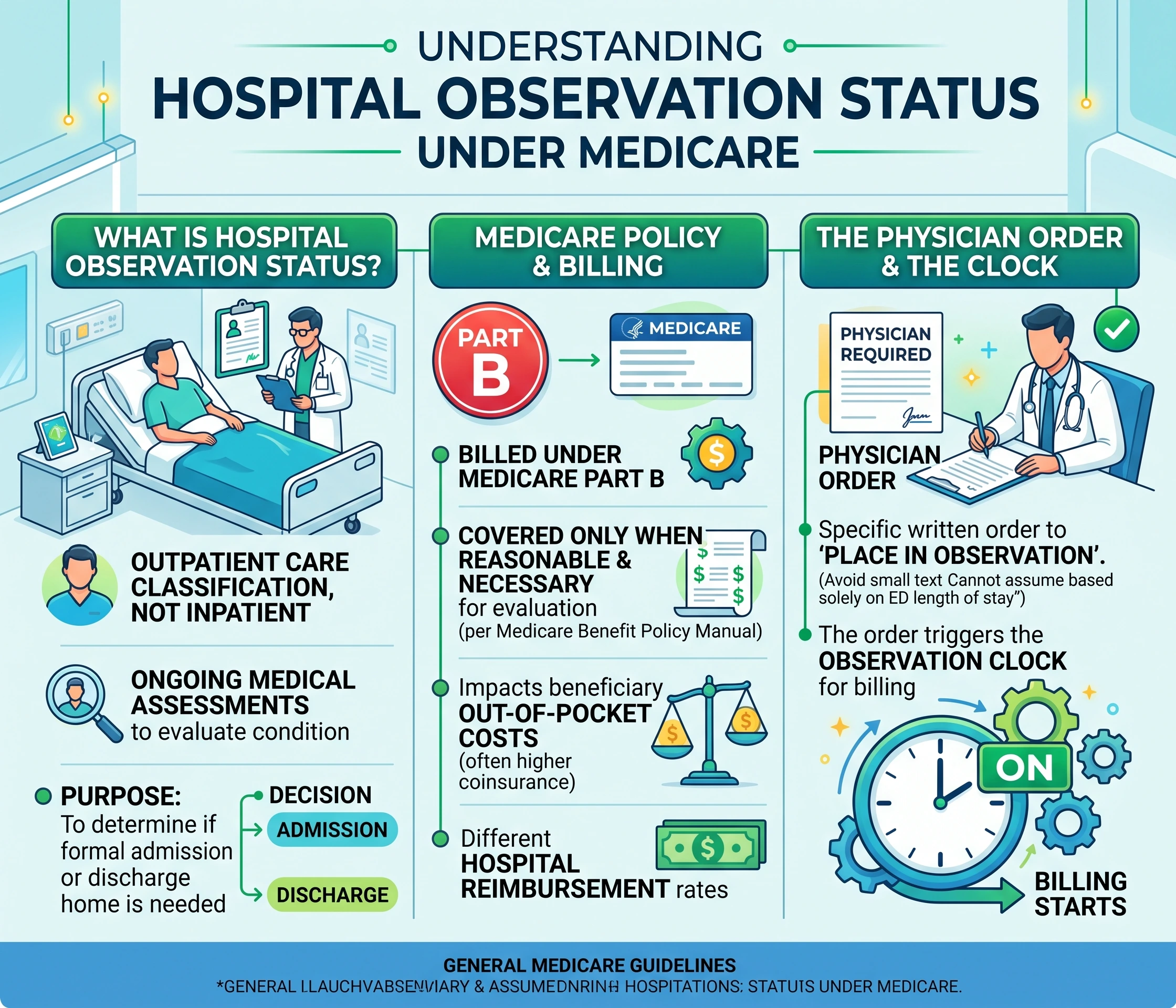
Hospital observation status is a specific classification of outpatient care. It applies when a patient receives ongoing medical assessments to determine if they need formal inpatient admission or if they are stable enough to return home.
According to the Medicare Benefit Policy Manual, observation services are covered only when they are reasonable and necessary to evaluate a patient’s condition. Because observation is an outpatient service, it is billed under Medicare Part B. This classification directly affects hospital reimbursement rates and alters the out-of-pocket financial responsibilities of Medicare beneficiaries.
A physician order is the required starting point for this process. The physician observation order must clearly direct the facility to place the patient in observation. Medical billers cannot assume observation status based solely on the length of time a patient spends in an emergency department bed. The specific written order triggers the observation clock for billing purposes.
What is the 48 hour observation rule for Medicare?
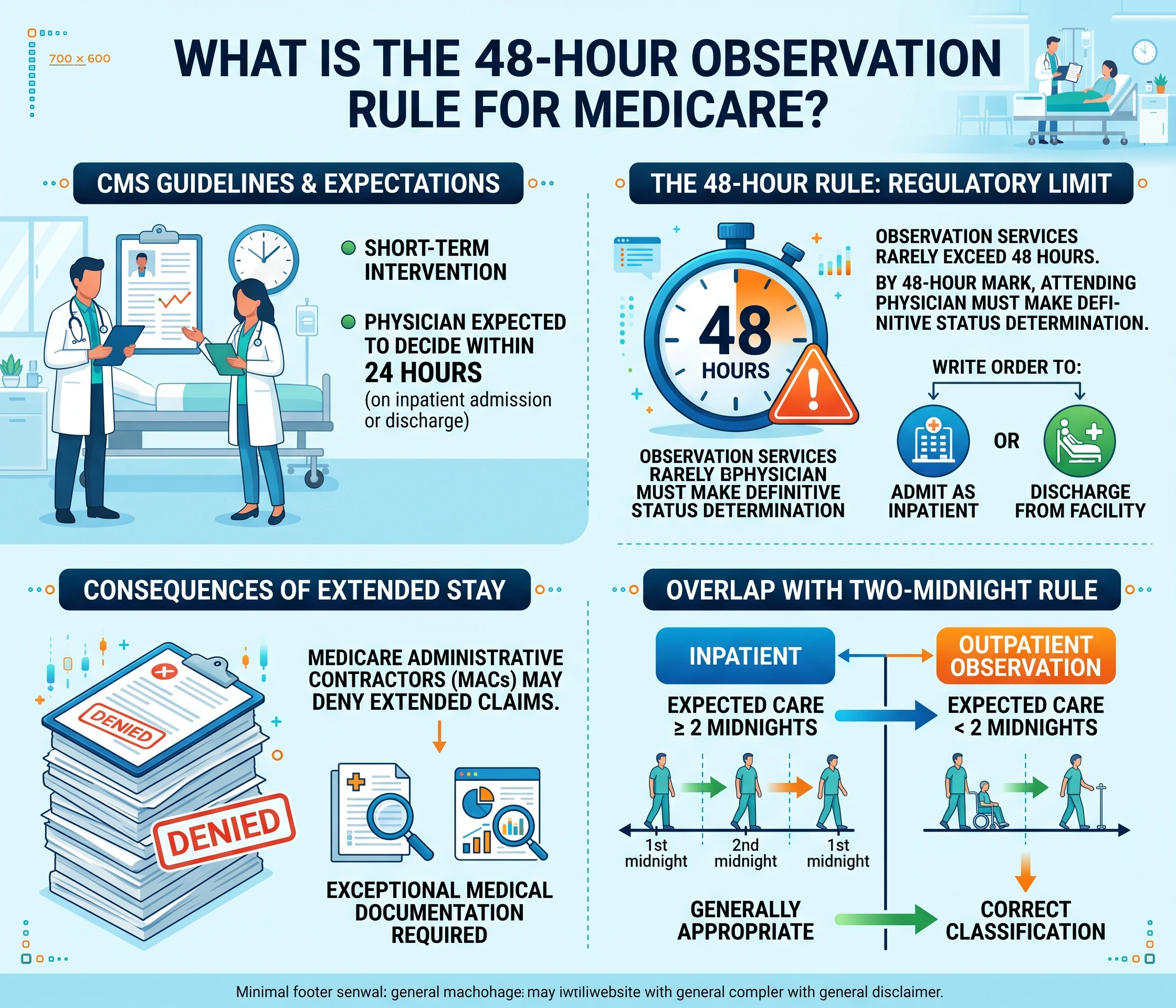
CMS guidelines for observation billing establish that observation care is a short-term intervention. The agency expects that a physician can typically make a decision regarding inpatient admission or discharge within 24 hours.
The 48-hour rule serves as a regulatory limit, establishing that observation services should only rarely exceed 48 hours. By the time a patient reaches the 48-hour mark in a hospital bed under observation, the attending physician must make a definitive status determination. The doctor must write an order to either formally admit the patient as an inpatient or discharge them from the facility.
If a hospital keeps a patient in observation beyond 48 hours, Medicare Administrative Contractors (MACs) may deny the extended observation claims unless the facility provides exceptional medical documentation justifying the delay.
This rule frequently overlaps with the CMS Two-Midnight Rule. The Two-Midnight Rule states that if a physician expects a patient to require hospital care that crosses two midnights, inpatient admission is generally appropriate. If the anticipated care will require less than two midnights, outpatient observation status is the correct classification.
Maximum recommended length of stay for observation patients
Healthcare professionals frequently ask how long a hospital can keep a patient under observation. The maximum recommended length of stay for a patient in observation status is 48 hours.
While hospital staff will not force a patient out of a bed precisely at hour 49, the facility risks losing Medicare reimbursement for services provided beyond the 48-hour threshold. The average length of stay for observation patients across U.S. hospitals is typically between 15 and 24 hours.
Many facilities aim for a 23 hour observation period. This 23-hour benchmark is especially common for patients recovering from minor procedures. A 23 hour observation after surgery allows the medical team to monitor for immediate post-operative complications without triggering the stricter documentation requirements and higher costs associated with an inpatient admission.
CMS observation billing rules and coding guidelines
Medical billers and coders must follow precise observation coding guidelines to secure accurate Medicare reimbursement. When reporting these outpatient hospital services on a Medicare claim, coders use specific revenue and HCPCS codes to distinguish observation from standard emergency department visits.
The standard revenue code for observation is 0762. This revenue code groups the facility charges for the observation room and the nursing care associated with monitoring the patient.
To report the actual hours of care provided, coders use HCPCS code G0378 (Hospital observation service, per hour). Medicare requires facilities to report the exact number of hours the patient spent under active observation.
G0378 billing guidelines require several specific conditions to be met before a hospital can submit a claim:
- The patient must receive a minimum of eight hours of observation services.
- The medical record must contain a signed physician observation order.
- The observation claim must be tied to a payable facility visit, such as an emergency department visit or critical care service.
- The hospital must carve out any time spent receiving active monitoring during procedures, such as routine recovery room time following a surgery.
Calculating observation time requires precision. Observation time begins at the clock time documented in the patient’s medical record that coincides with the initiation of observation care. It ends when all clinical or medical interventions are complete, including any follow-up care furnished by hospital staff after the physician writes the discharge order.
Physician documentation for observation claims
Medicare observation documentation requirements demand specific details from the attending physician. Vague medical record entries result in rejected claims.
The physician must document the specific medical reason for the observation. Stating “monitor patient” is insufficient for CMS auditors. The documentation must detail the exact symptoms being evaluated, the specific diagnostic tests ordered, the risks of immediate discharge, and the planned medical interventions. The clinical notes must clearly demonstrate why the patient required continued hospital-level care rather than monitoring at home.
The Medicare outpatient observation notice requirement
Patient communication is a legally required component of observation stays that extend beyond a single day. Under the federal Notice of Observation Treatment and Implication for Care Eligibility (NOTICE) Act, hospitals must deliver a specific document known as the Medicare Outpatient Observation Notice (MOON).
Facility staff must provide the MOON to any Medicare beneficiary receiving outpatient observation services for more than 24 hours. The hospital is legally obligated to deliver and verbally explain this written notice no later than 36 hours after the observation period begins.
The MOON informs the patient that they are technically an outpatient rather than an admitted inpatient. This distinction directly affects their out-of-pocket costs under Medicare Part B. It also informs the patient about the impact on Skilled Nursing Facility (SNF) coverage. Medicare requires a three-day qualifying inpatient hospital stay before covering SNF care. Time spent in observation status does not count toward this three-day requirement.
Observation care vs inpatient admission criteria
The difference between observation status and inpatient admission alters how hospital billing departments process claims. Inpatient admission falls under Medicare Part A, which covers hospital room and board. Observation status falls under Medicare Part B, which covers outpatient medical services.
Under Part B, patients face different copayments and are financially responsible for the cost of self-administered drugs they take while in the hospital bed.
Patient conditions change rapidly, requiring hospital staff to perform observation to inpatient conversion. If clinical conditions worsen or diagnostic tests reveal a need for extended acute care, the physician will write an inpatient admission order. Once the doctor signs the admission order, the patient’s status changes. For Medicare billing purposes, the observation time prior to the admission order is merged into the Part A inpatient claim. The hospital cannot bill Medicare for both observation services and an inpatient admission for the same continuous stay.
Hospital utilization review for observation hours
Hospital utilization review committees actively monitor observation hours to maintain Medicare compliance. These teams track the time each patient spends in an observation bed.
If a patient approaches the 24 to 48-hour window in observation, utilization review staff typically intervene. They prompt the attending physician to review the clinical data and make a final determination regarding admission or discharge. This internal monitoring prevents patients from lingering in outpatient status past the 48-hour limit set by CMS.
MACs frequently audit observation claims to ensure hospitals are not using outpatient status to bypass inpatient admission criteria. Reviewers look for exact timestamps on physician orders, nursing flow sheets, and discharge summaries to verify that the reported observation hours match the clinical documentation. Facilities that implement strict documentation protocols and enforce the 48-hour decision deadline maintain higher compliance rates and experience fewer Medicare claim denials.