


Navigating the financial side of healthcare requires a precise understanding of payer guidelines. One of the most frequent administrative hurdles healthcare practices face is securing permission from an insurance company before rendering services. Understanding exactly when authorization is required in medical billing prevents delayed treatments and protects the financial health of a medical practice.
According to the American Medical Association’s 2023 prior authorization physician survey, 94 percent of physicians report that authorization requirements lead to delays in patient care. For medical billers and coders, mastering these requirements is a mandatory skill. A single missed step in the approval workflow frequently results in a denied claim, leaving the provider without reimbursement and the patient with an unexpected bill.
What is prior authorization in medical billing
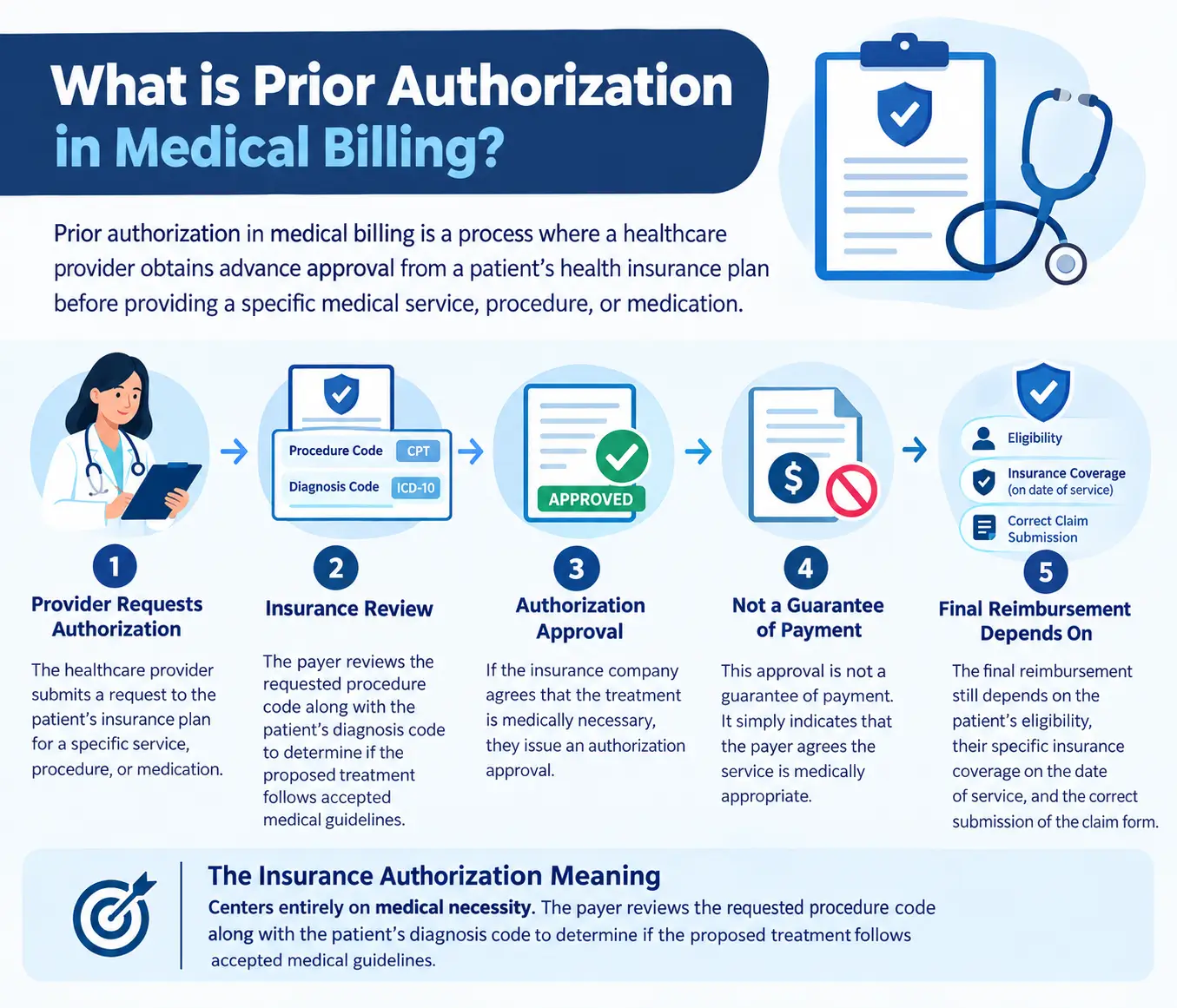
Prior authorization in medical billing is a process where a healthcare provider obtains advance approval from a patient’s health insurance plan before providing a specific medical service, procedure, or medication.
The insurance authorization meaning centers entirely on medical necessity. The payer reviews the requested procedure code alongside the patient’s diagnosis code to determine if the proposed treatment follows accepted medical guidelines. If the insurance company agrees that the treatment is medically necessary, they issue an authorization approval.
This approval is not a guarantee of payment. It simply indicates that the payer agrees the service is medically appropriate. The final reimbursement still depends on the patient’s eligibility, their specific insurance coverage on the date of service, and the correct submission of the claim form.
Why authorization is important in medical billing
Insurance companies use prior authorization as a primary mechanism to control healthcare costs. By requiring advance review, payers prevent the use of unnecessarily expensive treatments when equally effective, lower-cost alternatives exist.
For the healthcare provider, understanding why authorization is important in medical billing directly translates to revenue cycle management. Treating a patient without required prior approval almost always results in a claim denial due to no authorization. Medical billers spend hours attempting to appeal these specific denials, and payers rarely overturn them without evidence of a severe medical emergency. Securing the authorization upfront protects the provider’s bottom line and informs the patient of any potential out-of-pocket costs before treatment begins.
When authorization is required in medical billing
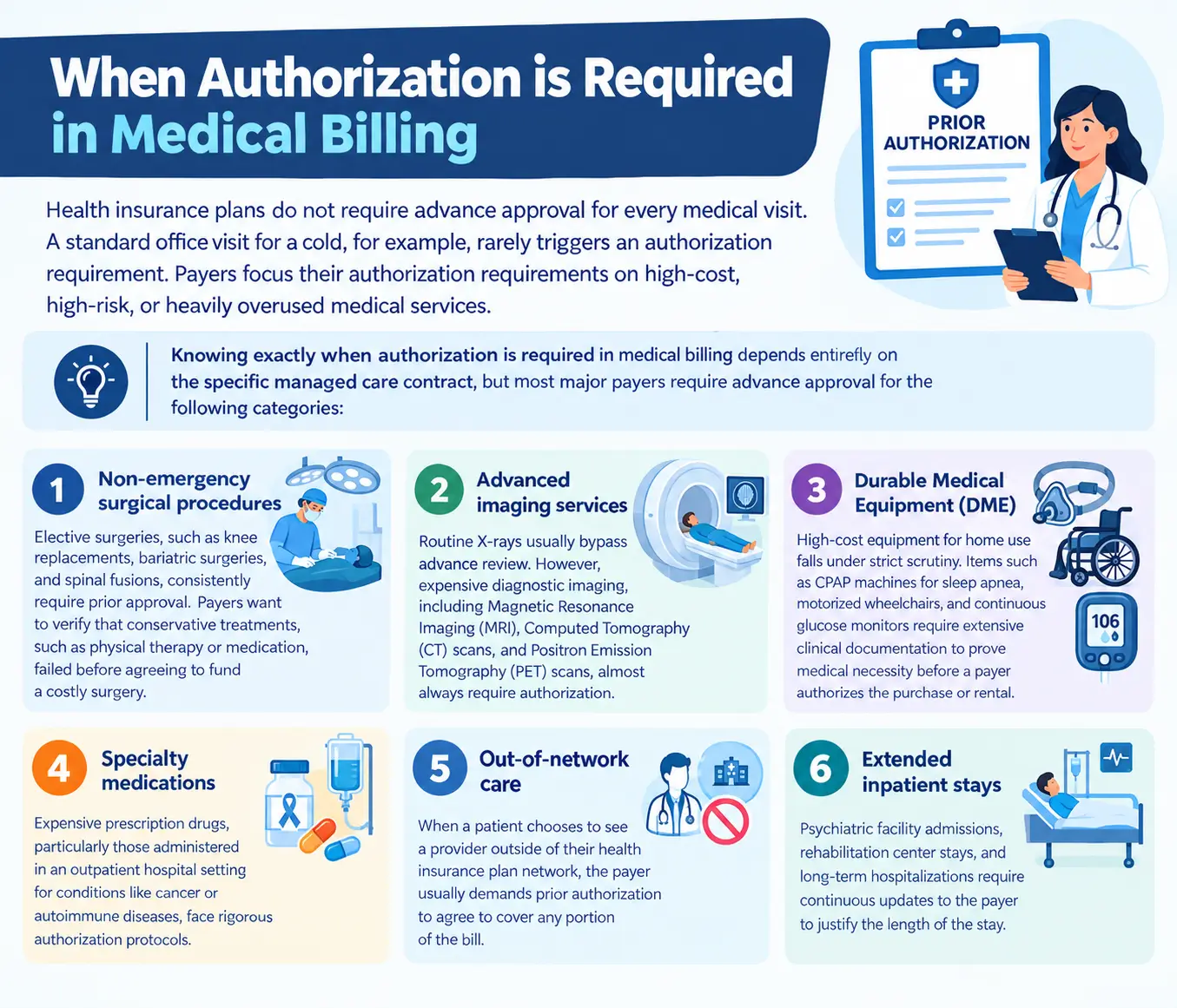
Health insurance plans do not require advance approval for every medical visit. A standard office visit for a cold, for example, rarely triggers an authorization requirement. Payers focus their authorization requirements on high-cost, high-risk, or heavily overused medical services.
Knowing exactly when authorization is required in medical billing depends entirely on the specific managed care contract, but most major payers require advance approval for the following categories:
- Non-emergency surgical procedures: Elective surgeries, such as knee replacements, bariatric surgeries, and spinal fusions, consistently require prior approval. Payers want to verify that conservative treatments, such as physical therapy or medication, failed before agreeing to fund a costly surgery.
- Advanced imaging services: Routine X-rays usually bypass advance review. However, expensive diagnostic imaging, including Magnetic Resonance Imaging (MRI), Computed Tomography (CT) scans, and Positron Emission Tomography (PET) scans, almost always require authorization.
- Durable Medical Equipment (DME): High-cost equipment for home use falls under strict scrutiny. Items such as CPAP machines for sleep apnea, motorized wheelchairs, and continuous glucose monitors require extensive clinical documentation to prove medical necessity before a payer authorizes the purchase or rental.
- Specialty medications: Expensive prescription drugs, particularly those administered in an outpatient hospital setting for conditions like cancer or autoimmune diseases, face rigorous authorization protocols.
- Out-of-network care: When a patient chooses to see a provider outside of their health insurance plan network, the payer usually demands prior authorization to agree to cover any portion of the bill.
- Extended inpatient stays: Psychiatric facility admissions, rehabilitation center stays, and long-term hospitalizations require continuous updates to the payer to justify the length of the stay.
Types of authorization in medical billing
The medical billing authorization workflow includes several distinct variations depending on when the provider requests the approval and the nature of the patient’s condition.
Pre-authorization in medical billing
Pre-authorization represents the standard workflow. The provider submits clinical documentation to the payer days or weeks before the scheduled service. The patient does not receive the treatment until the payer issues the authorization number.
Concurrent authorization in medical billing
Concurrent authorization in medical billing happens while the patient is actively receiving care. This scenario most commonly occurs during an inpatient hospital admission. A hospital might secure pre-authorization for a three-day stay for surgery. If the patient develops an infection and needs to remain hospitalized for seven days, the billing department must contact the payer to secure concurrent authorization for the additional four days.
Retro authorization in medical billing
Retro authorization in medical billing occurs after the provider has already delivered the medical services. Payers generally restrict this authorization scenario in medical billing to severe emergencies. If a patient arrives at an emergency department unconscious and requires immediate, life-saving surgery, the provider cannot wait for an insurance company to review paperwork. The hospital performs the surgery and the billing staff applies for retro authorization within a specific time limit, usually 24 to 72 hours after the event, depending on the payer’s guidelines.
Referral authorization in medical billing
A referral authorization in medical billing applies primarily to Health Maintenance Organization (HMO) plans. In an HMO, a patient must select a Primary Care Physician (PCP). If the patient needs to see a specialist, the PCP must issue an insurance referral.
Medical billers must understand the difference between authorization and referral. A referral is simply a primary care doctor directing a patient to a specialist. A prior authorization is the insurance company agreeing to pay for the specific treatment that the specialist plans to perform. A patient might have a referral to see a cardiologist, but that cardiologist still needs a prior authorization to perform an echocardiogram.
To clarify these authorization types in medical billing, review the following comparison:
Authorization Type | Timing of Request | Typical Medical Scenario |
Pre-authorization | Before service delivery | Scheduled MRI or elective surgery. |
Concurrent authorization | During service delivery | Extending a patient’s hospital stay. |
Retro authorization | After service delivery | Life-saving emergency surgery. |
Referral authorization | Before specialist visit | HMO patient visiting a dermatologist. |
The authorization process in medical billing
Obtaining approval requires precise communication between the healthcare provider’s clinical staff and the administrative billing team. Learning how to obtain authorization in medical billing involves following a strict sequence of events.
- Verification of eligibility and benefits: Before requesting approval, the medical biller verifies the patient’s insurance coverage. They check the active policy status and review the payer’s specific rules to see if the planned procedure falls under the medical services requiring authorization.
- Gathering clinical documentation: The provider compiles the patient’s medical records. This includes physician notes, laboratory results, past treatment histories, and the specific diagnosis codes.
- Submitting the authorization request: The billing staff submits the documentation to the payer. This submission includes the specific authorization service code (the exact CPT or HCPCS code for the planned procedure). Submissions happen through secure payer web portals, electronic data interchange (EDI) clearinghouses, or sometimes via fax.
- Payer review: The insurance company’s medical reviewers analyze the clinical data against their internal coverage guidelines.
- Receiving the authorization number in medical billing: If approved, the payer issues an insurance authorization number. This alphanumeric code serves as proof that the payer agreed to the medical necessity of the service.
- Billing the claim: After the provider performs the service, the medical coder generates the claim. The biller must place the authorization code in medical billing directly onto the claim form. On the standard CMS-1500 paper claim form, this number goes in Box 23 (Prior Authorization Number). On electronic 837P claims, it occupies a specific data segment.
Every approval comes with an effective date and an expiration date. If a provider secures approval for a procedure but the patient reschedules the appointment past the expiration date, the biller must contact the payer to extend the timeline. Billing a service outside of this approved date range guarantees a denial.
Authorization denial in medical billing
Payers frequently reject requests, requiring billers to navigate the appeals process. A prior authorization denial means the insurance company refuses to cover the planned service.
Medical billers encounter several common authorization denial reasons:
- Lack of medical necessity: The payer’s medical director determines that the patient’s condition does not warrant the requested procedure based on the submitted notes.
- Step therapy requirements: The payer requires the patient to try a less expensive medication or treatment first before they will approve the requested service.
- Incomplete documentation: The billing staff failed to submit all required laboratory results or physician notes.
- Incorrect coding: The diagnosis code provided does not logically support the requested procedure code.
- Out-of-network provider: The plan does not offer out-of-network benefits, or the provider failed to prove that an in-network specialist was unavailable.
When an authorization denial occurs, the provider can file an appeal. This usually involves scheduling a peer-to-peer review, where the treating physician speaks directly with the insurance company’s medical director to argue the clinical merits of the case.
If a provider accidentally performs a service without securing a required approval, they will face a claim denial due to no authorization after submitting the bill. Overturning this specific type of denied claim is exceedingly difficult. Most payer contracts hold the provider financially liable in these situations, meaning the provider must write off the cost of the service and cannot legally bill the patient for the balance.
Summary
Medical billing professionals must continuously monitor payer guidelines to determine when authorization is required in medical billing. The process acts as a strict gateway between patient care and provider reimbursement. By identifying the medical services requiring authorization, understanding the difference between prior authorization and retro authorization, and meticulously tracking expiration dates and authorization numbers, a medical billing department protects its practice from devastating revenue losses and administrative delays.