

Every claim a provider submits carries at least two identifying numbers, and billers confuse them constantly. One is the National Provider Identifier. The other is a tax identification number. Enter one where the other belongs, and a clean, medically necessary claim can bounce back unpaid for a reason that has nothing to do with the care delivered. Understanding NPI vs Tax ID starts with recognizing that these numbers answer two separate questions: who provided the care, and who gets paid and reports the income to the IRS.
That distinction sounds straightforward until a group practice, three rendering providers, and one shared tax ID all show up on the same claim. Then the confusion gets expensive. The sections below cover what each identifier does, where it belongs on a claim form, and where a third, related number, the PTAN, fits into Medicare billing specifically.
What is an NPI number?
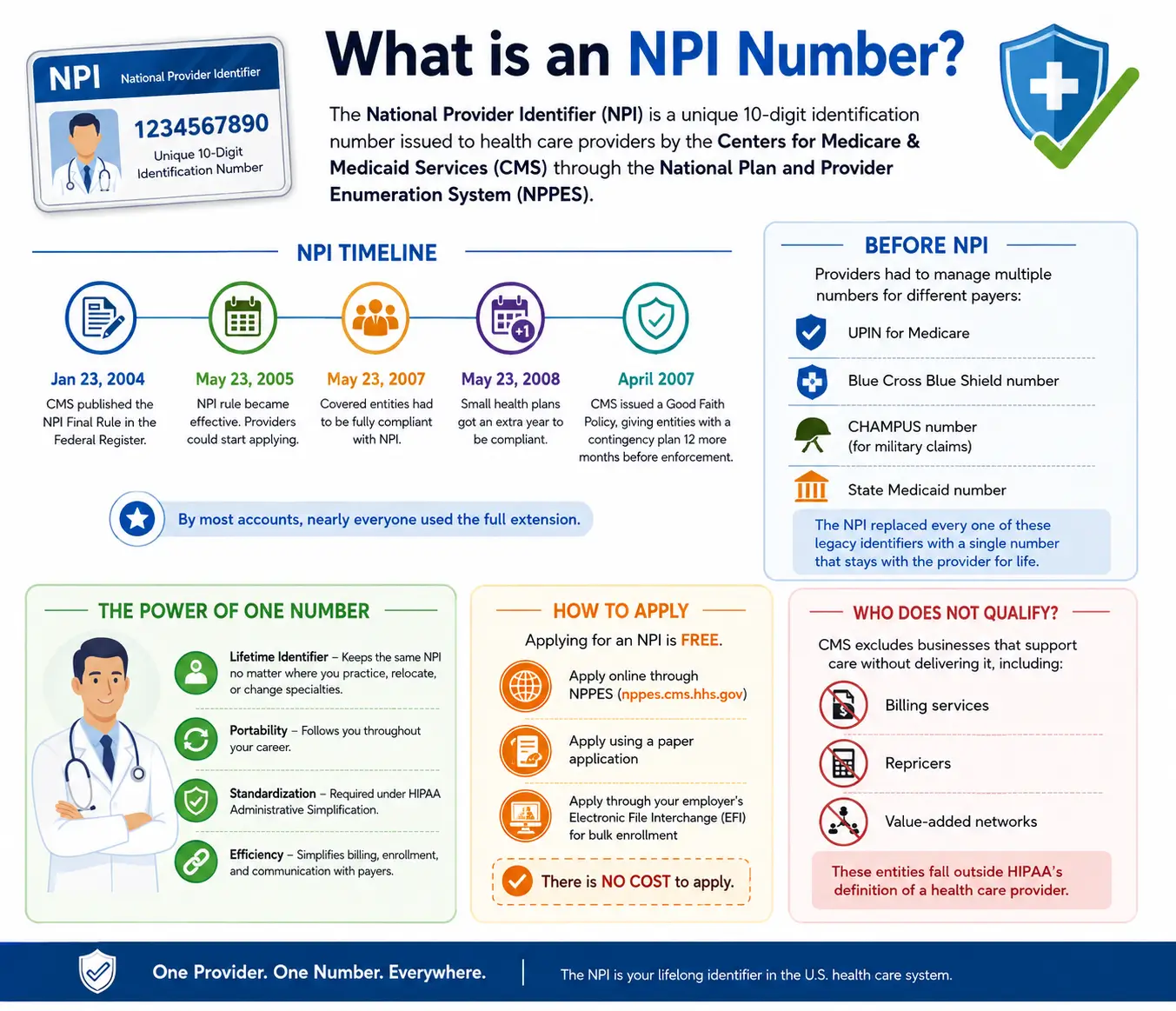
The National Provider Identifier (NPI) is a unique 10-digit identification number issued to health care providers by the Centers for Medicare & Medicaid Services (CMS) through the National Plan and Provider Enumeration System (NPPES). CMS published the NPI Final Rule in the Federal Register on January 23, 2004, adopting the NPI as the standard unique health identifier required under the Administrative Simplification provisions of the Health Insurance Portability and Accountability Act (HIPAA) of 1996, over the signature of then-CMS Administrator Mark McClellan’s “Dear Provider” letter announcing the change. The rule became effective May 23, 2005, meaning providers could start applying that day, and covered entities had to be fully compliant by May 23, 2007 (small health plans got an extra year, until May 23, 2008). Facing industry concerns about readiness, CMS softened that deadline slightly in April 2007 with a Good Faith Policy, giving entities with a contingency plan a further 12 months before enforcement; by most accounts, nearly everyone used the full extension.
Before the NPI, a provider juggled a different number for nearly every payer: a Unique Physician Identification Number (UPIN) for Medicare, a separate Blue Cross Blue Shield number, a CHAMPUS number for military claims, and a state Medicaid number on top of all of it. The NPI replaced every one of these legacy identifiers with a single number that follows the provider for life. A doctor who changes practices, relocates, or switches specialties keeps the same NPI throughout.
Applying costs nothing. Providers apply directly through NPPES online, by paper application, or through an employer’s Electronic File Interchange for bulk enrollment. Not everyone qualifies. CMS excludes businesses that support care without delivering it, including billing services, repricers, and value-added networks, because these fall outside HIPAA’s definition of a health care provider.
What is a tax ID in medical billing?
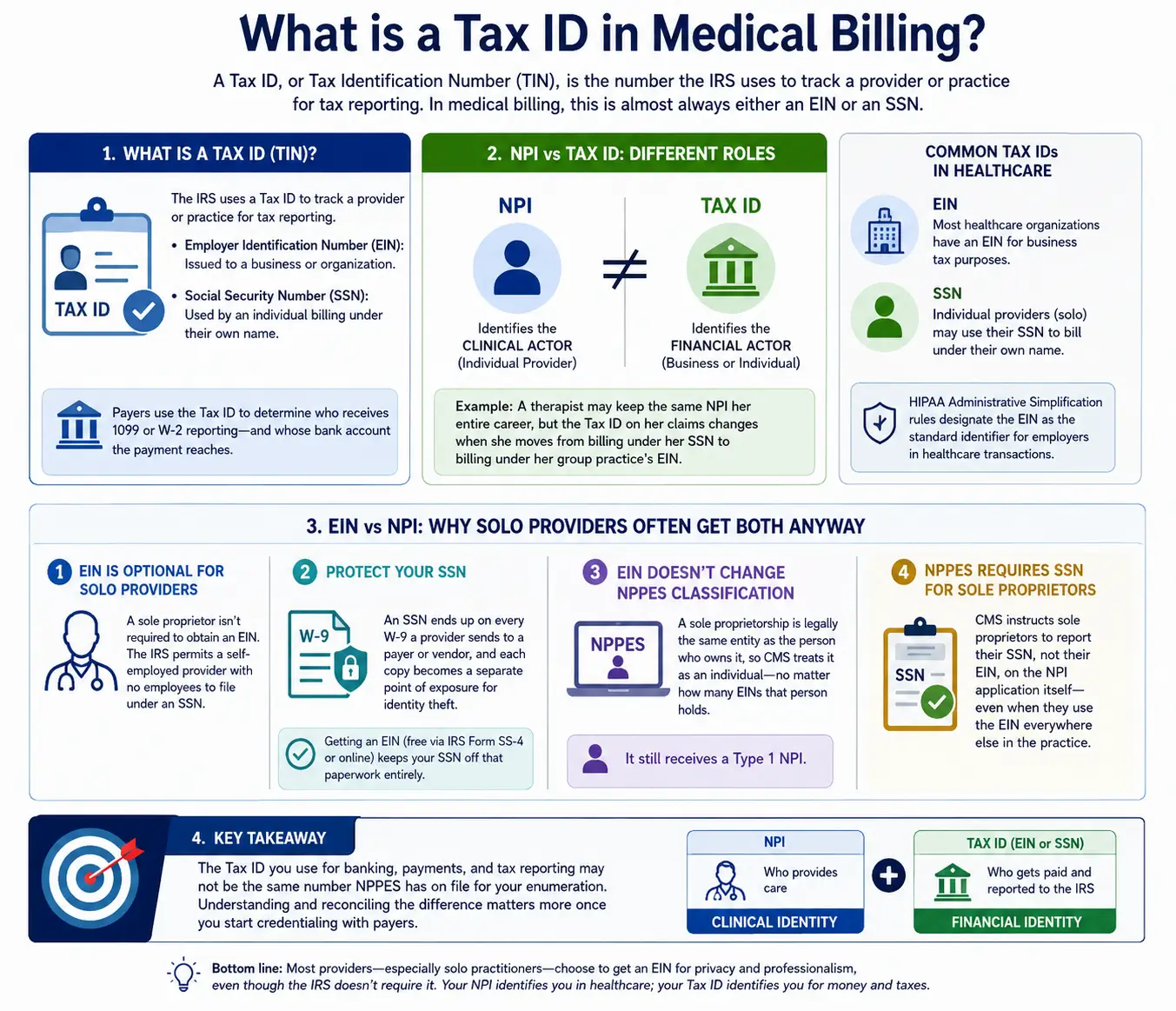
A tax ID, or Tax Identification Number (TIN), is the number the IRS uses to track a provider or practice for tax reporting. In medical billing this is almost always one of two things: an Employer Identification Number (EIN) issued to a business, or a Social Security Number (SSN) used by an individual billing under their own name. A payer relies on the tax ID to determine who receives 1099 or W-2 reporting and, practically speaking, whose bank account the payment reaches.
That’s the functional split behind NPI vs Tax ID: the NPI identifies a clinical actor, and the tax ID identifies a financial one. A solo therapist and the group practice she joins six months later might keep her exact same NPI the entire time, while the tax ID on her claims changes the day she starts billing under the group’s EIN instead of her personal SSN.
Most healthcare organizations already carry an EIN for ordinary business tax purposes, and HIPAA’s Administrative Simplification rules designate the EIN as the standard identifier for employers in healthcare transactions. Individual providers billing under their own name can use either an SSN or a personal EIN, and there’s a practical reason a growing number choose the latter.
EIN vs NPI: why solo providers often get both anyway
A sole proprietor isn’t required to obtain an EIN. The IRS permits a self-employed provider with no employees to file under an SSN. But an SSN ends up on every W-9 a provider sends to a payer or vendor, and each copy becomes a separate point of exposure for identity theft. Getting an EIN, free through IRS Form SS-4 or the online application, keeps the SSN off that paperwork entirely.
This is where the confusion compounds. Obtaining an EIN doesn’t change how NPPES classifies the provider. A sole proprietorship is legally the same entity as the person who owns it, so CMS treats it as an individual no matter how many EINs that person holds. It still receives a Type 1 NPI, and CMS instructs sole proprietors to report their SSN, not their EIN, on the NPI application itself, even when they use the EIN everywhere else in the practice. The tax ID a provider uses for banking and the one NPPES has on file for their enumeration aren’t always the same number, and reconciling the two matters more once that provider starts credentialing with payers.
NPI vs Tax ID: the core relationship
NPI | Tax ID (TIN) | |
Issued by | CMS, through NPPES | IRS |
Format | 10 digits, numeric only | 9 digits (EIN or SSN) |
Identifies | The provider or organization that delivered care | The entity responsible for tax reporting and payment |
Changes over time | No, permanent for life | Can change when a provider moves from solo billing to a group EIN |
Public record | Yes, free lookup at the NPI Registry | No, never published |
Required for | All HIPAA standard transactions | Claims, 1099/W-2 reporting, payer credentialing |
Payers cross-reference both numbers against their credentialing file before a claim moves to adjudication. If the billing provider NPI on a claim doesn’t match the tax ID the payer has on record for that specific NPI, the claim typically rejects at the front end. This single mismatch accounts for a disproportionate share of preventable claim rejections industry-wide.
Type 1 and Type 2 NPI: individual versus organizational
CMS assigns two kinds of NPI. A Type 1 NPI belongs to an individual: a physician, nurse practitioner, physical therapist, or any other licensed clinician who personally delivers care. A person holds exactly one Type 1 NPI for their entire career. A Type 2 NPI belongs to an organization: a group practice, hospital, clinic, or any incorporated entity billing under its own name. An organization can hold more than one Type 2 NPI if it operates multiple distinct business units or locations that bill separately, each potentially tied to its own group tax ID.
A solo practitioner billing under their own name typically needs only a Type 1 NPI. The moment that provider incorporates, forms an LLC, or joins a group billing under a shared name, a Type 2 NPI enters the picture for the organization, while the clinician keeps their personal Type 1 NPI to identify themselves as the person who rendered the service. That’s why a claim from a group practice carries two different NPIs on it: the organization’s Type 2 number as the billing provider, and the treating clinician’s Type 1 number as the rendering provider.
Where NPI and tax ID appear on claim forms
CMS-1500 (professional claims)
On the CMS-1500, used for physician and outpatient professional claims, the tax ID goes in Box 25, labeled Federal Tax ID Number, with a checkbox indicating whether it’s an EIN or an SSN. The rendering provider’s NPI goes in the unshaded portion of Box 24J, tied to the specific service line, while the shaded portion above it can carry the rendering provider’s taxonomy code. The billing provider’s NPI goes in Box 33a, next to the billing provider’s name and address in Box 33. In a solo practice, the NPI in 24J and 33a is identical. In a group practice, 33a carries the organization’s Type 2 NPI, the billing provider NPI, while 24J carries the individual clinician’s Type 1 NPI, the rendering provider NPI. A referring or ordering provider’s NPI, when one applies, goes in Box 17b. Leaving 24J or 33a blank doesn’t just trigger a denial. It makes the claim unprocessable, since the payer’s system has no provider to attach the service to.
UB-04 (institutional claims)
Hospitals, skilled nursing facilities, and other institutional providers bill on the UB-04, also known as the CMS-1450. The National Uniform Billing Committee (NUBC) designs this 81-field form. Form Locator 5 carries the federal tax number, and Form Locator 56 carries the billing provider’s NPI, always a Type 2 organizational number for the facility submitting the claim. Attending, operating, and other individual physicians involved in the patient’s care get their own Type 1 NPIs entered in separate form locators later in the form. The provider name entered in Form Locator 1 needs to match the NPI in Form Locator 56, since a mismatch between the two is one of the more common reasons institutional claims get returned for correction before they’re even considered for payment.
PTAN: the identifier that gets confused with both
A third number complicates NPI vs Tax ID for anyone billing Medicare specifically: the Provider Transaction Access Number, or PTAN. A Medicare Administrative Contractor (MAC) issues a PTAN once a provider’s Medicare enrollment application, submitted through PECOS (the Provider Enrollment, Chain, and Ownership System), is approved.
The PTAN doesn’t substitute for either the NPI or the tax ID, and it never appears on a CMS-1500 or UB-04 claim line. Its only job is authentication. When billing staff call a MAC to check claim status or resolve an enrollment issue, the representative confirms the caller’s identity using three pieces of information together: the NPI, the PTAN, and the last five digits of the TIN. Missing any one of the three, the representative can’t discuss the account.
Unlike the NPI, a PTAN isn’t published anywhere public. It can’t be looked up through the NPI Registry or any other directory. A provider who has misplaced theirs needs to check the original approval letter from their MAC, or log into PECOS directly to view it. A single provider can also hold multiple PTANs, one for each enrollment tied to a different practice location or MAC jurisdiction, while still holding only one NPI.
What does PTAN stand for, and how many can one provider have?
PTAN stands for Provider Transaction Access Number. How many a provider holds depends on how many separate Medicare enrollments they maintain. A clinician billing Medicare through two practice locations under different MAC jurisdictions, for instance, typically ends up with two separate PTANs tied to that same single NPI.
How to find your NPI number
The fastest way to find any provider’s NPI, including your own, is the NPI Registry at npiregistry.cms.hhs.gov, a free public search tool CMS operates under 45 CFR Part 162. No login is required to search it, and there’s no cap on how many lookups a person can run, though CMS rate-limits queries per hour for high-volume users and directs them to the downloadable data file instead. A search returns the provider’s name, specialty or taxonomy code, and practice address, the information CMS considers publicly relevant. It does not display a provider’s SSN or tax ID.
Providers who need a new NPI instead of looking up an existing one must apply through the National Plan and Provider Enumeration System (NPPES). The process begins by creating an Identity & Access Management (I&A) account, which is required before the NPI application can be accessed. Providers with questions about an existing record can also reach the NPI Enumerator directly at 800-465-3203, or 800-692-2326 for TTY.
As of August 2026, the NPPES database maintained by CMS held more than 9.3 million active provider records, spanning every individual clinician and organizational entity enumerated since the system launched in 2005.
Why NPI and tax ID mismatches cause denials
Most claim scrubbers and payer adjudication systems check the NPI, tax ID, and taxonomy code combination against what the provider submitted during credentialing before anything else happens to a claim. A few scenarios trigger this kind of rejection more than others. A group practice adds a new clinician and starts billing under the group’s Type 2 NPI before that clinician’s Type 1 NPI has been linked to the group in the payer’s system. A provider switches from billing under a personal SSN to a practice EIN without updating every payer’s file individually. Or a locum tenens provider’s rendering NPI gets paired with the wrong facility’s billing provider TIN on a claim. In each case, nothing about the care delivered is wrong. The administrative pairing the payer has on file doesn’t match what’s on the claim, and that’s enough to stop payment until someone corrects it.
Keeping both numbers current
A handful of situations tend to force an update to NPI or tax ID information at the same time:
- Moving from solo billing under an SSN to group billing under a shared EIN
- Adding a new practice location that needs its own Type 2 NPI or separate Medicare enrollment
- A locum tenens assignment where the rendering provider NPI and the facility’s tax ID belong to two different organizations
- A merger or acquisition that changes the legal business name tied to an existing tax ID
Each of these needs the same follow-up: update the record in NPPES, update the PECOS enrollment if Medicare is involved, and notify every commercial payer’s credentialing department directly, since payers don’t automatically pull changes from NPPES on their own. Skipping any one of these steps is how a correctly coded, medically necessary claim ends up denied over an administrative mismatch instead of a clinical one. Getting NPI vs Tax ID right before the first submission, rather than fixing it after a denial lands, is one of the more reliable ways to keep a practice’s reimbursement timeline predictable.