


A radiology order comes across your desk marked “MRI abdomen w/wo contrast,” and the claim needs a code. For most facilities performing this dual-phase exam, that code is CPT 74183. It shows up constantly in gastroenterology, oncology, and hepatobiliary workups, yet it’s also one of the more commonly misapplied abdominal imaging codes because it gets confused with its single-phase siblings and with MRCP orders that don’t map to a code of their own. This guide walks through what the code actually describes, what the documentation needs to show before a claim goes out the door, and where billing teams tend to lose reimbursement they should have kept.
What CPT code 74183 covers
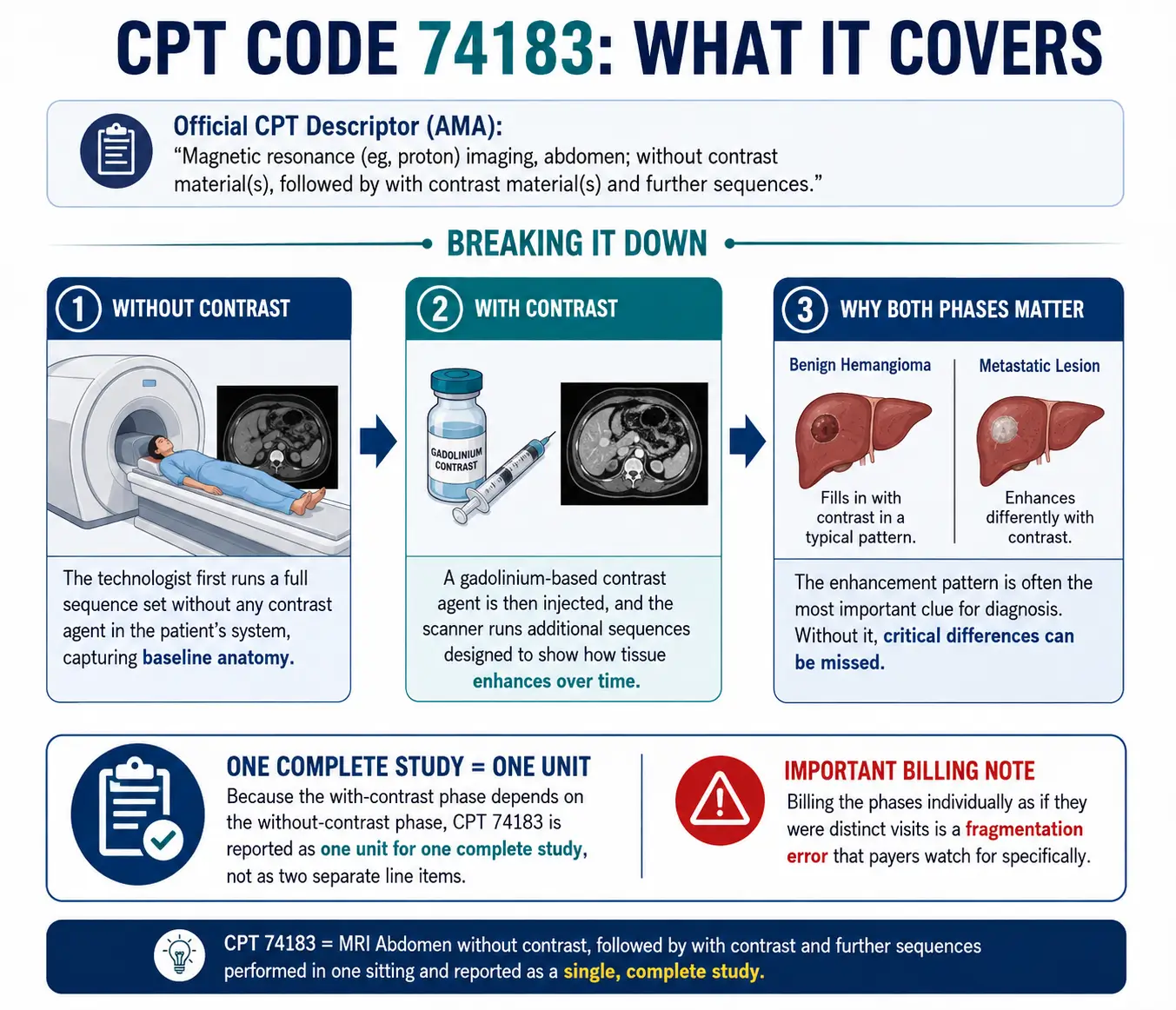
The American Medical Association’s official descriptor for CPT code 74183 reads: “Magnetic resonance (eg, proton) imaging, abdomen; without contrast material(s), followed by with contrast material(s) and further sequences.” That single sentence is doing a lot of work, so it helps to break it apart.
The exam has two phases performed in one sitting. The technologist first runs a full sequence set without any contrast agent in the patient’s system, capturing baseline anatomy. A gadolinium-based contrast agent is then injected, and the scanner runs additional sequences designed to show how tissue enhances over time. That enhancement pattern is often the single most useful piece of information in the study. A benign hemangioma fills in with contrast differently than a metastatic lesion, and a radiologist reading only the non-contrast images would miss that distinction entirely.
Because the with-contrast phase depends on the without-contrast phase, CPT 74183 is reported as one unit for one complete study, not as two separate line items. Billing the phases individually as if they were distinct visits is a fragmentation error that payers watch for specifically.
CPT 74183 compared with 74181 and 74182
The abdominal MRI code family has three members, and mixing them up is one of the most frequent coding mistakes in diagnostic radiology billing.
CPT code | Descriptor | When it applies |
74181 | MRI abdomen without contrast material(s) | Contrast is contraindicated, declined, or not clinically needed (for example, a limited follow-up on a known simple cyst) |
74182 | MRI abdomen with contrast material(s) | A contrast-only protocol is ordered and no non-contrast sequences are separately obtained as part of the billed study |
74183 | MRI abdomen without contrast, followed by with contrast and further sequences | The full two-phase protocol described above |
The distinction matters because a payer auditing a chart for 74183 expects to see documentation of both phases. If the radiology report only describes a single contrast-enhanced sequence set, the claim more accurately belongs under 74182, and billing 74183 anyway is an overstatement of the service performed, regardless of intent.
Where MRCP fits into the 74183 code family
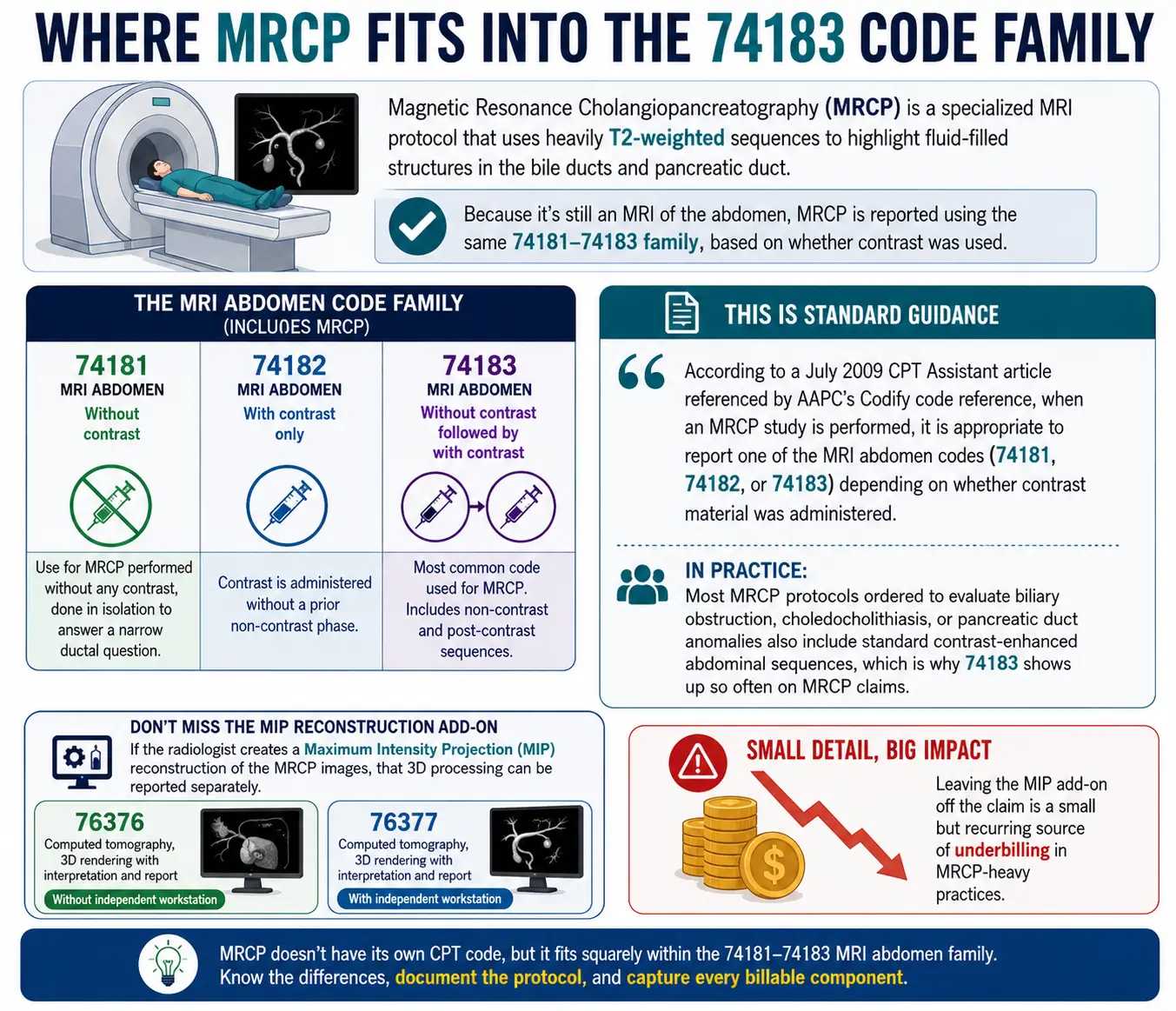
Magnetic resonance cholangiopancreatography, usually shortened to MRCP, doesn’t have a dedicated CPT code. It’s a specialized MRI protocol focused on the bile ducts and pancreatic duct, built on heavily T2-weighted sequences that make fluid-filled structures stand out. Because it’s still fundamentally an MRI of the abdomen, it gets reported using the same 74181 to 74183 family, chosen according to whether contrast was used.
This isn’t a workaround or a gray area. According to a July 2009 CPT Assistant article referenced by AAPC’s Codify code reference, when an MRCP study is performed, it is appropriate to report one of the MRI abdomen codes (74181, 74182, or 74183) depending on whether contrast material was administered. In practice, most MRCP protocols ordered to evaluate biliary obstruction, choledocholithiasis, or pancreatic duct anomalies also include standard contrast-enhanced abdominal sequences, which is why 74183 shows up so often on MRCP claims. A pure MRCP performed without any contrast, done in isolation to answer a narrow ductal question, would instead map to 74181.
One coding detail that gets missed: if the radiologist generates a maximum intensity projection (MIP) reconstruction of the MRCP images, that 3D processing can be reported separately using 76376 (when done without a separate, dedicated workstation) or 76377 (when an independent workstation is used). Leaving that add-on off the claim is a small but recurring source of underbilling in MRCP-heavy practices.
Clinical scenarios that call for 74183
A handful of indications account for most orders billed under this code.
Liver lesion characterization. When ultrasound or CT turns up an indeterminate mass, the dynamic contrast phases of 74183 are frequently the deciding test. A hemangioma, focal nodular hyperplasia, hepatocellular carcinoma, and a metastatic deposit can look similar on a single non-contrast image but enhance in distinctly different patterns across arterial, portal venous, and delayed phases.
Cancer staging. For gastrointestinal, gynecologic, urologic, and hepatobiliary malignancies, clinicians often need a continuous look from the diaphragm down through the pelvis. In those cases, 74183 for the abdomen is frequently ordered alongside 72197 (MRI pelvis without and with contrast) in the same session. Each code still needs its own supporting diagnosis and its own medical necessity documentation; ordering both together does not automatically guarantee both are paid.
Renal mass evaluation. A dedicated renal MRI protocol, sometimes called a renal mass protocol, uses multiphase contrast timing similar to liver protocols to characterize kidney lesions found incidentally on ultrasound or CT, particularly in patients where iodinated CT contrast is contraindicated.
Pancreatic and biliary disease. Chronic pancreatitis, suspected pancreatic neoplasm, and biliary strictures are common indications, frequently paired with the MRCP sequences described above.
Inflammatory bowel disease. MR enterography, a variant abdominal MRI protocol optimized for bowel wall assessment in Crohn’s disease, is also generally billed under this code family depending on the contrast protocol used.
Documentation requirements for CPT 74183
Payers scrutinize abdominal MRI claims more than many other imaging codes because of the cost difference between a single-phase and dual-phase study. Four categories of documentation need to be airtight.
Medical necessity
The referring provider’s order and clinical notes need to establish why an MRI, specifically, was needed rather than continued observation, ultrasound, or CT. For indeterminate liver lesions, this usually means referencing the prior imaging finding that prompted the MRI. For cancer staging, it means documenting the known or suspected malignancy and the specific staging question the MRI is meant to answer. Vague language like “abdominal pain, rule out pathology” without supporting clinical context is one of the more common triggers for a medical necessity denial.
Protocol documentation showing both phases
The technologist’s protocol summary and the radiologist’s report both need to reflect that non-contrast sequences were acquired first and that contrast-enhanced sequences followed. A report that only describes the post-contrast findings, with no mention of a non-contrast phase, undermines a 74183 claim even if the technologist actually performed both phases. If it isn’t written down, from a billing standpoint, it didn’t happen.
Contrast safety documentation
Before gadolinium-based contrast is administered, the chart should reflect a renal function assessment. The 2025 update to the American College of Radiology’s Manual on Contrast Media shifted away from universal baseline estimated glomerular filtration rate (eGFR) testing for every patient, moving instead toward targeted screening based on specific risk factors such as known kidney disease, diabetes, or prior acute kidney injury. Patients with stable eGFR in the 30 to 59 mL/min/1.73 m² range generally don’t require special precautions, since the ACR guidance notes that nephrogenic systemic fibrosis in that population is exceedingly rare with modern agents. For patients with eGFR below 30, on dialysis, or with acute kidney injury, the chart should document which contrast agent group was selected and the clinical rationale for proceeding. This isn’t just a safety formality; auditors reviewing high-cost contrast studies increasingly expect to see that renal risk was assessed and addressed, not simply that contrast was given.
A complete final report
The radiology report should include the clinical indication, the technique used (explicitly naming both phases and the sequences run), comparison to prior studies where relevant, findings organized by organ system, and an impression that directly answers the clinical question posed in the order. A report that reads as a generic template without patient-specific findings is a red flag in a payer audit, independent of whether the code itself was correct.
Billing tips and modifier guidance
Split the professional and technical components correctly. When the equipment and the interpreting radiologist belong to different entities, such as a hospital-owned scanner read by an outside radiology group, the technical component is billed with modifier TC and the professional interpretation with modifier 26. Getting this backward, or having both parties bill globally, is a common source of duplicate payment denials.
Check NCCI edits before combining codes. The National Correct Coding Initiative maintains Procedure-to-Procedure (PTP) edit pairs and Medically Unlikely Edits (MUEs) that govern which codes can be billed together on the same date of service. If a PTP edit pair carries a modifier indicator of 0, no modifier will bypass it; the codes simply cannot be paid together under any circumstances. When an edit does allow an override, modifier 59 or one of the more specific X-modifiers (XE, XS, XP, XU) can be appended, but only when the documentation genuinely supports that the services were distinct. CMS treats modifier 59 as a modifier of last resort, appropriate only when no more specific modifier applies.
Document distinctness when billing 74183 with 72197. Abdomen and pelvis MRI staging studies are frequently ordered together, and billing both is appropriate when the clinical picture supports imaging both regions. Each code still needs its own diagnosis code and its own line of medical necessity in the note; simply listing both regions in a single sentence without individual justification invites a bundling denial.
Don’t forget the 3D reconstruction add-on when applicable. As noted above, 76376 or 76377 can be reported alongside 74183 when MIP or other 3D processing is performed and separately documented, which is common on MRCP-heavy protocols.
Confirm prior authorization before scheduling. Advanced imaging, including 74183, is frequently subject to prior authorization through radiology benefit management vendors under commercial and Medicare Advantage plans. Submitting the authorization request with the specific clinical indication that matches what ultimately appears in the radiology report reduces the chance of a post-service medical necessity denial.
Reimbursement factors to know
Payment for 74183 under Medicare follows the standard Resource-Based Relative Value Scale (RBRVS) methodology: separate relative value units for physician work, practice expense, and malpractice risk, each adjusted by a geographic practice cost index for the locality, then multiplied by the annual conversion factor. Beginning with the CY 2026 Medicare Physician Fee Schedule final rule, CMS introduced two separate conversion factors, one for qualifying Alternative Payment Model participants and one for physicians and practitioners who are not APM participants, which means two practices billing the identical code can see different Medicare payment amounts depending on their APM status. Because both the RVU values and the conversion factor are updated annually and vary by locality, billing teams should pull current figures from the CMS Physician Fee Schedule Look-Up Tool for their specific locality rather than relying on a flat national number. Commercial payer contracts typically use Medicare RVUs as a starting benchmark but apply their own negotiated conversion factors, so the same code can reimburse very differently across payers even within the same metropolitan area.
Common denial reasons and how to avoid them
Most 74183 denials trace back to a small set of recurring issues: medical necessity documentation that doesn’t connect the order to a specific clinical question, a radiology report that fails to describe both the non-contrast and contrast-enhanced phases, missing or expired prior authorization, and NCCI bundling conflicts when multiple imaging codes are billed on the same date without adequate distinctness documentation. Building a pre-submission checklist around these four points, and having coders verify the report language matches the code billed before the claim goes out, catches the majority of avoidable denials before they happen.
CPT code 74183 is a routine part of abdominal and hepatobiliary imaging billing, but the documentation standard behind it is not casual. A claim only holds up when the record shows two distinct imaging phases, a renal safety check appropriate to the patient’s risk profile, and a clinical question that the report actually answers.