


A biller gets a claim back with a generic denial code and reaches straight for the appeal form. Half the time, that’s the wrong tool. The Centers for Medicare & Medicaid Services (CMS) and most commercial payers treat reopening, reconsideration, and appeal as three separate actions, each with its own paperwork, deadline, and reviewing party. Mixing them up costs time: a reopening request lands in front of a Qualified Independent Contractor that has no authority to grant it, or a formal appeal gets filed for a clerical fix that never needed one.
Understanding reopening vs reconsideration vs appeal in medical billing starts with one distinction: only appeal carries statutory rights that can, in Medicare’s case, run all the way to federal court. Reopening and reconsideration exist to resolve simpler disputes faster. Here’s how each one works, how Medicare structures its five appeal levels, and where commercial payers draw the lines differently.
What is reopening in medical billing
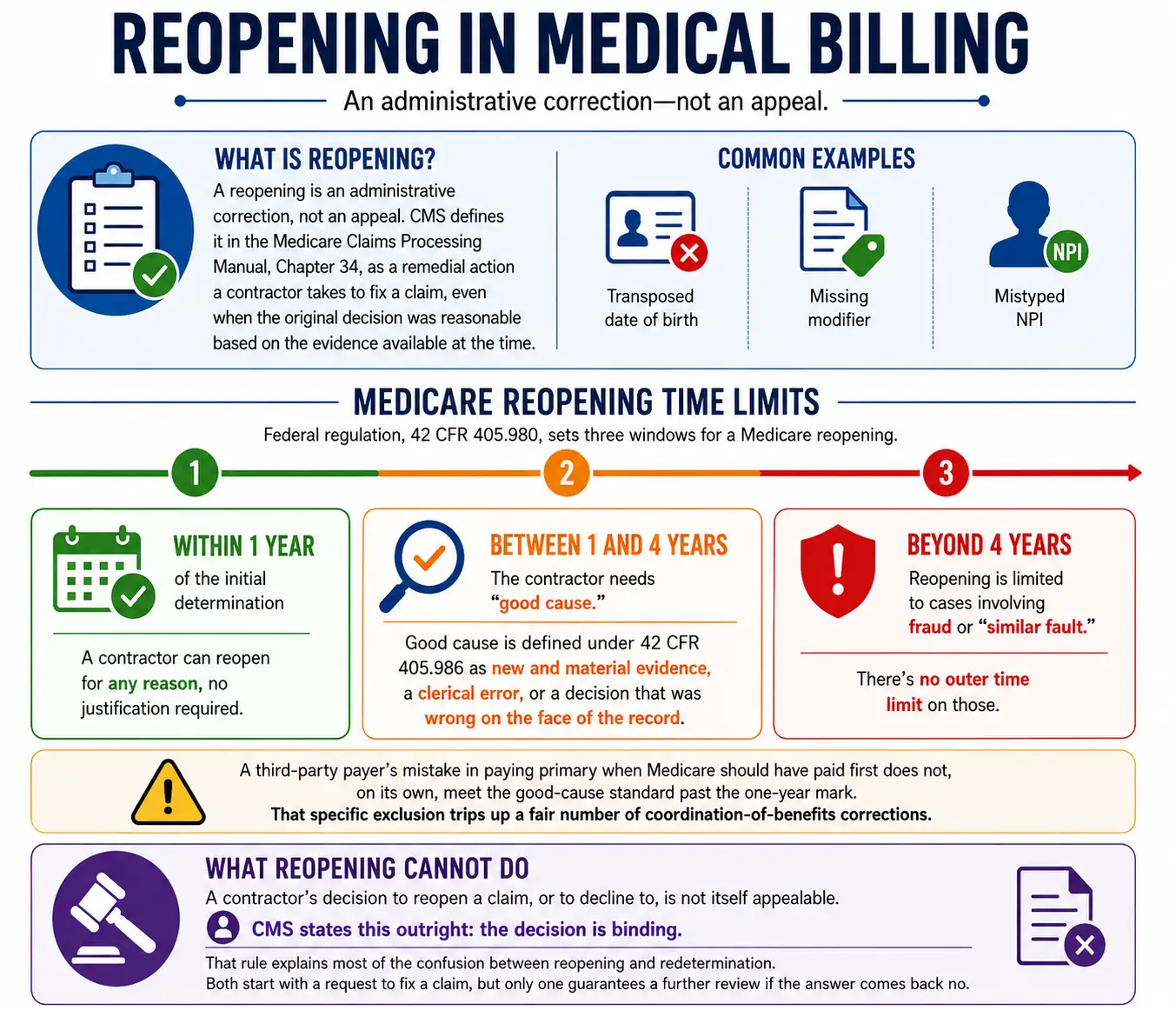
A reopening is an administrative correction, not an appeal. CMS defines it in the Medicare Claims Processing Manual, Chapter 34, as a remedial action a contractor takes to fix a claim, even when the original decision was reasonable based on the evidence available at the time. It’s built for errors that don’t need a hearing: a transposed date of birth, a missing modifier, a mistyped NPI.
Medicare reopening time limits
Federal regulation, specifically 42 CFR 405.980, sets three windows for a Medicare reopening:
- Within 1 year of the initial determination: a contractor can reopen for any reason, no justification required.
- Between 1 and 4 years: the contractor needs “good cause,” defined under 42 CFR 405.986 as new and material evidence, a clerical error, or a decision that was wrong on the face of the record.
- Beyond 4 years: reopening is limited to cases involving fraud or what CMS calls “similar fault.” There’s no outer time limit on those.
A third-party payer’s mistake in paying primary when Medicare should have paid first does not, on its own, meet the good-cause standard past the one-year mark. That specific exclusion trips up a fair number of coordination-of-benefits corrections.
What reopening cannot do
A contractor’s decision to reopen a claim, or to decline to, is not itself appealable. CMS states this outright: the decision is binding. That rule explains most of the confusion between reopening and redetermination. Both start with a request to fix a claim, but only one guarantees a further review if the answer comes back no.
Reopening vs redetermination: why the two get confused
Redetermination is the formal first level of Medicare’s appeal process, and it answers a question new billers ask constantly: what is the first level of appeal for Original Medicare. A provider who disagrees with an initial determination has 120 days to file Form CMS-20027, or a written equivalent, with the Medicare Administrative Contractor (MAC). The MAC then has 60 days to decide. Unlike reopening, a redetermination decision comes with full appeal rights; an unfavorable outcome can be escalated to reconsideration.
The two processes are also built for different errors. Timely filing denials show the split clearly. Under CMS policy, a claim denied for missing the 12-month filing deadline isn’t treated as an initial determination at all, so it can’t go through redetermination. The only route is a reopening request documenting one of CMS’s narrow exceptions, such as an error made by a Medicare contractor or agent of HHS. A redetermination filed against a timely filing denial goes nowhere, no matter how well it’s written.
What is reconsideration in medical billing?
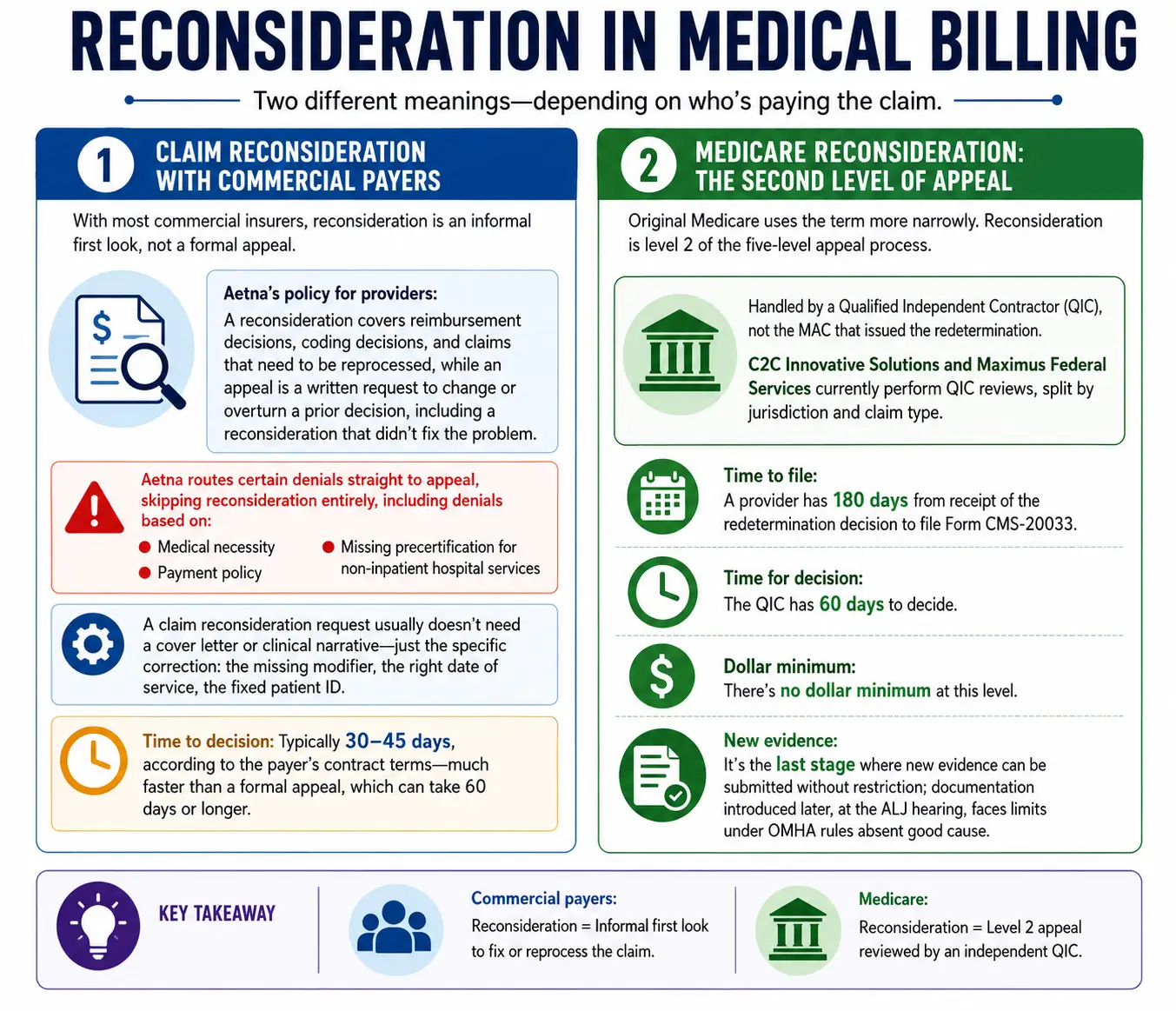
Reconsideration means two different things depending on who’s paying the claim, and that split is the biggest source of confusion around the term.
Claim reconsideration with commercial payers
With most commercial insurers, reconsideration is an informal first look, not a formal appeal. Aetna’s published disputes-and-appeals policy for providers puts it directly: a reconsideration covers reimbursement decisions, coding decisions, and claims that need to be reprocessed, while an appeal is a written request to change or overturn a prior decision, including a reconsideration that didn’t fix the problem. Aetna routes certain denials straight to appeal, skipping reconsideration entirely, including denials based on medical necessity, payment policy, or a missing precertification for non-inpatient hospital services.
A claim reconsideration request usually doesn’t need a cover letter or clinical narrative, just the specific correction: the missing modifier, the right date of service, the fixed patient ID. How long it takes to get a reconsideration decision back depends on the payer’s contract terms, but 30 to 45 days is typical, against 60 days or longer once a case becomes a formal appeal.
Medicare reconsideration: the second level of appeal
Original Medicare uses the term more narrowly. Reconsideration is level 2 of the five-level appeal process, handled by a Qualified Independent Contractor (QIC), not the MAC that issued the redetermination. C2C Innovative Solutions and Maximus Federal Services currently perform QIC reviews, split by jurisdiction and claim type. A provider has 180 days from receipt of the redetermination decision to file Form CMS-20033, and the QIC has 60 days to decide. There’s no dollar minimum at this level, and it’s the last stage where new evidence can be submitted without restriction; documentation introduced later, at the ALJ hearing, faces limits under OMHA rules absent good cause.
What is an appeal in medical billing?
An appeal, broadly, is a formal written request asking a payer to reverse a decision it has already made. A corrected claim just fixes a data error and resubmits, no dispute involved. A commercial reconsideration is a faster, less formal review that usually precedes a true appeal. An appeal is the heavier instrument: structured, evidence-based, and bound to deadlines the payer has to follow.
The types of appeals in medical billing split along two lines. The first is internal versus external: an internal appeal goes to the payer’s own appeals unit, while an external appeal (or external review) goes to an independent organization outside the payer. The second is patient versus provider. A patient’s right to internal and external review of a coverage denial comes from Affordable Care Act Section 2719, which applies to non-grandfathered plans, separate from a provider’s contractual right to appeal a payment decision, which depends on the provider agreement and, in many states, prompt-pay statutes. Medicare Advantage adds a further split, between pre-service appeals of a prior authorization denial (30-day standard, 72-hour expedited) and post-service appeals of a paid claim.
Reconsideration vs appeal in medical billing: the core distinction
The difference between appeal and reconsideration in medical billing comes down to formality and finality. Commercial reconsideration is a quick correction path with light documentation requirements. Appeal is structured, with defined deadlines, outcomes, and, in Medicare’s system, further-review rights at every level. Is reconsideration the same as an appeal? At most commercial payers, no. In Medicare’s own terminology, though, reconsideration is technically level 2 of the appeal process, so a biller working across both systems has to hold two definitions of the same word at once.
Process | What triggers it | Who reviews it | Typical filing deadline | Further appeal rights |
Reopening | Clerical error, minor correction, timely filing exception | Same MAC or contractor that processed the claim | 1 year (any reason); 4 years (good cause); no limit (fraud) | None; the decision is binding |
Redetermination (Medicare level 1) | Disagreement with an initial determination | Medicare Administrative Contractor | 120 days | Yes, to reconsideration |
Reconsideration, commercial payer | Coding, reimbursement, or processing dispute | Payer’s internal review team | Often 30–60 days, payer-specific | Yes, to formal appeal |
Reconsideration (Medicare level 2) | Disagreement with the redetermination | Qualified Independent Contractor | 180 days | Yes, to ALJ hearing |
Formal appeal | Medical necessity, policy denial, or unresolved reconsideration | Payer’s appeals unit, or OMHA/ALJ for Medicare | Payer-specific; 60 days at Medicare level 3 | Varies by level and payer |
The levels of appeal in medical billing for Medicare claims
Original Medicare’s appeal process runs through five defined levels, each with its own reviewer and timeframe. Starting at level 3, a minimum dollar amount has to remain in dispute before the case can move forward.
Level | Reviewer | Filing deadline | Decision timeframe | 2026 dollar threshold |
1. Redetermination | Medicare Administrative Contractor | 120 days | 60 days | None |
2. Reconsideration | Qualified Independent Contractor | 180 days | 60 days | None |
3. ALJ hearing | Administrative Law Judge, Office of Medicare Hearings and Appeals (OMHA) | 60 days | 90 days | $200 |
4. Appeals Council review | Medicare Appeals Council, HHS Departmental Appeals Board | 60 days | Varies | Same as level 3 |
5. Federal district court | U.S. District Court | 60 days | Court’s own schedule | $1,960 |
The amount-in-controversy threshold moves most years; it rose from $190 in 2025 to $200 in 2026, per CMS’s Federal Register adjustment. A claim worth less can still go through redetermination and reconsideration, but the appeal effectively stops there unless the provider aggregates related denials to clear the bar. Level 4 review, by the Medicare Appeals Council, generally focuses on whether the ALJ applied the law correctly and followed proper procedure, rather than re-weighing the clinical evidence from scratch.
Level 3 is where most providers feel the wait. OMHA’s own reporting shows average ALJ processing time peaked at 1,430 days in fiscal year 2020, the result of a backlog that once exceeded 800,000 pending claims after a period of aggressive post-payment auditing. Congress appropriated $182.3 million in 2018 to help OMHA add staff and work through it, and processing times have improved substantially since, though they can still run past the 90-day statutory target depending on the hearing office.
Commercial payer appeal levels are usually simpler: one internal level, then external review, against Medicare’s five.
What “upheld” and “overturned” mean in an appeal decision
QIC and ALJ decisions sort into a small set of outcomes, and the labels matter because they determine what happens next. CMS’s published Part C QIC reporting categorizes reconsideration outcomes as fully favorable, partially favorable, unfavorable, dismissed, withdrawn, or remanded, and the same basic categories apply across Medicare’s appeal levels.
In plain terms: a denial upheld means the reviewer agreed with the payer’s original decision, and the claim stays denied. A denial overturned, or appeal overturned, means the reviewer sided with the provider and reversed some or all of the original decision. Appeal upheld and decision upheld describe the same result from the reviewer’s side, that the earlier determination stands. A partially favorable decision overturns part of a claim while leaving the rest denied, common when a single claim bills several lines and only some of them lacked adequate documentation.
Overturn rates vary sharply by payer type. An analysis by Premier Inc., reported by TechTarget in 2025, found that private payers overturned more than 60% of initial denials once providers pursued the full appeal process, against roughly 50% for Medicare and managed Medicaid, about 53% for Medicare Advantage, and about 46% for Medicaid. Premier’s analysts noted that most overturns required multiple rounds of appeal, not a single request, which says as much about escalation friction as it does about the merits of the underlying claims.
Recoupment and its connection to reopening
Recoupment sits on the other side of a reopening, when the contractor, not the provider, starts the process. If a post-payment audit finds Medicare paid more than it should have, the MAC issues a demand letter and recovers the difference, either by withholding it from future payments or requiring a direct refund. That finding is itself the product of a reopening under the Program Integrity Manual, governed by the same one-year, four-year, good-cause standard that applies to a provider-requested correction.
A demand letter, unlike a routine reopening decision, comes with defined appeal rights under Section 935 of the Medicare Modernization Act. A provider who files a redetermination request within 30 days can stop recoupment while that appeal is pending. If the redetermination is unfavorable, recoupment resumes on day 60 unless the provider files a QIC reconsideration within 60 days of that decision, which pauses it again until the QIC rules. Once the QIC decides, recoupment resumes and continues regardless of any further appeal to an ALJ, the Appeals Council, or federal court. Interest accrues on the disputed balance throughout, recalculated if the appeal later reduces the amount owed.
Which process to use, and when
- Use a reopening for a clerical error on a processed claim: wrong date of birth, missing modifier, incorrect NPI, or a documented timely filing exception. No dispute, just a correction.
- Use a commercial reconsideration when a denial looks like a processing or coding mistake and the payer offers that step. Submit the specific fix, not a clinical narrative.
- Use a redetermination (Medicare level 1) for any initial determination the provider disagrees with, filed within 120 days.
- Use a Medicare reconsideration when a redetermination came back unfavorable and 180 days remain to escalate to the QIC.
- Use a formal appeal when the denial rests on medical necessity, coverage policy, or a reconsideration that didn’t resolve the dispute, and the provider is prepared to build a documentation-heavy case.
Billing teams that track these as one undifferentiated “appeals” bucket tend to lose the easy wins: the reopening that could have closed a claim in two weeks instead sits in a redetermination queue for two months. Knowing the difference between reopening, reconsideration, and appeal in medical billing isn’t a formality. It’s the difference between a claim that gets paid on the first correction and one that spends a year working through five levels of review it never needed to reach.