


Physicians and medical coders use the 99232 CPT code daily to bill for subsequent hospital care. This code applies to patients admitted to an inpatient floor or held under observation status. The American Medical Association (AMA) removed history and physical exam counting from evaluation and management (E/M) selection. Providers now assign this code using either the total encounter time or the medical decision-making (MDM) level.
To navigate these requirements, this guide covers the following headings:
- Official 99232 CPT Code Description and Setting Guidelines
- Medical Decision-Making Criteria for 99232
- Comparison of Subsequent Hospital Care Codes
- 99232 Time Requirements and Encounter Rules
- Split and Shared Visit Billing Requirements
- Modifier Applications and 99232 Frequency Limit Updates
- Audit Risks and Documentation Compliance
- Reimbursement Rates and Relative Value Units
Official 99232 CPT Code Description and Setting Guidelines
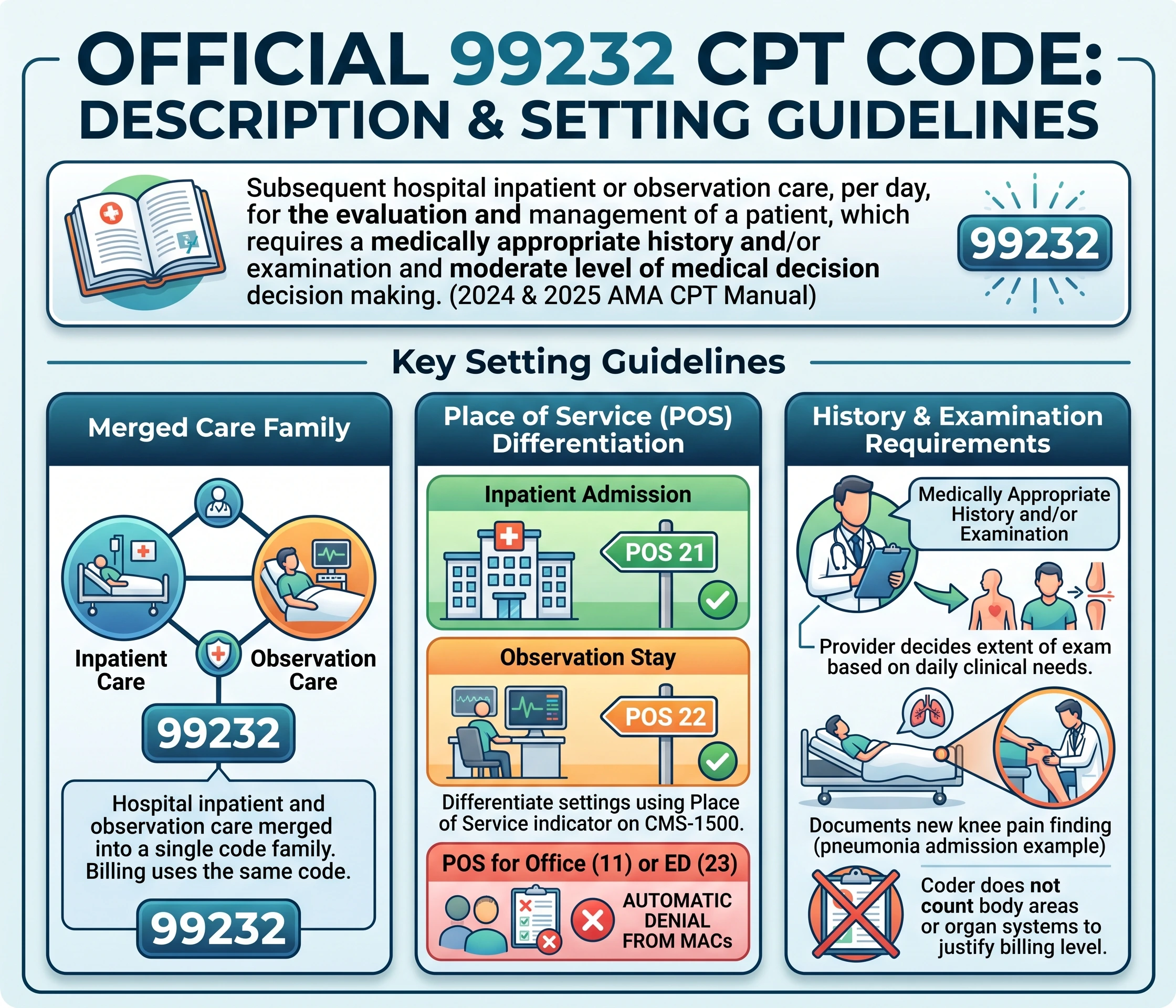
The exact 99232 CPT code description in the 2024 and 2025 AMA CPT manual states: “Subsequent hospital inpatient or observation care, per day, for the evaluation and management of a patient, which requires a medically appropriate history and/or examination and moderate level of medical decision making.”
The AMA merged hospital inpatient and observation care into a single code family. Billing teams use the same five-digit code for both admission types. They differentiate the setting using the Place of Service (POS) indicator on the CMS-1500 claim form.
A formal inpatient admission requires POS 21. An observation stay requires POS 22. Submitting 99232 with an office POS (11) or emergency department POS (23) generates an automatic denial from Medicare Administrative Contractors (MACs).
The code description mandates a “medically appropriate history and/or examination.” Providers decide the extent of the exam based on the patient’s daily clinical needs. If a patient admitted for pneumonia complains of new knee pain, the physician examines the knee and documents the findings. The coder does not count body areas or organ systems to justify the billing level.
Medical Decision-Making Criteria for 99232
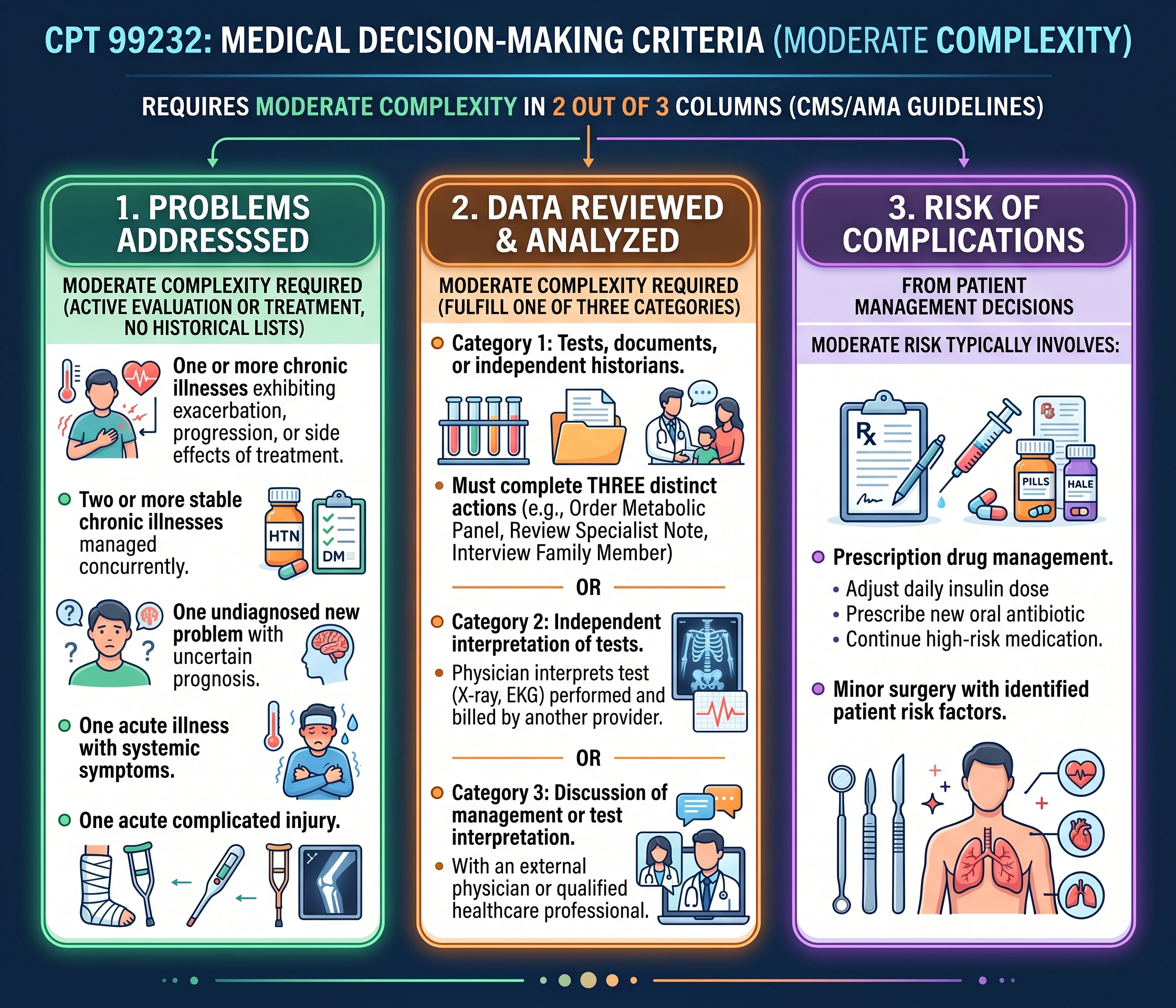
Billing based on complexity requires meeting the 99232 moderate MDM threshold. The Centers for Medicare and Medicaid Services (CMS) divides medical decision-making into three columns. A claim requires moderate complexity in two out of the three columns.
Problems Addressed
The first column tracks the number and complexity of problems managed during the encounter. The provider must actively evaluate or treat the conditions. Simply listing a patient’s historical diagnoses does not count.
Meeting the moderate threshold requires documenting one of the following:
- One or more chronic illnesses exhibiting exacerbation, progression, or side effects of treatment.
- Two or more stable chronic illnesses managed concurrently.
- One undiagnosed new problem accompanied by an uncertain prognosis.
- One acute illness featuring systemic symptoms.
- One acute complicated injury.
Data Reviewed and Analyzed
The second column measures the diagnostic data the provider orders, reviews, or analyzes. Moderate complexity requires fulfilling one of three categories:
- Category 1: Tests, documents, or independent historians. The provider must complete three distinct actions, such as ordering a metabolic panel, reviewing an external specialist’s note, and interviewing a family member because the patient has dementia.
- Category 2: Independent interpretation of tests. The physician interprets an X-ray or EKG that another provider performed and billed.
- Category 3: Discussion of management or test interpretation with an external physician or qualified healthcare professional.
Risk of Complications
The third column evaluates the risk of patient management decisions made during the visit. Moderate risk typically involves prescription drug management. Deciding to adjust a daily insulin dose, prescribing a new oral antibiotic, or intentionally continuing a high-risk medication meets this criteria. Minor surgery involving identified patient risk factors also qualifies as moderate risk.
Comparison of Subsequent Hospital Care Codes
Medical coders differentiate between the three subsequent care codes by searching the clinical note for specific acuity indicators.
CPT Code | MDM Level | Time Requirement | Typical Clinical Scenario |
99231 | Straightforward or Low | 25 minutes | Stable patient, expected response to therapy, medication continuation. |
99232 | Moderate | 35 minutes | Active worsening, medication adjustment, new data requiring synthesis. |
99233 | High | 50 minutes | Significant new complication, unstable condition, high-risk treatment decision. |
Auditors frequently scrutinize the line between 99231 vs 99232. According to an American Academy of Professional Coders (AAPC) 2024 coding clinic, continuing a home medication regimen for a stable patient supports 99231. If the provider reviews abnormal morning lab results and alters the dosage of an intravenous medication, the work shifts to a 99232.
Stepping down codes as patients recover is a regulatory requirement. A patient recovering from sepsis might justify a 99233 on Monday, a 99232 on Wednesday, and a 99231 on Friday prior to discharge.
99232 Time Requirements and Encounter Rules
Providers bypassing the MDM method can use the 99232 total encounter time for code selection. The 99232 35 minutes threshold represents the absolute minimum. The time span for this code extends to 49 minutes.
If a provider documents exactly 99232 37 minutes, the claim is compliant. If the documented time falls to 34 minutes, the coder must downcode the encounter to 99231, which requires only 25 minutes. If the time reaches 50 minutes, the encounter qualifies for 99233.
The total time calculation includes both face-to-face and non-face-to-face work performed by the billing provider on the same calendar date. Providers sum the minutes spent:
- Reviewing the patient’s chart and recent lab results before entering the room.
- Performing the physical examination and interviewing the patient.
- Counseling the patient’s family members about the treatment plan.
- Ordering new medications or diagnostic imaging.
- Documenting the clinical note in the electronic health record (EHR).
- Coordinating care with nurses or consulting specialists.
Providers cannot count time spent on separately billable procedures. If a physician spends 15 minutes performing a joint injection (CPT 20610) during a 45-minute patient visit, they must subtract the 15 procedure minutes. The remaining 30 minutes only supports a 99231 E/M code. Providers also cannot count time spent by nurses, medical assistants, or residents.
Split and Shared Visit Billing Requirements
Many hospitals deploy a shared care model where physicians work alongside advanced practice providers (APPs), such as nurse practitioners and physician assistants. The 2024 CMS Medicare Physician Fee Schedule final rule modified how facilities bill these split visits.
To bill a shared 99232 visit based on time, the facility submits the claim under the National Provider Identifier (NPI) of the clinician who accrued more than half of the total time. The clinical note must state the specific minutes contributed by each professional. If the APP spends 20 minutes and the physician spends 15 minutes, the hospital bills under the APP’s credential.
When billing based on medical decision-making, the billing provider must perform the substantive portion of the MDM. CMS requires documentation proving which provider formulated the assessment, analyzed the complex data, or made the moderate-risk management decisions. The physician cannot simply co-sign the APP’s note and bill under their own NPI based on MDM.
Modifier Applications and 99232 Frequency Limit Updates
Correct modifier usage prevents automated claim rejections. Medical billers append Modifier 25 to the 99232 code when the provider performs a significant, separately identifiable evaluation and management service on the same day as a minor surgical procedure. The E/M documentation must stand alone. The history and exam associated with the minor procedure do not count toward the 99232 requirements.
Modifier AI identifies the principal physician of record who oversaw the patient’s admission. While mandatory for initial hospital care (99221-99223), standard Medicare guidelines do not require Modifier AI on subsequent care codes.
The 99232 frequency limit depends entirely on clinical necessity rather than arbitrary payer caps. Medicare allows one subsequent hospital care code per patient, per day, per specialty. If two cardiologists from the same practice see the same patient on Tuesday, they must combine their work and bill a single E/M code for the day. If a cardiologist and a nephrologist see the patient on Tuesday, both can bill 99232 independently using their respective specialty taxonomy codes.
Following the expiration of the COVID-19 public health emergency, CMS finalized new rules for telehealth encounters. Providers can report 99232 for subsequent hospital care delivered via synchronous audio-video technology. Claims require Modifier 95 to denote a telehealth visit. Medicare discontinued coverage for audio-only subsequent hospital care; a two-way visual connection is a strict requirement.
Audit Risks and Documentation Compliance
Third-party auditors target hospital E/M codes due to high utilization volumes. According to a 2024 compliance review published by the Office of Inspector General (OIG), cloning or “copy-forwarding” clinical notes remains the most common error in inpatient billing.
EHR systems allow providers to copy yesterday’s note into today’s encounter. If a physician copies a Wednesday note to support a Thursday 99232 claim without updating the interval history, vital signs, or patient status, Medicare views the documentation as invalid. Every note must reflect the specific work performed on the actual date of service.
Another documentation risk involves the assessment and plan. Providers often pull the patient’s entire active problem list into the daily note. The 99232 billing guidelines dictate that providers only receive MDM credit for problems actively managed during that specific visit. A patient might have chronic kidney disease, hypertension, and gout. If the provider only evaluates and orders treatment for the hypertension on Tuesday, the other two conditions do not contribute to the moderate MDM calculation for that day.
Reimbursement Rates and Relative Value Units
The AMA assigns Relative Value Units (RVUs) to every CPT code to measure the required physician work, practice expense, and malpractice risk. For 2024 and 2025, 99232 carries 1.39 physician work RVUs and a total of roughly 2.01 facility RVUs.
CMS calculates the actual payment by multiplying the total RVUs by the annual conversion factor. The CY2025 Medicare Physician Fee Schedule sets the conversion factor at $32.347. This translates to an unadjusted Medicare national payment rate of approximately $65.01 for the 99232 code in a facility setting. Geographic practice cost indices (GPCI) adjust this baseline slightly depending on the hospital’s location.
Commercial health insurance plans negotiate reimbursement rates independently. A 2025 claims analysis by HCUP (Healthcare Cost and Utilization Project) indicates that private payers reimburse 99232 at rates ranging from 130% to 210% of the Medicare allowable amount. Billing the exact same code with identical documentation yields $65.01 from a Medicare Part B plan and up to $136.00 from a commercial PPO, emphasizing the financial impact of accurate code assignment across all payer classes. Maintaining strict adherence to the time and MDM guidelines secures this revenue against post-payment audits.