

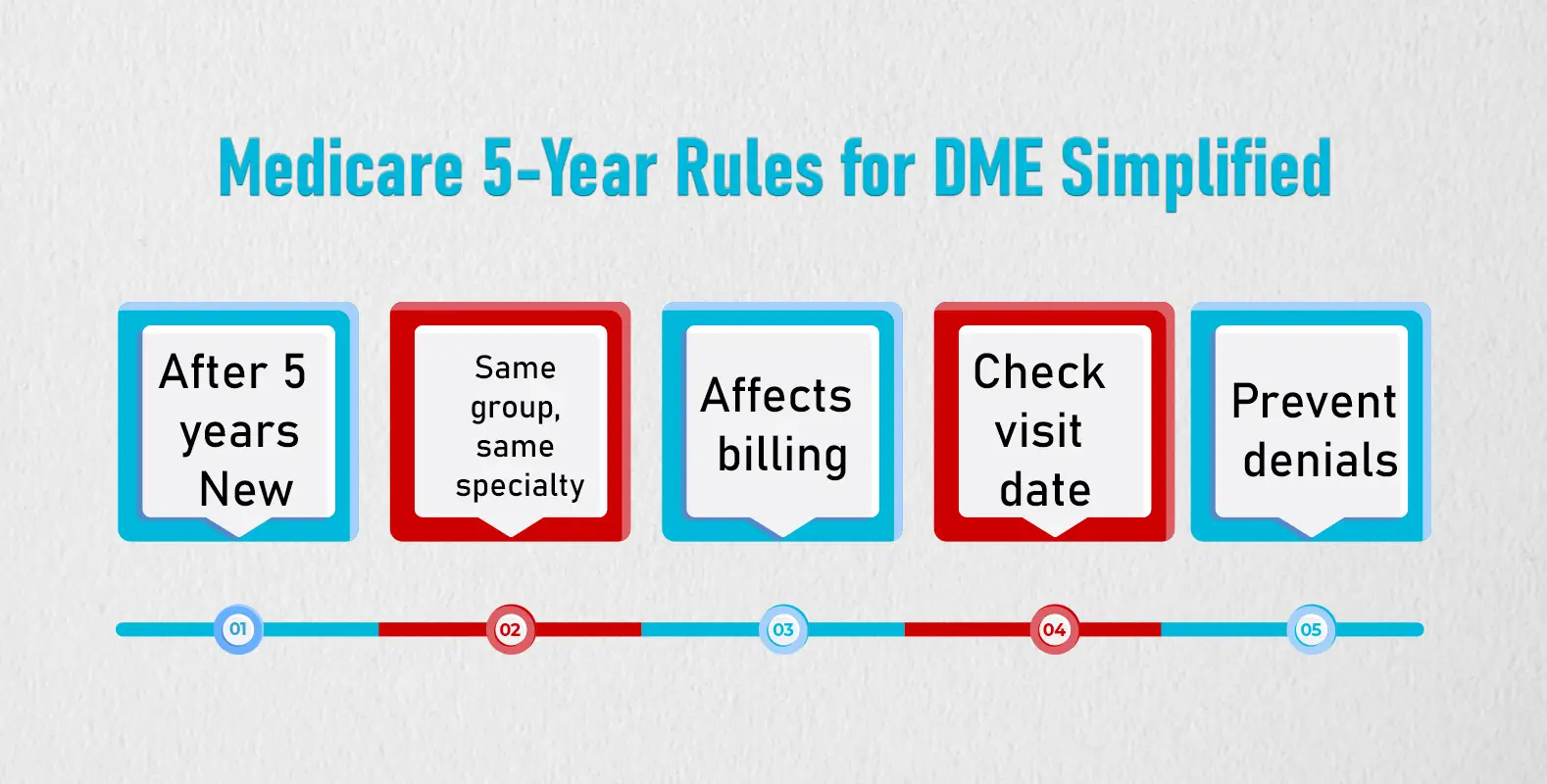
A patient’s power wheelchair stops climbing curbs the way it used to. A CPAP machine starts losing pressure in year four. A hospital bed motor seizes up two months before the five-year mark. Billers field these calls on a regular basis, and the answer almost never depends on how worn the equipment looks or how badly the patient wants something new. It depends on a single regulatory concept called reasonable useful lifetime, and on how the Medicare 5-year replacement rule for DME defines when a full replacement claim can actually be paid.
What qualifies as durable medical equipment in the first place
Before replacement timing matters, an item has to qualify as DME under Medicare Part B. CMS defines durable medical equipment in the Medicare Benefit Policy Manual (Pub. 100-02, Chapter 15, Section 110.1) as equipment that can withstand repeated use, is primarily used to serve a medical purpose, is not generally useful in the absence of illness or injury, and is appropriate for use in the home. There is also a durability floor built into the definition: an item must have a Minimum Lifetime Requirement, or MLR, of at least three years to be classified as DME at all. Items expected to wear out sooner get billed as supplies instead.
The MLR and the reasonable useful lifetime get confused constantly, including in a lot of published billing guidance. They are not the same thing. The MLR is a three-year durability test that decides whether an item can be called DME in the first place. The reasonable useful lifetime, or RUL, is a separate five-year clock that governs when Medicare will pay to replace an item the beneficiary already has. A biller who mixes the two up will misjudge when a replacement claim is even worth submitting.
How the Medicare 5-year replacement rule for DME actually works
Under 42 CFR 414.210(f), the reasonable useful lifetime of DME, orthotics, and prosthetics (with a few exceptions covered below) is set by the Secretary of Health and Human Services and cannot be less than five years. Where no specific program instruction sets a different period, DME Medicare Administrative Contractors determine the RUL for an item, but the floor is still five years. The Medicare Benefit Policy Manual, Chapter 15, Section 110.2(C), lays out the operating rule in plain terms: replacement due to wear during the RUL period is not covered. Once the RUL has passed, Medicare may pay for a replacement, provided the item is still medically necessary and the coverage criteria for that item are still met.
Age alone does not trigger payment. A five-year-old wheelchair that still functions and still meets the beneficiary’s needs will not get replaced automatically just because the clock ran out. The RUL sets the earliest point at which replacement becomes possible, not a guarantee that it will happen.
How Medicare counts the five years
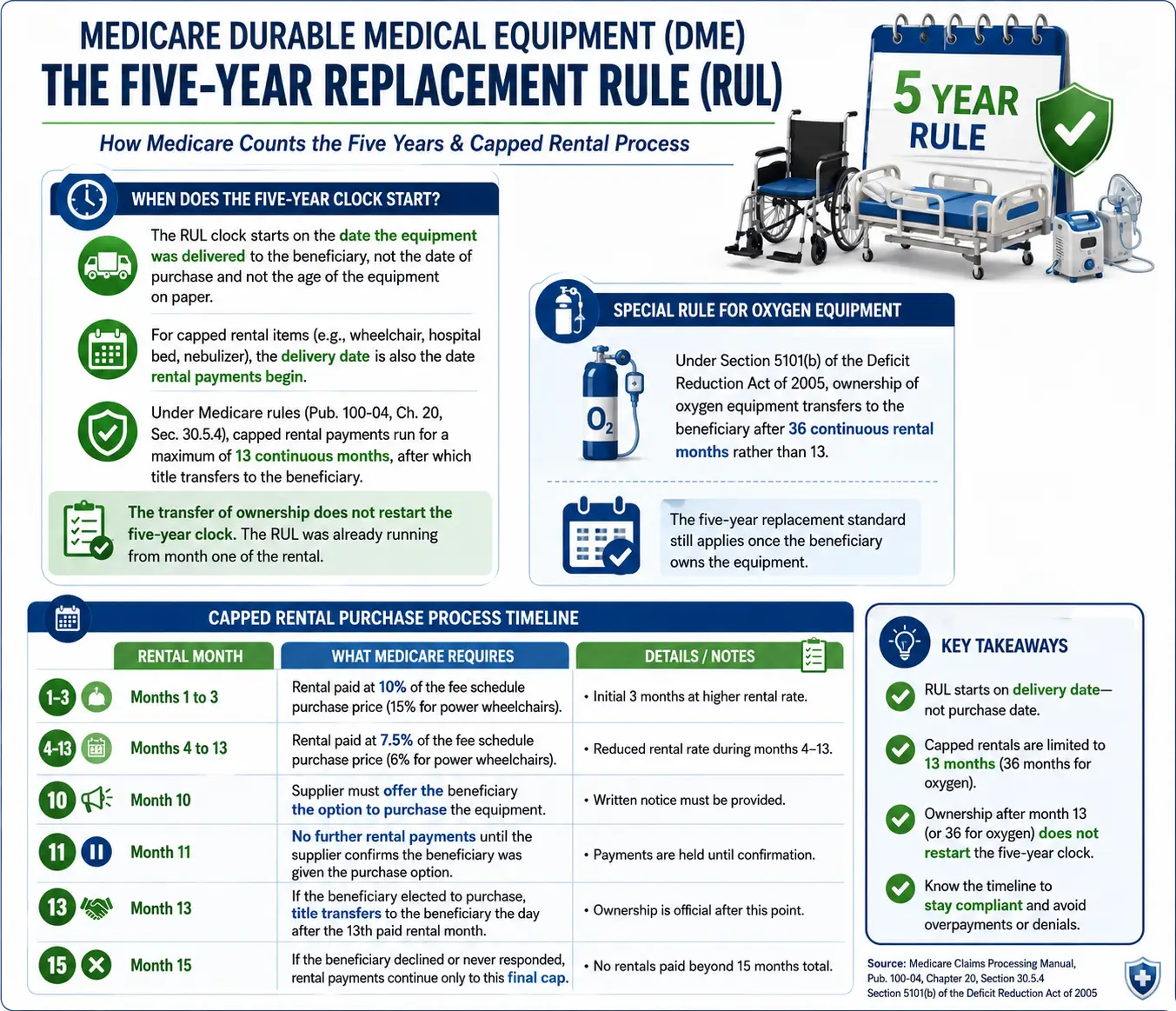
The RUL clock starts on the date the equipment was delivered to the beneficiary, not the date of purchase and not the age of the equipment on paper. For an item billed as a capped rental, such as a standard wheelchair, hospital bed, or nebulizer, the delivery date is also the date rental payments begin. Under the Medicare Claims Processing Manual (Pub. 100-04, Chapter 20, Section 30.5.4), capped rental payments run for a maximum of 13 continuous months, after which title to the equipment transfers to the beneficiary. That transfer of ownership does not restart the five-year clock. The RUL was already running from month one of the rental.
Oxygen equipment follows a different capped period. Under Section 5101(b) of the Deficit Reduction Act of 2005, ownership of oxygen equipment transfers to the beneficiary after 36 continuous rental months rather than 13, though the five-year replacement standard still applies once the beneficiary owns it.
The capped rental purchase process itself has specific timing that trips up billers unfamiliar with it:
Rental month | What Medicare requires |
Months 1 to 3 | Rental paid at 10 percent of the fee schedule purchase price (15 percent for power wheelchairs) |
Months 4 to 13 | Rental paid at 7.5 percent (6 percent for power wheelchairs) |
Month 10 | Supplier must offer the beneficiary the option to purchase the equipment |
Month 11 | No further rental payments until the supplier confirms the beneficiary was given the purchase option |
Month 13 | If the beneficiary elected to purchase, title transfers to the beneficiary the day after the 13th paid rental month |
Month 15 | If the beneficiary declined or never responded, rental payments continue only to this final cap |
Repairs during the reasonable useful lifetime
Within the five-year window, Medicare’s default position favors repair over replacement. Repairs to beneficiary-owned equipment are covered when they are reasonable and necessary to keep the item serviceable, but routine maintenance such as cleaning, testing, or regulating is not a covered repair. The limiting factor is cost: if the estimated repair expense exceeds the cost of replacing the item outright, Medicare will not pay for the repair. Suppliers are expected to compare the two before billing, not after.
That comparison matters more than it might appear, because it is not just theoretical. The HHS Office of Inspector General issued audit A-09-22-03003 on July 31, 2023, examining Medicare Part B claims for repairs made to enrollee-owned wheelchairs still within their five-year RUL. Over the January 2016 through December 2021 audit period, Medicare paid $91.1 million nationwide for repairs to 77,774 wheelchairs still inside their RUL. Of the 688,948 individual repair claims reviewed, 184,154 (27 percent) were paid after the accumulated repair costs for a given wheelchair had already crossed the federally recommended cost limit of 60 percent of the replacement cost. OIG classified $30.1 million of that spending as potentially unallowable, with an associated $7.6 million in beneficiary coinsurance. CMS concurred with the findings and agreed to work with the DME MACs on system edits to flag repair claims that cross the 60 percent threshold. As of this writing, CMS lists all four related recommendations as open and unimplemented. For billers, the practical lesson is straightforward: track accumulated repair costs against the replacement price before submitting another repair claim, because the accumulated total, not any single repair, is what determines whether the claim is compliant.
When early replacement is covered before the five-year mark
Medicare does allow replacement before the RUL has run its course, but only under a narrow set of circumstances. Early replacement is generally covered when:
- The equipment is lost.
- The equipment is stolen.
- The equipment is damaged beyond repair, including damage from an accident or a natural disaster.
- The beneficiary’s medical condition changes in a way that the current equipment can no longer meet, and a physician documents the change.
Wear and tear, no matter how severe, is not on that list. An item that is simply worn out inside its RUL period is a repair claim, not a replacement claim, unless the repair-versus-replacement cost comparison above justifies replacement on cost grounds. Loss, theft, and accidental damage claims generally require proof, such as a police report for theft or a supplier’s documented assessment for accident damage, along with a new order from the treating practitioner confirming the item is still medically necessary.
The paperwork that makes or breaks a replacement claim
CMS discontinued Certificates of Medical Necessity and DME Information Forms for claims with dates of service on or after January 1, 2023. In their place, every DMEPOS order, including a replacement order, now has to satisfy the Standard Written Order requirement. A compliant SWO includes six elements:
- Beneficiary name or Medicare Beneficiary Identifier
- Description of the item
- Quantity, if applicable
- Treating practitioner’s name or National Provider Identifier
- Date of the order
- Treating practitioner’s signature
For a replacement claim specifically, that order needs to sit alongside documentation establishing why the replacement is being requested, whether that is proof of loss or theft, a supplier’s repair-versus-replacement cost analysis, or clinical notes describing a change in the beneficiary’s condition. Medical necessity does not carry over automatically from the original claim. It has to be reestablished for the replacement.
Face-to-face and written-order requirements for certain DME
A separate layer of documentation applies to items on CMS’s Required Face-to-Face Encounter and Written Order Prior to Delivery List. Authorized under Section 6407 of the Affordable Care Act and codified at 42 CFR 410.38, this requirement means a physician, physician assistant, nurse practitioner, or clinical nurse specialist has to document a face-to-face encounter with the beneficiary within the six months preceding the written order, and the supplier has to receive that written order before the item is delivered, not after.
The list started in 2013 with a set of power mobility devices and has grown through periodic Federal Register updates. A January 13, 2022 notice (87 FR 2051) covered power mobility device codes plus several orthoses and an osteogenesis stimulator. A January 17, 2023 notice (88 FR 2546) added ten more orthoses. A May 13, 2024 notice (89 FR 41324) added a hospital bed, osteogenesis stimulator, and additional orthosis codes. Most recently, a January 13, 2026 notice (91 FR 1250) added eight oxygen and oxygen delivery system codes, bringing the list to 83 items as of April 13, 2026. Billers working with power mobility devices, certain orthoses, osteogenesis stimulators, or oxygen equipment need to check the current list before delivery, since a missing or late face-to-face encounter is a straightforward, avoidable denial reason.
Two exceptions to the five-year rule
Not every category follows the standard RUL. Prosthetic devices, such as artificial limbs, are governed by different replacement criteria. Under CMS Transmittal AB-01-123, effective for items replaced on or after April 1, 2001, a prosthetic device can be replaced when a physician documents a change in the beneficiary’s physiological condition, when the device is lost or irreparably damaged, or when repair costs would exceed 60 percent of the cost of a comparable replacement. There is no fixed five-year wait built into that standard.
External breast prostheses carry their own timeline. CMS instructs DME MACs to treat silicone breast prostheses as having a two-year reasonable useful lifetime, while fabric, foam, or fiber-filled prostheses are treated as having a six-month lifetime, reflecting how much faster those materials degrade with normal wear.
A hypothetical scenario billers run into often
Consider a beneficiary who received a power wheelchair through a capped rental five years and two months ago. The drive motor fails, and the supplier’s technician estimates a repair at roughly $1,100. A comparable replacement wheelchair prices out at around $1,400 on the DME fee schedule. Two facts make this a straightforward replacement claim rather than a repair claim. First, the RUL has already passed, since delivery was more than five years ago. Second, even setting the RUL aside, the repair cost sits close enough to the replacement cost that a repair-versus-replacement comparison would favor replacement anyway. The treating practitioner issues a new Standard Written Order confirming the wheelchair is still medically necessary, the supplier documents the failed motor and the cost comparison, and the claim goes in as a replacement rather than a repair. Had the same failure happened at year three instead of year five, with no lost, stolen, or irreparably damaged justification and no documented change in the beneficiary’s condition, the same claim would likely be denied as a replacement and would need to be billed as a repair instead.
What this means for billers and coding students
Three habits separate a clean replacement claim from a denied one. Confirm the original delivery date before assuming the RUL has passed, since ownership transfer dates and purchase dates are not the same as delivery dates. Compare accumulated repair costs against replacement cost before submitting another repair claim on an item nearing its RUL, given how the 2023 OIG wheelchair audit found suppliers weren’t consistently doing this. And check whether the item sits on the current Face-to-Face Encounter and Written Order Prior to Delivery List, since that list has changed four times since 2022 and keeps expanding into equipment categories, including oxygen, that were not on it a few years ago.
None of this replaces a physician’s clinical judgment about whether a patient still needs the equipment. It determines whether Medicare will pay for it, which is a separate question billers are the ones actually answering on every claim they submit.