
1. TL;DR: What You Need to Know About CPT 99204
⚡ Quick Facts
- What it is: CPT code 99204 is the billing code for new patient office or outpatient visits requiring moderate-complexity medical decision-making (MDM).
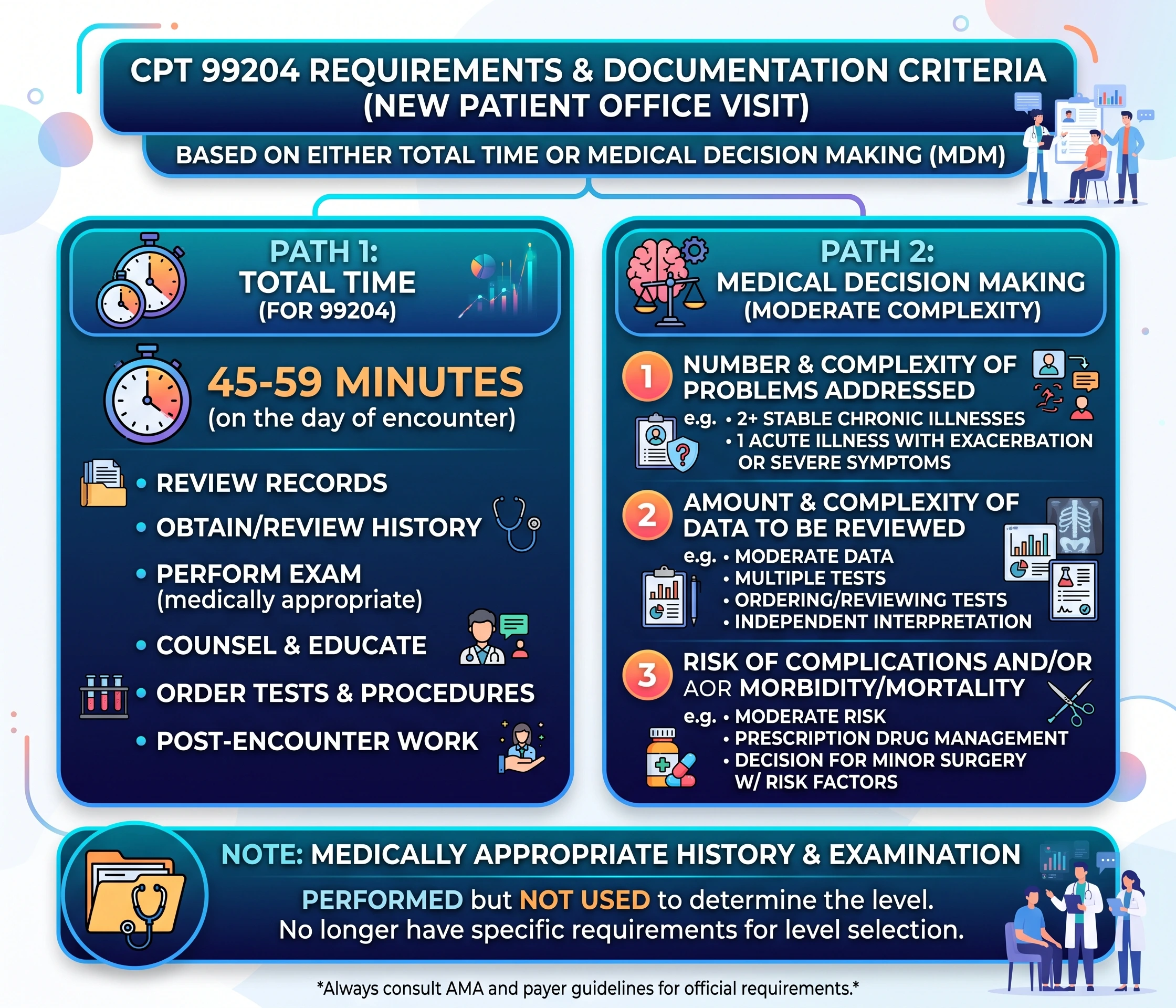
- When to use it: New patient (not seen by any provider in your practice within 3 years) + moderate MDM complexity + total encounter time 45–59 minutes
- 2025 Medicare reimbursement: $167.10 (varies by geographic area using GPCI; private payers average $181.72–$244.74)
- Key RVU values: 2.0 work RVU, 0.22 malpractice RVU
- Why it matters: Accurate 99204 billing maximizes reimbursement, reduces audit risk, and accelerates cash flow. Underbilling loses revenue; overbilling invites compliance scrutiny.
- Common pitfall: Many practices underutilize 99204 due to documentation concerns or misunderstanding time vs. MDM requirements post-2021 E/M rule changes.
- Bottom line: Accurate 99204 billing can increase practice revenue by 5–15% when properly documented and paired with strong denial prevention strategies.
2. What Is CPT Code 99204? Definition & Clinical Use
Official Definition
“Office or other outpatient visit for the evaluation and management of a new patient which requires a medically appropriate history and/or examination and moderate medical decision making.”
— American Medical Association (AMA), CPT® Code Official Definition
CPT code 99204 is part of the Evaluation & Management (E/M) service category—the most commonly billed set of codes in primary care, urgent care, and specialty medicine.
What “New Patient” Means
A new patient is someone who has not been seen by any provider within your practice in the past 3 years. This applies even if they’ve been seen by another provider at a different practice location or in a different specialty. Once the 3-year window resets, they revert to “established patient” status (codes 99211–99215).
Why 99204 Is Used in Practice
In real-world scenarios, 99204 billing applies to visits where:
- A patient presents with multiple chronic conditions requiring review and potential medication adjustments (e.g., uncontrolled diabetes + hypertension + recent cardiac event)
- The diagnosis is uncertain, requiring extensive history, examination, and data review to narrow differential diagnosis
- Risk of morbidity is significant (e.g., new chest pain, unexplained weight loss, neurological symptoms)
- Patient counseling and care coordination are required (e.g., lifestyle modifications, specialist referrals, care plan development)
- The visit includes diagnostic testing review or interpretation (e.g., labs, imaging, EKGs)
The Clinical vs. Administrative Reality
Clinically, providers often spend 50+ minutes with complex new patients—ordering tests, reviewing records, coordinating referrals, and educating patients on treatment options. Administratively, practices frequently underbill these encounters by selecting lower-complexity codes (99202 or 99203) due to documentation uncertainty.
According to a 2022 academic medical center audit, hospital-wide billing improvements for E/M services resulted in $233,988.79 in additional revenue per 10,000 encounters—demonstrating the financial stakes of accurate code selection.
3. When to Use 99204: Key Eligibility Criteria
Three Required Elements (Post-2021 Changes)
Criterion 1: Patient Status
- First visit in 3+ years (or new to practice entirely)
Criterion 2: Medically Appropriate History and/or Examination
- Unlike old rules, the 2021 E/M changes eliminated the “three key components” requirement
- History and exam must be medically appropriate to the patient’s presentation—not necessarily comprehensive
- For example: A patient with isolated knee pain may not need a comprehensive neurological exam, but the history should document injury mechanism, onset, severity, and functional impact
Criterion 3: Medical Decision-Making (MDM) Level OR Total Time (Choose One)
- MDM = Moderate complexity, OR
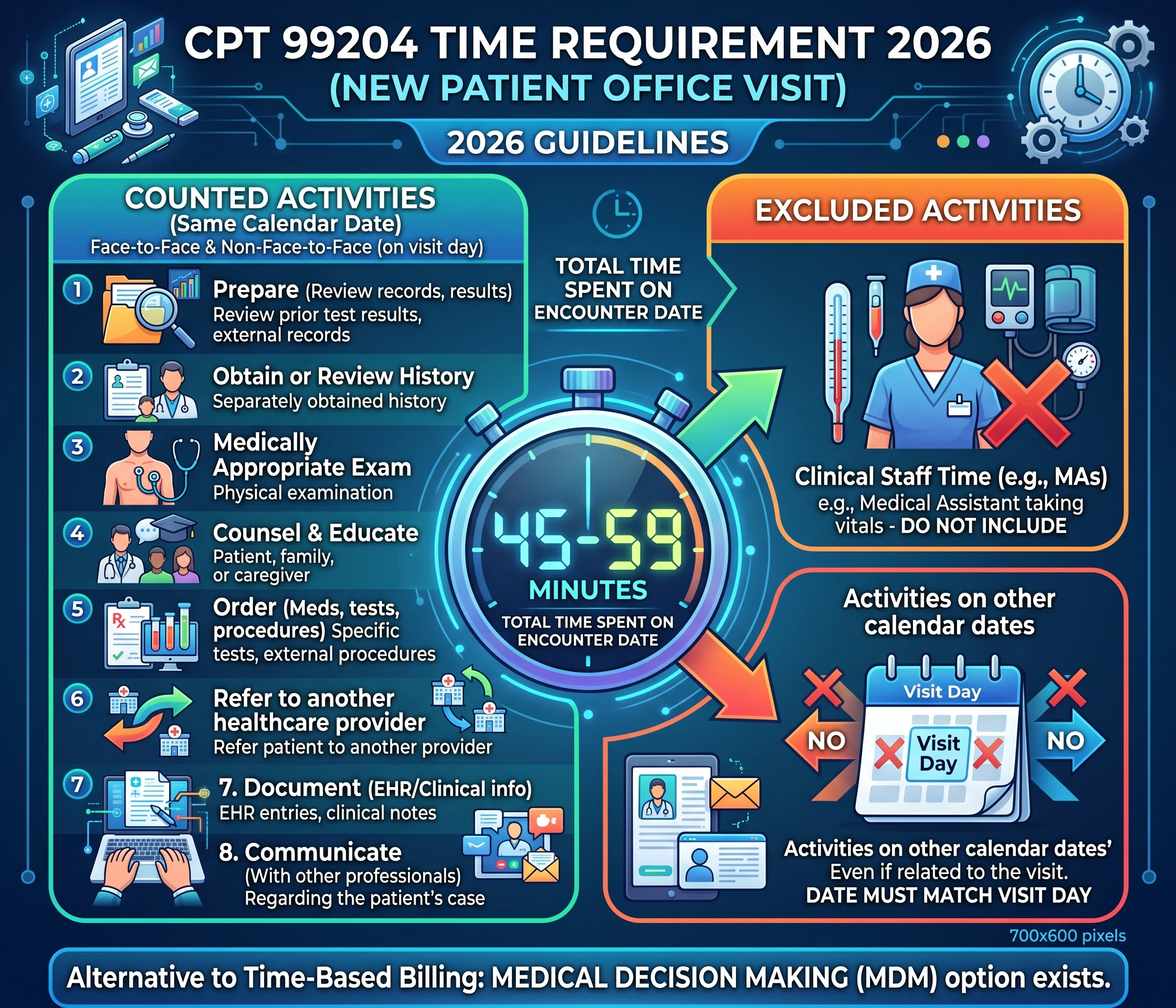
- Total time = 45–59 minutes on the date of service
This “either/or” approach (post-2021) gives providers flexibility: if documentation of MDM is strong, time becomes less critical; if time is well-documented, borderline MDM may suffice.
Understanding Moderate Complexity MDM
Moderate complexity requires at least two of the following three elements:
| Element | Definition | Examples |
|---|---|---|
| 1. Problem Complexity | Multiple or complex diagnoses; uncertain diagnosis; significant social or functional impact | Multiple chronic diseases; new symptom with broad differential; complex medication interactions |
| 2. Data Review | Review of diagnostic tests, imaging, prior records, specialist reports | Reviewing recent labs, X-rays, cardiology notes; ordering new tests; comparing historical trends |
| 3. Risk Level | Risk of serious complication or mortality; management decisions with moderate or significant consequences | Adjusting anticoagulation; managing sepsis risk; ruling out MI; initiating new oncology treatment |
Key point: For 99204, providers need at least 2 of 3 elements documented clearly. Vague documentation like “complex patient” or “multiple issues” will not withstand payer audits.
Time-Based Alternative (45–59 Minutes)
Total time includes:
- Face-to-face time with patient (history, exam, counseling, procedures)
- Non-face-to-face time on the date of service (reviewing records, ordering tests, coordinating care, documentation)
Best practice: Document actual time in the EHR. Time-based selection is especially defensible when physical or mental status makes detailed MDM documentation challenging (e.g., severely ill or confused patients).
4. 99204 vs. 99203 vs. 99205: Complete Comparison Table
| Feature | 99202 | 99203 | 99204 | 99205 |
|---|---|---|---|---|
| Patient Status | New | New | New | New |
| MDM Complexity | Straightforward | Low | Moderate | High |
| Typical Time (Minutes) | 15–29 | 30–44 | 45–59 | 60–74 |
| Medicare Reimbursement (2025) | $72.86 | $112.84 | $167.10 | $220.36 |
| Example Clinical Scenario | Stable viral URI; mild ear infection | Controlled HTN follow-up; mild asthma; lab review | Uncontrolled diabetes + HTN; new chest pain w/ neg workup; complex medication mgmt | Cancer diagnosis w/ treatment planning; major depression w/ suicidal ideation; complex polypharmacy |
| Common Documentation Gap | Lack of chief complaint | Insufficient MDM documentation | Incomplete history or incomplete MDM elements | Insufficient high-complexity evidence |
| Audit Risk | Low | Moderate | Moderate–High | High |
Why 99204 Gets Audited Most
CPT 99204 sits in the “sweet spot” of billing risk:
- It’s common enough that payers scrutinize it heavily
- The jump from 99203 → 99204 increases reimbursement by ~48% ($112.84 → $167.10), making payers sensitive to upcoding
- Moderate complexity is subjective, unlike “high complexity” (99205), which has clearer thresholds
Audit reality: CPT 99214 (established patient, moderate complexity) is consistently the most overbilled code across healthcare, per OIG reports. By extension, 99204 faces similar scrutiny.
5. Documentation Requirements for 99204 Claims
What Must Be Documented
1. History Component
- Chief Complaint (CC): Clear statement of the patient’s primary concern
- History of Present Illness (HPI): At least 4 elements (location, quality, severity, duration, timing, context, modifying factors, associated signs/symptoms)
- Review of Systems (ROS): Documentation of 2–9 systems reviewed (not just “all systems reviewed”)
- Past Medical History (PMHx): Relevant conditions, surgeries, hospitalizations
- Medications & Allergies: Complete list with doses
- Social History: Relevant occupational, substance use, family dynamics
2. Physical Examination
- Medically appropriate examination (doesn’t need to be head-to-toe for isolated complaints)
- Document findings in organ systems relevant to the chief complaint and differential diagnosis
- For example: Patient with knee pain should document lower extremity examination (range of motion, stability tests, effusion); comprehensive respiratory exam not required
3. Medical Decision-Making (MDM)
- Problem list: Diagnoses or conditions managed during visit
- Assessment & plan: Treatment approach for each problem, including counseling, medication changes, referrals, diagnostic testing
- Data review: Any labs, imaging, or prior records reviewed
- Risk and complexity statement: Explicitly mention why this is moderate complexity (e.g., “multiple active issues,” “uncertain diagnosis requiring differential,” “significant management decisions”)
The 2025 Documentation Gauntlet: NLP & AI Audits
As of 2025, payers are deploying Natural Language Processing (NLP) algorithms to compare clinical documentation against submitted CPT codes. This means:
- Vague documentation = automatic denial by algorithm
- Missing comorbidities or disease context = coding denial
- Insufficient medical necessity language = denial even if complexity is present
⚠️ Documentation Example:
❌ WEAK: “Complex patient. Reviewed labs. Multiple meds adjusted.”
✅ STRONG: “58M with uncontrolled diabetes (A1C 9.2), hypertension (BP 165/95), and recent hospitalization for chest pain (ruled out MI, diagnosed with GERD). Reviewed recent cardiology note and troponin series. Adjusted metformin dose, optimized amlodipine, counseled on diet and exercise compliance. Referred to cardiology for stress testing. Significant decision-making due to multiple active issues and cardiac risk stratification. 52 minutes total time.”
6. 2025 Medicare Reimbursement Rates & RVU Values
Medicare 2025 Rates by Code
| CPT Code | Complexity | Medicare Reimbursement (2025) | Work RVU | Malpractice RVU | Total RVU |
|---|---|---|---|---|---|
| 99202 | Straightforward | $72.86 | 0.93 | 0.07 | 1.60 |
| 99203 | Low | $112.84 | 1.42 | 0.11 | 2.51 |
| 99204 | Moderate | $167.10 | 2.00 | 0.22 | 3.58 |
| 99205 | High | $220.36 | 2.67 | 0.29 | 4.78 |
Geographic Adjustments (GPCI)
Medicare rates vary by Geographic Practice Cost Index (GPCI), which accounts for regional cost-of-living differences.
Example variation for CPT 99204:
- Rural area (GPCI 0.92): $167.10 × 0.92 = $153.74
- Urban area (GPCI 1.08): $167.10 × 1.08 = $180.47
Resource: Check your Medicare GPCI at CMS.gov’s RVU search tool to confirm exact reimbursement for your location.
Commercial Payer Variation
| Payer | 99204 Reimbursement (2025) | Notes |
|---|---|---|
| Medicare | $167.10 | Baseline; geographic adjustment applies |
| Blue Cross/Blue Shield (avg) | $185–$210 | Varies by state and plan |
| United Healthcare | $142–$344 | Specialty-dependent; highest for surgical subspecialties |
| Cigna | $175–$195 | Generally tracks Medicare +5–10% |
| Aetna | $170–$200 | Regional variation significant |
National average across all payers: $181.72–$181.92
Key takeaway: A single misused 99202 instead of 99204 costs ~$95 in lost revenue per claim. For a 20-provider practice seeing 50 new patients/week, this coding error could cost ~$247,000/year in underbilled revenue.
7. Modifiers, Billing Best Practices & Common Mistakes
Critical Modifiers for 99204
| Modifier | Name | Use Case |
|---|---|---|
| 25 | Significant, Separately Identifiable E/M Service | Patient receives E/M + procedure same day → Bill as 99204-25 and procedure code |
| 57 | Decision for Surgery | E/M service where provider decides on surgery same day → 99204-57 and surgery code |
| 95 | Telehealth—Audio and Video | Entire visit conducted via audio/video (synchronous) → Medicare pays same rate |
| 59 | Distinct Procedural Service | Two services normally bundled are distinctly different |
Best Practices to Maximize 99204 Reimbursement
1. Template Enforcement for Documentation
- Use EHR templates with mandatory fields for HPI, ROS, MDM, and time documentation
- Require providers to explicitly document 2+ MDM elements per claim
- Flag any chart without documented time or explicit MDM language before billing
2. Audit Before Submission (Front-End Denial Prevention)
- Implement claim scrubbing software to detect coding errors, missing modifiers, eligibility issues
- Target: 95%+ clean claim rate (industry benchmark for 2025)
- Real-time eligibility verification at check-in eliminates 18–22% of upfront denials
3. Time Tracking Integration
- Document actual time in EHR (even if selecting code via MDM)
- Use EHR start/stop buttons to auto-track visit duration
- Time documentation defends against audits and supports code selection rationale
4. Payer-Specific Rule Integration
- Maintain spreadsheet of payer-specific requirements for 99204
- Update annually or after payer newsletter changes
5. Deny Prevention Dashboard
- Track 99204 denial rates by payer
- Identify patterns and feed findings back to coders for targeted education
Common Billing Mistakes That Trigger Denials
| Mistake | Impact | Prevention |
|---|---|---|
| Missing modifier 25 when E/M + procedure same day | ~$95 loss per claim; potential audit | Implement rule in PMS: if procedure code, flag for modifier check |
| Insufficient MDM documentation (vague/incomplete) | Claim denied; request for documentation | Require explicit documentation of ≥2 MDM elements; use template |
| Time not documented | Downgraded to 99203 by payer | Enforce time entry in EHR; make mandatory field |
| Patient status error (billing established as new) | Full payment denial or demand for refund | Audit patient status pre-billing; auto-flag if not seen in 3+ years |
| Missing comorbidity documentation | Denial for “insufficient medical necessity” | Use ROS template; require comorbidity notation in assessment |
8. Why 99204 Claims Get Denied (And How to Prevent It)
2025 Denial Crisis: The Data
Healthcare claim denials are at historic highs:
- 41% of providers report >10% denial rate in 2025 (up from 30% in 2022)
- Industry average denial rate: 12–15% (up from ~10% in 2023)
- Providers lose $19.7 billion annually trying to overturn denials
- 65% of denied claims are never resubmitted, meaning providers simply absorb the loss
For E/M codes like 99204, denials are especially costly because: (1) high claim volume, (2) complex documentation requirements, and (3) payer scrutiny due to reimbursement jump.
Top 5 Denial Reasons for 99204 Claims
| Reason | % of Denials | Average Loss/Claim | Recovery Rate | Prevention Strategy |
|---|---|---|---|---|
| Insufficient Documentation (MDM/time) | 38% | $110 | 12% | Template enforcement; explicit MDM documentation; time tracking |
| Missing Prior Authorization | 22% | $275 | 6% | Real-time PA verification; automated PA status checking |
| Eligibility Issues | 19% | $95 | 15% | Real-time eligibility verification at check-in; refresh before billing |
| Coding Errors (ICD-10, CPT mismatch) | 12% | $105 | 18% | Claim scrubbing software; payer-specific rule mapping |
| Late Filing | 9% | $150 | 4% | Automated billing timeline tracking; escalation alerts |
Denial Prevention Checklist for 99204 Claims
🛡️ 10-Step Denial Prevention Process
- At check-in: Verify patient status (new vs. established), run real-time eligibility, check PA requirements, update insurance
- During visit: Document time in EHR, document history elements, note 2+ MDM elements, flag for modifier 25 if procedure same day
- Pre-billing: Run claim through scrubbing software, verify ICD-10 ↔ CPT match, confirm modifier presence, final eligibility check
- At submission: Verify correct NPI, confirm place of service, check payer-specific requirements
- Post-submission: Monitor claim status, track payment, categorize denials by CARC/RARC, appeal within timely filing window
9. 2025–2026 RCM Trends Impacting E/M Coding
Mega-Trend 1: AI-Driven Denial Prevention is Becoming Standard
By 2026, predictive denial models will flag 70%+ of high-risk claims before submission. This shift from reactive appeals to proactive prevention is redefining how practices approach 99204 coding.
What’s changing: AI analyzes historical denial patterns by payer, specialty, provider, and coding type. Practices using AI-enabled billing platforms see first-pass claim acceptance rates improve by 8–12%.
Action item: Partner with RCM vendors offering AI-driven claim scrubbing. Cost savings typically exceed software investment within 6 months.
Mega-Trend 2: CMS Interoperability Rule Reshaping Prior Authorization (2026)
The CMS Interoperability & Prior Authorization Rule goes live January 2026, requiring payers to respond to PA requests via API (automated, not fax/phone) with faster approval turnaround (48–72 hours target).
Impact on 99204 billing: Prior authorization denials (currently ~22% of all E/M denials) will drop as automation speeds approval. Practices without API-enabled workflows risk compliance penalties.
Action item: Ensure your EHR/billing system is API-enabled for payer connections by Q1 2026.
Mega-Trend 3: Payers Using NLP to Audit Clinical Documentation
Natural Language Processing (NLP) is now standard in payer denials departments. Algorithms compare submitted codes against clinical documentation, checking for alignment between diagnosis and documented symptoms/exam findings.
For 99204: Vague documentation no longer suffices. Payers want explicit evidence of complexity, data review, and medical necessity.
Action item: Implement Clinical Documentation Improvement (CDI) training for providers. Partner with vendors offering real-time documentation feedback.
Mega-Trend 4: Outsourcing RCM Accelerating (70% of Hospitals Planning Expansion)
By 2026, 70% of hospitals and health systems plan to expand outsourced RCM engagements. This reflects complexity of payer rules exceeding in-house staff capacity, AI/automation requiring vendor expertise, and compliance burden.
For practices: Outsourcing RCM no longer means loss of control. Modern outsourcing partners provide real-time access to claims status, AI-powered denial prediction, and HIPAA-compliant data handling.
Action item: Evaluate RCM outsourcing ROI. A 30-provider practice outsourcing billing could save $150k–$300k annually in staff costs while improving collection rates by 5–15%.
Mega-Trend 5: Value-Based Care Requiring Integrated Billing & Clinical Data
Shift from fee-for-service → value-based care is forcing practices to merge financial and clinical metrics. Billing codes must support quality metrics; claims must link to clinical outcomes.
Action item: Align documentation templates with quality metrics. Ensure coders flag clinical quality components when billing E/M codes.
10. Hospital & Specialty-Specific Applications
Primary Care / Internal Medicine
Typical 99204 scenarios: New patient with multiple chronic conditions (HTN, diabetes, COPD, depression) requiring medication review and optimization; undifferentiated illness requiring broad evaluation (new chest pain, unexplained weight loss, fatigue); complex medication interactions requiring specialist consultation coordination.
Billing challenges: Providers often undervalue visit complexity and select 99203 instead of 99204; documentation often lacks explicit MDM elements; time tracking inconsistent.
Best practices: Use visit templates highlighting MDM elements; track time via EHR start/stop buttons; partner with billing vendor to audit monthly 99203 vs. 99204 rates (target ≥20% of new patient visits as 99204).
Revenue impact: Primary care practice misselecting 99203 for 25% of 99204-appropriate visits loses $197/visit × 20 visits/week × 50 weeks/year = $197,000 annual revenue loss.
Cardiology / Specialty Medicine
Typical 99204 scenarios: New patient with recent cardiovascular event (MI, stroke, arrhythmia) requiring extensive evaluation, imaging review, medication initiation; complex arrhythmia management requiring pacemaker/ICD consideration; heart failure evaluation with echocardiogram, catheterization data review.
Billing challenges: Specialty procedures often billed same day as 99204, requiring modifier 25 coordination; complex documentation with multiple data elements; high denial risk due to medical necessity scrutiny.
Best practices: Use cardiology-specific templates noting diagnostic test results; pair 99204 claims with appropriate modifier 25 when procedures billed same day; maintain denial tracking dashboard by payer.
Pediatric Practices
Typical 99204 scenarios: New patient with complex developmental or behavioral issues requiring detailed family history, educational records review, specialist coordination; acute illness with uncertain diagnosis requiring extensive workup; multisystem involvement.
Best practices: Use pediatric-specific templates; document time clearly; partner with vendors experienced in pediatric coding.
Urgent Care / Walk-In Clinics
Typical 99204 scenarios: New patient (never seen in network) with acute + chronic issues (acute injury + diabetes management); acute illness in patient with significant past medical history requiring moderate complexity decision-making.
Best practices: Use time-based coding (urgent care visits naturally fit 45–59 min range); implement automated patient status check; daily billing audits to catch status errors before submission.
11. Optimizing Revenue: Real-World Case Study
Multi-Specialty Medical Group Recovers $287K via Accurate 99204 Coding
📊 The Practice
- 28 providers (family medicine, internal medicine, pediatrics, urgent care)
- 4 office locations
- 15,000 patient encounters/year
- Estimated 3,500 new patient visits/year
🔍 The Problem
- Claims denied at 11.2% rate (higher than industry 12%)
- Average A/R days: 46 days (trending upward)
- Payer denials often cited “insufficient documentation”
- Practice suspected significant underbilling
📋 The Audit
RCM audit reviewed 500 random claims over 3-month period and found:
- 34% of 99203 codes should have been 99204
- 18% of 99204 claims had insufficient MDM documentation (15% denial rate)
- 12% of 99204 claims missing modifier 25 when procedures billed same day
- Only 62% of charts had recorded time
- 3 instances of established patient billed as new
💰 Financial Impact
- Underbilling loss: 34% × 3,500 new visits × ($167.10 – $112.84) = $65,422/year
- Denial recovery cost: 18% × 3,500 × 45 min admin time × $25/hr = $18,900 labor cost
- Modifier 25 losses: 12% × 3,500 × $167.10 = $70,092/year
- Total annual revenue opportunity: $154,414
✅ Results (6-month follow-up)
- Underbilling resolved: 99204 coding volume increased from 18% → 31% of new visits
- 99204 denial rate dropped from 18% → 6%
- Clean claim rate for E/M codes improved from 84% → 95%
- Modifier 25 errors eliminated (99.7% compliance)
- Average A/R days decreased from 46 → 38 days
📈 Revenue Recovery
- Recovered underbilled 99204 revenue: $94,500 (6-month annualized: $189,000)
- Reduced denial costs: $47,500 (6-month annualized: $95,000)
- Net improvement: $142,000 (6 months) = $287,000 annualized
📊 ROI
- Investment: $38,500 (templates + training + software + consultation)
- ROI: 745% in first year
📌 Key Lessons
- Systematic audits reveal hidden revenue leakage
- Template + training solutions address 60–70% of documentation issues
- Technology (scrubbing, auto-alerts) prevents mistakes at front-end
- Real-time feedback loop to providers sustains behavior change
- Provider buy-in critical—frame as “ensuring fair payment for work done”
12. Frequently Asked Questions: 12 Provider Questions Answered
Q1: What’s the difference between CPT codes 99203 and 99204?
A: The primary differences are medical decision-making complexity and time. 99203 requires low complexity MDM or 30–44 minutes (Medicare pays $112.84). 99204 requires moderate complexity MDM or 45–59 minutes (Medicare pays $167.10). Many providers misselect 99203 due to documentation concerns, costing $50–$95 per claim in underbilled revenue.
Q2: Can I use 99204 for telehealth (video visit)?
A: Yes. Apply modifier 95 (Telehealth—Audio & Video): 99204-95 for a video-based new patient visit with moderate complexity. Medicare reimburses 99204-95 at the same rate as in-person 99204 ($167.10). Modifier 95 notes that the entire service was delivered synchronously via audio/video.
Q3: What if I see a patient for 35 minutes and the complexity seems moderate—should I code 99204?
A: Yes, if MDM = moderate. Post-2021 E/M rules state: “time alone is not sufficient; select the code describing the service provided.” Time and MDM are independent selectors. If MDM = moderate, then 99204 is appropriate regardless of time being <45 min. Document MDM explicitly to defend code selection.
Q4: Do I need prior authorization for 99204 visits?
A: No, office visit E/M codes (99202–99205) do not require prior authorization. However, any diagnostic tests or procedures ordered during the 99204 visit may require PA (e.g., advanced imaging, specialty drugs).
Q5: How do I document time if the patient is very ill or confused?
A: Document what you actually spent. Time includes all activities on the date of service benefiting the patient (direct care + record review + coordination of specialists + care planning). This is valid even if face-to-face time was shorter.
Q6: What’s the difference between CPT 99204 and 99214?
A: 99204 is for NEW patients; 99214 is for ESTABLISHED patients. 99204 requires moderate MDM or 45–59 min (Medicare $167.10). 99214 requires moderate MDM or 30–39 min (Medicare $146.80). 99214 is the established patient equivalent of 99204 complexity.
Q7: Can I bill both 99204 and 99211 for the same patient if they return same day?
A: Generally, no. One patient = one visit per day. Billing two E/M codes for the same patient same day triggers denial for “duplicate service.” Combine both issues into a single encounter; select the code matching overall complexity.
Q8: Does CPT 99204 require a prior 99213 or lower visit to have been billed?
A: No. A patient is “new” if not seen in your practice within 3 years—regardless of where they were seen or what codes were used elsewhere. You start fresh with new patient codes (99202–99205).
Q9: How do I prove medical necessity for 99204 if denied?
A: On appeal, include detailed clinical note documenting 2+ complexity elements, evidence of data review, explicit complexity statement, time documentation, and payer policy reference. Appeals with detailed clinical documentation have 15–18% overturn rate vs. 4–6% for coding-only appeals.
Q10: If I’m unsure between 99204 and 99205, which should I select?
A: Select based on the complexity level matching your documented service. Never “split the difference.” Auditors penalize practices that consistently code mid-range. If documentation shows high complexity, billing 99204 is underbilling (and you lose revenue). If documentation shows moderate complexity, billing 99205 risks audit and denial.
Q11: Are there age-specific limits for CPT 99204?
A: No. CPT 99204 applies to newborns through 99-year-olds. Pediatric patients use the same office visit codes (99202–99205) as adults. Neonatal and pediatric critical care have separate codes (99468–99469, 99291–99292).
Q12: What documentation is required for 99204 in 2025 to survive NLP audits?
A: Document (1) explicit diagnoses/comorbidities (not just “multiple issues”), (2) documented data review (“reviewed cardiology note, EKG, troponin series”), (3) complexity rationale (“significant decision-making due to cardiac risk stratification”), (4) time documentation, and (5) explicit MDM elements (problem complexity + data + risk). Payers now use NLP, so vague documentation triggers automatic denials.
13. Call-to-Action: Partner With A2Z Billings for RCM Excellence
The Revenue Cycle is More Complex Than Ever
In 2025, healthcare providers face rising denial rates (41% report >10%), tighter payer scrutiny (NLP, AI audits), staffing shortages (11–40% turnover annually), regulatory pressure (CMS 2026 Prior Auth Rule), and patient expectations (digital-first billing, payment transparency).
Many practices respond by underbilling or struggling with denials, losing 5–12% of revenue annually.
Why Partner With A2Z Billings?
A2Z Billings is a trusted revenue cycle management partner specializing in:
1. Quality Billing Services
- Expert coding by certified professionals (AAPC CPC, AHIMA RHIT)
- Specialty-specific coding expertise
- Compliance with all CMS, HIPAA, and state regulations
- Monthly coding audits to identify trends and education needs
2. Denial Management & Rejection Prevention
- AI-powered predictive denial models (flag >70% risk claims pre-submission)
- Automated claim scrubbing
- Root-cause analysis by CARC/RARC codes
- Strategic appeals with documented evidence
- Typical improvement: Denial rate reduction from 12–15% → 5–8% within 6 months
3. Credentialing & Revalidation
- Provider enrollment with Medicare, Medicaid, commercial payers
- CAQH ProView updates (quarterly)
- Revalidation tracking and monitoring
- Result: Eliminates 30% of billing delays caused by credentialing lapses
4. Hospital RCM
- Charge capture optimization
- Claim submission & follow-up (250+ payers)
- AR management & collections
- Typical improvement: First-pass claim acceptance 80–85% → 95%+
5. EHR/EMR Integration & EDI
- HL7, FHIR, EDI 270/271 setup and maintenance
- EHR-to-payer API integration (CMS 2026 compliance)
- Real-time eligibility verification
- Result: Faster approvals, fewer eligibility denials
6. Analytics & Reporting
- Real-time RCM dashboard (clean claim rate, denial rate, A/R days)
- Specialty-specific benchmarking
- Trend analysis & predictive forecasting
- Benefit: Data-driven decisions, revenue optimization
A2Z Billings Difference: Human + AI Hybrid Model
A2Z Billings combines AI-powered automation for routine tasks with expert human judgment for complex cases, ensuring reliability, accountability, and HIPAA compliance.
Client Success Metrics
Practices partnering with A2Z Billings typically see:
- Revenue recovery: 5–15% increase in collections within 6 months
- Denial rate improvement: 12–15% → 5–8% (or lower)
- Clean claim rate: 85% → 95%+ (first-pass acceptance)
- A/R days: 40–50 → 25–35 days
- Cost savings: $150k–$300k annually (vs. in-house billing)
- Compliance: 100% audit-ready documentation, zero HIPAA violations
Get Started: Three Ways to Partner
1. Full-Service RCM Outsourcing
- End-to-end billing, coding, AR management, appeals
- Best for practices wanting to eliminate billing headache entirely
- Typical cost: 2–4% of collected revenue
2. Specialty Services (A La Carte)
- Coding + auditing only
- Denial management only
- Credentialing support only
- Typical cost: $2,500–$5,000/month per specialty
3. Consultation & Training
- RCM audit + optimization recommendations
- Staff training workshops
- Payer contract negotiation support
- Typical cost: $5,000–$25,000 project fee
Next Steps: Book Your Free RCM Consultation
Struggling with denied claims? Want to increase your monthly collections?
A2Z Billings offers a free, no-obligation 30-minute RCM consultation where we review your denial trends, identify revenue leakage opportunities, and provide a targeted improvement roadmap.
Same-week availability • Senior RCM strategists • 15+ years experience
Final Word: The Future of Medical Billing is Data-Driven & Intelligent
CPT code 99204 is deceptively simple on the surface—three required elements, moderate complexity, 45–59 minutes. But in the real world of 2025 healthcare, accurate 99204 billing requires meticulous documentation, denial prevention strategy, compliance vigilance, technology adoption, and specialist expertise.
Practices that master 99204 billing—through training, templates, and technology—unlock 5–15% revenue gains while reducing audit risk and staff burnout.
For comprehensive support, A2Z Billings stands ready to partner with you on your revenue cycle journey.