


A patient walks in with a swollen wrist and no clear injury history. The physician orders an ultrasound to check for a ganglion cyst or fluid in the joint space, not a full joint workup, just a focused look at one structure. That single scenario is where CPT code 76882 lives, and it’s also where a lot of coders get tripped up, because the line between “limited” and “complete” extremity ultrasound isn’t always obvious from the chart alone.
This guide breaks down what CPT code 76882 actually covers, how it differs from its sibling code 76881, when modifiers apply, and what Medicare’s local coverage policies expect from documentation. It’s written for coders, billers, and providers who need more than a one-line definition pulled from a fee schedule.
What is CPT code 76882?
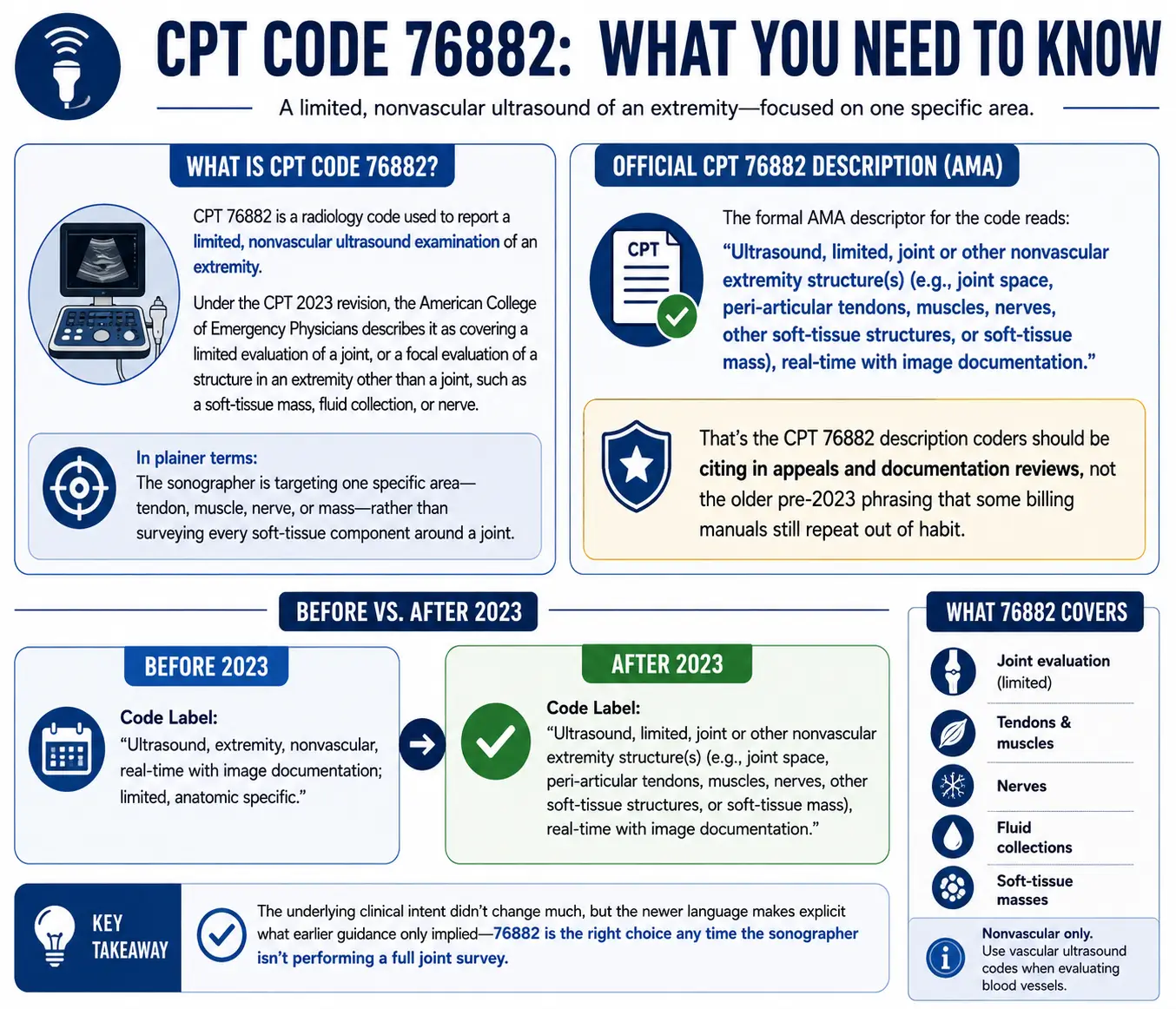
CPT 76882 is a radiology code used to report a limited, nonvascular ultrasound examination of an extremity. Under the CPT 2023 revision, the American College of Emergency Physicians describes it as covering a limited evaluation of a joint, or a focal evaluation of a structure in an extremity other than a joint, such as a soft-tissue mass, fluid collection, or nerve. In plainer terms, the sonographer is targeting one specific area, tendon, muscle, nerve, or mass, rather than surveying every soft-tissue component around a joint.
The formal AMA descriptor for the code reads: “Ultrasound, limited, joint or other nonvascular extremity structure(s) (e.g., joint space, peri-articular tendons, muscles, nerves, other soft-tissue structures, or soft-tissue mass), real-time with image documentation.” That’s the CPT 76882 description coders should be citing in appeals and documentation reviews, not the older pre-2023 phrasing that some billing manuals still repeat out of habit.
Before 2023, the code carried a different label: “Ultrasound, extremity, nonvascular, real-time with image documentation; limited, anatomic specific.” The underlying clinical intent didn’t change much, but the newer language makes explicit what earlier guidance only implied, that 76882 is the right choice any time the sonographer isn’t performing a full joint survey.
CPT 76881 vs 76882: how to tell them apart
The single biggest source of confusion in musculoskeletal ultrasound coding is choosing between 76881 and 76882. CPT Assistant settled the question back in September 2016, and the guidance still holds: code 76881 is restricted to reporting ultrasound of a joint, because only a joint contains all the components needed for a complete exam. Ultrasound evaluation of non-joint areas of an extremity, such as the groin, axilla, or calf, does not qualify as a full joint survey. Those studies are anatomically focused exams that meet the definition of the limited code 76882.
Element | CPT 76881 (complete) | CPT 76882 (limited) |
Scope | Full joint exam: joint space plus surrounding soft-tissue structures | One specific structure or a non-joint area |
Anatomic requirement | Must be a joint (shoulder, elbow, wrist, hip, knee, ankle) | Can be a joint (partial) or any other extremity site, including axilla or groin |
Documentation | Images and report covering every required element around the joint | Images and report covering only the structure(s) actually evaluated |
Typical use case | Rotator cuff evaluation, complete knee joint assessment | Ganglion cyst, single tendon check, soft-tissue mass, axillary lump |
A practical rule that holds up in most audits: if the order and the report describe a full joint workup with every surrounding structure documented, bill 76881. If the study zeroes in on one tendon, one nerve, or a mass, and skips the rest of the joint, 76882 is correct, even if the target happens to sit near a joint.
Soft tissue ultrasound CPT code use: where 76882 fits
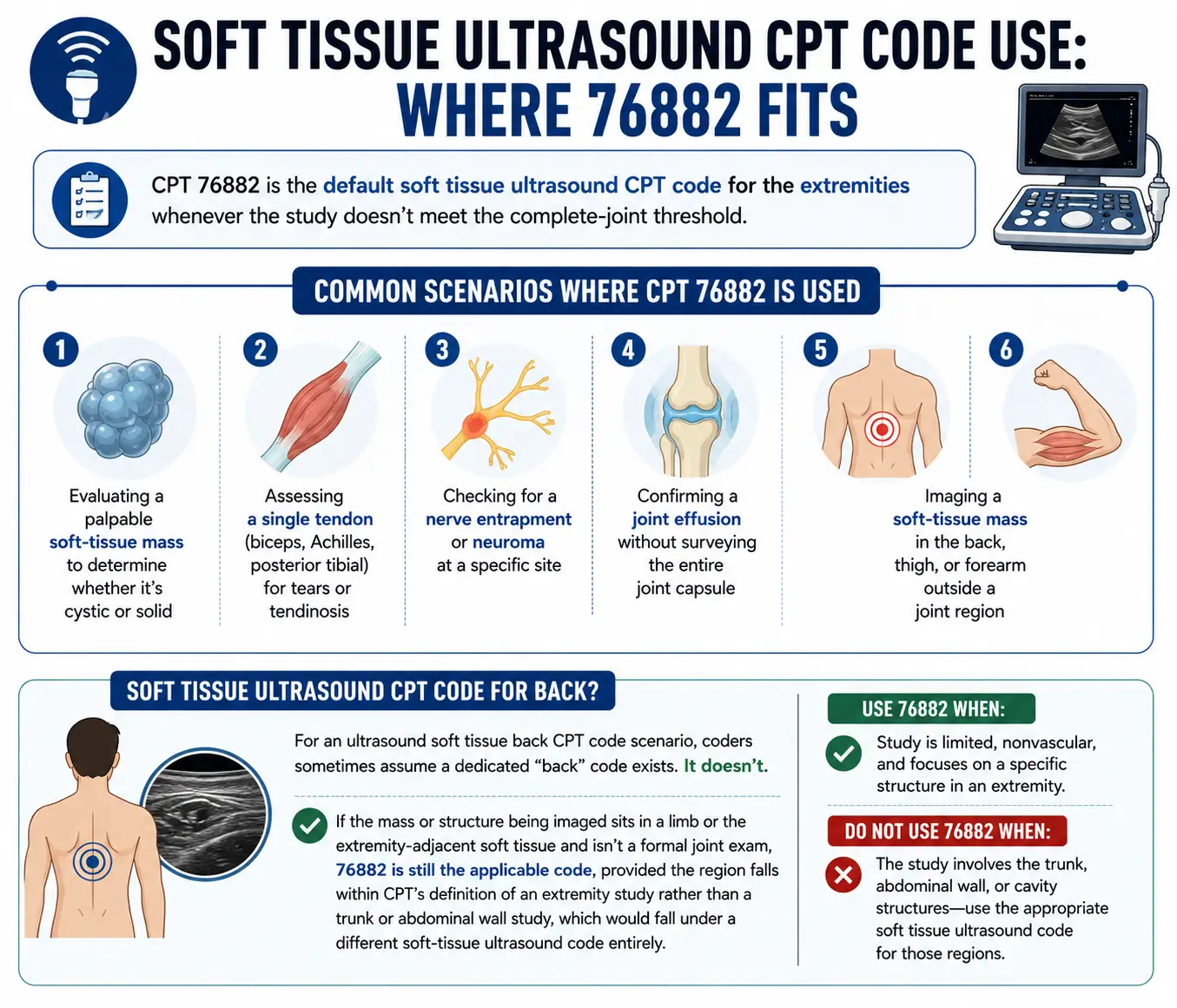
CPT 76882 functions as the default soft tissue ultrasound CPT code for the extremities whenever the study doesn’t meet the complete-joint threshold. That includes musculoskeletal ultrasound CPT code scenarios such as:
- Evaluating a palpable soft-tissue mass to determine whether it’s cystic or solid
- Assessing a single tendon (biceps, Achilles, posterior tibial) for tears or tendinosis
- Checking for a nerve entrapment or neuroma at a specific site
- Confirming a joint effusion without surveying the entire joint capsule
- Imaging a soft-tissue mass in the back, thigh, or forearm outside a joint region
For an ultrasound soft tissue back CPT code scenario, coders sometimes assume a dedicated “back” code exists. It doesn’t. If the mass or structure being imaged sits in a limb or the extremity-adjacent soft tissue and isn’t a formal joint exam, 76882 is still the applicable code, provided the region falls within CPT’s definition of an extremity study rather than a trunk or abdominal wall study, which would fall under a different soft-tissue ultrasound code entirely.
Ultrasound axilla CPT code: the axillary exception
Right axillary ultrasound CPT code and left axillary ultrasound CPT code questions come up constantly in breast imaging and lymph node workups, and the answer is more specific than most billing guides let on. According to a coding review published in the Radiology Coders and Compliance Board’s spring 2025 newsletter, if the axilla alone is imaged, without an accompanying breast ultrasound, code 76882 is the correct choice for a limited ultrasound of the extremity.
This matters because the axilla sits at the boundary between “breast” and “extremity” coding conventions. When a breast ultrasound (76641 for complete, 76642 for limited) already includes an axillary view as part of that same encounter, the axilla is not billed separately, since both breast codes already account for axilla when performed. It’s only when the axilla is the sole target of the study, say, evaluating a palpable right axillary mass or checking for enlarged lymph nodes with no breast component ordered, that 76882 applies on its own. That’s the CPT code for axillary ultrasound in isolation.
Laterality still needs to be reported. A right axillary ultrasound CPT code claim uses 76882 appended with modifier RT, and a left axillary ultrasound CPT code claim uses 76882 with LT. Payers that still require modifier 50 for bilateral procedures will occasionally reject RT/LT pairs on separate lines, so it’s worth checking each payer’s laterality preference before submitting.
Does CPT 76882 need a modifier?
Whether CPT 76882 needs a modifier depends entirely on who performed which part of the service and what else happened during the same encounter. There’s no blanket rule requiring a modifier on every claim.
- Modifier 26 (professional component): Append this when the radiologist or ordering physician is billing only for image interpretation, and someone else (often a hospital or imaging center) owns the equipment and bills the technical side.
- Modifier TC (technical component): Used by the facility or practice that owns the ultrasound equipment and employs the sonographer, when the interpreting physician bills separately.
- RT/LT: Required whenever laterality matters and the payer wants distinct claim lines rather than a bilateral modifier.
- Modifier 59 or the more specific X{EPSU} modifiers (XE, XS, XP, XU): Needed when 76882 is billed alongside a procedure code that National Correct Coding Initiative (NCCI) edits would otherwise bundle it into, most commonly joint injection or aspiration codes like 20600, 20604, 20606, and 20611. One coder on the AAPC billing forum described exactly this pattern: Medicare paid a diagnostic 76882 billed with modifier 59 alongside an injection code once documentation showed the ultrasound was a separate diagnostic evaluation and not simply guidance for the needle. The distinction the payer is checking for is whether the ultrasound was diagnostic (a standalone exam, billable with 76882) or used purely to guide the needle (bundled into the injection code, not separately billable).
So, does CPT code 76882 need a modifier? Only when one of these situations applies. In most cases, a standalone diagnostic ultrasound that is both performed and interpreted by the same physician does not require any modifier other than the appropriate laterality, provided no same-day procedure involves the same anatomical area.
Can CPT 76882 be billed with modifier 50?
Modifier 50 (bilateral procedure) can technically be appended to 76882, but it’s less common than separate RT/LT lines in musculoskeletal practice. Whether it’s appropriate hinges on medical necessity, not convenience. Medicare has long made it clear that bilateral extremity ultrasound exams are covered only when each extremity has a separate clinical indication that warrants its own diagnostic evaluation. Imaging the uninvolved side purely as a comparison or “control” does not meet the reasonable-and-necessary standard.
In practice, that means a patient with bilateral wrist pain and documented findings on both sides can support two units of 76882, whether billed as 76882-50, or as 76882-RT and 76882-LT on separate lines, depending on payer preference. A patient with a single symptomatic wrist and a clinician who wants to scan the “normal” side for comparison generally will not clear medical necessity review for the second study.
CPT 76882 medical necessity and the LCD
Medicare coverage for CPT 76882 runs through Local Coverage Determinations (LCDs) and associated billing and coding articles, since there’s no National Coverage Determination dedicated to nonvascular extremity ultrasound. Article A56787, “Billing and Coding: Nonvascular Extremity Ultrasound,” published by Wellpoint Federal for jurisdictions covering Illinois, Minnesota, Wisconsin, Connecticut, New York, Maine, Massachusetts, New Hampshire, Rhode Island, and Vermont, lays out specific utilization limits that coders should build into claim scrubbing logic. The article states plainly that services in excess of two tests per extremity in six months will be considered not medically necessary, and it requires a permanent record that includes images labeled with exam date, patient identification, and image orientation, documentation of any variation from normal accompanied by measurements, and a formal interpretation shared with the referring physician.
That two-tests-per-extremity-per-six-months threshold is a hard utilization edit in this LCD article, not a soft guideline, so a third 76882 claim for the same extremity within that window is likely to trigger a denial unless the documentation clearly supports a new, distinct clinical indication.
Because LCDs are written by individual Medicare Administrative Contractors (MACs) rather than CMS nationally, the 76882 LCD in one jurisdiction won’t necessarily match another. A practice billing across state lines should pull the specific article for each MAC rather than assuming uniform rules. The ICD-10-CM codes that establish medical necessity differ by Medicare contractor, but most Local Coverage Determinations (LCDs) for nonvascular extremity ultrasound accept diagnoses such as joint effusion, soft tissue masses, tenosynovitis, bursitis, and localized limb swelling while excluding nonspecific symptoms or cosmetic indications.
Common denial triggers and how to avoid them
A few patterns show up repeatedly in claim rejections for this code:
- Missing or mismatched laterality. A claim without RT, LT, or a properly documented 50 modifier is one of the fastest routes to a denial, particularly for axillary or single-limb studies.
- Bundling with same-day procedures. Billing 76882 alongside an injection or aspiration code without the appropriate distinct-service modifier, and without documentation separating the diagnostic exam from the procedural guidance, invites an automatic NCCI edit rejection.
- Exceeding utilization limits. Repeated studies on the same extremity within the LCD’s window without a new clinical indication will be flagged as not medically necessary.
- Incomplete documentation. A report that doesn’t describe the specific structure evaluated, include measurements of abnormal findings, or reflect a formal interpretation won’t satisfy the LCD’s documentation standard, even if the study itself was clinically justified.
- Confusing 76881 and 76882. Reporting 76881 for a study that only evaluated one tendon or a soft-tissue mass, rather than a full joint, overstates the service and can trigger a downcoding audit.
Getting the coding right the first time
CPT code 76882 covers more ground than its short descriptor suggests, spanning everything from a single tendon check to an isolated axillary mass evaluation. The details that matter for clean claims are the ones easy to skip past: whether the study was truly limited rather than a full joint survey, whether laterality and modifiers match what actually happened during the encounter, and whether the documentation meets the specific LCD requirements for the jurisdiction billing the claim. Coders who treat those three checkpoints as non-negotiable tend to see far fewer 76882 denials cross their desk.